Dart Frog Vivarium Airflow: The Missing Piece Most UK Keepers Ignore
Most dart frog keepers obsess over humidity.
Fair enough. Humidity matters. A dry dart frog vivarium is asking for trouble.
But here’s the bit that gets missed far too often:
Humidity without airflow can become stagnation.
And stagnation is sneaky.
It doesn’t always announce itself with one big dramatic disaster. It creeps in. Glass stays fogged all day. Moss looks wet but tired. Plants rot at the base. The substrate starts smelling a bit swampy. Springtails boom in one corner and vanish in another. Frogs become less confident, less visible, or start sitting in odd places.
Meanwhile, your hygrometer still says 85%.
Lovely. Useless little liar.
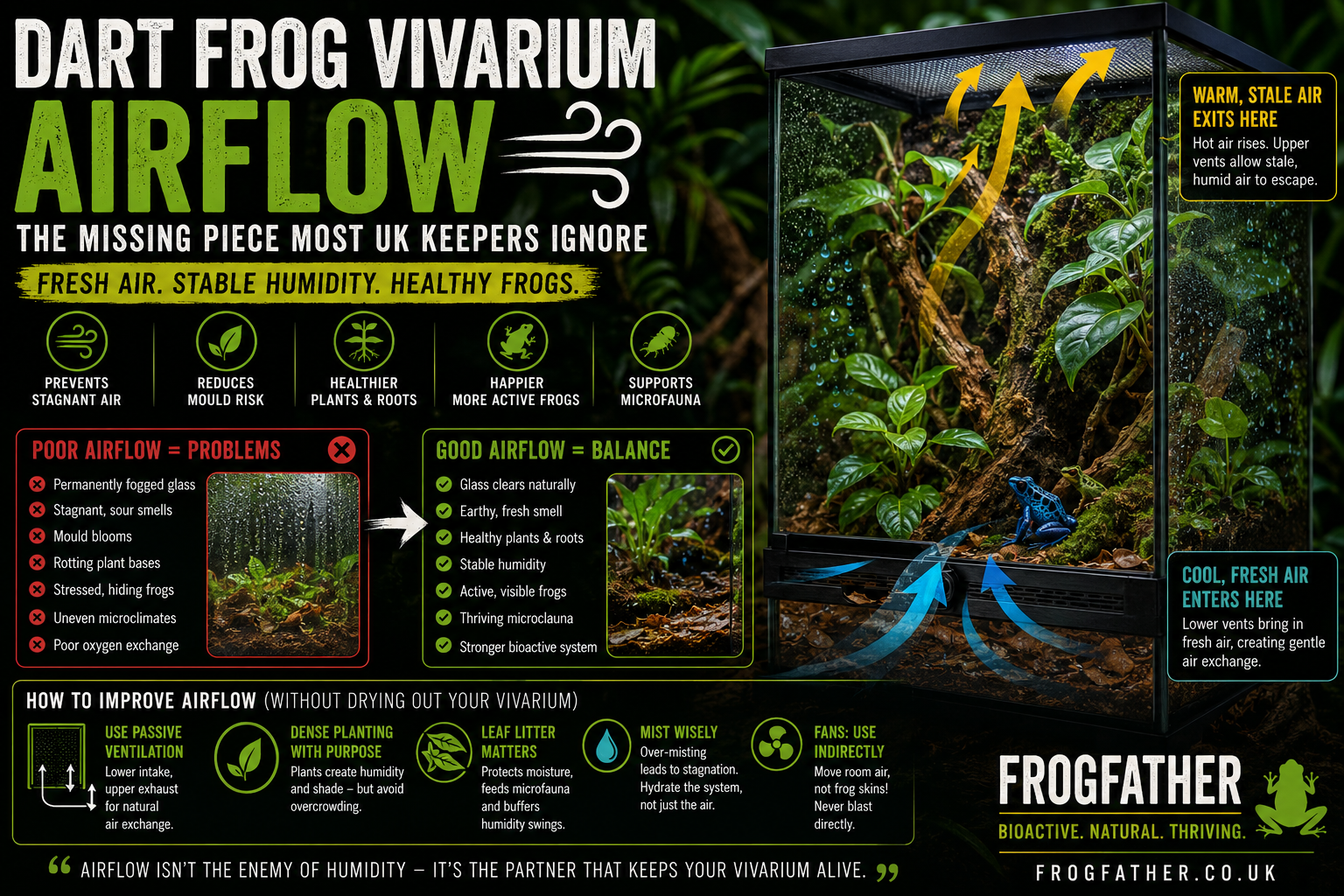
That’s because good dart frog vivarium airflow isn’t the enemy of humidity. It’s what stops humidity becoming stale, sour, and biologically unstable.
If you’re setting up or improving a dart frog vivarium, airflow should be planned from the beginning, not treated as an afterthought once mould, smells, or condensation start kicking off.
Airflow and humidity are not opposites
This is the first big mental shift.
A lot of keepers think:
More ventilation = less humidity.
Sometimes that’s true, especially if you’ve got huge open mesh areas, strong draughts, or a vivarium sitting in a dry heated room.
But in a properly built bioactive dart frog setup, humidity should not only come from trapped wet air. It should come from the system itself.
That means:
- hydrated substrate
- proper leaf litter
- dense planting
- moss pockets
- evaporation from safe surfaces
- stable microclimates
- balanced misting
When those foundations are right, you can have airflow and humidity.
That’s the sweet spot.
Why stagnant vivariums cause so many hidden problems
Dart frogs come from humid environments, yes. But humid does not mean sealed and stale.
Rainforest floors still have air movement. Warm air rises. Moisture evaporates. Leaves dry and rehydrate. Gases exchange. Microbes breathe. Roots need oxygen. Nothing healthy sits in the same dead pocket of air forever.
Inside a glass vivarium, though, it’s very easy to create dead zones.
Poor airflow can affect:
- plant roots
- springtails
- isopods
- substrate bacteria
- fungal balance
- frog behaviour
- glass condensation
- heat build-up
That’s why some problems blamed on “humidity”, “bad plants”, or “mould” are actually airflow problems underneath.
Signs your dart frog vivarium has poor airflow
You don’t need expensive equipment to spot poor ventilation. The vivarium usually tells you.
1. The glass stays fogged all day
Temporary condensation is normal, especially in the morning or after misting.
But if your glass never clears, that can suggest trapped moisture, poor exchange, or a temperature difference that isn’t being managed properly.
Foggy glass does not automatically mean “perfect humidity”. Sometimes it means your vivarium can’t breathe.
If this is a recurring issue, it also ties closely into vivarium glass fogging and condensation management, which Frogfather has covered separately in why vivarium glass fogs up.
2. The vivarium smells swampy instead of earthy
A healthy bioactive vivarium usually smells like damp forest floor. Earthy. Fresh. Organic.
A struggling one may smell sour, rotten, eggy, or swampy.
That smell often points to oxygen-poor conditions, trapped waste, stagnant water, or substrate starting to go wrong. It’s worth reading alongside why your vivarium smells because smell is one of the best early warning signs keepers get.
3. Plants rot near the base
Plants can cope with humidity. Many love it.
What they don’t love is being constantly wet with poor gas exchange around their roots and stems.
If creeping plants, begonias, bromeliad bases, or moss patches are rotting while the rest of the vivarium looks wet and “tropical”, airflow could be part of the issue.
This links strongly with why vivarium plants survive but don’t thrive. Plants are often the first things to show that a vivarium is biologically out of balance.
4. Mould keeps returning in waves
Some mould is normal in bioactive setups, especially new ones.
But if mould constantly comes back, overwhelms surfaces, or appears alongside poor smells and wet stagnant corners, airflow needs checking.
Springtails help, but they’re not miracle workers. A weak airflow pattern can keep feeding the same mould cycle again and again.
For deeper reading, pair this with the science of mould in vivariums.
5. Frogs avoid certain areas
Dart frogs are excellent little environmental critics.
If they stop using lower areas, avoid one side of the vivarium, or spend unusual amounts of time near vents, upper ledges, or specific plant pockets, they may be responding to airflow, heat, humidity, or stale zones.
Behaviour is rarely random. It’s information.
This is why airflow should always be considered alongside normal dart frog behaviour and stress signs.
Too much airflow is also a problem
Right, before anyone points a desk fan at their vivarium and proudly creates a tiny amphibian wind tunnel — don’t.
Strong airflow can be dangerous.
Too much ventilation or direct fan movement can:
- dry leaf litter too quickly
- shrink moss
- dehydrate surfaces frogs rely on
- drop humidity too fast
- stress frogs
- dry out feeder insects
- damage delicate plants
The goal is not wind.
The goal is gentle air exchange.
Fresh air in. Stale air out. Moisture retained in the structure of the vivarium, not trapped as dead wet air.
How airflow moves inside a vivarium
Air inside a vivarium is layered.
It is not one neat box of identical conditions.
Upper zones
The top of the vivarium is usually:
- warmer
- brighter
- drier
- closer to lights
- more ventilated
Lower zones
The lower vivarium is usually:
- cooler
- wetter
- more shaded
- closer to substrate
- more prone to stagnant pockets
Dart frogs spend a lot of time interacting with the lower and mid-level zones. That means the air quality near leaf litter, hides, moss, cork, and substrate really matters.
A vivarium can have decent top ventilation and still have poor lower-level air movement.
Why UK homes make airflow harder
UK homes create their own weird challenges.
In winter, houses are often closed up, centrally heated, and dry in some rooms but damp in others. In summer, heatwaves can make rooms stuffy fast, especially upstairs or in frog rooms with multiple vivariums and lights running.
That means the room itself can become part of the vivarium problem.
If the room air is stagnant, the vivarium is exchanging stale air for stale air. Not exactly a win.
Sometimes the best vivarium airflow upgrade is boring:
Improve airflow in the room first.
Open a window safely when conditions allow. Use indirect room fans. Avoid trapping heat around shelves. Keep lights from cooking the top of the enclosure.
For hot weather, Frogfather’s guide on keeping dart frogs cool in a UK summer without drying out the vivarium is a useful companion article.
Fans on dart frog vivariums: useful tool or terrible idea?
Fans can help.
Fans can also ruin everything if used badly.
Helpful fan use usually means indirect air movement around the vivarium or frog room, not blasting frogs directly through mesh.
Fans may help with:
- room air circulation
- heat dispersal
- reducing stagnant pockets around enclosures
- helping condensation clear
But they can also:
- strip humidity
- dry moss
- dry leaf litter
- increase evaporation too quickly
- stress frogs if airflow is direct
If you’re using fans in summer, read should you use fans on a dart frog vivarium in summer before experimenting.
Passive ventilation is usually better than blasting air around
Most good dart frog vivariums rely on passive ventilation.
That means the enclosure design encourages gentle exchange without mechanical force.
Common approaches include:
- lower front vents
- upper rear vents
- partial top ventilation
- controlled mesh sections
- small crossflow areas
- sliding door seals where needed
Warm air naturally rises. If you give it somewhere to leave and somewhere for fresher air to enter, you get controlled movement.
Not wind. Not drying.
Just breathing.
Sealing everything can backfire
I get why people do it.
Humidity drops, so they cover vents. Then more vents. Then gaps. Then the whole vivarium becomes basically a wet lunchbox with frogs in it.
Short term, the hygrometer looks better.
Long term, you can create:
- poor oxygen exchange
- persistent condensation
- mould issues
- rotting plants
- anaerobic substrate zones
- stale smells
Instead of blocking everything, fix moisture retention properly.
That means improving substrate, leaf litter, plants, and microclimates. Frogfather’s humidity guide explains this properly here: dart frog humidity and real microclimates.
How leaf litter helps airflow and humidity at the same time
Leaf litter is brilliant because it buffers the vivarium floor.
It helps retain moisture underneath while still allowing small air spaces and microhabitats around the substrate surface.
A good leaf layer:
- protects substrate moisture
- supports springtails and isopods
- creates frog hiding routes
- reduces exposed wet mud
- helps prevent rapid drying
Thin, broken-down litter often leaves the floor exposed, which can make moisture swings worse.
Durable tropical leaves like premium tropical leaf litter, catappa leaves, and guava leaves are useful because they hold structure longer than flimsy leaves that disappear too quickly.
Microfauna need oxygen too
Springtails and isopods are often talked about like little cleaning robots.
They’re living animals.
They need suitable moisture, food, shelter, and oxygen.
Poor airflow and stagnant wet substrate can affect microfauna populations, especially if the lower layers become sour or anaerobic.
If your clean-up crew keeps crashing, don’t only blame food or temperature. Look at the whole system.
For more depth, Frogfather’s guide to dart frog microfauna is the ideal internal link here.
Lighting affects airflow more than people think
Lights heat the top of the vivarium. Even efficient LEDs add some thermal effect.
That heat can either help gentle convection or create trapped hot zones, depending on how the enclosure is built.
Raising lights slightly can improve:
- heat spread
- air movement above the vivarium
- condensation management
- plant light distribution
Products like Arcadia Jungle Dawn LED light risers or double light risers for LED and T5 units can help manage this without turning the vivarium into a sealed heat trap.
Sliding doors and hidden gaps
Not all airflow is useful airflow.
Random gaps around sliding doors can create uneven drying, feeder fly escapes, and poor humidity control without giving you the controlled ventilation you actually want.
That’s different from purposeful vents.
If your vivarium loses humidity unpredictably through door gaps, a sliding glass seal can help tidy up the system while still allowing proper ventilation elsewhere.
How to improve airflow without drying out the vivarium
1. Improve room air first
A stagnant room makes vivarium airflow harder. Gentle room circulation often helps more than attacking the vivarium directly.
2. Stop sealing every vent
Retain humidity through substrate, plants, moss, and leaf litter instead of simply trapping stale air.
3. Use dense planting wisely
Plants create humidity and cover, but overly dense areas can trap stagnant pockets. Prune when needed.
4. Keep leaf litter topped up
Leaf litter protects moisture and supports floor-level microhabitats.
5. Watch condensation patterns
Glass should usually fog and clear in cycles, not stay permanently opaque.
6. Use fans indirectly
Move room air, not frog skin.
7. Check smells weekly
Your nose is a useful vivarium tool. Slightly ridiculous, but true.
What healthy airflow looks like
A dart frog vivarium with good airflow usually has:
- temporary condensation rather than permanent fog
- an earthy smell
- healthy plant bases
- stable moss patches
- active springtails and isopods
- no persistent rotten smell
- frogs using multiple zones
- humidity that recovers after misting without becoming swampy
It should feel humid, alive, and fresh.
Not dry.
Not stale.
Not like a sealed compost bin with lighting.
The simple Frogfather airflow test
Here’s a practical check.
Look at your vivarium first thing in the morning, midday, and evening.
Ask:
- Does the glass clear at any point?
- Does one corner stay wet forever?
- Does the substrate smell clean?
- Are plants rotting at the base?
- Do frogs use the whole vivarium?
- Do springtails appear under leaf litter?
- Does humidity crash too fast after airflow improves?
You’re not chasing one perfect number.
You’re looking for balance.
Good airflow makes a vivarium more stable, not less tropical.
FAQ: Dart frog vivarium airflow
Does a dart frog vivarium need ventilation?
Yes. Dart frog vivariums need controlled ventilation and air exchange to prevent stagnant conditions, mould build-up, bacterial imbalance, plant rot, and poor substrate health.
Can too much airflow dry out dart frogs?
Yes. Strong or direct airflow can dry moss, leaf litter, substrate surfaces, and frog hydration zones too quickly. The aim is gentle air exchange, not wind.
Should vivarium glass stay fogged all day?
Usually no. Temporary condensation is normal, especially after misting or overnight, but glass that never clears can suggest poor airflow or excessive trapped moisture.
Are fans safe for dart frog vivariums?
Fans can be safe when used indirectly to move room air, but they should not blast directly into a dart frog vivarium. Direct airflow can dry the enclosure too aggressively.
Why does my dart frog vivarium smell swampy?
A swampy or rotten smell often suggests stagnant wet areas, poor oxygen exchange, trapped waste, anaerobic substrate pockets, or over-saturation.
Can better airflow reduce mould?
Yes, better airflow can help reduce persistent mould problems, especially when combined with strong springtail populations, proper leaf litter, and balanced misting.
Will more ventilation lower humidity?
It can if the vivarium lacks moisture retention. In a well-built bioactive setup, substrate, plants, moss, and leaf litter help maintain humidity while still allowing healthy air exchange.
What is the best airflow setup for dart frogs?
Most dart frog vivariums do well with gentle passive ventilation, often using lower intake and upper exhaust areas so warm stale air can leave while fresh air enters slowly.
FAQ: Dart Frog Vivarium Airflow
Does a dart frog vivarium need ventilation?
Yes. Dart frog vivariums need controlled ventilation and air exchange to prevent stagnant conditions, mould build-up, bacterial imbalance, plant rot, and poor substrate health.
Can too much airflow dry out dart frogs?
Yes. Strong or direct airflow can dry moss, leaf litter, substrate surfaces, and frog hydration zones too quickly. The aim is gentle air exchange, not wind.
Should vivarium glass stay fogged all day?
Usually no. Temporary condensation is normal, especially after misting or overnight, but glass that never clears can suggest poor airflow or excessive trapped moisture.
Are fans safe for dart frog vivariums?
Fans can be safe when used indirectly to move room air, but they should not blast directly into a dart frog vivarium. Direct airflow can dry the enclosure too aggressively.
Why does my dart frog vivarium smell swampy?
A swampy or rotten smell often suggests stagnant wet areas, poor oxygen exchange, trapped waste, anaerobic substrate pockets, or over-saturation.
Can better airflow reduce mould?
Yes. Better airflow can help reduce persistent mould problems, especially when combined with strong springtail populations, proper leaf litter, and balanced misting.
Will more ventilation lower humidity?
It can if the vivarium lacks moisture retention. In a well-built bioactive setup, substrate, plants, moss, and leaf litter help maintain humidity while still allowing healthy air exchange.
What is the best airflow setup for dart frogs?
Most dart frog vivariums do well with gentle passive ventilation, often using lower intake and upper exhaust areas so warm stale air can leave while fresh air enters slowly.