

Description
Important: This listing is for a 3D printed riser only. No lighting units or live animals are included.
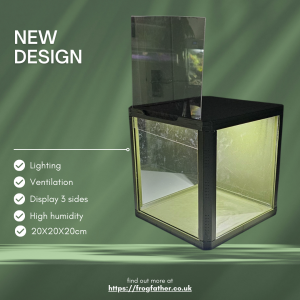
Take your vivarium lighting to the next level with our Double Light Riser, custom-designed to fit Arcadia Jungle Dawn LED Bars or T5 fluorescent units. This 3D printed accessory elevates your lighting system by 10 cm, improving air circulation and ensuring more even light coverage across your enclosure.
Whether you’re illuminating bioactive terrariums, tropical plants, or amphibian habitats, this riser is built to promote plant health and environmental balance while maintaining a clean and professional appearance.
Key Features:
-
🟢 No lighting or animals included – riser only
-
💡 Supports two Arcadia LED or T5 bars
-
🔺 10 cm elevation for better light spread and airflow
-
🔥 3D printed in heat-resistant material
-
🎨 Sleek design that complements modern vivarium setups
-
🔧 Tool-free installation – simply place on mesh or glass tops
Perfect for:
-
Dart frog vivariums
-
Rainforest reptile terrariums
-
Planted bioactive displays
-
Hobbyists seeking better lighting performance without added heat
Note: This product does not include the light units or any animals. It is a physical 3D printed riser designed for home or professional vivarium use.
UVB & Lighting Safety Review
Last reviewed: 5 September 2026
This product guidance has been reviewed against peer-reviewed amphibian UVB/vitamin D research and current Frogfather husbandry guidance.
Important: a riser, stand or mount positions a lamp; it does not by itself establish a safe or appropriate UVB exposure. UVB reaching an animal depends on the lamp and reflector, distance, mesh or other obstruction, angle, enclosure layout and the species being kept. Where UVB is used, provide a gradient with effective shade and assess exposure at animal level rather than choosing a setup from the percentage printed on the lamp alone.
Published amphibian evidence supports a biological role for UVB and vitamin D3, but does not establish one universal UVB requirement or one fixed lamp percentage/distance for all amphibians or all dart frogs.
Evidence & further reading
- Antwis & Browne (2009) – Ultraviolet radiation and vitamin D3 in amphibian health
- Tapley et al. (2015) – Meeting ultraviolet B radiation requirements of amphibians in captivity
- Ferrie et al. – Nutrition and Health in Amphibian Husbandry