
Husbandry & Evidence Review – 6 September 2026
This article has been checked against Frogfather’s current evidence-led husbandry guidance. No high-consequence contradiction requiring a body-text rewrite was identified in the 5 September snapshot; this review note records that the post has been checked.
One of the questions I’m asked most often is, “How do you manage to feed so many frogs?”
People often imagine that keeping a larger collection simply means buying more fruit flies.
In reality, feeding a frog room efficiently has very little to do with speed.
It’s about consistency.
Whether you’re feeding two dart frogs or two hundred, the goal is exactly the same.
Every frog should receive nutritious live food, properly supplemented, without creating unnecessary stress or wasting time.
After years of breeding dart frogs, I’ve gradually simplified my routine. Ironically, the larger my collection became, the simpler my feeding routine became as well.
I don’t believe in complicated feeding schedules.
I don’t rotate six different supplement tubs.
I don’t spend hours trying to calculate nutritional ratios.
Nature doesn’t carry a nutrition spreadsheet.
Instead, I try to make every single feed count.
My Feeding Philosophy
I think many keepers accidentally overcomplicate feeding.
They worry about:
- Which supplement to use today.
- Whether Vitamin A was given three days ago.
- If calcium was used twice this week.
- Whether they should change products again.
Meanwhile the frogs simply need healthy live food offered consistently.
Over time I’ve found that simple routines are easier to maintain, easier to remember and far less likely to result in mistakes.
🐸 From My Frog Room
If somebody else needed to feed my frogs tomorrow morning, I’d want the routine to be so simple that they couldn’t get it wrong. That’s usually a good test of whether a husbandry routine is practical.
Healthy Frogs Start Long Before Feeding Time
One of the biggest changes in my thinking came when I stopped looking at supplementation as the beginning of nutrition.
It actually starts much earlier.
The nutritional value of a fruit fly is largely determined while it is developing as a larva.
That’s why I spend almost as much effort producing healthy fruit fly cultures as I do feeding the frogs themselves.
Strong cultures produce healthier flies.
Healthier flies produce healthier frogs.
By the time those flies are dusted with supplement, they’re already carrying the nutritional benefits of good quality culture media.
That’s also why I don’t believe you can simply rescue poor quality feeder insects by adding more powder afterwards.
The foundation has already been laid.
If you’d like to understand that process in more detail, have a look at our guide explaining why healthy fruit fly cultures produce healthier dart frogs.
My Routine Starts With Observation
Before I even open a fruit fly culture, I spend a few minutes simply looking around the frog room.
Who’s already active?
Who’s calling?
Has everyone come out to greet me?
Is anyone behaving differently today?
A frog that suddenly refuses food isn’t always hungry.
Sometimes it’s telling you something else.
I’ve learned more by watching frogs before feeding than I ever have from rushing straight in with a cup of flies.
🐸 Breeder’s Mistake
Treating feeding as a job to complete rather than an opportunity to observe your frogs. Feeding time is when I notice most husbandry issues before they become real problems.
Preparing the Feeders
Once I have checked the frog room, I move on to choosing which fruit fly cultures are ready to harvest.
I do not simply empty whichever tub is closest.
I look for cultures that are:
- Producing strongly.
- Free from obvious mould or mites.
- Holding active, healthy adult flies.
- Not so heavily harvested that the next generation will be compromised.
Running a larger frog collection means thinking beyond today’s feed.
If I strip every productive culture completely, I may solve today’s problem but create a much bigger one later in the week.
That is why I keep fruit fly cultures at different stages of development rather than relying on one large batch made on the same day.
🪰 From My Frog Room
I always try to harvest from several cultures rather than taking everything from one. It spreads the pressure and gives each culture a better chance of continuing to produce.
I Prepare One Working Cup at a Time
For me, the simplest method is to tap the required number of flies into a clean working cup, add a small amount of supplement and gently rotate the cup until the flies are evenly coated.
The goal is not to bury them in powder.
They should carry a fine, visible coating without becoming completely smothered.
Too much supplement creates waste, makes the cup messy and can cause the flies to clump together.
Too little means some feeders may carry virtually nothing.
A light, even coating is what I look for.
Why I Dust Immediately Before Feeding
Fruit flies groom themselves.
If dusted flies are left sitting for too long, they gradually remove some of the supplement before the frogs ever eat them.
That is why I prepare them immediately before they are offered.
My routine is:
- Collect the flies.
- Add the supplement.
- Coat them gently.
- Feed them straight away.
It is a small detail, but when you repeat the same process across a large collection week after week, small details matter.
Why I Use the Same Balanced Supplement at Every Feed
My supplementation routine used to involve several tubs and a rotating schedule.
That system can work perfectly well, and many excellent breeders still use one.
For my own collection, however, it became harder to manage as the number of frogs increased.
I wanted one consistent routine that I could repeat without checking a calendar every morning.
That is why we developed our own Frogfather All-in-1 Vitamin & Mineral Dust.
It contains calcium, Vitamin D3, Vitamin A, carotenoids, essential vitamins and trace minerals in one every-feed formulation.
It was originally developed for our own frogs, then shared with other breeders before being made available more widely.
The biggest advantage for me is not that it is complicated.
It is that it is not.
🐸 Frogfather Philosophy
Nature does not have a nutrition spreadsheet.
I would rather use one carefully balanced supplement consistently than own several excellent products and regularly forget which one is due next.
You can read more about the thinking behind that routine in our Complete Guide to Dart Frog Supplementation.
Different Frogs Need Different Amounts of Food
Feeding a frog room does not mean giving every enclosure the same number of flies.
A group of large adult Dendrobates will consume far more than a pair of tiny Ranitomeya.
Froglets may need smaller, more frequent feeds.
Breeding females may be particularly enthusiastic feeders.
A newly transported frog may eat cautiously for the first few days.
I adjust the quantity according to:
- Species and body size.
- Number of frogs in the enclosure.
- Age and growth stage.
- Current body condition.
- Breeding activity.
- How much food remains from the previous feed.
I do not feed by a rigid numerical formula.
I feed according to what the frogs in front of me are telling me.
How I Make Sure Shy Frogs Get Food
In a group, the boldest frog often reaches the first flies.
That does not necessarily mean the others are not eating, but it is something I watch carefully.
Rather than releasing every fly into one spot, I distribute them around the enclosure.
I may place flies:
- Near the front for confident feeders.
- Among leaf litter.
- Higher up for more arboreal species.
- Near established hiding places.
- On more than one side of the vivarium.
This creates several feeding opportunities rather than one competitive feeding point.
🐸 Breeder’s Mistake
Dumping all the flies into one corner and assuming every frog has eaten because the food disappeared. In group enclosures, I spread feeders around and watch which animals actually come out.
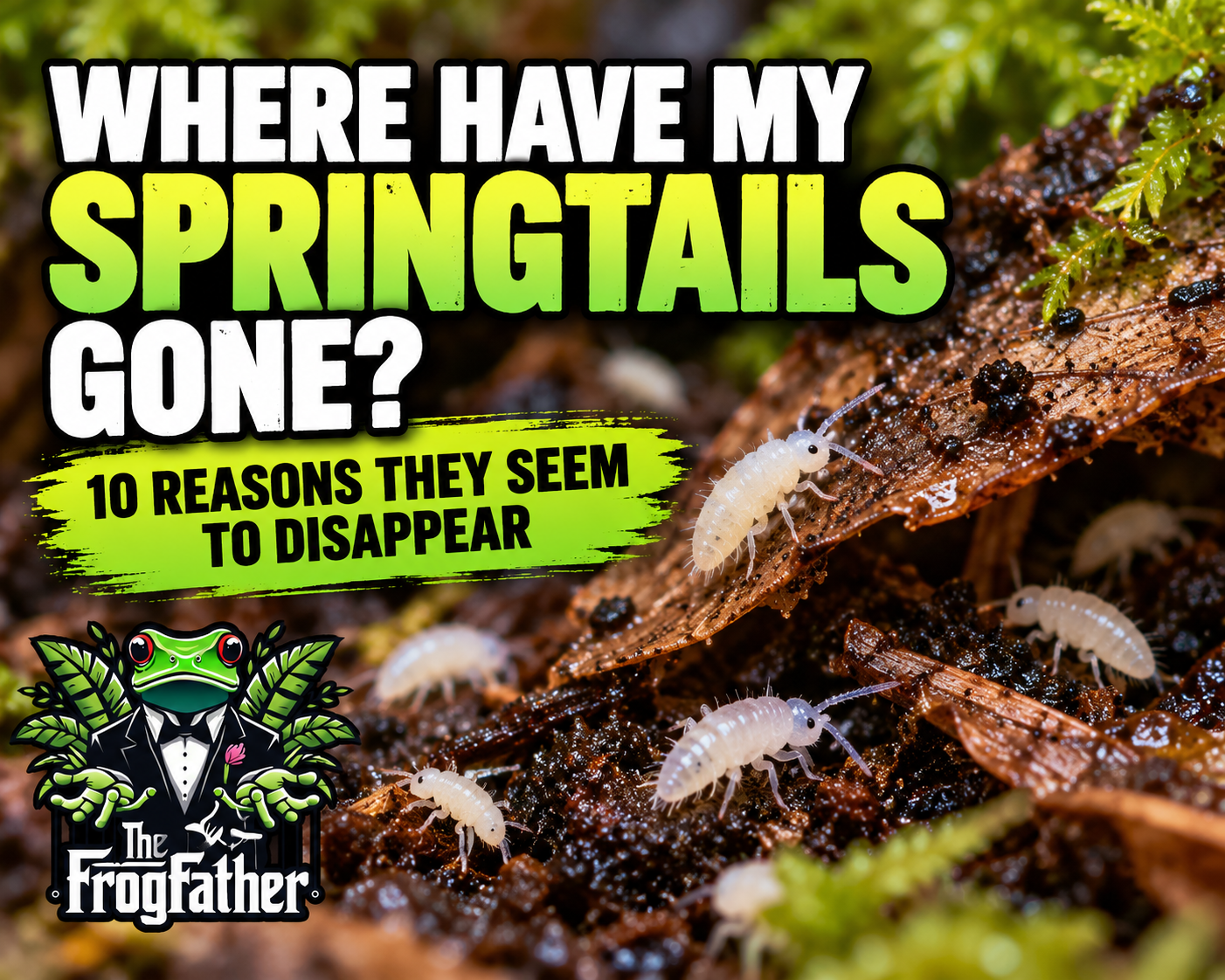
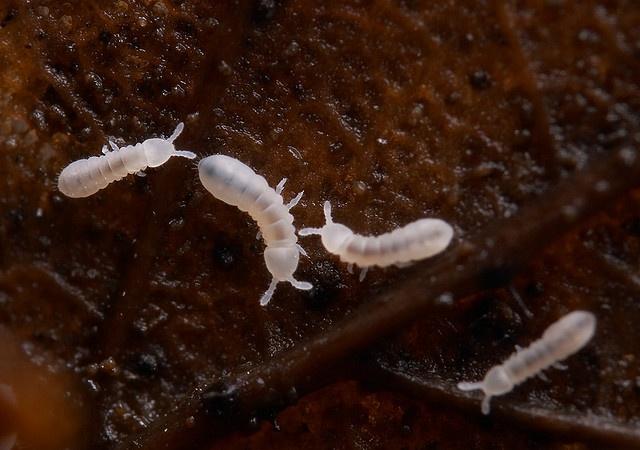
Springtails Are Useful, but They Are Not My Main Supplemented Feed
Springtails are excellent for froglets, shy feeders and natural grazing behaviour.
They also play an important role inside the bioactive vivarium as part of the clean-up crew.
I seed enclosures with springtails so frogs can forage naturally between larger feeds.
However, I do not rely on springtails alone as the main diet for adult dart frogs.
Fruit flies remain the core feeder for most of the collection because they can be harvested in predictable quantities and dusted evenly.
Our Complete Guide to Springtails for Dart Frogs explains how I use them as both microfauna and live food.
Feeding Is Also a Health Check
When you feed the same frogs regularly, you quickly learn what normal looks like.
You know which frog is usually first to the food.
You know which one waits under a leaf.
You know which male stops calling the moment you approach.
That makes changes easier to spot.
If a normally bold frog suddenly ignores food, I take notice.
If one animal consistently loses out to a dominant tank mate, I take notice.
If the entire enclosure becomes less interested in food, I start reviewing environmental conditions.
Feeding may be a routine job, but it is also one of the most useful diagnostic opportunities I have.
Why I Never Rely on One Fruit Fly Culture
One fruit fly culture will eventually fail.
That’s not bad luck.
It’s simply part of culturing live food.
Every culture has a lifespan, and no matter how good your media is, there will come a point where production naturally slows.
That’s why I never think in terms of individual cultures.
I think in terms of production.
At any given time I like to have cultures that are:
- Less than a week old.
- Developing larvae.
- Producing heavily.
- Approaching retirement.
If one culture crashes unexpectedly, it becomes an inconvenience rather than a disaster.
Consistency Beats Perfection
I don’t try to make the perfect fruit fly culture.
I try to make consistently good ones.
Over the years I’ve realised that a repeatable routine will always outperform chasing perfection.
That means:
- Using the same proven media.
- Using the same quantities.
- Keeping cultures in the same conditions.
- Starting fresh cultures on a regular schedule.
- Replacing old cultures before they completely stop producing.
It’s surprisingly boring.
But boring routines produce reliable live food.
Reliable live food produces healthy frogs.
What Happens If A Culture Fails?
It still happens.
Even after making hundreds of cultures.
Sometimes a culture goes mouldy.
Sometimes it dries out.
Occasionally one simply performs poorly for no obvious reason.
I don’t waste time trying to rescue every failed culture.
If something looks unhealthy, smells wrong or clearly isn’t producing, it goes.
It’s usually quicker and safer to replace one culture than risk contaminating several others.
🪰 From My Frog Room
One failed culture has never caused me a problem. Running out of cultures has. That’s why redundancy is far more important than trying to save every single tub.
I Don’t Feed By The Clock
People often ask me exactly what time I feed.
The honest answer is that the frogs don’t own watches.
Life gets busy.
Courier collections happen.
Orders need packing.
Vivariums need building.
Some mornings I feed earlier.
Some afternoons I feed later.
What matters is that the frogs receive regular, nutritious feeds over time.
Consistency is much more important than precision.
Watching Frogs Eat Tells You More Than Weighing Them
One of my favourite parts of the day is simply watching feeding behaviour.
Healthy dart frogs are enthusiastic hunters.
Some chase flies immediately.
Others stalk them slowly before striking.
Each frog develops its own little personality.
Watching those behaviours tells me:
- Body condition.
- Confidence.
- Competition within the group.
- General health.
- Whether anything has changed since yesterday.
I honestly believe I learn more during feeding than I do at any other time of day.
People Often Ask Me What The “Secret” Is
I don’t think there is one.
There isn’t a miracle supplement.
There isn’t a magic temperature.
There isn’t a perfect feeding schedule.
There are simply lots of small habits that are repeated every single week.
Healthy cultures.
Balanced supplementation.
Careful observation.
Good hygiene.
Stable husbandry.
Those small routines eventually become healthy frogs.
🐸 Frogfather Philosophy
Healthy frogs rarely happen by accident.
They’re usually the result of hundreds of small, consistent decisions made every week.
🐸 Breeder’s Mistake
Thinking there is a shortcut to feeding success.
Looking back, almost everything that improved my frogs came from becoming more consistent, not more complicated.
Frequently Asked Questions
How often do you feed your dart frogs?
That depends on the species, age and stage of development.
Growing froglets generally need feeding more frequently than established adults, while breeding adults may also have increased nutritional demands.
Rather than following a rigid timetable, I watch body condition, behaviour and how much food remains after each feed.
Do you feed exactly the same amount every day?
No.
Every enclosure is slightly different.
A busy breeding group will often eat far more than a quiet pair.
The important thing is providing enough live food that every frog has the opportunity to feed without leaving excessive numbers of uneaten flies wandering around the vivarium.
Do you still use springtails?
Absolutely.
Springtails are one of the most useful additions to any bioactive vivarium.
They help break down waste, improve the health of the enclosure and provide natural grazing opportunities for froglets and smaller species.
They complement fruit flies rather than replace them.
What if one frog always gets to the food first?
That’s one of the reasons I spread feeder insects around the enclosure.
Multiple feeding points reduce competition and give quieter animals the chance to feed naturally.
Watching feeding behaviour tells me far more than simply seeing an empty cup of flies.
A Typical Feeding Day in My Frog Room
Although every day is slightly different, the routine is remarkably simple.
- Walk the frog room and observe every enclosure.
- Select productive fruit fly cultures.
- Harvest only what I need.
- Dust the flies immediately before feeding.
- Feed each enclosure according to the frogs inside it.
- Watch every enclosure for a few minutes.
- Make a mental note of anything unusual.
- Move on to the next vivarium.
There isn’t a stopwatch.
There isn’t a complicated spreadsheet.
There is simply a routine that has developed naturally over years of looking after frogs.
🐸 From My Frog Room
One thing people often don’t expect is how enjoyable feeding time becomes.
It’s no longer just another job.
It’s when I see new behaviour.
It’s when I spot the first signs of breeding.
It’s when I notice that one froglet has suddenly doubled in confidence.
Feeding has become my favourite health check of the entire day.
Related Guides
If you’d like to learn more about the way I feed and maintain my own collection, these guides are a great place to continue:
- Complete Guide to Dart Frog Supplementation
- Which Vitamin Powder Should I Actually Buy?
- Why Have My Dart Frogs Lost Their Colour?
- Why Healthy Fruit Fly Cultures Matter
- Complete Guide to Springtails for Dart Frogs
- From the Frog Room
If There’s One Thing I’d Like You to Remember…
People often assume feeding a large frog collection must involve shortcuts.
In reality, I’ve found the opposite.
The larger the collection became, the more important consistency became.
I don’t believe successful feeding is about finding one miracle product or following an impossibly complicated schedule.
It’s about building a routine that’s simple enough to repeat every single week.
Healthy cultures.
Balanced supplementation.
Careful observation.
Good husbandry.
Repeat.
🐸 Frogfather Philosophy
The best feeding routine is the one you can still follow in five years’ time.
Complicated routines often look impressive on paper.
Simple, repeatable routines are much more likely to produce healthy frogs over the long term.
Final Thoughts
Everything in this article reflects the way I currently feed and manage my own breeding collection.
It isn’t the only way to keep dart frogs, but it’s the routine that has evolved through years of trial, error and observation.
If reading this helps simplify your own feeding routine, encourages you to spend a little more time watching your frogs or gives you confidence to trust a consistent approach, then it’s achieved exactly what I hoped it would.
After all, that’s what From the Frog Room is about—sharing the practical lessons that only come from living with these incredible animals every single day.