Husbandry & Evidence Review – 5 September 2026
This is Frogfather’s current canonical bioactive-vivarium guide. It already treats bioactive as a managed system, limits clean-up-crew claims and emphasises humidity cycles, drainage and ventilation rather than a sealed “self-sustaining” enclosure.
Written by Tony Burton, The Frogfather | UK dart frog keeper, breeder and bioactive vivarium designer | Last reviewed: 14 August 2026.
Quick answer: A successful bioactive dart frog vivarium combines a suitable enclosure, controlled drainage, coarse biological substrate, substantial leaf litter, live plants, springtails, appropriate isopods, gentle ventilation and stable environmental conditions.
It should be built around the needs of the frogs—not around a photograph, a particular plant or the equipment somebody already happens to own.
Over the years, I have built, maintained and sold hundreds of planted bioactive vivariums. The best ones are rarely the most complicated. They are the ones where water has somewhere to go, plants have room to root, the forest floor remains protected, microfauna can reproduce and the frogs can choose between different levels of moisture, light and cover.
This guide explains the complete build in the order I would approach it at The Frogfather. Where a subject needs more detail, it links to the relevant specialist guide rather than repeating several competing versions of the same advice.
Contents
- What bioactive actually means
- Quick build plan
- Choose the animal before designing the enclosure
- Choosing the enclosure
- Drainage layers and false bottoms
- Choosing bioactive substrate
- Backgrounds and hardscape
- Leaf litter and the forest floor
- Choosing and preparing plants
- Springtails and isopods
- Temperature, humidity and ventilation
- Plant lighting and UVB
- Misting and water management
- Step-by-step build order
- Cycling and maturing the vivarium
- Introducing the frogs
- Long-term maintenance
- Normal changes and warning signs
- Troubleshooting table
- Frequently asked questions
- Final checklist
What does bioactive actually mean?
A bioactive vivarium is a managed living enclosure containing plants, microorganisms and small decomposer animals that contribute to the processing of organic material.
In a functioning system:
- springtails graze on fungal growth and fine organic material;
- isopods fragment leaves, decaying wood and other material;
- bacteria and fungi continue the decomposition process;
- plants use some of the released nutrients;
- leaf litter protects the substrate and provides habitat; and
- the physical structure regulates moisture and drainage.
Bioactive does not mean maintenance-free, sterile or capable of making unlimited waste disappear.
You must still:
- remove dead animals, spoiled food and significant waste;
- inspect and manage the drainage reservoir;
- clean glass and equipment;
- prune or replace plants;
- maintain lighting and misting equipment;
- refresh leaf litter;
- monitor microfauna populations; and
- observe the frogs for health problems.
The aim is not to eliminate maintenance. It is to create a biologically active environment where routine maintenance supports an established system instead of repeatedly stripping it apart.
Quick bioactive vivarium build plan
| Component | Purpose | Practical starting point |
|---|---|---|
| Enclosure | Provides secure, ventilated living space | Front-opening vivarium sized for the species and group |
| Drainage buffer | Holds water below the root zone | LECA, suitable filter foam or a raised false bottom |
| Drainage access | Allows excess water to be removed | Accessible pipe, siphon point or drain |
| Separator | Keeps substrate above an open drainage layer | Inert mesh or suitable permeable barrier |
| Substrate | Supports roots, microbes and microfauna | Approximately 5–8cm of coarse tropical mix, deeper where required |
| Leaf litter | Creates cover and habitat while protecting the soil | A substantial, overlapping layer rather than scattered decoration |
| Plants | Provide structure, cover and root activity | A mixture of low, middle and upper-level planting |
| Microfauna | Processes organic material | Springtails and a suitable small tropical isopod |
| Lighting | Supports plant growth and a clear day/night cycle | Quality LED on a timer, with optional correctly arranged UVB |
| Misting | Provides controlled moisture | Tested hand-misting or automatic system using suitable water |
| Maturation | Allows plants and biological processes to establish | At least four weeks in my routine; longer where possible |
Choose the animal before designing the enclosure
Do not build a generic rainforest display and decide afterwards which frogs will fit inside it.
Different dart frogs vary in:
- adult size;
- activity level;
- territorial behaviour;
- use of vertical space;
- dependence on bromeliads or elevated deposition sites;
- group compatibility; and
- feeding and observation requirements.
A setup for a terrestrial pair of larger Dendrobates tinctorius should not automatically be designed in the same way as a tall enclosure for a small climbing Ranitomeya group.
Choose the species, intended number and purpose of the enclosure first. Then design the usable space, planting and hardscape around them.
If you are still choosing an animal, use the Complete Dart Frog Species Guide.
Choosing the right enclosure
A purpose-built, front-opening vivarium is normally the most practical option. It provides easier feeding and maintenance while reducing the need to approach the frogs from above.
Look for:
- secure doors with no feeder-sized gaps;
- frog-safe ventilation;
- a waterproof lower section;
- enough depth for drainage, substrate and leaf litter;
- safe access for cables, tubing and nozzles;
- adequate planting space after hardscape is installed; and
- doors that remain usable once the substrate is added.
Useful space matters more than empty volume
Branches, cork, ledges, plants and textured backgrounds can turn height into usable territory. A tall enclosure with nothing to climb is not automatically better than a shorter enclosure with carefully designed structure.
For many first-time dart frog keepers, a 45 × 45 × 60cm or 60 × 45 × 60cm enclosure provides a practical balance of planting room, stability and access. The final choice still depends on the species and number of frogs.
Use the Dart Frog Vivarium Size Guide before purchasing the tank.
Escape-proofing
Check:
- door seams;
- cable openings;
- ventilation slots;
- drainage outlets;
- mist-nozzle holes; and
- gaps created by warped or misaligned doors.
A gap capable of releasing a fruit fly may also become a problem for a newly metamorphosed froglet.
Drainage layers and false bottoms
A drainage layer is a water buffer beneath the biological substrate. It does not remove water from the enclosure by itself, and it does not make over-misting harmless.
For most UK dart frog vivariums using automated misting, some form of drainage buffer is sensible.
Common drainage systems
| System | Advantages | Considerations |
|---|---|---|
| LECA or expanded clay | Widely available and straightforward | Requires a separator and adds weight |
| Open-cell filter foam | Lightweight, structurally supportive and easy to shape | Use a suitable grade and plan access for water removal |
| Raised false bottom | Creates a large open reservoir | Requires careful construction and complete frog-proofing |
Whatever system you use:
- keep accumulated water below the main substrate;
- provide a way to inspect and remove water;
- prevent substrate from collapsing into an open reservoir;
- make sure small frogs cannot enter the drainage space; and
- do not allow stagnant water to remain indefinitely.
The detailed options are compared in the Dart Frog Substrate and Drainage Guide.
Choosing bioactive substrate
A vivarium substrate needs to balance several competing requirements. It must hold useful moisture without becoming permanently saturated, retain an open structure, support roots and provide habitat for microorganisms and microfauna.
A functional tropical mix commonly includes some combination of:
- fine organic material;
- orchid bark or another coarse structural component;
- sphagnum moss;
- horticultural charcoal;
- tree fern or similar durable fibrous material; and
- partially decomposed leaf material.
There is no benefit in copying an ingredient list if the finished mixture behaves badly. Test the structure: it should remain airy when moist and should not compact into dense mud.
Substrate depth
Around 5–8cm is a useful starting depth for many builds, with deeper areas for large root systems. The correct depth depends on the plants, drainage design and available enclosure height.
Materials to avoid
Avoid substrate containing:
- pesticides or herbicides;
- slow-release fertiliser pellets;
- wetting agents of unknown composition;
- fresh manure;
- strongly perfumed additives;
- sharp material accessible to the frogs; or
- unknown garden composts.
Our own Aged Bioactive Vivarium Substrate is matured for approximately three to six months and contains established organic material and microfauna. This gives a new build a biological head start, but it does not remove the need to test drainage, misting, plants and environmental conditions.
Backgrounds and hardscape
A background should create usable structure, not simply cover the rear glass.
Useful features include:
- planting pockets that can drain;
- ledges wide enough for the frogs;
- routes between ground and upper planting;
- visual barriers;
- shaded retreats;
- secure bromeliad or epiphyte mounting points; and
- surfaces that roots and moss can colonise.
Hardscape safety
- Secure heavy wood and stone before loose substrate is added.
- Do not balance weight on material that may decompose or settle.
- Remove sharp points and trapping gaps.
- Make sure frogs cannot become sealed behind a background.
- Keep doors, drains and equipment accessible.
- Allow adhesives, foams, sealants and coatings to cure fully according to their instructions.
Plan for plant growth. A beautiful new arrangement can become completely inaccessible after six months if every gap is filled at the start.
Leaf litter is a working layer
Leaf litter is not a scattering of decorative leaves. It forms the interface between the frogs, substrate and clean-up crew.
A functional layer provides:
- visual cover for the frogs;
- humid spaces beneath drier upper surfaces;
- habitat and food for microfauna;
- protection against direct contact with wet soil;
- natural foraging opportunities; and
- gradual organic input as the leaves decompose.
Use overlapping leaves of different sizes and durability. Leave some protected pockets where microfauna can reproduce without being eaten immediately.
Long-lasting leaves maintain physical structure, while softer leaves break down more quickly and feed the system. A mixture usually works better than relying on one leaf type.
Read the Leaf Litter for Dart Frogs Guide or view our Premium Bioactive Leaf Mix.
Choosing and preparing vivarium plants
Plants provide cover, visual barriers, climbing structure and useful moisture gradients. Their root systems also help stabilise the substrate.
They should not be credited with supplying all the oxygen or “filtering” every problem from the enclosure. Their main welfare value comes from physical structure, cover, root activity and the microclimates created around their leaves.
Plant by zone
| Zone | Useful plant characteristics | Design purpose |
|---|---|---|
| Forest floor | Low, creeping and shade-tolerant | Cover without eliminating leaf-litter access |
| Middle level | Broad leaves, climbing stems and compact ferns | Visual barriers and resting surfaces |
| Background | Climbing, shingling or trailing growth | Turns the rear surface into usable space |
| Upper level | Epiphytes and suitable bromeliads | Elevated cover and possible deposition sites |
Prepare plants before use
- Identify the plant correctly.
- Inspect leaves, stems and roots for pests.
- Remove unsuitable nursery soil and fertiliser where practical.
- Rinse the plant carefully.
- Quarantine it away from established vivariums.
- Watch for mites, snails, slugs, scale insects and chemical damage.
A plant being non-toxic does not make nursery pesticides safe for amphibians.
Use the Best Plants for Dart Frog Vivariums Guide when planning the planting scheme.
Springtails and isopods
A dependable clean-up crew normally begins with springtails and a suitable small tropical isopod.
Springtails
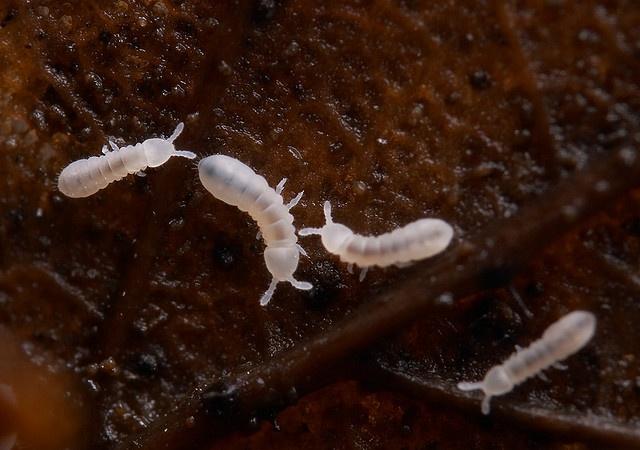
Springtails graze on fungal films, mould, microorganisms and fine decomposing material. They are especially valuable during the early maturation of a vivarium, when fungal growth often appears on new wood and leaves.
Isopods
Isopods fragment leaf litter, soft decaying wood and larger organic material. Tropical White Isopods are generally my most dependable recommendation for humid dart frog enclosures because they remain small and spend much of their time within the substrate.
Not every attractive isopod is an appropriate clean-up crew. Large, protein-hungry or surface-active species may be unsuitable around eggs and tiny froglets.
Microfauna are not magic cleaners
Springtails and isopods cannot safely process:
- a dead frog;
- large amounts of spoiled food;
- chemical contamination;
- continually waterlogged substrate; or
- more waste than the biological system can support.
Remove significant contamination manually.
The Dart Frog Microfauna Guide explains species selection, feeding and establishment in more detail.
Temperature, humidity and ventilation
A bioactive vivarium succeeds when temperature, moisture and airflow work together. Maximising humidity while ignoring temperature and ventilation produces a wet box—not a balanced rainforest system.
Temperature
For many commonly kept dart frogs, I generally aim for approximately 22–24°C during the day, with a modest night-time reduction. Species and localities differ, so this is a practical starting range rather than a universal target.
Overheating is usually the more immediate risk in a UK frog room. Never position a glass vivarium in direct sunlight.
Humidity
For many species, daytime relative humidity often moves around 70–90%, rising after misting and then gradually falling. The important feature is the cycle and the availability of humid retreats—not maintaining one maximum reading continuously.
Ventilation
Healthy airflow helps:
- leaves dry between misting cycles;
- reduce stagnant air;
- support healthy roots;
- limit persistently wet surfaces; and
- create usable moisture gradients.
The enclosure should retain humidity without sealing in stagnant, permanently saturated air.
Use these supporting guides:
Plant lighting and UVB
A quality LED supports plant growth and establishes a consistent day-and-night cycle. It should illuminate the enclosure without creating dangerous heat at the top.
Good lighting is not simply the brightest unit that fits. Consider:
- the height of the vivarium;
- plant requirements;
- shaded areas;
- heat produced by the fixture;
- the distance between the lamp and foliage;
- ventilation around the equipment; and
- how the canopy will change as plants grow.
Use a timer to maintain a predictable photoperiod. Around 10–12 hours is a practical starting point for many planted systems, adjusted according to plant response and seasonal management.
UVB
Low-level UVB can form part of a well-designed dart frog enclosure, but it must be arranged with shade and retreat areas. Lamp percentage alone does not describe the exposure reaching the frogs.
Mesh, reflector, distance, foliage and lamp age all change the final ultraviolet level.
Read the Dart Frog Lighting Guide and Dart Frog UVB Guide before choosing fixtures.
Misting and water management
Misting should restore moisture and provide droplets without keeping every surface permanently soaked.
Test the completed enclosure rather than copying another keeper’s timer settings. The correct schedule changes with:
- enclosure size;
- ventilation;
- room temperature;
- plant density;
- substrate depth;
- nozzle output; and
- seasonal conditions.
RO water is generally useful in automatic misting systems because it reduces mineral deposits on glass, leaves, tubing and nozzles. Misting water and tadpole water are different subjects and should not be treated as interchangeable.
Use the Misting System Guide and Water for Dart Frogs Guide.
Monitor the drainage reservoir
The water level should remain below the substrate. If it continually rises:
- reduce unnecessary misting;
- check for blocked drainage;
- remove accumulated water; and
- review whether the enclosure dries sufficiently between cycles.
Step-by-step bioactive vivarium build
- Choose the species and enclosure. Decide how the frogs use space before planning the interior.
- Leak-test the vivarium. Resolve drainage and door problems before adding permanent materials.
- Plan cables, tubing and access. Make sure equipment can be serviced later.
- Install and secure the background. Prevent access behind it and allow all materials to cure fully.
- Secure heavy hardscape. Do not rely on loose substrate to support it.
- Install the drainage system. Include an inspection and removal point.
- Add the separator where required. Cover gaps without preventing water movement.
- Add coarse bioactive substrate. Create deeper planting areas without burying doors or vents.
- Plant the vivarium. Allow space for mature growth and keep crowns out of saturated soil.
- Add cork, branches and smaller structure. Create routes, visual barriers and shaded areas.
- Add substantial leaf litter. Retain accessible feeding and observation areas.
- Introduce springtails and suitable isopods. Place them in several protected damp locations.
- Install and test lighting. Check heat at different enclosure levels.
- Test misting and drainage. Observe the vivarium immediately after misting and several hours later.
- Monitor the empty enclosure. Record temperature and humidity across several days.
- Allow the system to mature. Do not add frogs simply because the build looks finished.
Cycling and maturing the vivarium
“Cycling” a terrestrial bioactive vivarium is not identical to cycling an aquarium. There is no single test proving that the enclosure becomes safe on a particular day.
The maturation period allows:
- plants to begin rooting;
- microfauna populations to spread;
- new wood and organic material to pass through early fungal growth;
- moisture distribution to settle;
- equipment problems to become visible;
- temperature patterns to be recorded; and
- the keeper to adjust misting and ventilation without animals present.
My normal minimum is around four weeks, and six weeks or longer is preferable where the build and circumstances allow.
This is not a guarantee that every four-week-old enclosure is ready. A tank with waterlogged substrate, dying plants or unstable temperatures needs correction regardless of its age.
Signs of useful progress
- plants are producing roots or new growth;
- microfauna can be found beneath leaves and bark;
- the enclosure smells fresh and earthy rather than sour;
- substrate remains moist but structurally open;
- water stays below the soil layer;
- misting produces a predictable wet-to-drier cycle; and
- temperature remains safe during the warmest part of the day.
Introducing frogs to the completed vivarium
Only introduce healthy frogs that have completed an appropriate quarantine and observation period.
Before transfer:
- confirm the enclosure suits the species and number;
- check all escape routes;
- confirm temperature across the full daily cycle;
- verify that misting and drainage are working;
- make sure microfauna are established;
- prepare suitable live food; and
- record the frogs’ starting condition.
After introduction, keep the routine stable. Offer appropriately sized, freshly supplemented food and make sure every frog has an opportunity to feed.
Do not assume that immediate hiding means the vivarium has failed. Recently moved frogs may need time to settle. Persistent hiding combined with poor feeding, weight loss or abnormal behaviour requires investigation.
Long-term bioactive vivarium maintenance
Daily or at each feed
- Observe every frog where possible.
- Check temperature and obvious equipment function.
- Remove spoiled food, dead feeders or unusual waste.
- Look for leaks, flooding or trapped animals.
Weekly
- Inspect drainage level.
- Check misting nozzles and spray coverage.
- Clean accessible glass as needed.
- Inspect plants for rot, pests and overgrowth.
- Check leaf-litter coverage.
Monthly
- Prune plants to preserve usable space and airflow.
- Inspect lighting, timers, tubing and electrical connections.
- Top up leaf litter where the soil is becoming exposed.
- Look for springtails and isopods in protected areas.
- Review temperature and humidity trends.
As required
- Remove excess drainage water.
- Top up microfauna populations.
- Replace failed plants.
- Remove unsafe fungal growth or decomposing hardscape.
- service pumps, filters and nozzles;
- replace lamps according to their effective working life; and
- deep-clean only when the condition of the enclosure genuinely requires it.
Do not routinely replace healthy mature substrate simply because it is old. Preserve stable biological material unless contamination, structural collapse, disease control or another specific problem makes replacement necessary.
The Bioactive Vivarium Cleaning Guide explains safe maintenance without destroying the whole system.
Normal changes and genuine warning signs
| Observation | Often normal | Investigate when |
|---|---|---|
| White mould on new wood | A limited early bloom during maturation | It spreads continuously, smells foul or covers living plants |
| Mushrooms | Temporary fruiting bodies from fungi in organic substrate | They accompany waterlogging, decay or potentially unsafe unidentified growth |
| Condensation | Temporary misting or overnight condensation | The glass remains completely wet all day with stagnant air |
| Leaf decomposition | The normal function of the forest-floor layer | All leaf structure disappears rapidly or the substrate becomes exposed |
| Occasional plant leaf loss | Adjustment after planting | Roots, stems or crowns become soft and rotten |
| Small soil organisms | Many decomposers are harmless | The organism is unidentified, biting, predatory or associated with declining frogs |
| Earthy smell | Normal biological substrate | The smell becomes sour, sulphurous, sewage-like or strongly stagnant |
Bioactive vivarium troubleshooting
| Problem | Likely checks | Response |
|---|---|---|
| Substrate is swampy | Misting volume, drainage level, compaction and blocked outlets | Remove accumulated water, restore drainage and reduce unnecessary saturation |
| Plants repeatedly rot | Wet roots, buried crowns, direct nozzle spray, low airflow and unsuitable species | Correct the cause before replacing the plants |
| Plants stretch or lose colour | Light intensity, spectrum, distance and shading | Adjust lighting or reposition the plants gradually |
| Persistent heavy mould | New organic material, stagnant air, overfeeding and weak microfauna | Remove excess material, improve balance and reinforce springtails |
| Microfauna disappear | Dry substrate, flooding, lack of refuges, predation and food availability | Create protected damp pockets and reseed when conditions are suitable |
| Glass stays fogged all day | Ventilation, room temperature and excessive misting | Review the complete moisture cycle rather than chasing a lower humidity number |
| Vivarium smells sour | Anaerobic substrate, stagnant water and decomposing material | Locate and remove the source; partial rebuilding may be necessary |
| Frogs remain hidden and do not feed | Recent transfer, insufficient cover, temperature, aggression and health | Observe individuals and investigate persistent changes promptly |
| Drainage fills rapidly | Nozzle output, duration, frequency and leaks | Remove water and recalibrate the system |
Frequently asked questions
How long should a bioactive vivarium mature before adding frogs?
I normally allow at least four weeks, with six weeks or longer preferable. Readiness depends on plant establishment, microfauna, drainage and environmental stability—not the calendar alone.
Can I add frogs on the day I build the vivarium?
I would not recommend it for a permanent display enclosure. A maturation period allows problems to appear while no animals are at risk.
Does a bioactive vivarium need a drainage layer?
Not every possible design requires a traditional LECA layer, but most misted dart frog vivariums benefit from a drainage buffer and a method of removing excess water.
How deep should bioactive substrate be?
Approximately 5–8cm is a practical starting point for many builds, with deeper areas where larger plants require them.
Do I need both springtails and isopods?
They perform complementary roles. Springtails are particularly useful for fungal growth and fine material, while isopods fragment larger organic matter.
Are springtails enough to clean frog waste?
No clean-up crew should be expected to process unlimited waste. Remove significant deposits, dead feeders, spoiled food and dead animals manually.
How much leaf litter should I use?
Enough to create an overlapping working layer with protected pockets and very little exposed soil. Replace it gradually as it decomposes.
Should the substrate always feel wet?
No. It should retain useful moisture without becoming saturated mud. Different areas can be wetter or drier, giving frogs and microfauna a choice.
Is mould normal in a new vivarium?
A limited bloom on new wood or leaf litter is common. Persistent, foul-smelling or rapidly spreading growth indicates that the enclosure’s moisture, airflow or organic load needs attention.
Can I use compost from a garden centre?
Only if its complete composition is known to be appropriate. Many products contain fertiliser, manure, wetting agents or pesticides and should not be used around amphibians.
Can I collect wood, moss and leaves outdoors?
Outdoor material may introduce pesticides, pollutants, parasites, pests and unsuitable organisms. Correct identification and safe preparation are essential. Commercially supplied material with known provenance is the safer default.
Does bioactive mean I never replace the substrate?
Healthy mature substrate may remain functional for years. Replacement may still be necessary after contamination, disease, structural collapse, persistent anaerobic conditions or a major redesign.
Can a bioactive vivarium be too wet?
Yes. High humidity does not require saturated soil and permanently wet leaves. Excess water can damage roots, reduce healthy airflow and create stagnant areas.
Can I build the vivarium before choosing the dart frog species?
You can build a general planted enclosure, but species choice affects dimensions, layout, planting, group structure and usable height. Choosing the inhabitants first normally produces a better result.
Final bioactive vivarium checklist
- The enclosure suits the species and intended number of frogs.
- Doors, vents, cables and nozzles are escape-proof.
- Heavy hardscape is securely supported.
- All building materials have cured fully.
- Excess water can collect below the substrate and be removed.
- The substrate remains moist, coarse and aerated.
- Leaf litter forms a substantial working layer.
- Plants have been identified, prepared and quarantined.
- The clean-up crew contains springtails and suitable isopods.
- Temperature is safe throughout the daily cycle.
- Humidity rises and falls rather than remaining permanently saturated.
- Ventilation provides gentle air exchange.
- Lighting supports plants without overheating the enclosure.
- Misting and drainage have been tested repeatedly.
- The enclosure has matured before animals are introduced.
- A separate quarantine arrangement remains available.
- Every frog can be observed and fed after introduction.
A good bioactive vivarium is not finished when the last plant goes in. It becomes established gradually as roots grow, leaves fall, microfauna reproduce and the keeper learns how water and air move through the enclosure.
If you would prefer the system to be designed and built for you, view the Custom-Built Bioactive Euro Vivarium Commission Service. Each commission is planned around the intended frogs, available space, planting style and optional equipment.
For the complete husbandry system surrounding the enclosure, return to the Complete Dart Frog Care Guide UK.
Frequently asked questions about bioactive dart frog vivariums
What is a bioactive vivarium?
A bioactive vivarium is a managed living enclosure containing plants, microorganisms and small decomposer animals such as springtails and isopods. Together, these components process some organic material and support a more naturalistic environment. Bioactive does not mean maintenance-free or completely self-cleaning.
How long should a bioactive vivarium mature before adding frogs?
At The Frogfather, I normally allow a new vivarium to mature for at least four weeks, with six weeks or longer preferable where possible. Readiness depends on plant establishment, microfauna, drainage and environmental stability—not the calendar alone.
Can I add dart frogs on the day I build the vivarium?
I would not recommend it for a permanent display enclosure. Allowing the vivarium to mature gives plants time to root, microfauna time to reproduce and equipment or drainage problems time to become visible before animals are placed at risk.
Does a bioactive dart frog vivarium need a drainage layer?
Not every possible design requires a traditional LECA layer, but most regularly misted dart frog vivariums benefit from a drainage buffer. This may use LECA, suitable filter foam or a raised false bottom. There must also be a safe way to inspect and remove accumulated water.
How deep should bioactive substrate be?
Approximately 5–8cm is a practical starting depth for many dart frog vivariums. Deeper areas may be needed for larger plants, while the finished depth must still leave enough clearance beneath the doors and ventilation.
Do I need both springtails and isopods?
Springtails and isopods perform complementary roles. Springtails graze on fungal films, mould and fine organic material, while suitable isopods fragment leaf litter, decaying wood and larger material. Tropical White Isopods are generally my preferred isopod for humid dart frog vivariums.
Are springtails enough to clean frog waste?
No. A clean-up crew can process limited organic material but should not be expected to deal with unlimited waste, spoiled food or dead animals. Remove significant waste and contamination manually.
How much leaf litter should a dart frog vivarium have?
Use enough leaf litter to create a substantial overlapping forest-floor layer with protected spaces underneath. Very little bare substrate should remain exposed. Add fresh leaves gradually as the existing layer decomposes.
Should bioactive substrate always be wet?
No. It should retain useful moisture without becoming saturated mud. A well-designed enclosure contains wetter and slightly drier areas, allowing frogs, plants and microfauna to use the conditions they prefer.
Is mould normal in a new bioactive vivarium?
A limited bloom of white mould on new wood or leaf litter is common during early maturation. Persistent, foul-smelling or rapidly spreading growth may indicate excessive moisture, weak ventilation, overfeeding or too much decomposing material.
Can I use ordinary garden-centre compost?
Only when its complete composition is known to be appropriate. Many garden products contain fertiliser, manure, pesticides, wetting agents or other additives that should not be used around amphibians.
Can I collect wood, moss and leaves outdoors?
Outdoor material may introduce pesticides, pollutants, pests, parasites and unsuitable organisms. Correct identification and safe preparation are essential. Material with known provenance is the safer default for sensitive amphibian enclosures.
Does bioactive mean I never replace the substrate?
Healthy mature substrate may remain functional for years. Replacement can still become necessary after chemical contamination, disease, structural collapse, persistent anaerobic conditions or a major enclosure redesign.
Can a bioactive vivarium be too wet?
Yes. High humidity does not require saturated soil and permanently wet leaves. Excess water can damage plant roots, reduce healthy airflow, weaken microfauna populations and create stagnant conditions.
What temperature should a bioactive dart frog vivarium be?
For many commonly kept dart frogs, I generally aim for approximately 22–24°C during the day with a modest reduction overnight. Species and localities differ, and overheating is normally the more immediate danger.
What humidity should a dart frog vivarium have?
For many species, daytime relative humidity commonly moves around 70–90%, rising after misting and then gradually falling as air circulates. Providing humid retreats and a healthy moisture cycle is more useful than chasing one permanent reading.
Can I build the vivarium before choosing the dart frog species?
You can build a general planted enclosure, but species choice affects dimensions, planting, hardscape, group structure and the use of vertical space. Choosing the intended inhabitants first normally produces a safer and more practical design.
Is a bioactive vivarium completely self-cleaning?
No. Bioactive systems process some organic material, but the keeper must still remove spoiled food and significant waste, inspect drainage, clean glass, prune plants, maintain equipment and monitor the animals.