Husbandry & Evidence Review – 5 September 2026
This is Frogfather’s current temperature guide. Low-to-mid 20s °C figures are practical starting points for many commonly kept dart frogs, not a universal species optimum.
This article forms part of Frogfather’s Complete Dart Frog Care series. The full cornerstone guide will be linked here once it has been published.
Dart Frog Temperature Guide (2026)
Maintaining a suitable temperature is one of the most important parts of dart frog care, but it is also one of the areas most commonly misunderstood by new keepers.
Dart frogs come from tropical regions, but that does not mean they should be kept constantly hot. Many inhabit shaded rainforest environments where dense vegetation, cloud cover, rainfall and evaporation protect them from extreme temperatures.
In a UK home, many commonly kept dart frog species can be maintained successfully at a stable room temperature. In fact, overheating is usually a more immediate danger than allowing the enclosure to become slightly cooler overnight.
At Frogfather, we generally aim to maintain most of our dart frog vivariums at approximately 22–24°C during the day, with a gentle reduction overnight. The exact requirements can vary between species and localities, so these figures should be treated as a practical general guide rather than a universal rule.
This guide explains the ideal temperature range for dart frogs, whether supplementary heating is necessary, how to measure enclosure temperatures accurately and what to do during hot UK weather.
Contents
- What temperature do dart frogs need?
- Dart frog temperature reference table
- Do dart frogs need a night-time temperature drop?
- Does temperature vary between species?
- How hot is too hot for dart frogs?
- How cold is too cold?
- Do dart frogs need heating?
- How to measure vivarium temperature
- Creating a safe temperature gradient
- Protecting dart frogs during a UK heatwave
- Winter temperature management
- Signs of temperature stress
- Frequently asked questions
What Temperature Do Dart Frogs Need?
For many commonly kept dart frog species, a daytime air temperature of approximately 22–24°C provides a sensible target.
A slightly broader range of around 20–25°C may be tolerated by many healthy adult dart frogs, provided that temperatures remain stable, the vivarium contains cooler shaded areas and the requirements of the particular species are understood.
The aim is not to maintain every centimetre of the vivarium at exactly the same temperature. A well-designed enclosure should contain small differences between brighter, warmer areas and cooler, shaded areas.
These microclimates allow the frogs to move between different parts of the enclosure according to their needs.
Temperature should always be considered alongside:
- Humidity.
- Ventilation.
- Lighting intensity.
- Enclosure size.
- Planting density.
- The species and locality being kept.
A suitable temperature cannot compensate for stagnant air, poor hydration or an overcrowded enclosure. Dart frog husbandry works as a complete environmental system rather than as a collection of isolated readings.
🐸 Frogfather Verdict
Most dart frogs are more likely to experience serious problems from excessive heat than from a modest, temporary drop below their preferred daytime temperature.
We would rather see a stable enclosure at 21–23°C than one repeatedly heated to 26°C before cooling sharply whenever the heater switches off.
Dart Frog Temperature Reference Table
The following table provides a practical general reference for many commonly kept dart frogs. Species-specific research should always be completed before acquiring an animal.
| Temperature | General interpretation | Recommended response |
|---|---|---|
| Below 16°C | Potentially dangerous if prolonged | Warm the room gradually and check the monitoring equipment. Avoid rapidly heating the vivarium itself. |
| 16–18°C | Cool for many commonly kept species | A short night-time dip may be tolerated by some species, but prolonged exposure should be investigated. |
| 18–20°C | Cool but often manageable | Monitor behaviour and confirm the species’ requirements. This may be acceptable overnight for some frogs. |
| 20–22°C | Suitable for many species | Generally acceptable, particularly overnight or for species that prefer cooler conditions. |
| 22–24°C | Preferred general daytime target | Maintain stability and provide shaded, well-ventilated areas. |
| 24–25°C | Warm but often manageable | Monitor closely and ensure that cooler areas remain available. |
| 26–27°C | Heat-stress risk is increasing | Begin cooling measures and check whether lighting or nearby equipment is adding heat. |
| 28°C and above | Potentially dangerous | Take prompt action to reduce the room temperature safely and monitor every animal closely. |
These figures refer primarily to the air temperature inside the vivarium. The surface directly beneath a light or near a heating appliance may be considerably warmer than the reading displayed by a sensor positioned elsewhere.
That is why a single thermometer reading should never be assumed to represent the entire enclosure.
Do Dart Frogs Need a Night-Time Temperature Drop?
A modest reduction in temperature overnight is natural and is generally beneficial for many dart frog species.
If the enclosure is maintained at approximately 22–24°C during the day, allowing it to fall gradually to around 18–21°C overnight is usually reasonable for many commonly kept species.
The drop should happen naturally as the lights switch off and the room cools. There is generally no need to create a dramatic artificial change.
A gentle day-and-night cycle may support:
- Natural daily activity patterns.
- Normal resting behaviour.
- Seasonal conditioning.
- More natural breeding cues.
- Reduced exposure to continuous warmth.
The exact overnight minimum depends on the species, the duration of the temperature drop and the health and age of the frogs. Recently metamorphosed froglets and unwell animals may be less tolerant of environmental extremes than established healthy adults.
Does the Correct Temperature Vary Between Dart Frog Species?
Yes. The term “dart frog” covers numerous species and localities originating from different elevations, forest types and geographical regions.
A frog originating from a cooler, higher-altitude environment may not respond to heat in the same way as a species associated with warmer lowland forest.
As a broad husbandry principle:
- Some Ranitomeya species may appreciate stable, moderately warm conditions but still require protection from overheating.
- Many commonly kept Dendrobates and Phyllobates species do well at ordinary indoor temperatures within the general range described in this guide.
- Some highland species and localities may benefit from cooler conditions and a more noticeable night-time reduction.
- Newly imported, recently transported, juvenile or medically compromised animals may require closer monitoring.
Always research the exact species and locality rather than relying solely on a generic dart frog care sheet.
How Hot Is Too Hot for Dart Frogs?
Once the air temperature begins approaching 26–27°C, we recommend treating the situation seriously and monitoring the enclosure closely.
At 28°C or above, many dart frogs may be at significant risk, particularly when the heat is prolonged, ventilation is poor or the frogs cannot move into a cooler area.
High humidity does not protect a frog from overheating. Warm, saturated and stagnant air can be particularly difficult because evaporative cooling becomes less effective and there may be little environmental relief available.
The danger also depends on duration. A brief rise is not the same as several hours of sustained heat, but neither should be ignored.
Common causes of excessive vivarium temperature
- High room temperature during summer.
- Direct sunlight reaching the glass.
- Powerful lighting positioned too close to the enclosure.
- Heat mats or heat cables attached directly to the vivarium.
- Ceramic heat emitters or basking lamps.
- Poor ventilation around lighting equipment.
- An inaccurate or badly positioned thermometer.
- A vivarium placed near a radiator, boiler or other appliance.
🐸 Frogfather Tip
Do not wait until the displayed temperature reaches an emergency level before acting. If your frog room regularly rises towards 26°C, put your cooling plan in place before the hottest part of the day.
How Cold Is Too Cold for Dart Frogs?
Slightly cool conditions are generally less immediately dangerous than extreme heat, but prolonged low temperatures can still cause problems.
When kept too cold for too long, dart frogs may become less active, eat less frequently and digest food more slowly. Breeding behaviour may also decline.
Temperatures below approximately 18°C should prompt closer observation, particularly when the reduction continues throughout the day. A short overnight dip is different from keeping the enclosure continuously cold.
Prolonged temperatures approaching 16°C or below may become dangerous for many tropical dart frog species and should be corrected gradually.
Avoid responding by attaching a strong heater directly to the vivarium. Rapid heating and intense localised hot spots may create a greater risk than the original cool conditions.
Do Dart Frogs Need Heating?
In many centrally heated UK homes, dart frogs do not require a dedicated vivarium heater.
If the room naturally remains around 20–24°C during the day and does not become excessively cold overnight, the enclosure may already sit within a suitable range.
The lighting may also raise the internal temperature slightly during the daytime. This increase should be measured rather than assumed.
Heating the room is usually safer
Where additional warmth is genuinely needed, heating the room is generally safer and more stable than heating an individual glass enclosure.
Room heating reduces the likelihood of:
- Hot spots against the glass.
- Rapid temperature fluctuations.
- Substrate drying around a heating element.
- Frogs becoming trapped in an excessively warm area.
- Uneven conditions between connected parts of the vivarium.
Should you use a heat mat?
We do not recommend routinely attaching a heat mat to a dart frog vivarium. Heat mats can warm one surface far more than the rest of the enclosure and may dry the substrate or create an unnoticed hot spot.
Heating the base is particularly unsuitable because dart frogs often move towards the lower substrate and leaf litter when seeking cooler, damper conditions.
Should you use a ceramic heat emitter or basking lamp?
Strong overhead heat sources are rarely appropriate for dart frogs. They can rapidly raise surface temperatures and dry the upper areas of the enclosure.
Dart frogs are not basking reptiles and should not be provided with an intense hot basking zone.
🐸 Frogfather Verdict
Whenever possible, control the temperature of the frog room rather than trying to heat each dart frog vivarium individually.
A stable room creates stable enclosures and greatly reduces the chance of one heater producing an isolated hot spot.
How to Measure Dart Frog Vivarium Temperature Properly

A reliable digital thermometer should be used in every permanent dart frog enclosure.
A combined thermometer and hygrometer can be convenient, but temperature and humidity should still be understood as separate measurements.
Where should the temperature sensor be positioned?
Position the primary sensor within the part of the enclosure regularly used by the frogs. Avoid placing it:
- Directly beneath the light.
- Against the coldest section of glass.
- Immediately beside a ventilation strip.
- Inside the path of a misting nozzle.
- Directly on wet substrate.
The aim is to measure a representative air temperature rather than the hottest or coldest isolated point.
Use more than one measurement point
In a larger enclosure, it is useful to compare readings from:
- The upper planted area.
- The middle of the vivarium.
- The shaded lower area.
- The room outside the enclosure.
This reveals whether the frogs have access to a genuine temperature gradient.
Use maximum and minimum records
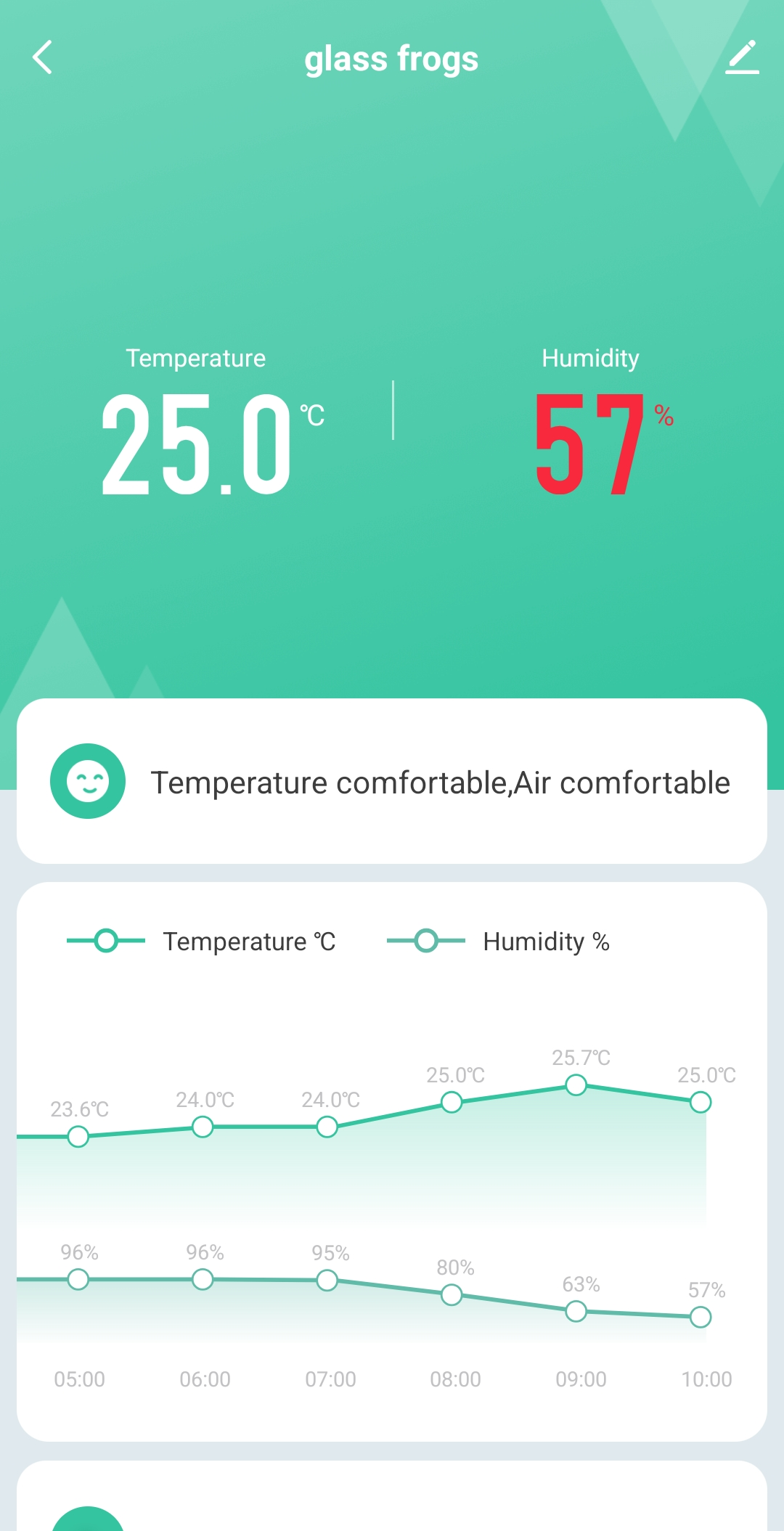
A monitor that records daily maximum and minimum readings is particularly helpful. Looking at the display at one moment does not tell you what happened during the hottest part of the afternoon or the coldest part of the night.
Wi-Fi monitoring can provide additional reassurance because temperature changes can be checked remotely and alerts can be set before the enclosure reaches a dangerous level.
Creating a Safe Temperature Gradient
Dart frogs should be able to choose between slightly different environmental conditions within the vivarium.
This does not require creating a hot basking area. Instead, the enclosure should contain natural variation produced by planting, shade, airflow and the position of the lighting.
Ways to create useful microclimates
- Use broad leaves to create shaded areas.
- Provide deep leaf litter at ground level.
- Use cork and hardscape to form sheltered retreats.
- Allow airflow through the upper part of the vivarium.
- Avoid positioning every plant directly beneath the brightest light.
- Leave some areas open enough for air to circulate.
Enclosure size also affects stability and the number of microclimates that can be created. Our guide to Choosing the Right Dart Frog Vivarium Size explains how enclosure dimensions influence usable space, planting and environmental control.
Dense planting can help create shade, but the vivarium should not become so overgrown that airflow is severely restricted. Temperature, humidity and ventilation must remain balanced.
Protecting Dart Frogs During a UK Heatwave
Summer heat is one of the most significant temperature risks for UK dart frog keepers.
Glass enclosures can warm rapidly, particularly in an upstairs room, conservatory, converted loft or room receiving direct afternoon sunlight.
Prepare before hot weather arrives
Do not wait until the vivarium is already dangerously hot. Before a forecast heatwave:
- Check every thermometer and temperature alarm.
- Close curtains or blinds before direct sunlight reaches the room.
- Move heat-producing equipment away from the enclosure where possible.
- Increase ventilation around the light fittings.
- Adjust the lighting schedule to avoid the hottest hours.
- Prepare fans or air conditioning for the room.
- Confirm that someone can check the frogs if you are away.
Reduce heat produced by lighting
Vivarium lighting can add several degrees to the internal temperature. During extreme weather, it may be appropriate to shorten the lighting period or switch the lights off during the hottest part of the day.
A short temporary reduction in plant lighting is generally less dangerous than exposing the frogs to sustained excessive heat.
Use fans to move room air
A fan can help circulate air around the room and remove heat trapped above the enclosures. It should not blast dry air directly into the vivarium.
Fans do not reduce the room temperature below the ambient air temperature, but they can prevent pockets of hot air from building up around lights and enclosure tops.
Use air conditioning where available
Air conditioning is one of the most effective ways to manage a frog room during severe heat. Cooling the entire room produces more even and predictable results than attempting to cool each vivarium separately.
Can frozen bottles or ice packs be used?
Frozen bottles may be used cautiously as a short-term emergency measure outside the enclosure, but they should not touch the frogs or create a sudden cold area against the glass.
They can also cause condensation and rapid fluctuations, so they are not a replacement for controlling the room temperature.
Do not flood the enclosure with cold water
Heavy misting with very cold water may create a sudden temperature shock without solving the underlying room-temperature problem.
Normal misting can continue where appropriate, but cooling should focus primarily on the room, lighting and airflow.
🐸 Frogfather Tip
Set temperature alerts below the emergency point. An alert at approximately 25–26°C gives you time to act before the frogs are exposed to more dangerous temperatures.
Managing Dart Frog Temperatures During Winter
Winter management should focus on stability rather than intense heating.
Check how cold the frog room becomes during the early hours of the morning, not only during the daytime when the central heating is running.
A thermostat-controlled room heater may be appropriate where the room regularly becomes too cold. It should be positioned safely and used to maintain the room rather than directing heat towards one vivarium.
Also consider:
- Cold exterior walls.
- Drafts from windows and doors.
- Enclosures positioned directly on cold floors.
- Large overnight reductions in central heating.
- Thermometers that do not record overnight minimums.
Avoid sealing the vivarium completely in an attempt to retain warmth. Ventilation remains necessary during winter, and reducing airflow excessively can create stagnant conditions.
Signs of Temperature Stress in Dart Frogs
Behavioural changes can have many causes, but unusual activity during a temperature event should never be ignored.
Possible signs associated with excessive heat
- Unusual restlessness or frantic movement.
- Repeatedly seeking the lowest or coolest area.
- Remaining close to vents or wet surfaces.
- Open-mouthed breathing.
- Loss of coordination.
- Weakness or collapse.
- A sudden refusal to feed.
Possible signs associated with prolonged cold
- Reduced activity.
- Reduced feeding response.
- Remaining hidden for unusually long periods.
- Slower movement.
- Reduced calling or breeding behaviour.
These signs are not specific to temperature and may also indicate illness, dehydration, poor water quality or another husbandry problem.
If a frog appears weak, uncoordinated, unresponsive or otherwise seriously unwell, correct environmental problems gradually and seek advice from a suitably experienced exotic or amphibian veterinary surgeon.
Frequently Asked Questions
What is the ideal temperature for dart frogs?
For many commonly kept dart frog species, approximately 22–24°C during the day is a sensible target. Exact requirements vary between species and localities, so always research the animals being kept.
Can dart frogs live at normal room temperature?
Yes. In many UK homes, normal room temperature is suitable for commonly kept dart frogs. The enclosure should be monitored because lighting, sunlight and room position can make the vivarium warmer or cooler than the surrounding room.
Do dart frogs need a temperature drop at night?
A gentle overnight reduction is natural and usually beneficial. For many species, a gradual fall to around 18–21°C can be acceptable, provided the temperature does not remain excessively low.
Is 26°C too hot for dart frogs?
A brief reading of 26°C may not immediately harm a healthy frog, but it should be treated as a warning. Check the temperature throughout the enclosure and begin cooling measures before it rises further or remains elevated for a prolonged period.
Is 28°C dangerous for dart frogs?
Yes. Temperatures of approximately 28°C and above can become dangerous for many dart frog species, especially when sustained or combined with stagnant, humid air. Cooling measures should be taken promptly.
Is 18°C too cold for dart frogs?
Some dart frogs may tolerate a brief overnight reduction to around 18°C, but this is cool for many species. Continuous exposure at this temperature may reduce activity, feeding and digestion.
Do dart frogs need a heat mat?
Dart frogs do not normally require a heat mat in a suitably heated room. A heat mat can create localised hot spots and dry sections of the enclosure. Where warmth is needed, heating the room is usually safer.
Can I use a ceramic heater for dart frogs?
Strong ceramic heaters are rarely appropriate for dart frog vivariums because they can create excessive localised heat and dry the enclosure. Stable room heating is generally preferable.
Where should I put the thermometer in a dart frog vivarium?
Position the main sensor in an area regularly used by the frogs, away from direct mist, intense light, ventilation openings and wet substrate. In larger vivariums, compare readings from several locations.
How can I cool a dart frog vivarium during a heatwave?
Cool the room by blocking direct sunlight, reducing heat from lighting, circulating room air and using air conditioning where available. Avoid sudden temperature shocks or flooding the enclosure with very cold water.
Continue Reading
Temperature is only one part of a stable dart frog environment. The following guide is already available:
Further supporting guides in this series will include:
- Dart Frog Humidity Guide
- Dart Frog Ventilation Guide
- Dart Frog Lighting Guide
- Choosing the Best Dart Frog Misting System
Summary
For many commonly kept dart frog species, a stable daytime temperature of approximately 22–24°C provides a practical target, with a gentle reduction overnight.
Stability is more important than trying to maintain one exact number. The enclosure should include shaded areas and small temperature variations that allow the frogs to choose where they feel comfortable.
Excessive heat presents one of the greatest temperature risks. Once an enclosure approaches 26–27°C, it should be monitored closely, and readings around 28°C or above require prompt action.
In most UK homes, it is safer to regulate the temperature of the frog room than to use direct heat mats, ceramic heaters or basking lamps on individual vivariums.
Use reliable digital monitoring, record maximum and minimum readings and prepare for hot weather before the temperature reaches an emergency level.