
Description
Aged Bioactive Vivarium Substrate – 7L
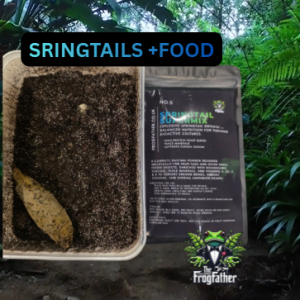
A Frogfather substrate blend that has been held and developed within our own bioactive husbandry system before sale and contains established organic material plus live microfauna, 1 bag is designed to provide 1.5cm of ground cover across a 45cm cube and should be topped with leaves
What “aged” means
The substrate is typically maintained for approximately 3–6 months before sale. During that period organic material, microorganisms and microfauna can become established. This is not equivalent to a laboratory-defined “cycled” endpoint and does not guarantee a fixed microbial community or a self-sustaining enclosure.
Included biological components
- Springtails.
- Tropical white isopods/woodlice where present in the live batch.
- Grindal/grindle worms and other resident small detritivores where present.
- Organic and mineral substrate components.
Claims corrected
We have removed claims that the clay/calcium blend “buffers the system”, that the substrate guarantees healthier plants or “substrate resilience”, and that it becomes self-maintaining. Those claims have not been demonstrated by controlled product-specific trials.
How to use
Use as part of a complete substrate system appropriate to the enclosure. A drainage layer may be useful where the design and misting regime create a need for a water reservoir, but it is not automatically required in every vivarium. Keep standing water below the biological substrate where a drainage layer is used.
Top with suitable leaf litter and monitor moisture rather than trying to keep the entire substrate uniformly wet. Allow a newly built enclosure to settle and confirm drainage, lighting, planting, temperature and ventilation before animals are introduced.
Frogfather experience
We use aged substrate because it gives us a mature starting material containing established microfauna and organic matter. Observations of easier establishment in our own builds are practical experience rather than proof of a universal biological advantage over every freshly prepared substrate.
Bioactive System & Evidence Review
Last reviewed: 5 September 2026
A bioactive vivarium can use plants, leaf litter, microorganisms and detritivorous invertebrates to process some organic material, but it is not a closed or self-sustaining ecosystem. Microarthropods can contribute to decomposition, although the magnitude of that effect varies with the organisms, substrate, organic material and environmental conditions.
Frogfather therefore uses terms such as aged, established or matured to describe systems that have been running before sale. Those terms do not guarantee biological stability, eliminate routine maintenance or prove that a vivarium is immediately suitable for any species.
Evidence & further reading
- Kampichler & Bruckner – microarthropods and terrestrial decomposition
- St Claire et al. – husbandry and care of dendrobatid frogs