
Husbandry & Evidence Review – 5 September 2026
This misting-system guide remains current. Automated misting is a water-delivery tool, not a humidity guarantee: nozzle output, drainage, ventilation, substrate moisture and the animals themselves still need direct checks.
This article forms part of Frogfather’s Complete Dart Frog Care series. The full cornerstone guide will be linked here once all of the supporting care guides have been published and indexed.
Choosing the Best Dart Frog Misting System (2026)
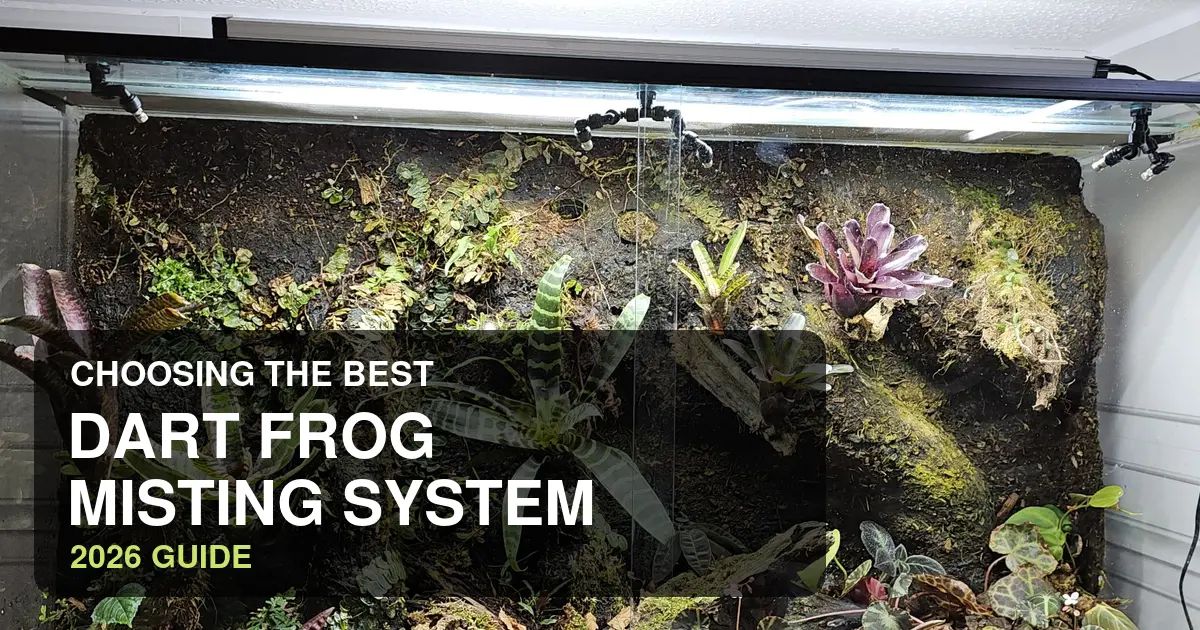
A good dart frog misting system should provide reliable surface moisture, support healthy plants and create natural changes in humidity without leaving the vivarium permanently saturated.
That sounds simple, but misting systems vary enormously. Some are designed for one compact enclosure, while others can supply an entire bank of vivariums. Some include a water reservoir and built-in controls. Others use an external container, separate timer and expandable high-pressure pump.
The most expensive or powerful system is not automatically the best one. The right choice depends on the number and size of your vivariums, their ventilation, the type of planting, your water supply and how precisely you want to control each misting cycle.
At Frogfather HQ, we use automated misting because we maintain multiple planted enclosures and need consistent rainfall cycles. However, automation never replaces observation. A timer cannot see waterlogged substrate, a blocked nozzle, a deteriorating plant or a frog behaving differently.
This guide explains how the different types of misting system work, compares the strongest options available to UK keepers in 2026 and shows you how to install and programme a system without turning your vivarium into a swamp.
Contents
- The quick answer
- What a misting system actually does
- Manual versus automatic misting
- Types of automatic misting system
- Dart frog misting system comparison
- Which system is best for your setup?
- Features that genuinely matter
- Nozzle numbers and positioning
- Which water should you use?
- Creating a safe misting schedule
- Signs you are misting too much or too little
- Maintenance and failure planning
- Common misting-system mistakes
- Frequently asked questions
The Quick Answer
Best for one compact vivarium: A compact programmable unit or Wi-Fi misting system with one or two fine nozzles.
Best for several vivariums: An external-reservoir pressure system such as the HabiStat Rainmaker Pro or MistKing Starter system.
Best for future expansion: Choose a pump designed to operate substantially more nozzles than you initially require.
Best budget option: A quality hand-pressure sprayer can work perfectly well if someone dependable is available every day.
Most important control: A seconds-level timer. Many ordinary smart plugs only operate in whole minutes, which is too crude for short vivarium misting cycles.
Best water: Reverse-osmosis or distilled water for the misting reservoir. Avoid adding remineralising salts to water that will pass through fine nozzles.
Most important warning: Never programme a system and assume the job is finished. Watch how quickly the vivarium dries between cycles and adjust it seasonally.
What Is a Dart Frog Misting System Actually Supposed to Do?
A misting system forces water through a fine nozzle, producing small droplets that settle on leaves, cork, backgrounds and other surfaces. This is different from simply raising the humidity reading on a sensor.
Correct misting helps to:
- Rehydrate leaves, bark and other usable surfaces.
- Create water films from which dart frogs can absorb moisture.
- Increase relative humidity temporarily.
- Water epiphytic and tropical plants.
- Replenish bromeliad axils and suitable deposition sites.
- Support humid pockets within leaf litter.
- Create daily and seasonal rainfall cues.
- Encourage natural activity, calling and breeding behaviour.
A misting system is not intended to hold the enclosure at 100% humidity continuously. It should create a moisture cycle: surfaces become wet, humidity rises and then some areas gradually dry as fresh air circulates.
This relationship is covered in more detail in our dart frog humidity guide and dart frog ventilation guide.
A healthy vivarium can remain humid while exposed leaves, branches and sections of the glass become visibly drier. That partial drying is useful. It reduces plant rot, mould, stagnant water and anaerobic substrate while giving frogs a range of microclimates.
Do Dart Frogs Need an Automatic Misting System?
No. Dart frogs can be maintained successfully with manual misting, provided it is done consistently and the enclosure retains moisture properly.
A fine hand sprayer or pump-pressure sprayer may be entirely adequate when:
- You keep one or two vivariums.
- Someone reliable is present every day.
- The enclosures have stable temperature and humidity.
- You are prepared to arrange cover during holidays or emergencies.
- You regularly observe how wet each enclosure becomes.
Manual spraying also gives you direct feedback. You see the plants, smell the enclosure, notice the drainage level and observe the frogs every time you mist.
Automatic misting becomes especially valuable when:
- You keep several vivariums.
- Your working hours vary.
- You sometimes spend nights away from home.
- The enclosure dries rapidly during winter central heating.
- You want repeatable morning and evening rainfall cycles.
- You are managing breeding groups or sensitive tropical plants.
The practical difference is consistency. An automatic system will not forget because you are busy, but it can repeatedly make the same mistake if programmed incorrectly.
For a fuller discussion, read can dart frogs be kept without a misting system?
The Main Types of Automatic Misting System
Compact Self-Contained Systems
These normally combine a pump, timer and reservoir in one unit. They are convenient, tidy and relatively easy to install.
They work best for one or two vivariums, but the smaller reservoir means more frequent refilling. Their limited pump capacity may also make them unsuitable for a growing collection.
The Exo Terra Monsoon Solo II is one example. It has a 1.5-litre reservoir, a 2.5-bar pump and supports up to two nozzles.
Compact External-Reservoir Systems
These use a separate water container rather than a small built-in tank. The pump can remain compact while the keeper chooses an appropriately sized reservoir.
The Exo Terra Monsoon Nano is designed for one or two vivariums, includes two brass nozzles and can be expanded to four nozzles. It can draw from a reservoir chosen by the keeper.
This format is useful where space is limited but you do not want to refill a small integrated tank continually.
Expandable Pressure Systems
Expandable systems use a separate pump, reservoir, tubing, timer and replaceable nozzles. They require slightly more planning but are generally the strongest option for several enclosures.
The HabiStat Rainmaker Pro includes four copper nozzles, 5.5 metres of tubing and a digital seconds timer. The system can be expanded to a stated maximum of 20 nozzles.
The MistKing Starter v5.0 includes a 24-volt pump, one check-valved nozzle, opaque tubing, reservoir bulkhead, filter and seconds timer. Its standard pump supports up to ten nozzles, with a larger pump available for bigger installations.
Wi-Fi and App-Controlled Systems
Wi-Fi control allows you to change schedules remotely, check settings and operate the system without accessing a timer behind the vivarium.
Our Frogfather Smart Spray Wi-Fi misting system is designed for keepers who want app-controlled scheduling in a compact installation.
Remote control is convenient, but it should not be confused with remote animal monitoring. An app can confirm that a command was sent; it may not prove that water reached every nozzle. A blocked line, empty reservoir or disconnected fitting still requires physical inspection.
Foggers and Humidifiers
An ultrasonic fogger creates airborne water vapour rather than rainfall droplets. It can raise relative humidity and produce an attractive cloud effect, but it does not perform the same job as a pressure mister.
A fogger may supplement a specialised enclosure, but it should not automatically replace surface misting. Continuously pumping fog into a poorly ventilated vivarium can create cool, stagnant conditions while leaving some usable surfaces inadequately hydrated.
Dart Frog Misting System Comparison
| System type | Typical capacity | Best suited to | Main advantages | Important limitations |
|---|---|---|---|---|
| Manual hand or pressure sprayer | One or two vivariums | Present, attentive keepers | Low cost, simple and encourages daily observation | No automatic holiday cover and results depend on the keeper |
| Frogfather Smart Spray Wi-Fi system | Compact installations | Keepers wanting app-controlled scheduling | Remote programming, neat installation and short scheduled cycles | Physical reservoir, tubing and nozzle checks are still necessary |
| Exo Terra Monsoon Solo II | Up to two nozzles | One compact display or two small enclosures | Integrated 1.5-litre reservoir and straightforward installation | Small reservoir and limited expansion |
| Exo Terra Monsoon Nano | Supplied with two nozzles; expandable to four | One or two vivariums using an external reservoir | Compact, two-bar pump and reservoir size chosen by keeper | Not intended for a large vivarium collection |
| HabiStat Rainmaker Pro | Four included; expandable to 20 nozzles | Several vivariums or a growing collection | Seconds timer, external reservoir and strong UK availability | Larger initial installation and more tubing to organise |
| MistKing Starter v5.0 | One included; standard pump supports up to ten | Expandable, high-quality installations | Fine approximately 50-micron mist, check valve, seconds timer and extensive modular parts | Reservoir must be prepared and additional nozzles increase the initial cost |
Capacities are manufacturers’ stated maximums, not guarantees that every layout will perform identically. Tubing length, vertical lift, fittings, nozzle condition and system design all affect performance. Product specifications can also change, so check the current manufacturer documentation before ordering.
Which Dart Frog Misting System Is Best for Your Setup?
One Small Vivarium
For one compact enclosure, a manual pressure sprayer, compact Monsoon system or Wi-Fi misting unit is normally sufficient.
Do not buy a large pump simply because it appears more professional. The priorities are a fine spray, reliable short-cycle timing and a nozzle that can be positioned correctly.
One Large or Densely Planted Vivarium
A larger enclosure may need two nozzles to reach both the foreground and densely planted background. This is particularly relevant where bromeliads, cork and broad leaves shield parts of the vivarium.
A compact two-nozzle system may work, but an expandable pressure system gives more control if the layout changes as plants mature.
Several Vivariums
For a bank of vivariums, the HabiStat Rainmaker Pro and MistKing-style external pump systems are generally the strongest choices.
Choose a pump with spare capacity. Running a system at its absolute nozzle limit leaves less flexibility for longer tubing runs, additional fittings or future enclosures.
Individual vivariums may also dry at different rates. One shared pump does not mean every enclosure should automatically receive the same quantity of water. Different nozzle arrangements, shut-off valves or separately controlled zones may be needed in an advanced collection.
A Display Vivarium Where Appearance Matters
A self-contained or carefully concealed Wi-Fi system can produce a tidier installation. Black or opaque tubing is generally less visually intrusive and also reduces light reaching the water line.
Plan the route before planting the enclosure. Retrofitting tubing through an established canopy is possible, but it is considerably less elegant.
A Breeding Vivarium
Breeding enclosures benefit from repeatable environmental cycles, but more water does not automatically produce more eggs.
Rainfall can act as one seasonal cue alongside temperature, food availability, mature planting, suitable deposition sites and the condition of the frogs. A programmable system makes it easier to create a deliberate wetter period, but permanently saturating the enclosure may damage eggs, plants and microfauna.
Misting-System Features That Genuinely Matter
A Seconds-Level Timer
This is one of the most important features. Dart frog misting cycles often need to be adjusted in seconds, not whole minutes.
An extra minute of pump operation can introduce a substantial amount of water, especially when several nozzles are running. If you use a smart plug, confirm that it supports seconds-based pulses or an inching function. Our guide to setting Sonoff misting cycles in seconds explains one practical approach.
Fine, Replaceable Nozzles
A good nozzle should create a broad, fine pattern rather than a narrow jet. Replaceable nozzle heads make maintenance easier and allow individual components to be cleaned without dismantling the complete installation.
Check-valved nozzles are particularly useful because they reduce dripping after the pump switches off.
An Appropriately Sized Reservoir
A reservoir should hold enough water for normal operation without becoming so large that it is ignored for weeks.
Marking the reservoir with normal fill levels makes unusual water consumption easier to notice. A sudden increase may indicate a leak or programming error; an unexpected reduction in consumption can indicate a blocked nozzle or failed pump.
Use an opaque, food-safe container with a secure lid. This limits contamination, prevents animals or debris entering the water and reduces algae growth caused by light.
Dry-Run Protection or a Low-Water Warning
Pumps vary in how well they tolerate running dry. A low-water warning or automatic shut-off reduces risk, but the reservoir should still be checked routinely.
Accessible Replacement Parts
Pumps usually outlast inexpensive connectors and nozzles, provided they are maintained properly. Before choosing a system, check whether tubing, elbows, bulkheads, filters, nozzles and replacement power supplies are readily available in the UK.
Quiet Operation
Most pressure systems are audible while running. Rubber feet, sensible mounting and ensuring the pump is not vibrating against a cabinet panel can reduce transmitted noise.
How Many Misting Nozzles Does a Dart Frog Vivarium Need?
There is no universal nozzle-to-vivarium formula, but these are useful starting points:
| Vivarium | Typical starting point | Positioning considerations |
|---|---|---|
| 30 × 30 × 45 or 30 × 30 × 60 cm | One fine nozzle | Aim diagonally across foliage rather than straight down |
| 45 × 45 × 45 or 45 × 45 × 60 cm | One or two nozzles | Two may help where dense planting blocks the spray |
| 60 × 45 × 60 cm | Usually two nozzles | Create broad coverage without directly soaking one area |
| 90 cm-wide or complex custom vivarium | Two or more nozzles | Test the completed hardscape and planting before fixing positions permanently |
Nozzles are normally mounted near the top and directed diagonally across the enclosure. The aim is to intercept foliage, cork and background rather than firing directly into the substrate.
Avoid aiming continuously at:
- One favourite frog perch.
- Electrical sensors or exposed fittings.
- Delicate flowers or plant crowns prone to rot.
- A single bromeliad until it continually overflows.
- The front doors if clear viewing glass matters.
- Egg deposition sites that are already sufficiently moist.
Run several short test cycles before introducing frogs. Check the enclosure immediately afterwards and again several hours later. A spray pattern that looks perfect in an empty tank may change considerably once plants mature.
Vivarium dimensions and planting space are discussed in our dart frog vivarium size guide.
Which Water Should You Put in a Misting System?
Reverse-osmosis or distilled water is normally the best choice for a dart frog misting system.
Hard tap water repeatedly passing through a fine nozzle can leave calcium and magnesium deposits inside the nozzle, tubing and connectors. It can also produce white spotting on glass, leaves and backgrounds.
At Frogfather HQ, our main misting reservoir contains RO water only. Water intended for tadpoles, standing dishes or other specialist uses can be treated or remineralised separately. We do not add remineralising products to the water that passes through the precision misting nozzles.
This distinction matters:
- Misting water needs to remain clean and low in dissolved minerals to protect the equipment and prevent deposits.
- Tadpole or standing water may require a different mineral profile depending on its use.
Do not add vitamins, calcium powder, electrolytes, plant fertiliser, water conditioner concentrates or supplements directly to the misting reservoir unless the product and equipment manufacturer explicitly confirms that use.
Our guide to the hidden impact of tap water on dart frogs and bioactive vivariums explains the water-quality issue in more detail.
How Often Should a Dart Frog Misting System Run?
There is no single schedule that works for every dart frog vivarium.
A heavily planted Euro-style vivarium with controlled ventilation may retain moisture far longer than a screen-topped enclosure. Room temperature, lighting, substrate depth, drainage, plant mass and seasonal central heating all influence the drying rate.
For a newly commissioned system, a sensible approach is:
- Start with one moderate misting cycle around or shortly before lights-on.
- Observe coverage immediately after the cycle.
- Check the vivarium again at midday and before lights-out.
- Add a shorter later cycle only if surfaces and leaf-litter refuges are drying excessively.
- Monitor drainage accumulation for at least a week.
- Adjust one setting at a time.
Depending on the nozzle output, a starting cycle may be only 10–30 seconds. That is a commissioning range, not a universal care instruction. A particular enclosure might require a shorter pulse, a longer rainfall period or a second cycle.
The objective is more important than the number:
- Humidity should rise after misting.
- Leaves and hardscape should receive usable droplets.
- Some exposed surfaces should gradually dry.
- Leaf litter should retain humid refuges underneath.
- The drainage layer should remain manageable.
- The enclosure should smell fresh rather than sour or stagnant.
Do not allow a humidity controller to trigger the pump every time the reading falls below one fixed percentage. A sensor near a vent, light or wet leaf can produce misleading readings and repeated short cycling. Trend monitoring is useful, but the enclosure itself should determine the final schedule.
Temperature also affects evaporation. Read the dart frog temperature guide before trying to solve every seasonal humidity change with additional misting.
Signs You Are Misting Too Much
- The glass remains heavily condensed throughout the entire day.
- The substrate is saturated rather than merely damp beneath the surface.
- The drainage layer fills unusually quickly.
- Water runs continuously down the background.
- Bromeliad centres, moss or plant crowns begin to rot.
- The vivarium develops a sour, stagnant or anaerobic smell.
- Mould blooms repeatedly despite an established clean-up crew.
- Fungus gnats increase.
- Springtail or isopod populations decline.
- Supplemented fruit flies are drenched before the frogs eat them.
Over-misting should not automatically be addressed by increasing ventilation dramatically. First reduce unnecessary water input and then reassess the balance. More airflow combined with excessive misting can simply waste water while creating extreme wet-and-dry swings.
Read the truth about over-misting dart frog vivariums for more troubleshooting advice.
Signs You May Be Misting Too Little
- Leaves and cork remain dry throughout the day.
- Leaf litter becomes crisp all the way through.
- Plants wilt despite healthy roots and suitable lighting.
- Moss dries and recedes rapidly.
- Humidity falls sharply and remains low.
- Frogs repeatedly retreat into the only damp corner.
- Frogs show persistently dry or wrinkled-looking skin.
- Egg clutches repeatedly desiccate or shrink.
Before increasing the schedule, confirm that the nozzle is not partially blocked and that the humidity sensor is reasonably accurate. Also inspect ventilation openings, room temperature and the condition of the substrate.
Misting-System Maintenance
Daily or Frequent Checks
- Confirm the reservoir contains enough clean water.
- Watch at least one complete cycle regularly.
- Check that every nozzle produces an even pattern.
- Look for leaking connectors or wet cabinet surfaces.
- Confirm the pump sounds normal.
Routine Maintenance
- Rinse and refill the reservoir rather than continually topping it up.
- Inspect the inlet filter for debris.
- Check tubing for kinks, algae, damage or loose fittings.
- Clean nozzles when the spray becomes uneven.
- Review programmed times after clock changes, power interruptions and app updates.
- Check drainage capacity before holidays.
If mineral deposits have already obstructed a nozzle, our guide to cleaning blocked MistKing nozzles provides a practical process. Always rinse cleaned components thoroughly before reconnecting them to an occupied vivarium.
Plan for Failure
Every automatic system needs a fallback plan. Pumps fail, plugs are accidentally switched off, reservoirs empty and Wi-Fi connections disappear.
A safe setup should include:
- A hand-pressure sprayer kept nearby.
- A visible reservoir rather than one forgotten behind furniture.
- Remote temperature and humidity alerts where practical.
- A written care routine for anyone covering holidays.
- Enough drainage capacity to contain an accidental extended cycle.
- Electrical equipment positioned above or safely away from potential leaks.
Automation should reduce repetitive work while making problems easier to identify. It should never make the enclosure impossible to care for manually.
Common Dart Frog Misting-System Mistakes
Buying for Today Without Considering Expansion
A two-nozzle system may be perfect now but unsuitable if you expect to add several vivariums. Buying one appropriately sized expandable system can be simpler than operating several unrelated pumps and timers.
Using Ordinary Hard Tap Water
This is one of the fastest ways to create blocked nozzles and white deposits. Use clean RO or distilled water in the misting reservoir.
Programming in Minutes Rather Than Seconds
A basic plug timer may turn a suitable pump into an uncontrolled rainstorm. Use a dedicated seconds timer or confirmed seconds-level smart control.
Aiming Every Nozzle Straight Down
This tends to soak the substrate beneath each nozzle while leaving vertical foliage and background areas comparatively dry. Angled coverage is normally more useful.
Trying to Keep the Hygrometer at One Number
A reading of 80% does not prove that frogs, plants and leaf litter have the correct surface moisture. Equally, a brief post-misting reading near 100% is not automatically dangerous. Look at the complete daily cycle.
Changing Several Environmental Controls Together
If you alter misting, ventilation and lighting simultaneously, it becomes difficult to determine which change produced the result. Adjust one variable, observe the enclosure and keep notes.
Assuming More Rain Will Trigger Breeding
A wetter period can be part of a breeding cycle, but it cannot compensate for incompatible animals, poor nutrition, excessive heat, unsuitable deposition sites or an immature enclosure.
Our Practical Verdict
For one small dart frog vivarium, a compact programmable or Wi-Fi system with one or two quality nozzles is usually the most practical choice.
For several vivariums, an external-reservoir system such as the HabiStat Rainmaker Pro or MistKing Starter is the stronger long-term investment. These systems offer better expansion, replaceable components and seconds-level control.
Manual misting remains perfectly valid for a small collection, but it requires daily consistency and a dependable plan for absences.
Whichever system you choose, the best result will come from the same process: use clean water, position the nozzles carefully, begin with a conservative schedule and observe how the complete vivarium behaves between rainfall cycles.
The real goal is not to own the most advanced misting system. It is to create a stable planted environment with surface moisture, fresh air, effective drainage and enough variation for the frogs to choose where they want to be.
Frequently Asked Questions
What is the best misting system for dart frogs?
For one or two vivariums, a compact programmable or Wi-Fi system with fine nozzles is normally sufficient. For several enclosures, an expandable external-reservoir system such as the HabiStat Rainmaker Pro or MistKing Starter is usually more appropriate.
Do dart frogs need an automatic misting system?
No. Dart frogs can be maintained successfully with consistent manual spraying. Automatic misting improves repeatability and holiday resilience, particularly where several vivariums are being maintained.
How often should a dart frog vivarium be misted?
There is no universal schedule. Many enclosures begin with a primary morning cycle and, where necessary, a shorter later cycle. The correct frequency depends on ventilation, temperature, enclosure size, planting and how quickly surfaces dry.
How long should a misting cycle run?
Some systems may provide adequate coverage in 10–30 seconds, while other installations require longer. Start conservatively, observe the spray coverage and drainage, and adjust in seconds rather than making large changes.
Can I use tap water in a dart frog misting system?
RO or distilled water is normally preferable. Hard tap water can leave deposits on glass and plants and can gradually block fine misting nozzles.
Should misting water be remineralised?
Water passing through precision misting equipment should normally remain free from added minerals. Remineralised water intended for tadpoles or standing water should be prepared separately rather than added to the misting reservoir.
Is a fogger the same as a misting system?
No. A fogger produces airborne vapour, while a pressure misting system places fine water droplets on plants, hardscape and other surfaces. A fogger may supplement humidity control but does not necessarily replace rainfall-style misting.
How many misting nozzles does a 45 × 45 × 60 cm vivarium need?
One nozzle may be adequate in an open layout, but two can give more even coverage where dense planting or hardscape blocks the spray. Test the completed enclosure rather than relying only on its dimensions.
Can over-misting harm a bioactive vivarium?
Yes. Excessive water can saturate substrate, encourage plant rot and mould, create stagnant conditions and reduce healthy microfauna populations. A good vivarium should experience controlled moisture cycles rather than remaining soaked continuously.
Continue Reading
- Dart Frog Humidity Guide
- Dart Frog Ventilation Guide
- Dart Frog Temperature Guide
- Choosing the Right Dart Frog Vivarium Size
- The Truth About Misting Systems: Are You Overdoing It?
- Captive-Bred Dart Frogs at Frogfather
Experience the Frogfather difference today.


