Husbandry & Evidence Review – 5 September 2026
This current maintenance guide already treats bioactive as managed rather than maintenance-free. Household cleaners, pesticides, fragrances and disinfectants are not recommended around occupied amphibian vivariums unless a specific veterinary-directed decontamination protocol requires them.
Part of the Frogfather Dart Frog Knowledge Base
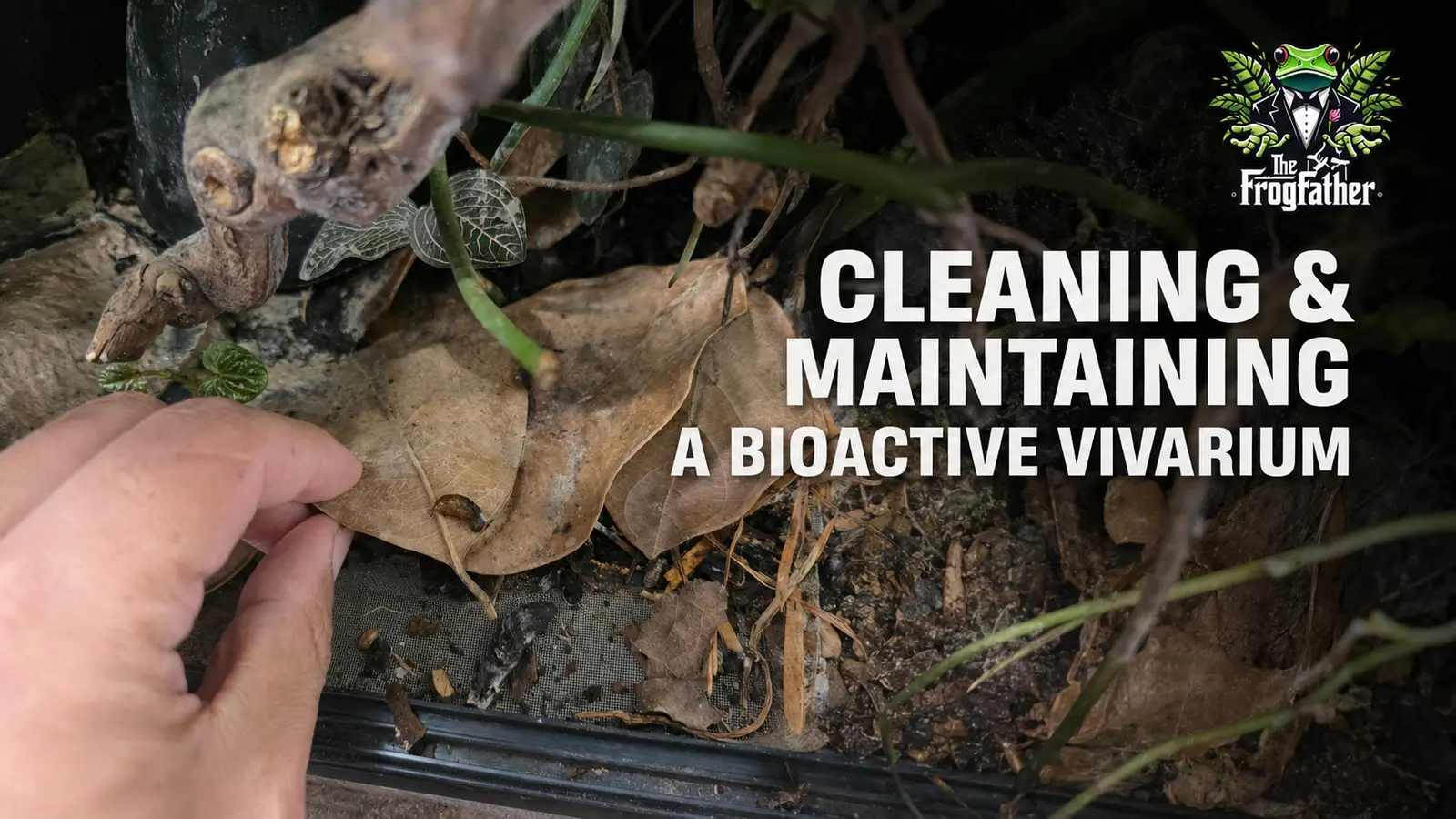
A good bioactive vivarium should not be stripped down and disinfected as part of a routine cleaning schedule. Its substrate, fungi, bacteria, springtails, isopods and decomposing leaves form a living system. Remove all of that and you have not cleaned the ecosystem—you have largely reset it.
Bioactive does not mean maintenance-free, either. Glass becomes marked, plants overgrow, leaf litter thins, drains fill and clean-up crew populations fluctuate. The aim is targeted maintenance that protects the frogs while preserving the biology doing useful work.
This guide explains what to do daily, weekly, monthly and over the long term, what should be left alone, and when a local problem genuinely requires a larger intervention.
What does cleaning a bioactive dart frog vivarium actually mean?
In a conventional enclosure, cleaning often means removing all waste and replacing the floor covering. A bioactive vivarium works differently. Organic material is continuously processed by microorganisms and small invertebrates, while plant roots take up some of the resulting nutrients.
Your job is not to prevent decomposition. It is to keep decomposition happening in the right places and at a rate the system can handle.
Useful routine maintenance includes:
- Removing concentrated waste before it overwhelms a small area
- Taking out dead feeder insects and excessive uneaten food
- Cleaning drinking, bathing and tadpole-deposition water
- Keeping the viewing glass and ventilation clear
- Pruning plants and removing genuinely rotten tissue
- Replenishing leaf litter and supporting microfauna
- Monitoring misting, drainage, temperature and humidity
- Correcting small problems before they become system-wide
Healthy stained leaves, softened wood, fungal threads and tiny soil organisms are not dirt in the usual sense. They are part of the enclosure’s biological machinery.
Bioactive dart frog vivarium maintenance schedule
This is a working routine rather than a rigid calendar. A heavily stocked breeding vivarium may need more frequent attention than a large enclosure holding a pair of frogs. Observation should always override the date.
| Frequency | Main tasks |
|---|---|
| Daily or whenever feeding | Observe every frog, check temperature and equipment, remove obvious dead food or abnormal waste, and confirm water is available where used. |
| Weekly | Clean water dishes, wipe glass where necessary, clear vents, inspect plants, leaf litter, nozzles, drains and microfauna refuges. |
| Monthly | Review logged temperatures and humidity, inspect hidden hardscape and plant bases, check drainage depth, assess microfauna and replenish leaf litter where thin. |
| Seasonally | Adjust for room-temperature changes, service misting equipment, review lighting output and plant growth, and check seals, hinges, cables and ventilation. |
| Only when evidence requires it | Replace failed substrate sections, dismantle unsafe hardscape, quarantine frogs or perform a full reset. |
Daily checks: observe before you clean
The most valuable daily task takes less than a minute: look at the vivarium before opening it. You are checking both the frogs and the system.
- Are all frogs accounted for, alert and moving normally?
- Are they feeding and maintaining normal body condition?
- Has a frog spent unusual time exposed, pressed against glass or sitting in water?
- Are temperature readings within the normal range?
- Did the mister and lights operate at the expected times?
- Is there a leak, blocked nozzle, flooded area or empty reservoir?
- Is any food dead, moulding or gathering in one place?
- Is there unusual faeces, regurgitated food or a strong smell?
Cleaning should never hide health evidence before you have noticed it. A repeated patch of abnormal faeces, uneaten food or unusual frog behaviour may be more important than the mess itself.
Weekly bioactive vivarium maintenance
Not every vivarium needs every task each week. Use this as an inspection list and carry out only the work that is required.
- Water: clean and refill dishes; remove decomposing matter from pools or deposition sites.
- Glass: wipe the viewing panes and door tracks without spraying chemicals into the enclosure.
- Ventilation: remove leaves, moss and debris blocking vents or mesh.
- Plants: remove soft, rotten leaves; redirect aggressive vines and trim growth that blocks airflow or light.
- Leaf litter: check coverage and lift a small edge to look for springtails and healthy moisture beneath.
- Feeding areas: remove excessive powder, dead flies and spoiled fruit used to concentrate feeders.
- Misting: inspect spray pattern, drips, tubing and reservoir cleanliness.
- Drainage: check the water level if the reservoir is visible or accessible.
Work calmly and avoid dismantling multiple refuges at once. Dart frogs often use the same leaves, cork gaps and planting pockets repeatedly. Maintenance should not turn every week into a major territory change.
Monthly and seasonal maintenance
Once a month, look past the attractive front view and inspect the system more critically.
Monthly review
- Check plant crowns, wood contact points and shaded corners for soft rot
- Look for compacted, black or permanently saturated substrate
- Assess whether leaf litter is still deep enough to provide dry and damp refuges
- Confirm springtails or isopods remain present in protected areas
- Inspect drainage access and remove excess water before it reaches the substrate
- Review minimum and maximum temperature readings rather than only the current value
- Check cables, misting connections, door seals and escape points
Seasonal review
UK rooms change considerably through the year. A misting schedule that works in winter may overwater the enclosure during a humid summer, while a light that provides welcome warmth in January may push the vivarium too hot during a heatwave.
At each major seasonal change, review the temperature, humidity, ventilation and misting together. Alter one variable at a time where possible, then observe the result.
How to clean vivarium glass safely
For routine marks, clean water and a dedicated soft cloth, squeegee or chemical-free glass tool are usually enough. Wipe the inside carefully while the frogs are away from the working area, then remove loosened residue rather than allowing it to fall into water or onto the substrate.
For limescale or stubborn deposits:
- Remove any grit from the glass and cleaning surface.
- Wet the affected area with clean water.
- Use light, repeated passes rather than aggressive pressure.
- Wipe away the lifted material with a clean damp cloth.
- Keep the doors secure and account for every frog before and after cleaning.
The Frogfather Glass Cleaner Pro is a chemical-free tool designed to lift water marks, algae film and mineral residue without household cleaning products.
If limescale returns quickly, review the water being used. Pure reverse-osmosis water is normally the best choice for an automatic misting system because it reduces mineral deposits and helps protect nozzles.
Cleaning water dishes, pools and standing water
Bioactive substrate cannot keep a small water dish hygienic. Frogs may soak, deposit tadpoles, walk through substrate and defecate in standing water, so dishes need direct maintenance.
- Change contaminated water immediately.
- Otherwise replace it regularly before a film, smell or debris develops.
- Physically wipe the dish to remove biofilm; merely topping it up is not cleaning.
- Use dedicated equipment that has never been exposed to household chemicals.
- Rinse thoroughly before returning the dish.
Small pools and water features need their own circulation and maintenance plan. They are not made safe simply because they sit inside a bioactive vivarium. Remove decaying food and leaves, prevent stagnant sludge, and ensure frogs can enter and leave safely.
RO water used for misting should normally remain unmineralised to protect nozzles. Water intended for tadpoles or significant standing water may need different preparation for the species and purpose. Do not assume one water recipe is ideal for every use.
Should you remove frog waste and dead feeder insects?
The clean-up crew can process small, dispersed amounts of frog waste and dead organic matter. It cannot instantly neutralise every concentrated deposit.
Remove:
- Large or repeated faecal deposits on leaves, glass or feeding areas
- Any waste that looks abnormal enough to monitor or photograph
- Dead crickets, flies, beetles or other feeders accumulating faster than they break down
- Large clumps of wet supplement powder
- Spoiled fruit or feeder stations showing uncontrolled mould
- Dead animal tissue immediately
A turkey baster, pipette, long tweezers, damp paper towel or small spoon can remove a local patch without disturbing the entire floor. Dedicate these tools to animal use and clean them between enclosures to reduce cross-contamination.
If large numbers of feeders repeatedly die in the vivarium, the solution is not more clean-up crew. Feed a more appropriate quantity and check feeder quality, supplement use and whether the frogs are actually eating.
Plant maintenance without destroying frog cover
Plants provide visual barriers, climbing routes, calling sites, deposition sites and security. Pruning should preserve those functions rather than simply restoring the enclosure to its original photograph.
What to remove
- Leaves that are soft, blackened or genuinely rotting
- Growth blocking ventilation or forcing doors open
- Roots or vines threatening drainage access and equipment
- Dead material collecting in a deep, airless wet pocket
- Plants confirmed to be unsafe or badly infested
What can usually remain
- Healthy fallen leaves beginning normal decomposition
- Minor cosmetic leaf damage
- Roots attached securely to wood or background
- Plant growth that creates useful cover without blocking airflow
Check bromeliad axils and favourite leaves for eggs or tadpoles before cutting. Also inspect the plant from several angles for a hidden frog. Clean pruning tools between vivariums.
When replacing a failed plant, correct the reason it failed—light, moisture, airflow or an unsuitable planting pocket—before adding another. The dart frog vivarium plant guide explains suitable choices, and the current Frogfather vivarium plant range includes humidity-tolerant options.
How often should leaf litter be replaced?
Leaf litter is habitat and food, not temporary decoration. It creates visual cover, moisture gradients and refuges for springtails and isopods. As leaves soften, they become more biologically useful, so there is no need to remove the entire layer merely because it no longer looks new.
Top up leaf litter when:
- Large areas of bare substrate become exposed
- The existing layer has mostly collapsed into fragments
- Frogs have lost useful cover and foraging structure
- Microfauna refuges are becoming sparse
- A local contaminated section has been removed
Add fresh leaves over and among the older layer so decomposition stages overlap. Remove only material that is foul, slimy, contaminated or creating a blocked wet mass.
The complete dart frog leaf litter guide explains depth and species choices. For a practical top-up, use the Frogfather Premium Bioactive Leaf Mix.
Maintaining springtails and isopods
Do not judge the clean-up crew only by how many animals are walking across the front glass. Springtails and dwarf isopods spend much of their time under leaves, bark and within the upper substrate.
To assess them, lift one or two damp refuges and look for:
- Springtails moving through moist decomposing material
- Isopods of more than one size
- Gradual breakdown of leaves without foul sludge
- Activity in several locations rather than only the original release point
Support the colony with continuous leaf litter, protected damp areas and occasional tiny, controlled amounts of appropriate food. More food is not automatically better; excess powder and protein can mould, attract pests and reduce air quality.
If numbers are genuinely low, first investigate flooding, dryness, lack of cover, predation and over-cleaning. Then top up with a suitable culture such as the Mixed Springtail Culture. The dart frog microfauna guide covers colony establishment and troubleshooting in detail.
Should bioactive substrate be turned or replaced?
Do not routinely dig over or turn healthy substrate. This damages plant roots, destroys microfauna refuges, mixes decomposing surface waste into deeper material and disrupts the moisture structure of the floor.
A properly constructed bioactive substrate can remain functional for years. Age alone is not a reason to replace it.
Healthy substrate usually:
- Smells earthy rather than sour or sewage-like
- Remains structurally open instead of becoming dense sludge
- Supports roots and active microfauna
- Is moist but not submerged
- Drains excess water into the reservoir below
Intervene when:
- A defined section is waterlogged, foul or collapsing
- The drainage barrier has failed and substrate is falling into the reservoir
- Plant roots are rotting across a broad area
- A contaminant has entered the substrate
- A veterinary investigation requires substrate removal
Where possible, repair only the affected area and retain healthy mature material. If the whole floor has failed, a controlled rebuild is safer than repeatedly masking the smell or adding more dry substrate on top.
Inspect the drainage layer regularly and remove water before it reaches the substrate. The bioactive substrate and drainage guide explains the complete floor system.
Should mould and mushrooms be removed?
Small fungal blooms are normal, particularly in new vivariums or after fresh wood and leaves are added. Mushrooms can also appear briefly in established systems. Fungi are part of decomposition, and springtails often graze fungal growth.
Leave a small, localised bloom alone or remove only the affected loose material if it is unsightly. Then observe whether it declines.
Act when fungal growth is expanding rapidly, repeatedly smothering plants, associated with excessive uneaten food, or accompanied by waterlogging and a foul smell. The underlying correction is normally moisture, airflow, feeding or removal of concentrated rotting material—not sterilisation.
Colour alone cannot identify a fungus or establish whether it is dangerous. For the full explanation, read The Science of Mould in Vivariums.
What about fungus gnats, mites, slugs and other unwanted organisms?
A bioactive vivarium contains life, so occasionally it contains organisms you did not intentionally add. Not every mite, nematode or tiny fly is a threat. Correct identification matters before treatment.
- Fungus gnats: often increase in permanently wet, food-rich substrate. Reduce excess microfauna food, improve moisture cycling and use only animal-safe physical controls.
- Slugs and snails: can damage plants and consume eggs. Remove them manually and inspect at night, along with egg clusters and new plants.
- Mites: many are harmless decomposers, while a sudden explosion can indicate excessive food. Do not use acaricides or household pesticides.
- Ants: treat these as a serious biosecurity problem. Prevent access, remove affected materials and seek species-appropriate advice without applying insecticide near frogs.
Never release biological controls, predatory invertebrates or chemicals into a dart frog vivarium without confirming they are safe for the frogs and for the specific problem. When identification is uncertain, photograph the organism closely and isolate incoming plants or materials rather than treating blindly.
Preventing cross-contamination between vivariums
Cleaning tools can transfer faeces, soil, pests and infectious organisms. This matters especially when one frog is unwell or new animals are in quarantine.
- Use separate or disinfected tools for quarantine enclosures
- Work with healthy established animals before quarantined or unwell animals
- Wash hands and change gloves between groups when disease is suspected
- Do not pour drainage water, substrate or used leaf litter from one enclosure into another
- Keep cultures and food preparation away from waste-cleaning equipment
Normal ecosystem preservation does not mean transferring mature substrate between unrelated enclosures without considering disease and pest risk.
When does a bioactive vivarium need a deep clean or full reset?
A full strip-down is disruptive and should be evidence-led. It may be justified when:
- A toxic chemical, pesticide or unknown contaminant entered the enclosure
- A veterinarian recommends disinfection following a confirmed or strongly suspected infectious disease
- The drainage or substrate has failed across most of the floor
- Hardscape is unstable and cannot be repaired safely in place
- A serious pest cannot be controlled with targeted removal
- Persistent foul odour remains after water, food, dead material and local rot have been ruled out
Move the frogs to a secure, appropriately heated and humid temporary enclosure before major work. Preserve genetic or locality separation, use clean equipment and do not rush animals back into fresh silicone, adhesives or an untested rebuilt environment.
A major reset may need curing and cycling just like a new build. Use the pre-frog cycling and readiness checklist before reintroduction.
Healthy signs versus maintenance warning signs
| Usually healthy | Needs investigation |
|---|---|
| Earthy forest-floor smell | Sour, sewage-like, chemical or rotting smell |
| Humidity rises after misting and then eases | Every surface remains saturated continuously |
| Gradual leaf breakdown | Thick, black, airless sludge |
| Local temporary mould or occasional mushroom | Fast-spreading growth with rot, flooding or foul odour |
| Springtails beneath several damp refuges | Microfauna disappear while waste and mould accumulate |
| New roots and plant growth | Multiple crowns soften and roots rot |
| Drainage water remains below substrate | Reservoir reaches and saturates the soil layer |
| Frogs feed, call, explore and maintain condition | Reduced appetite, weight loss, unusual soaking or lethargy |
If the enclosure looks normal but the frogs do not, investigate the animals rather than assuming the bioactive system will correct the problem. Seek an experienced amphibian veterinarian promptly for illness, injury, unexplained weight loss or abnormal behaviour.
A simple vivarium maintenance kit
Keep a small set of dedicated tools together:
- Long tweezers and small plant scissors
- Turkey baster or large pipette
- Soft cloths and a chemical-free glass-cleaning tool
- Small siphon or drainage tubing
- Spare RO water and clean water containers
- Disposable gloves and paper towel
- A temporary secure frog tub for emergencies
- Replacement leaf litter and a backup microfauna culture
Label the equipment and never borrow cloths, sprays or containers from household cleaning supplies.
The Frogfather maintenance checklist
Use this quick check whenever the vivarium receives a more thorough inspection:
- All frogs seen or their normal hiding pattern understood
- Normal appetite, movement and body condition
- No persistent abnormal waste or dead feeders
- Water dishes clean and safe to enter and leave
- Viewing glass and vents clear
- Plants secure, with rot removed and useful cover retained
- Leaf litter covers the substrate sufficiently
- Springtails or isopods present in protected areas
- Substrate smells earthy and remains structurally open
- Drainage water remains below the substrate
- Mister, lights and sensors operate correctly
- No leaks, unstable hardscape or escape gaps
Clean enough to be safe, mature enough to remain alive
The best-maintained bioactive vivariums do not look sterile. They contain decomposing leaves, roots, fungi and tiny invertebrates because those are the components that make them bioactive.
Good maintenance is selective. Remove concentrated waste, contamination and genuine rot. Keep water, glass and equipment clean. Support plants, leaf litter, drainage and microfauna. Most importantly, observe the frogs and the direction in which the system is moving.
A stable vivarium should improve with age. The keeper’s role is not to rebuild it every month, but to make small, well-timed corrections that allow it to keep functioning safely.
Frequently asked questions
How often should I clean a bioactive dart frog vivarium?
Observe it daily, clean water and remove concentrated waste regularly, and inspect glass, plants, vents, leaf litter, microfauna and drainage each week. Healthy substrate does not need a routine full replacement.
Do I need to remove dart frogs while cleaning?
Not for brief, targeted maintenance if the doors remain secure and the frogs can move away. Remove them to a suitable temporary enclosure for major pruning, substrate work, hardscape repairs, chemical contamination or a complete reset.
Should I remove frog poo from a bioactive vivarium?
Remove large, concentrated or abnormal deposits, especially from leaves, glass and feeding areas. Small dispersed amounts can be processed by a healthy clean-up crew, but bioactive does not mean every deposit should be ignored.
Should bioactive substrate be changed every year?
No. Healthy substrate can remain functional for years. Replace only failed or contaminated sections unless the complete drainage and substrate system has broken down.
Should I stir or turn bioactive substrate?
No. Routine turning damages roots and microfauna refuges and can mix surface waste into deeper layers. Investigate and repair a specific compacted or waterlogged area instead.
Can I use vinegar or household glass cleaner in a frog vivarium?
Do not use household sprays or fragranced cleaning products in an occupied amphibian enclosure. For routine cleaning, use water and a dedicated chemical-free tool. Major disinfection should follow veterinary or product-specific instructions with the animals removed and all residue eliminated.
Is mould a sign that the vivarium is dirty?
Not necessarily. Small fungal blooms are a normal part of decomposition, especially after adding fresh wood or leaves. Rapid spread combined with excess food, waterlogging, plant rot or foul odour requires investigation.
How often should I add new leaf litter?
Top it up whenever coverage becomes thin or large areas of substrate are exposed. Layer fresh leaves among older decomposing material instead of removing the entire existing layer.
How do I know whether the clean-up crew is still alive?
Lift damp leaves or bark in several places and look for springtails, isopods of different sizes and gradual organic breakdown. A lack of animals on the front glass does not prove the colony has disappeared.
When should a bioactive vivarium be completely reset?
Reserve a full reset for serious contamination, veterinary-directed disease control, widespread substrate or drainage failure, unsafe hardscape, an uncontrollable pest or persistent foul conditions that targeted corrections cannot solve.