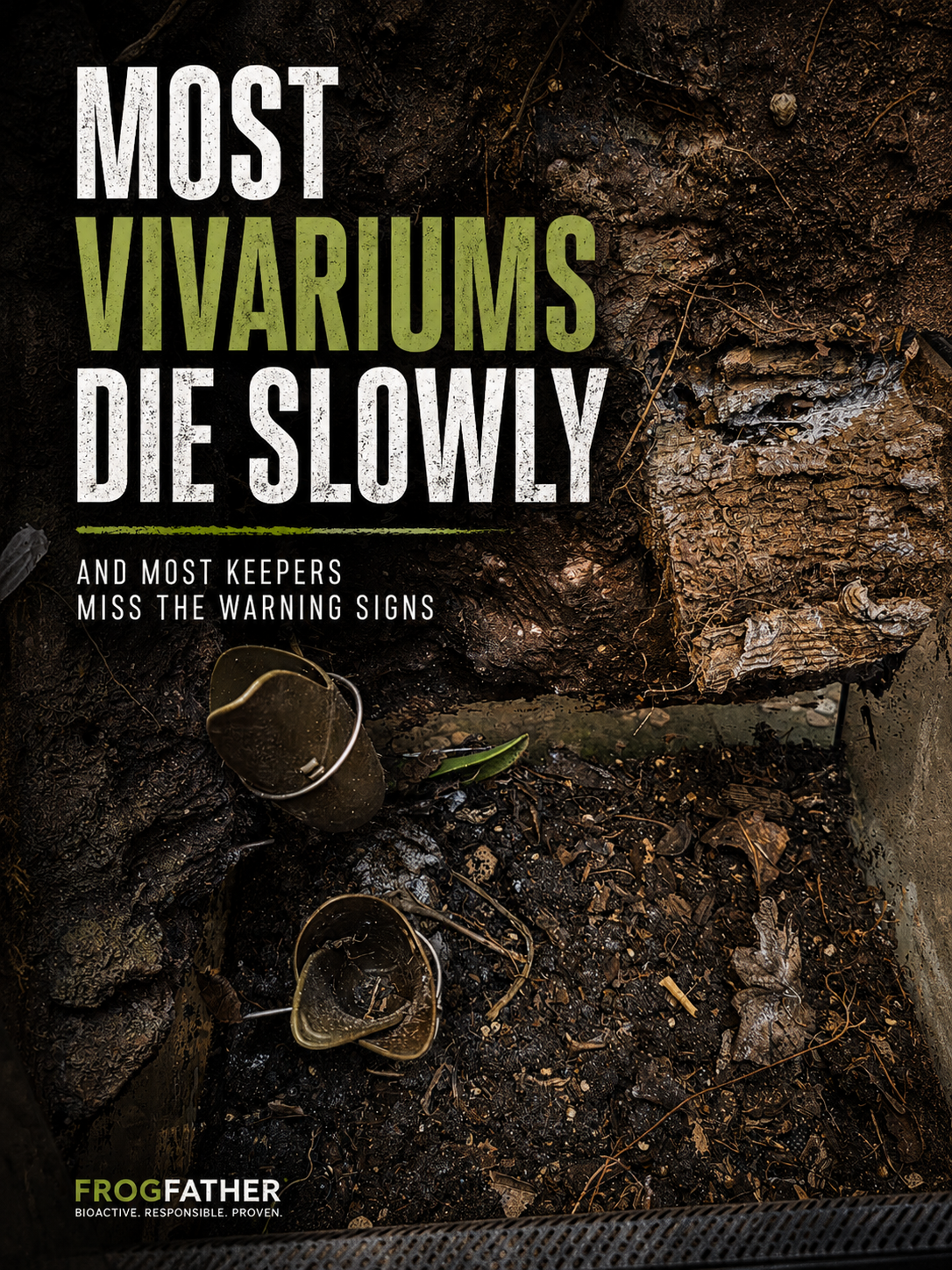
Most dart frog vivariums do not fail on day one.
They usually look brilliant at first. Fresh plants, clean glass, perfect leaf litter, active frogs, humidity sitting where you want it. Everything feels stable.
Then, somewhere around month six, eight, or twelve, things start to shift.
The plants slow down. The substrate smells slightly sour. Springtails are harder to find. Isopods disappear. Moss thins out. Mould returns in odd patches. The frogs may still look fine, but the whole vivarium feels like it has lost its balance.
That is what I call a vivarium crash.
It does not always mean total failure. It does not always mean frogs are immediately at risk. But it does mean the biological engine underneath the setup is no longer keeping up.
What Does a Vivarium Crash Actually Mean?
A crashed vivarium is not just a messy vivarium.
It is a bioactive system where the balance between moisture, airflow, microbes, plants and clean-up crew has started to break down.
In a healthy bioactive setup, waste is processed. Leaf litter breaks down gradually. Springtails and isopods reproduce. Plants root properly. The substrate smells earthy rather than sour.
When that balance slips, the system becomes harder to manage. You start fixing symptoms instead of addressing the underlying cause.
The Most Common Early Signs
- Substrate smells sour or stale rather than earthy
- Springtails are no longer visible when leaf litter is disturbed
- Isopods are present but not breeding
- Leaf litter sits unchanged for months
- Mould returns after the original setup phase
- Plants grow slowly, yellow, or rot at the base
- Glass films over quickly after cleaning
- Humidity readings look fine, but the vivarium feels stagnant
The difficult bit is that these signs often arrive slowly. Nothing looks catastrophic at first. That is why keepers miss it.
Cause 1: The Clean-Up Crew Was Never Established Properly
Adding springtails and isopods once does not guarantee a functioning clean-up crew.
A proper clean-up crew needs time, food, refuge and the right moisture gradient. If frogs are added too early, they can reduce young isopod numbers before the colony becomes self-sustaining.
Springtails are more forgiving, but even they can struggle if the substrate becomes waterlogged or sterile.
If your springtail population has thinned out, it may be worth reseeding the vivarium and feeding the microfauna directly. Products such as Springtail Supermix and the Bioactive Microfauna Support Pack are useful when you are trying to rebuild that hidden base layer.
Cause 2: The Substrate Has Gone Anaerobic
This is one of the big ones.
Substrate should be damp, airy and biologically alive. It should not be sludge.
If the lower layers stay too wet for too long, oxygen levels drop. Once that happens, you can get anaerobic pockets. These smell sour, stale, or sometimes slightly rotten.
This often happens when:
- misting is too heavy
- the drainage layer is full
- substrate is too fine and compacted
- there is not enough air exchange
- leaf litter is too thin to buffer moisture
A mature substrate should have structure. My own preference is to use aged, active material where possible, because a living substrate behaves differently to freshly mixed ingredients. That is the principle behind using aged bioactive vivarium substrate rather than treating substrate as decoration.
Cause 3: Too Much Water, Not Enough Dry-Down
Dart frogs need humidity. They do not need a swamp.
One of the easiest ways to crash a vivarium is to keep misting because the hygrometer says the air has dropped, while ignoring what the substrate is doing.
Healthy vivariums go through small wet and dry cycles. Leaves dry slightly. Surfaces stop glistening. The top layer breathes.
If everything stays wet all the time, you lose gradients. Isopods cannot self-regulate. Plant roots suffer. Microbial balance shifts.
This is why misting should be based on the whole vivarium, not just the number on a sensor.
Cause 4: Airflow Was Designed for Humidity, Not Biology
A lot of vivariums are sealed too tightly because people are scared of losing humidity.
That works for a short time. Then the system starts to feel heavy.
You can have 85% humidity and still have poor air exchange. Those are not the same thing.
Fresh air matters because the substrate, plants, frogs and microbes are all using oxygen and producing carbon dioxide. Without exchange, the vivarium becomes stale.
If this is happening, improving ventilation gradually is often better than making one drastic change. Light risers, vent strips, mesh sections and better top clearance can all help. The aim is not to dry the vivarium out. It is to let it breathe.
Cause 5: The Plants Were Surviving, Not Growing
Plants can look fine for months while quietly failing underneath.
A cutting may hold its leaves for ages without rooting properly. A bromeliad may stay green but stop producing new growth. A creeping plant may sit there doing very little.
That matters because plants are not just decoration. They help stabilise humidity, use nutrients, create cover and support microhabitats.
If the plant layer stalls, the vivarium loses one of its stabilising systems.
Good plant selection matters here. So does light, drainage, and giving roots something useful to grow into.
Cause 6: Leaf Litter Was Treated as Decoration
Leaf litter is not a styling choice. It is food, shelter and moisture control.
If you only add a thin scattering of leaves at the start, the clean-up crew will eventually run short of structure and food. Frogs also lose visual security, and the substrate surface becomes more exposed.
A proper leaf layer gives springtails and isopods somewhere to live. It also slows evaporation and protects the substrate from being blasted directly by misting.
Long-lasting tropical leaves such as premium tropical leaf litter are worth using because they break down gradually rather than vanishing in a week.
Cause 7: The Vivarium Was Stocked Too Soon
This is uncomfortable, because most of us have done it at some point.
A vivarium can look ready long before it is biologically mature.
Plants may be in. Mist may be running. The glass may look clean. But the microbial and detritivore systems may still be thin.
Then frogs go in, food goes in, waste appears, and the system is asked to do a job it has not grown into yet.
That does not always cause an immediate problem. Sometimes it shows up months later.
How to Rescue a Vivarium Before It Fully Crashes
If the frogs are healthy and the system is only starting to slip, you do not always need to strip it down.
Start with the least disruptive fixes first.
- Check the drainage layer and remove excess water if needed
- Reduce misting slightly and allow gentle dry-down
- Add fresh leaf litter in deeper patches
- Reseed springtails heavily
- Add microfauna food sparingly
- Improve airflow gradually
- Remove rotting plant material
- Spot replace sour substrate patches
Do not panic-clean the whole vivarium unless you need to. A full reset destroys the good biology as well as the bad.
When a Full Reset Is Better
Sometimes the system is too far gone.
A full reset may be sensible if:
- the substrate smells strongly rotten
- fungal growth is spreading through lower layers
- plants are repeatedly collapsing
- drainage is permanently flooded
- frogs are losing condition
If frogs are losing weight, showing skin issues, or behaving abnormally, treat that as a welfare issue first. Move them to a simpler, clean holding setup and assess the vivarium separately.
The 12-Month Maintenance Check I Recommend
Once a vivarium is established, I like to think in terms of seasonal checks rather than constant interference.
At around 6–12 months, check:
- Is the drainage layer holding too much water?
- Is leaf litter still breaking down?
- Are springtails visible?
- Are isopods breeding?
- Are plants actively growing?
- Does the substrate smell earthy?
- Does condensation clear naturally?
If those answers are mostly positive, the vivarium is probably functioning. If several are negative, it is time to intervene gently.
So…
A bioactive vivarium is not finished when the build is finished.
It is alive. That means it changes.
The best dart frog setups are not the ones that look perfect on day one. They are the ones that still smell clean, grow well, support microfauna and give frogs stable conditions a year later.
If your vivarium is starting to crash, do not see it as failure. See it as feedback.
The system is telling you something. Listen early, and you can usually bring it back.
Frequently Asked Questions
Why has my bioactive vivarium started to smell?
A sour or stale smell usually means the substrate is too wet, compacted, or lacking oxygen. Check drainage, reduce misting slightly, and look for anaerobic patches.
Why have my springtails disappeared?
Springtails may decline if the substrate becomes waterlogged, food runs out, or the vivarium becomes too stagnant. Reseeding and feeding the microfauna can help rebuild the population.
Do I need to replace all the substrate in a crashed vivarium?
Not always. If only small areas smell sour, spot replacement may be enough. A full reset is usually reserved for severe breakdown, persistent rot, or welfare concerns.
How long should a bioactive dart frog vivarium last?
A well-maintained bioactive vivarium can last for years, but it still needs top-ups, leaf litter replacement, microfauna support and occasional drainage checks.
Can too much misting crash a vivarium?
Yes. Constant saturation can reduce oxygen in the substrate, suppress isopod breeding, encourage mould and damage plant roots.