At first glance, many dart frog vivariums look fairly similar.
Glass box. Plants. Wood. Moss. Lighting.
That is why newer keepers are often confused by pricing differences.
One setup might cost £120. Another might cost £500 or more.
From photographs alone, both can appear tropical and visually impressive.
But long-term bioactive vivariums are not really defined by how they look on day one.
The real difference usually appears six months later.
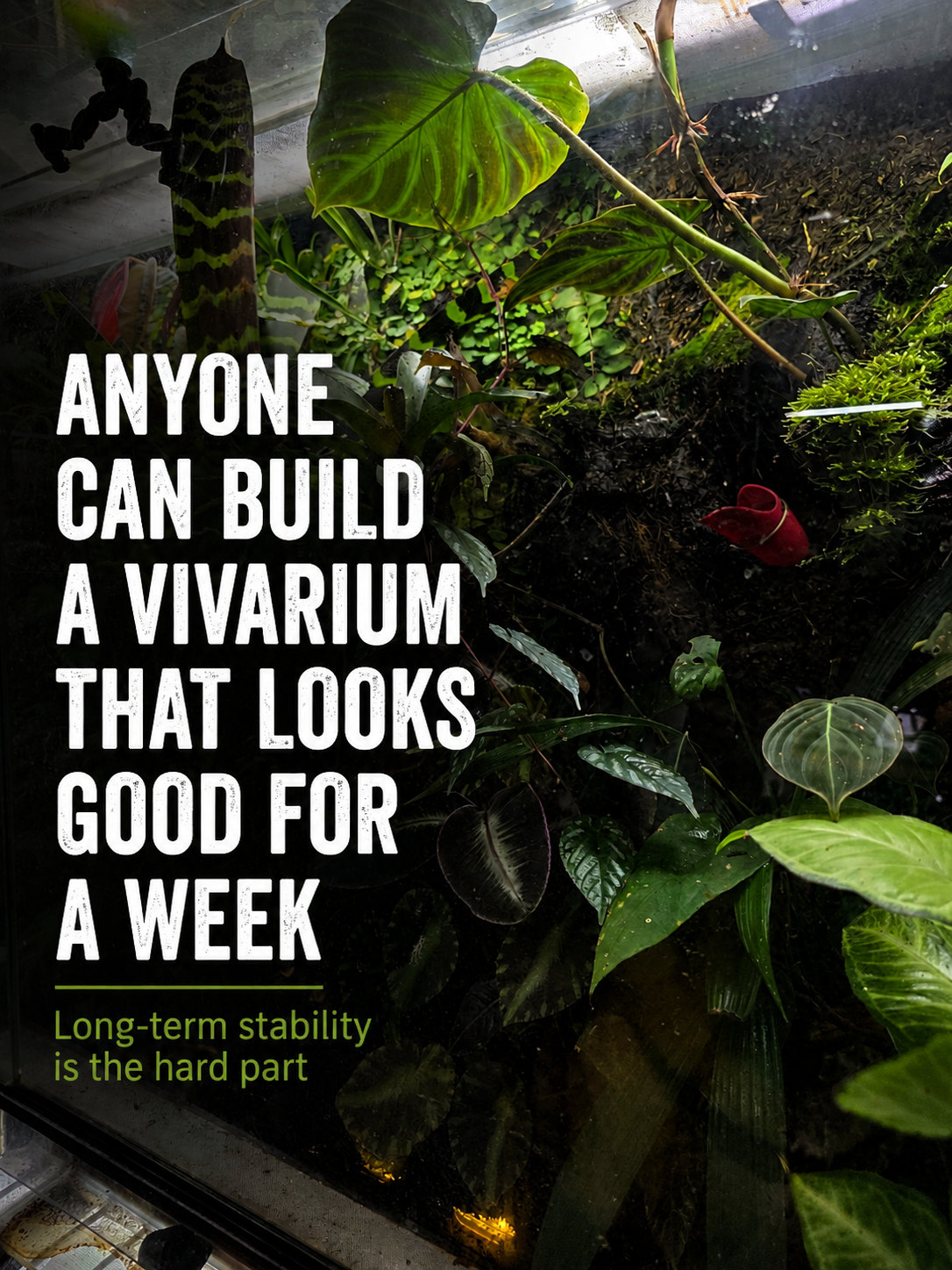
Anyone Can Build a Vivarium That Looks Good for a Week
This sounds harsh, but it is true.
Fresh moss, newly planted cuttings and damp substrate photograph beautifully. Even unstable vivariums can look impressive initially.
The challenge is building a system that still functions properly after:
- thousands of misting cycles
- constant humidity exposure
- microbial activity
- plant root expansion
- organic breakdown
- temperature fluctuations
That is where the difference between decorative setups and genuinely stable ecosystems starts to show.
Premium Vivariums Usually Prioritise Stability
The best long-term vivariums are designed around environmental consistency rather than immediate appearance.
That includes:
- proper drainage capacity
- balanced airflow
- thermal stability
- rooting depth
- microfauna support
- water management
Many cheaper setups skip these hidden structural details because they are difficult to photograph and expensive to implement.
The Drainage Layer Matters More Than People Think
One of the first things that tends to fail in budget setups is water management.
If excess water cannot separate properly from the substrate layer, the vivarium gradually becomes unstable.
You start seeing:
- sour substrate
- fungal blooms
- plant collapse
- stagnant conditions
- declining microfauna
As discussed in why vivariums crash after 6–12 months, many long-term failures begin underneath the visible layer.
Good drainage systems are rarely exciting visually, but they are critical biologically.
Airflow Is Usually the Biggest Hidden Difference
Humidity and airflow are not opposites.
That is one of the most misunderstood parts of dart frog husbandry.
Many cheaper vivariums trap humidity successfully but exchange air poorly. Initially this looks fine because humidity readings remain high.
Over time, however, the system often becomes heavy and stagnant.
Premium vivariums usually manage airflow much more deliberately through:
- vent positioning
- heat gradient management
- mesh balance
- top clearance
- controlled evaporation
The goal is not simply “high humidity”. The goal is biologically stable air exchange.
Planting Density Is Not Just Decoration
Good planting changes behaviour.
Healthy root systems stabilise moisture, improve nutrient cycling and provide security for frogs.
That is one reason heavily planted vivariums often produce more confident frogs over time, as discussed in why some dart frogs become bold — and others never do.
Cheaper setups often use sparse planting because mature plants, rooted bromeliads and established moss systems are expensive and time-consuming.
Freshly assembled tanks can still look tropical initially, but mature planted systems behave differently biologically.
Established Biology Has Value
One of the biggest differences between basic and premium bioactive setups is maturity.
A freshly mixed substrate is not the same as a biologically active substrate.
Established systems contain:
- bacterial networks
- fungal activity
- microfauna populations
- decomposition cycles
- stable moisture structure
This is why many experienced keepers value aged bioactive vivarium substrate and mature microfauna systems rather than treating substrate as inert filler.
Lighting Quality Changes Everything
Lighting is another area where costs separate quickly.
Cheap lighting often produces enough brightness to illuminate a vivarium visually while still failing biologically.
Plants may survive temporarily without truly thriving.
Better systems usually prioritise:
- PAR output
- light spread
- heat control
- photoperiod stability
- plant-supportive spectrum
That becomes especially important in dense tropical planting systems.
Misting Systems Are About Consistency
Hand misting can absolutely work well.
But one reason many advanced keepers move toward automated misting systems is consistency.
Stable hydration cycles are easier to maintain when environmental changes happen gradually and predictably.
The issue is not convenience alone. It is environmental stability over long periods.
Premium Vivariums Usually Age Better
This is probably the simplest way to explain it.
Cheap vivariums often peak visually during the first few weeks.
Premium vivariums usually improve over time.
The moss thickens. The plants root properly. Microfauna populations establish. Frogs become more confident.
The ecosystem settles rather than declines.
That Does Not Mean Expensive Always Equals Better
Price alone means very little.
There are expensive vivariums with poor biology and modest setups with excellent environmental design.
The important thing is understanding where the money actually goes.
In genuinely stable vivariums, a large proportion of the work is hidden:
- cycling time
- substrate structure
- drainage engineering
- plant establishment
- microfauna development
- environmental balancing
Those things are difficult to photograph, but they are usually what determine long-term success.
Final Thoughts
The difference between cheap and premium vivariums is rarely about decoration alone.
It is usually about long-term ecosystem stability.
A good vivarium should not simply survive humidity.
It should function biologically within it.
The setups that continue thriving years later are usually the ones built around environmental balance first and appearance second.
Frequently Asked Questions
Why are some dart frog vivariums so expensive?
Premium vivariums often include mature planting, drainage engineering, environmental control systems and established bioactive biology that take significant time and materials to develop.
Do dart frogs need expensive vivariums?
Not necessarily. Well-designed vivariums can exist at many budgets, but environmental stability is more important than simple appearance.
What is the most important part of a bioactive vivarium?
Drainage, airflow and biological stability are usually more important long-term than decorative elements alone.
Why do some vivariums fail after a few months?
Poor drainage, stagnant airflow, weak substrate structure and unstable microfauna systems are common causes of long-term decline.
Do planted vivariums help dart frog behaviour?
Yes. Dense planting and natural cover often encourage more confident and natural frog behaviour.