By The Frogfather
Quick verdict: Ranitomeya imitator ‘Intermedius’ is one of the more achievable thumbnail poison frogs for a properly prepared keeper, but it should not be mistaken for a miniature version of a larger Dendrobates. Its tiny size, ability to escape through minute gaps, requirement for very small live food and strongly pair-oriented social biology demand careful husbandry.
Ranitomeya imitator ‘Intermedius’ at a glance
Scientific species: Ranitomeya imitator (Schulte, 1986)
Hobby/locality name: ‘Intermedius’
Adult size: approximately 17–22 mm snout–vent length
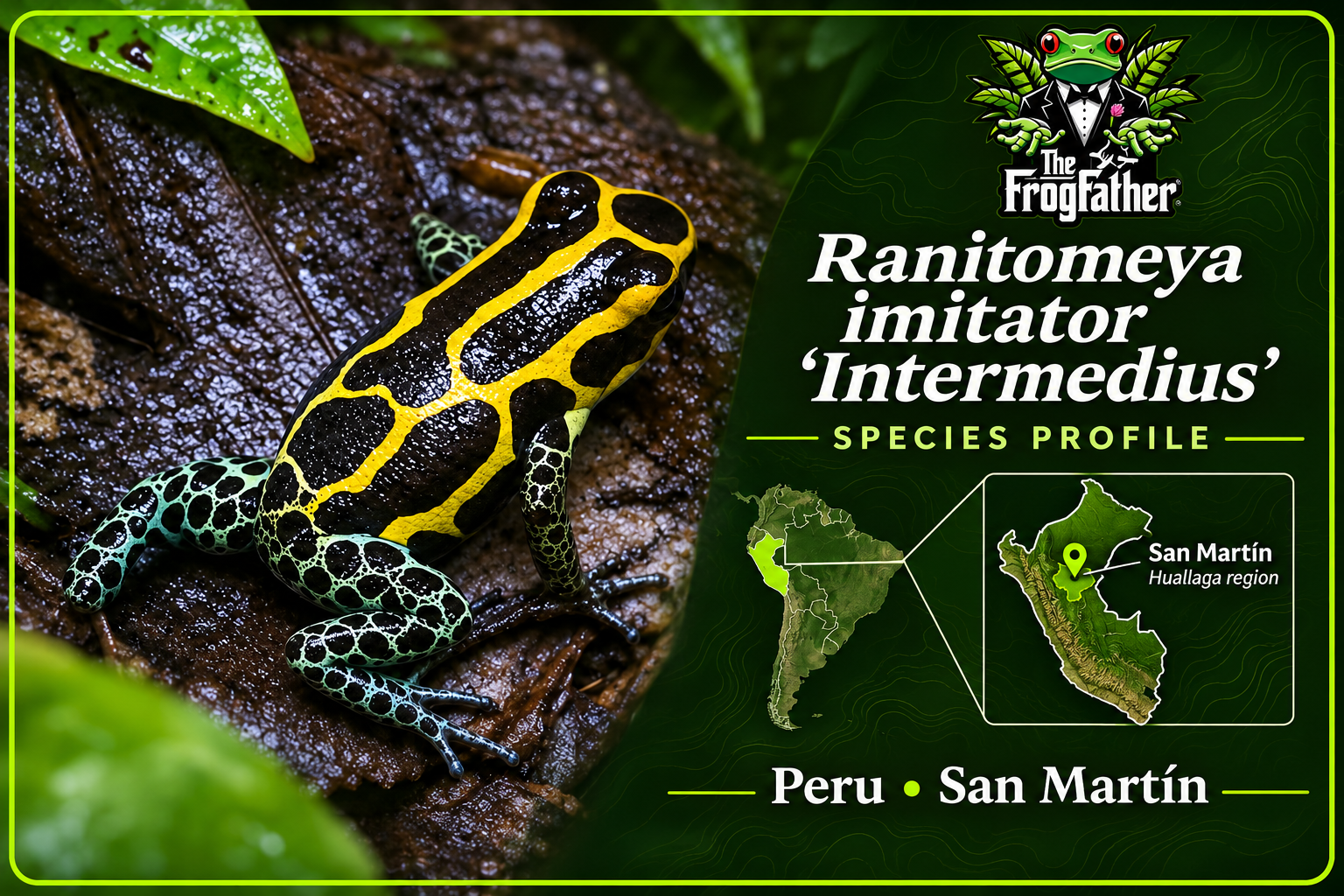
Natural distribution: endemic to Peru; the historical ‘intermedius’ name is associated with the Huallaga Canyon area of San Martín
Activity: diurnal, scansorial and frequently arboreal
Recommended housing: one established male–female pair
Preferred minimum vivarium: 45 × 45 × 60 cm for a pair
Daytime temperature: 22–25 °C
Night temperature: approximately 18–21 °C
Relative humidity: normally cycled through roughly 75–95%, with ventilation and surface drying between misting events
Diet: very small live invertebrates, principally Drosophila melanogaster and springtails
Breeding strategy: small clutches, male tadpole transport and biparental care with female trophic-egg feeding
Beginner suitability: 3/5 — suitable as a first thumbnail species, but not the easiest first dart frog overall
Taxonomy: what does ‘Intermedius’ actually mean?
The scientifically accepted species is Ranitomeya imitator. The name Dendrobates imitator intermedius was proposed for frogs associated with the Huallaga Canyon in San Martín, Peru, but ‘intermedius’ is not currently recognised as a valid subspecies. Modern taxonomic treatments place it within Ranitomeya imitator.
That does not make the hobby name meaningless. ‘Intermedius’ remains useful for identifying a particular captive lineage and colour-pattern tradition. It should therefore be written in quotation marks and treated as a locality or morph label, not as a formal third part of the scientific name.Lineage matters: never mix Intermedius with other R. imitator morphs or localities. Even where two animals belong to the same recognised species, crossing distinct captive lineages destroys locality information and produces offspring that cannot honestly be represented as either form.
Origin and natural habitat
Ranitomeya imitator is endemic to Peru and is recorded from Amazonian rainforest in the departments of San Martín and Loreto. The historical type locality attached to the Intermedius name lies in the Huallaga Canyon region of San Martín at about 200 metres elevation. The species as a whole occupies a mosaic of lowland and foothill rainforest rather than a single uniform habitat.
These frogs are closely associated with humid, structurally complex vegetation. They use leaves, stems, root tangles, bromeliads and small water-holding plant structures rather than living only on the forest floor. Their expanded toe discs reflect this climbing lifestyle. In the wild, males use calling sites and the adults exploit tiny phytotelmata—water held in leaf axils or other plant cavities—for tadpole deposition.
The captive lesson is not simply “keep it wet”. A successful vivarium must reproduce usable three-dimensional structure, numerous visual barriers, humid retreats, small breeding sites and moving air. A sealed box with permanently saturated surfaces is not an adequate rainforest analogue.
Appearance and adult size
Adults are genuinely tiny, normally around 17–22 mm from snout to vent. Intermedius animals are recognised in the hobby by their contrasting black and yellow-to-orange dorsal patterning and blue-green or reticulated colour on the limbs, although individual pattern and colour intensity vary.
R. imitator is an important example of Müllerian mimicry. Different geographical populations resemble other toxic Ranitomeya occurring in the same areas. This is not merely superficial resemblance: published research has identified strong geographical differentiation among the species’ colour-pattern forms.
Captive-bred poison frogs do not obtain the same dietary alkaloids responsible for wild toxicity, but they remain delicate amphibians with highly permeable skin. They should be viewed rather than handled.
Temperament, visibility and social behaviour
Well-established Intermedius can be active and visible, especially in a mature planted vivarium offering shaded routes through the vegetation. Newly introduced frogs may remain cautious while they map feeding areas and retreat sites. Excessively bright, exposed enclosures often make thumbnail frogs less confident, not more visible.
Ranitomeya imitator has exceptional reproductive social biology. Field and genetic research has demonstrated social and genetic monogamy, supported by intensive biparental care. The male attends eggs, transports tadpoles and guides the female to deposition pools; the female supplies unfertilised trophic eggs on which the developing tadpoles depend.
That biology is the main reason Frogfather recommends keeping Intermedius as an established male–female pair. Multiple males may compete and multiple females may interfere with eggs, tadpoles or pair stability. A trio can appear peaceful until sexual maturity or breeding begins, so lack of immediate fighting is not proof that the arrangement is safe.Communal rating: not recommended. Keep one pair per vivarium. Do not mix them with other dart-frog species or other R. imitator localities.
Recommended vivarium size
For one adult pair, Frogfather recommends a vivarium no smaller than 45 × 45 × 60 cm, with the height used productively. A 45 cm cube can work for an experienced keeper if it is exceptionally well structured, but the taller enclosure provides more planting area, more usable climbing routes and a better vertical microclimate.
Floor dimensions alone are a poor measure for an arboreal thumbnail. The enclosure should include:
- escape-proof ventilation with no gaps around doors, cable ports or misting apertures;
- a free-draining base and accessible drainage reservoir;
- leaf litter over a biologically active substrate;
- cork, branches, roots and plant stems connecting the full height;
- dense broad-leaved and climbing plants, including bromeliads where appropriate;
- several shaded retreats and visual barriers;
- multiple small breeding and tadpole-deposition options;
- easy-to-observe feeding points so both animals can be monitored.
Before introducing frogs, allow the vivarium to establish and confirm that temperature, drainage, misting and ventilation remain stable. The Frogfather pre-frog checklist provides a useful final review.
Temperature
A practical captive target is 22–25 °C during the day, with a modest night reduction to approximately 18–21 °C. The vivarium should contain small temperature differences rather than one uniformly heated volume. Measure conditions at frog level and in both upper and lower zones.
A brief reading outside the target range is less informative than duration, humidity, ventilation and the frogs’ access to cooler refuges. Sustained temperatures approaching 27–28 °C should be treated as a warning, especially in a closed, saturated vivarium. Thumbnail frogs have little body mass and can overheat or dehydrate quickly.
Do not create an intense reptile-style basking point. Where additional heat is genuinely needed, warm the room or use a thermostatically controlled external method that cannot produce a hot patch against the glass.
Humidity, misting and ventilation
Intermedius requires high ambient humidity, but a single fixed percentage is misleading. Aim for a daily cycle: humidity may rise into the 90s following misting and overnight, then fall towards roughly 75–85% as air moves and exposed leaves begin to dry. Moist retreats and leaf litter should remain available throughout that cycle.
Constantly fogged glass, waterlogged substrate and permanently dripping leaves are not signs of better husbandry. They can reduce gas exchange, damage plants and encourage bacterial or fungal imbalance. Conversely, a small arboreal frog should never be forced to endure prolonged dry air without humid refuges.
Use amphibian-safe water for misting and keep the reservoir, tubing and nozzles clean. See the misting-reservoir cleaning guide, dart-frog ventilation guide and UK water guide.
Lighting and UVB
Provide a consistent day–night cycle, normally close to 12 hours, using lighting capable of supporting the plants without overheating the vivarium. Dense planting must still leave shaded routes where frogs can choose lower light levels.
Low-level UVB can be provided as part of a carefully measured Ferguson Zone 1 arrangement, with shade and distance appropriate to the lamp. It is not a substitute for correct dietary supplementation. If UVB is not measured and controlled, do not guess with a powerful lamp placed directly over a small enclosure. Read Do Dart Frogs Need UVB? for the evidence and practical trade-offs.
Feeding and supplementation
Adult Intermedius need frequent access to very small moving prey. Flightless Drosophila melanogaster are the usual staple, supported by springtails and occasional appropriately sized alternatives such as pea aphids. Large fruit flies and many pinhead crickets may be too large for smaller animals or newly morphed froglets.
Feed amounts should be judged by body condition, age, breeding activity and how quickly prey is consumed. Adults commonly do well with small feeds on most days; growing froglets require especially reliable access to springtails and very small flies. Do not create a permanently crawling mass of uneaten flies.
Use a complete, correctly formulated amphibian supplement on every fruit-fly feed in accordance with its instructions. Store it cool and dry, replace it while still potent and avoid combining multiple high-dose vitamin products without a reasoned plan. Frogfather’s All-in-One Vitamin & Mineral Dust, small flightless fruit flies and mixed springtail culture are appropriate commercial pathways for this section.
For broader context, use the dart-frog feeding guide and supplementation guide.
Breeding behaviour and parental care
Intermedius may breed readily once a compatible pair is mature and settled. Males advertise with a comparatively quiet call and lead females to suitable oviposition sites. Captive clutches are small—often two eggs, within a reported range of approximately one to four—and are commonly placed on protected vertical or near-vertical surfaces.
After development, the male transports tadpoles individually to tiny water bodies such as bromeliad axils or similarly small artificial phytotelmata. The male later guides the female back to each tadpole, where she deposits unfertilised trophic eggs. Research has shown that this biparental system is not decorative behaviour: provisioning is critical to tadpole growth and survival in the small, nutrient-poor pools used by the species.
A well-proven pair can rear its own offspring successfully. Provide several small deposition choices distributed through the vivarium and keep them accessible to the parents. Leaving tadpoles with competent parents preserves the species’ natural care system and often produces robust froglets.
If tadpoles are removed, do not treat them like ordinary detritivorous dart-frog tadpoles. They may be cannibalistic and should be reared separately. Artificial rearing also requires a nutritionally appropriate high-protein programme and close water-quality control. It should be undertaken deliberately, not simply because an egg or tadpole has been discovered.
Sexing Intermedius
Calling is the strongest practical evidence of a male. Females may become broader through the abdomen when mature, but body shape alone is unreliable, particularly in juveniles or well-fed males. Behaviour, repeated observation and maturity are more useful than attempting to sex young frogs from a single photograph.
Do not assemble an unconfirmed group and wait for aggression to reveal the sexes. If purchasing a purported pair, establish the animals’ age, provenance and the basis on which they were sexed.
Health monitoring
A healthy animal should be alert during its active period, move confidently, feed accurately and maintain a smooth, well-filled but not bloated body profile. Record weights or standardised photographs where practical. Warning signs include persistent hiding combined with declining condition, repeated missed strikes, abnormal posture, failure to climb normally, marked colour dulling, sitting exposed in water, rapid weight loss or persistent skin abnormalities.
Quarantine new frogs away from established amphibians and use dedicated tools. Seek an experienced exotics veterinarian for unexplained weight loss, suspected infection, injury or neurological signs. Products and supplements must never be presented as treatments for disease.
Beginner rating: 3/5
Intermedius is beginner-suitable within the thumbnail category, but intermediate compared with larger dart frogs. Its advantages are manageable temperatures, fascinating parental care, relatively dependable breeding and potentially confident behaviour. Its challenges are tiny live-food requirements, escape-proofing, sensitivity to overheating or drying and the need to maintain a compatible pair rather than a casual group.
A keeper who has already stabilised a planted vivarium, cultures melanogaster and springtails, understands supplementation and can monitor a small frog carefully may reasonably choose Intermedius as a first Ranitomeya. Someone seeking their first amphibian with the widest margin for error may be better starting with a robust, captive-bred Dendrobates.
Buying captive-bred Intermedius responsibly
Buy only captive-bred animals with clear lineage information. Ask whether the frogs are feeding reliably, what prey they currently take, how old they are and whether sex has been confirmed through calling or breeding. Do not mix unrelatedly labelled stock simply because the colour pattern looks similar.
Frogfather’s current Ranitomeya imitator ‘Intermedius’ tadpole listing should link back to this profile, while this profile gives prospective keepers the complete adult-care and breeding context before purchase.
Frequently asked questions
Is Intermedius a separate species or subspecies?
No. It is currently treated as a hobby/locality name within Ranitomeya imitator, not as a valid subspecies.
Can Intermedius live in groups?
A stable male–female pair is the recommended arrangement. Extra males or females can create competition, egg loss or disruption once the frogs mature.
What size vivarium does a pair need?
Frogfather recommends at least 45 × 45 × 60 cm for a pair, densely planted and structured throughout its height.
What temperature should Intermedius be kept at?
A practical target is 22–25 °C by day with a gentle reduction to approximately 18–21 °C at night. Avoid sustained high temperatures and provide cooler retreats.
What humidity do they need?
Use a cycle rather than chasing one number: often around 75–95%, rising after misting and overnight, with ventilation and partial surface drying between misting events.
Are they suitable for beginners?
They are one of the more approachable Ranitomeya for a prepared keeper, rated 3/5 for difficulty, but larger Dendrobates generally offer a wider margin for error.
Do the parents care for their tadpoles?
Yes. The male transports tadpoles and coordinates later visits by the female, who feeds them unfertilised trophic eggs. This biparental care is central to the species’ biology.
Scientific basis and further reading
- Amphibian Species of the World: accepted taxonomy, synonymy and distribution of Ranitomeya imitator.
- Brown, Morales & Summers (2010): ecological evidence for biparental care and genetic/social monogamy in R. imitator.
- Brown et al. (2011): revision and species-level treatment of Ranitomeya, including synonymy of ‘intermedius’.
- Twomey, Vestergaard, Venegas & Summers (2016): geographical mimetic divergence within R. imitator.