
By The Frogfather
An automatic mister can make daily husbandry much more consistent. It can also make one part of the routine surprisingly easy to overlook: the container supplying the water.
If the reservoir is hidden beneath a rack, it is tempting to lift the lid, pour in another jug and move on. Eventually, the only maintenance record is the memory that the pump still sounded normal yesterday.
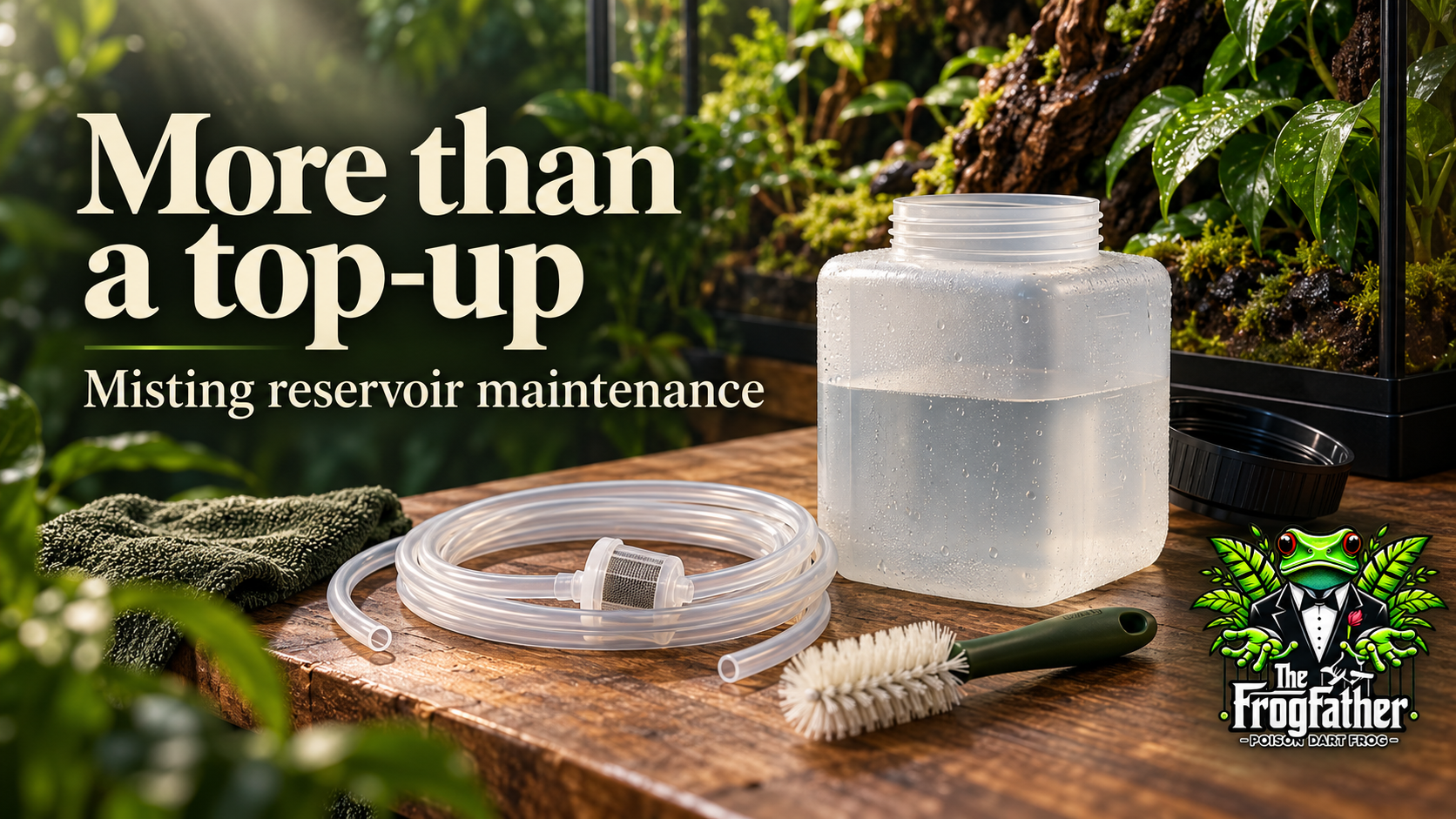
The reservoir deserves the same practical attention as the nozzles. This guide follows the supply side of a misting system, covering inspection, routine cleaning, stored water, reassembly and the checks to make before the system sprays an occupied vivarium again.
Quick answer
Inspect the reservoir whenever you refill it. Keep it covered as the manufacturer intends, use the specified water and clean accessible surfaces before deposits accumulate. Disconnect the system safely, remove old water, clean removable components using a compatible method, rinse appropriately and test the reassembled system without exposing frogs to cleaning residues.
There is no universal disinfectant recipe or cleaning interval for every pump, tube and enclosure. Follow the actual equipment instructions and distinguish routine maintenance from a response to suspected contamination or disease.
Follow the water from storage to nozzle
A useful maintenance check starts before the reservoir. Identify the container in which prepared water is stored, the jug or hose used for filling, the reservoir itself, its intake or bulkhead, any filter and the tubing feeding the pump.
Then follow the pressure line to the nozzles. You do not need to dismantle every component at every inspection, but you do need to know which parts can be removed, washed, replaced or serviced.
Write down the system make and model and keep its current manual available. Similar-looking systems may have different pump arrangements, filters, valves and priming requirements. A maintenance instruction for one model should not be silently applied to another.
Our misting-system guide covers choosing and arranging equipment. Here, the focus is keeping the supply path inspectable and serviceable once it is operating.
Choose water for the job it is doing
Water used through fine misting nozzles has a different practical role from prepared tadpole water. Mineral content matters for equipment deposits, while tadpole-water preparation must consider the needs of the animals and rearing method.
MistKing recommends distilled or reverse-osmosis water for its systems to reduce mineral accumulation in nozzle tips [1]. That is a manufacturer recommendation for the equipment, not a claim that untreated RO water is appropriate for every amphibian use.
Do not add remineralising salts, supplements, plant feed or medication to a misting reservoir unless the equipment manufacturer and the relevant animal-care guidance specifically support that use. A reservoir is not a convenient universal dosing system.
Label stored misting water clearly so it is not confused with another preparation. For the wider distinction between water sources and uses, see our water guide for dart frogs and tadpoles.
Low mineral content does not mean sterile
Reverse osmosis describes a treatment process. It does not guarantee that water remains microbiologically sterile after collection, transfer and storage [6]. A clean-looking jug or a low dissolved-solids reading cannot establish that a stored batch is free from microbial contamination.
Treat the handling route as part of the system. Keep storage vessels and filling equipment clean, covered appropriately and dedicated to their intended use. Do not reuse a container with an uncertain history merely because it holds the right volume.
Avoid dipping a dirty measuring jug into the stored supply. Keep lids, hose ends and filling spouts away from substrate, livefood preparation and used enclosure tools. These are sensible separation measures rather than a claim that ordinary home storage can be made sterile.
If water becomes visibly contaminated, develops an unexpected smell or has an uncertain source, stop using it while you investigate. Adding fresh water to the same batch does not resolve uncertainty about what is already present.
Make inspection part of refilling
Before adding water, look inside the reservoir in good light. Check the walls, bottom, underside of the lid and accessible fittings. Look for loose debris, accumulated deposits, an unusual film and changes from the container’s normal condition.
Observe the water level and how quickly it has fallen. A change may reflect a different programme, a leak or altered demand. It is a prompt to check the system, not proof of any one fault.
Inspect the outside as well. Damp shelving, staining around a bulkhead or water beneath the container can reveal a problem that is difficult to see from above. Keep electrical equipment away from spills and deal with damaged components before normal operation resumes.
Record concerns before emptying the reservoir. A photograph can help when asking the manufacturer for advice. Do not identify a pathogen, an alga or a bacterial species from colour or texture alone.
Cleaning, descaling and disinfection do different jobs
Cleaning removes dirt and organic material from surfaces. Descaling addresses mineral deposits. Disinfection uses a specified process to reduce or inactivate target microorganisms. These are related maintenance tasks, but they are not interchangeable.
A reservoir that needs physical cleaning is not necessarily asking for a stronger chemical. Likewise, a visually clean surface is not proof that it has undergone a validated disinfection process.
For routine care, begin with the manufacturer’s cleaning method. Where suspected disease or significant contamination changes the purpose of the work, obtain an appropriate protocol that addresses the organism, equipment materials, contact conditions and residue removal [4].
Do not mix cleaning products or improvise chemical combinations. In particular, keep acidic descaling products separate from chlorine-based products [5]. Never assume that a chemical suitable for an empty bucket is suitable for the pump, seals, tubing or an amphibian enclosure.
Prepare before you disconnect anything
Arrange a clean, dedicated hand sprayer or another suitable temporary watering method before taking the automatic system offline. Fill it with the appropriate water and retain your normal observation routine.
Check which programmed events could occur while you are working. Isolate power and relieve pressure as instructed before removing fittings. Keep your hands and the electrical area dry, and avoid leaving loose water lines where they can drain onto equipment.
Prepare a work area away from frogs, livefood and plant propagation. Have a clean brush or other approved cleaning tool, suitable rinse water and a container for discarded water ready.
If a fitting is unfamiliar, stop and consult the instructions rather than forcing it. Take a photograph of the original arrangement and label lines if several systems run beside one another. Reassembly is much easier when you know which connection belonged where.
A practical routine-cleaning sequence
The following is a general workflow. The equipment manual determines the compatible products, dismantling steps and any component-specific restrictions.
- Disconnect and make the system safe according to its instructions. Prevent an automatic programme from starting during the work.
- Remove remaining reservoir water without sending it into occupied enclosures. Keep discarded water separate from fresh prepared supplies.
- Remove only components the manufacturer allows you to service. Protect the pump and electrical parts from immersion or splashes.
- Clean accessible reservoir surfaces with the approved method. Physically remove deposits rather than relying on a quick rinse to reach every corner.
- Clean or replace serviceable intake parts as instructed. Inspect seals, threads and connection surfaces for damage.
- Rinse thoroughly using the specified procedure, then inspect for remaining debris and cleaning product.
- Reassemble, refill with appropriate fresh water and perform leak and operation checks before restoring normal use.
A container with a narrow opening can be difficult to inspect and scrub. If you cannot reach a contaminated surface reliably, ask whether a more accessible reservoir or replacement component is suitable for the system.
Look after the intake and filter
A reservoir filter is one component in a water-supply system, not evidence that the downstream water is sterile. Its intended function depends on its design.
MistKing describes its washable reservoir filter as a sediment filter intended to keep dirt and debris out of the pump and nozzles [2]. Follow its specific cleaning and replacement guidance rather than treating every mesh intake as equivalent.
Inspect accessible intake parts when servicing the reservoir. Debris around the intake can be missed if attention stays on the large open surfaces of the container. Refit parts in the correct orientation and check for damaged seals or loose connections.
Do not add improvised filter materials that could restrict flow or shed fragments without manufacturer approval. A change intended to improve water quality may create a supply problem if it is incompatible with the pump arrangement.
Tubing and pumps need their own instructions
Some tubing can be inspected easily; other sections disappear behind a rack. Keep a record of the route and make critical connections accessible where possible. A maintenance plan that requires dismantling the entire frog room is unlikely to remain practical.
If a line is persistently fouled, damaged or impossible to clean using an approved process, replacement may be the more reliable option. Match the specified tubing dimensions and pressure requirements rather than fitting whatever happens to be available.
Do not circulate a household disinfectant through a pump because someone has successfully used it in a different brand. Materials, seals and permitted cleaning methods vary. Obtain confirmation from the manufacturer if the manual is silent.
If a pump has been serviced or a reservoir changed, follow the correct priming instructions. Do not assume every model may run dry simply because one manufacturer’s pump is designed to tolerate it.
Reassemble and test before spraying the vivarium
Check all connections and support the tubing so it does not strain fittings. Restore the reservoir and pump to the position required by the manufacturer.
For MistKing, the official placement guidance specifies positioning the reservoir and pump below nozzle level and arranging the pump relative to the reservoir bulkhead as directed [3]. This is a system-specific instruction; other equipment may be arranged differently.
Where cleaning or service has affected the water path, test in a way that prevents unverified water or residue reaching frogs. Follow the manufacturer’s flushing requirements, direct test discharge into a suitable separate container and dispose of it appropriately.
Watch for leaks, unusual sounds, poor priming and changed spray behaviour. Then restore the programme deliberately and confirm the next scheduled event operates as expected. A timer left in manual mode can undermine an otherwise careful maintenance session.
Decide on a routine you can review
There is no defensible universal rule that every reservoir should be disinfected every week or emptied after a fixed number of days. Water handling, container design, temperature, equipment instructions and observed condition all affect the maintenance plan.
Begin with the manufacturer’s schedule and inspect at every refill. Record cleaning dates and findings. If deposits appear before the next planned service, shorten the interval and investigate why they are forming.
A larger reservoir may reduce refill frequency, but it should not become an excuse to stop inspecting the supply. Choose usable capacity around the system’s demand and your ability to maintain it, rather than maximum volume alone.
Make an exceptional check after contamination, an extended shutdown, equipment replacement or a change in water source. Those events can justify attention beyond the normal routine without turning every refill into a complete system overhaul.
What slime, odour or unusual colour can tell you
An unexpected surface film, smell or water colour tells you the supply needs investigation. It does not identify a particular disease or prove that a frog has been infected.
Stop using the suspect supply, maintain appropriate moisture by an alternative safe route and inspect the storage and delivery chain. If a problem returns rapidly after cleaning, look beyond the bucket to the filling jug, source water, intake and inaccessible lines.
If animals are unwell, describe the water-system findings to an amphibian-experienced vet alongside the husbandry and clinical history. Do not treat the enclosure with a guessed chemical solution or assume cleaning the reservoir alone resolves the animal’s condition.
The dart frog emergency plan provides a wider framework when an equipment problem interrupts normal care.
Keep the routine easy to hand over
A useful maintenance note lists the water source, reservoir identity, normal refill method, cleaning instructions and the safe temporary misting arrangement. Include the manual location and the person to contact if a leak or unusual deposit appears.
For several enclosures, label reservoirs and lines clearly. A helper should not have to guess which container supplies which bank or whether a jug contains plain misting water or a different preparation.
At Frogfather HQ, maintaining multiple planted enclosures makes consistency particularly useful. This article does not claim that a particular reservoir-cleaning trial has been conducted or that one treatment has been tested across our entire collection.
For the wider relationship between watering, drainage and enclosure management, use the complete bioactive vivarium guide. Routine equipment care supports that living system; it does not replace observation of it.
Keep the water supply visible in your husbandry
A dependable misting system needs more than a full container and a working timer. It needs appropriate water, accessible components, a compatible maintenance process and a deliberate check after servicing.
Look inside before topping up. Keep dirty and clean equipment separate. Record what you do and follow the correct instructions. Those small habits make the supply easier to understand and help prevent a hidden reservoir becoming the neglected part of an otherwise carefully managed vivarium.
References and further reading
The checking and management workflows are practical editorial guidance. Manufacturer documents apply to their stated equipment; general horticultural and biosecurity sources do not validate every vivarium application.
- MistKing — Official system and water guidance. Manufacturer advice on RO/distilled water and nozzle deposits.
- Jungle Hobbies / MistKing — Washable reservoir filter. Sediment filter function; does not claim sterilisation.
- Jungle Hobbies / MistKing — Reservoir and pump placement. Placement for this manufacturer’s arrangement only.
- CDC — Cleaning and disinfecting pet supplies. General cleaning/disinfection distinction and following product instructions. Household recipes are not adopted as amphibian or pump protocols.
- CDC / NIOSH — Disinfectant hazard communication. Chemical mixing hazards, including bleach and acidic cleaners.
- CDC — Safe water storage. General protection against recontamination. Human drinking-water dosing instructions are not adopted for misting systems.