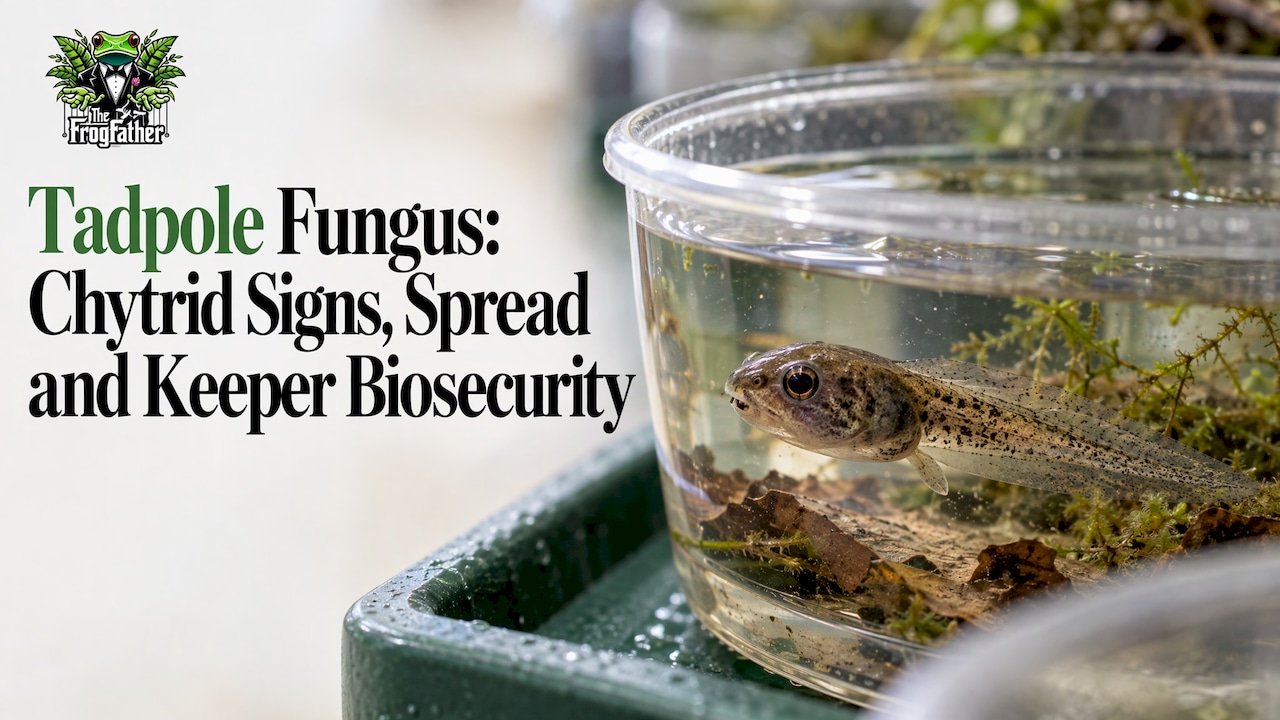
When people search for “tadpole fungus”, they almost always mean chytrid, a microscopic fungus that infects the keratinised mouthparts of tadpoles. In a captive collection the best defence is steady biosecurity, not a rescue treatment: clean routines, separate equipment for each enclosure, careful waste disposal, and early help from an exotics vet if something looks wrong. Below we explain what the fungus is, what it does to tadpoles, how it moves, and what a UK keeper can do about it.
TL;DR
- “Tadpole fungus” usually means chytridiomycosis, caused by Batrachochytrium dendrobatidis (Bd), which infects tadpole mouthparts rather than the skin.
- Many infected tadpoles show nothing, so a healthy-looking tank is not proof of a clean one. Pale or thinning jaw sheaths are the sign researchers describe most often.
- Spread is through water-borne zoospores, contact and shared equipment, so separate kit, gloves and proper disposal of water matter more than any product.
- Antifungal baths exist but can be toxic to larvae. Any treatment decision belongs with an exotics vet.
- In Great Britain Bd is widespread without the mass die-offs seen overseas, but captive keepers still carry a duty of care.
Table of Contents
- What people mean by “tadpole fungus”
- How chytrid infects a tadpole
- Signs to watch for in tadpoles
- How it spreads, and what that means for a frog room
- Biosecurity routine for UK keepers
- Can tadpole fungus be treated?
- Putting the risk in proportion in the UK
- Keeping the tadpole environment steady
- Starting with healthy, UK-bred stock
- Our view on tadpole fungus
- FAQ
- Sources
What people mean by “tadpole fungus”
The phrase covers a few different things, and it helps to separate them.
The main one is chytridiomycosis. The World Organisation for Animal Health lists the pathogen as a fungus in the Chytridiomycota, officially called infection with Batrachochytrium dendrobatidis. The UK charity Amphibian and Reptile Conservation notes that two species cause the disease, Bd and B. salamandrivorans (Bsal). Bd infects a large range of frogs, toads, salamanders and caecilians, while Bsal appears limited to salamanders and newts. For a frog keeper, Bd is the one to understand.
The second thing people mean is a non-fungal tadpole illness. Not every sick tadpole has a fungus. A UK citizen science project, Tadpole Doctor, has identified single-celled Perkinsea microbes related to those linked with severe infections and die-offs in wild tadpoles in the USA and in captive European tree frogs in the UK. These are not fungi, but a keeper looking at an ailing tank can easily confuse them with one.
The third is simple uncertainty. The Birmingham & Black Country Wildlife Trust points out that little is understood about tadpole diseases, and that vanished tadpoles may simply have been eaten or hidden in silt. A missing tadpole is not automatically an infected one.
How chytrid infects a tadpole
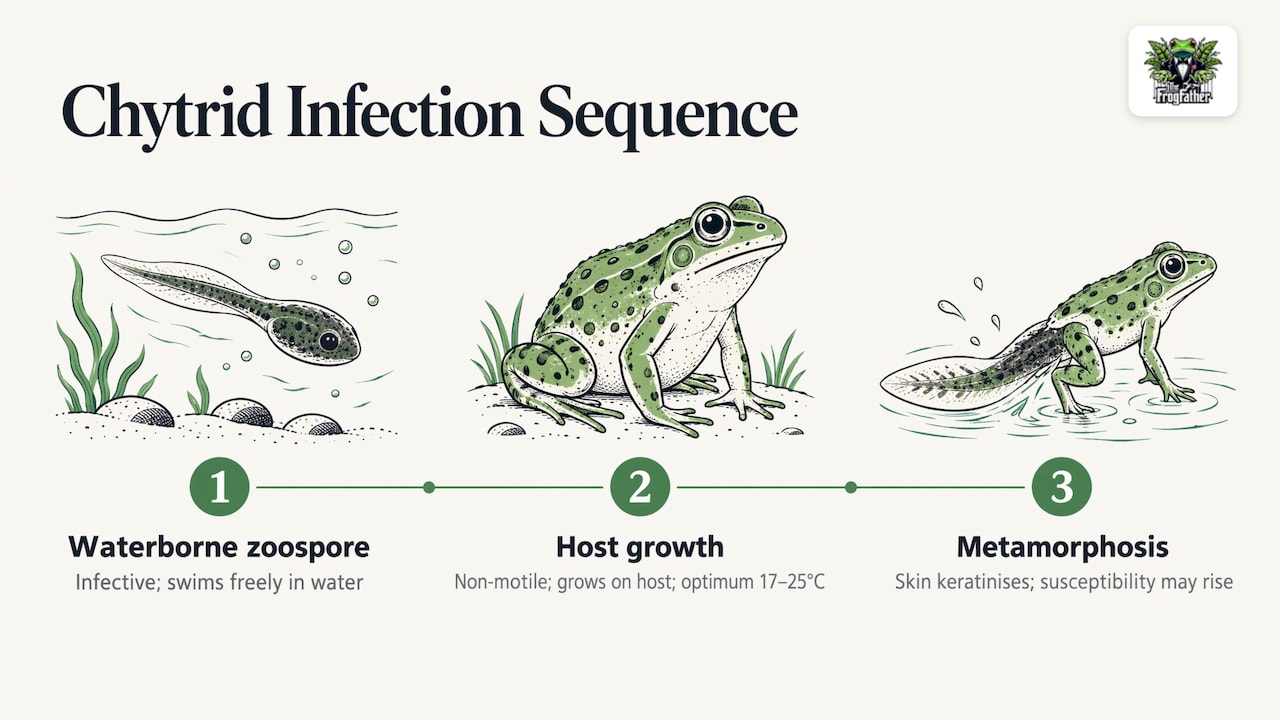
Chytrid feeds on keratin. In adult frogs that means the skin. Tadpole skin is not keratinised, so the fungus only takes hold in the mouthparts: the jaw sheaths and tooth rows tadpoles use to graze.
The life cycle has two stages. Bd has an infective, free-swimming zoospore stage in water and a non-motile stage that grows on the host, with a thermal optimum for growth between 17 and 25°C. That range overlaps with the cooler end of many dart frog setups and with a typical UK frog room, so temperature alone is not a safeguard. Do not treat it as a reason to chase a particular temperature either: stick to the range your species needs.
The disease picture changes at metamorphosis. As the tadpole transforms, its skin starts to keratinise, controlled by thyroid hormone, and the same review notes this may coincide with immune suppression and greater susceptibility. A tadpole that carried a light mouthpart infection can become a froglet whose skin is now a target. This is one reason froglets are a point of vulnerability in any breeding programme, and why our guide to why young dart frogs die in grow-out tubs looks at the whole grow-out stage and not only the water.
Signs to watch for in tadpoles
Here is the honest difficulty: often there is nothing to see. The ARC explains that infection in tadpoles often causes no visible signs, though in severe cases it can slow growth and metamorphosis and lead to death. A histology guide adds that apparently healthy infected tadpoles can be highly prevalent in a population.
What researchers do describe is change to the mouthparts:
- Loss of jaw sheath pigment. WOAH lists loss of the pigmented jaw sheaths in the mouth as a sign in infected tadpoles.
- Patchy or thinning colour. In a Japanese study of wild bullfrog tadpoles, lesions were most often on the lower jaw sheath and were mainly partial depigmentation or thinning of the pigmented layer. Bd infection was confirmed in 20 of the 21 tadpoles with jaw sheath deformities.
- Slow growth or stalled development. Compare tadpoles of the same clutch and age. One that lags well behind its siblings deserves a closer look, though many other husbandry problems cause the same thing.
Those findings come from wild bullfrog tadpoles, and a dart frog tadpole is a very different animal, so treat them as a guide to what to look for, not a diagnosis. Dart frog tadpoles are small, and the mouthparts are tiny. A pale jaw can also be down to diet, age or lighting. You cannot confirm chytrid by eye.
How infection is confirmed
Confirmation is a laboratory job. The most widely accepted approach is a skin swab with a quantitative PCR test, and absolute confirmation needs tissue sampling and histology. The ARC cautions that testing can be difficult and expensive, so infection may go undetected or re-emerge in animals thought negative. That is exactly why a negative result, or a clean-looking tank, should never relax your routine.
How it spreads, and what that means for a frog room
The WOAH disease card says that horizontal transmission happens through zoospores in fresh water, possibly also by skin-to-skin contact, while transmission through eggs is unlikely. Bd is known to infect over 500 species, with susceptibility varying by life stage and species.
It also travels on surfaces. In a Honduran field study, Bd was found on 76.1% of leaves (35 of 46) where an infected frog had rested, showing it can move between water and land without direct contact between animals. In a vivarium the translation is plain: your hands, nets, pipettes, tubs, leaf litter and plants can all carry water from one enclosure to the next.
That shapes where problems start in a real collection:
- New arrivals. Frogs, plants and cultures coming in from elsewhere.
- Shared tools. One net, one pair of tweezers, one water jug used across tanks.
- Hands. Moving from tadpole tubs to adult enclosures without a change of gloves.
- Waste water. Tipping tadpole water down a drain or onto a garden, or sending it out of the room.
Biosecurity routine for UK keepers
The guidance written for professional amphibian collections is a good template. The WAZA/CBSG husbandry and biosecurity guide recommends treating all captive amphibians as potentially infected, avoiding discharge of potentially infectious water, and changing non-powdered gloves for each enclosure. The same guide says that screening and treating is no substitute for strict quarantine and high levels of barrier management.
Turned into a routine for a home or small breeding room:
- Assume every tank could carry it. That mindset drives everything else and costs nothing.
- Work from youngest and healthiest to oldest and most doubtful. Do tadpoles and froglets first, newly arrived animals last.
- Glove up per enclosure. Change non-powdered gloves between tanks, as the WAZA/CBSG guide advises.
- Dedicate kit to each enclosure or tub. Nets, tubs, tweezers and pipettes should not travel from one to the next without disinfection.
- Quarantine new animals. Keep them physically separate, with their own equipment, and look after them last.
- Keep records. Note when clutches were laid, when tadpoles were moved, and any that lag behind. Patterns show up on paper before they show up by eye.
- Treat waste before it leaves the room. The guide recommends incineration, chemical disinfection, heating to 60°C for 5 minutes, or complete desiccation for enclosure waste, and treating wastewater before disposal.
Our own piece on reducing risk in frog rooms covers biosecurity alongside power backup and alarms, and our overview of the deadly frog fungus gives the wider picture. If you are moving animals between homes, how to move or transport dart frogs safely is worth reading first.
Never release or mix with wild amphibians
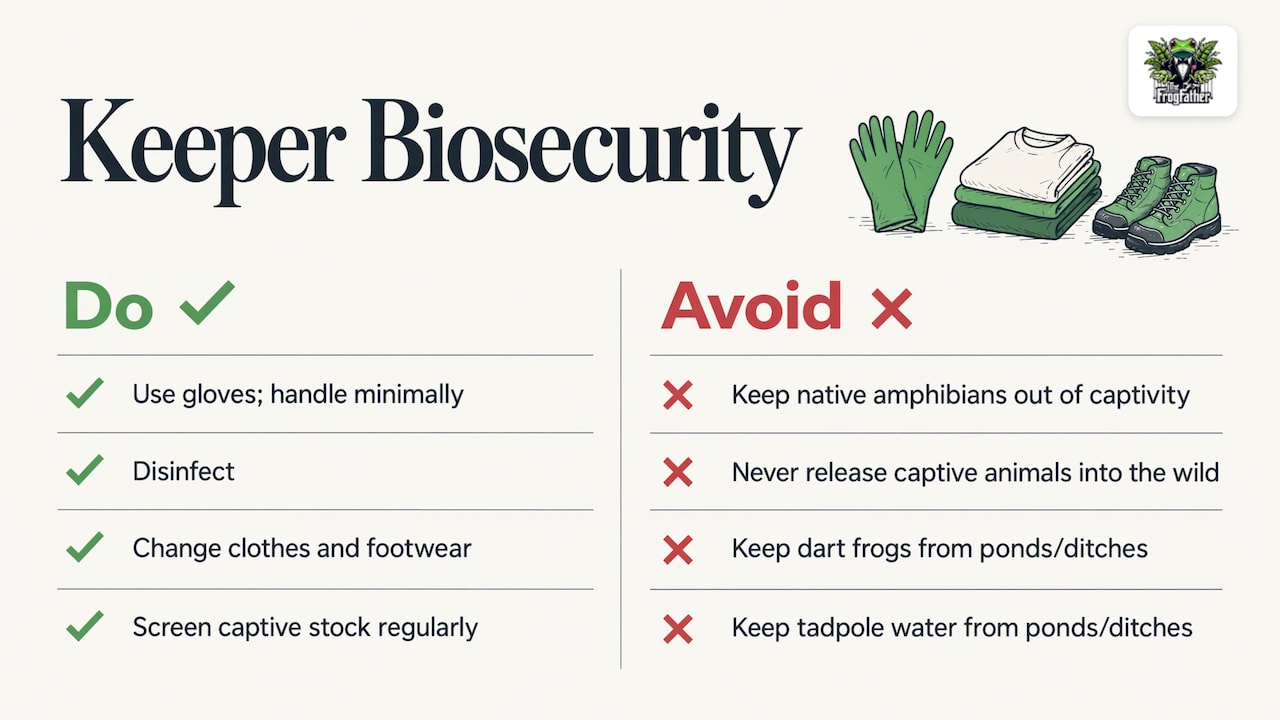
This is a legal-and-ethical line, not a preference. ARG UK’s advice note says keepers of non-native species should use rigorous barrier methods (gloves, minimal handling, disinfection, change of clothes and footwear), screen captive stock regularly, and not bring native amphibians into captivity or release captive animals into the wild. Disease emergence is also commonly linked with non-native species. Dart frogs and their tadpole water should never go near a garden pond or ditch.
Can tadpole fungus be treated?
In captivity, chytridiomycosis can be treated; in the wild it cannot, which is why the ARC stresses precaution to limit spread to new ponds. But treatment is a veterinary decision, and tadpoles are the hardest case.
A review in Microbiology Spectrum describes an itraconazole bath at 0.01% for 5 minutes once daily over 10 days that can sharply cut infection load, but it warns the treatment is toxic to some species and especially to larval life stages. A Belgian-led veterinary study concluded that voriconazole or itraconazole appears to be the only reliable option at present, and that florfenicol in bath water did not eliminate infection. The same review notes that there is no silver bullet.
So do not mix up a bath at home from figures you have read. Dose, species and life stage all matter, and a mistake can kill the tadpoles you are trying to save. If you suspect infection:
- Isolate the affected tub or tank and stop sharing equipment with it.
- Record what you see: which tadpoles, how many, how they compare with siblings, and when it began.
- Call an exotics vet who treats amphibians and ask about swab testing and treatment for your species and stage.
- Handle waste properly (see above) while you wait for answers.
- Hold off on moving animals or selling anything from the affected room until you have a result.
Putting the risk in proportion in the UK
Headlines about worldwide tadpole die-offs can alarm keepers. The UK picture is more measured. ARG UK states that Bd is widespread in Great Britain but does not appear to have caused the mass die-offs reported overseas, while Bsal is present in captive amphibians here but has not been detected in the wild. The ARC adds that great care should be taken with imported or captive amphibians so that no disease can spread.
Three points follow for a keeper. Chytrid is a reason for routine, not panic. Captive collections are exactly where careful practice makes the difference. And the ARG UK note highlights that signs of infection are not necessarily evident on visual inspection, so habits protect you where your eyes cannot.
Keeping the tadpole environment steady
Most tadpole losses in hobby collections trace back to husbandry, and a stable setup makes it far easier to tell a real disease signal from ordinary trouble. Good records, clean water changes with dedicated tools, sensible stocking density and a well-run enclosure give you a baseline. A bioactive set-up is not maintenance-free, and it does not replace biosecurity: it still needs watching, trimming and cleaning, and the tadpole tubs sit outside it.
It also pays to build the enclosure around the animal’s needs. Our bioactive checklist helps you judge whether a vivarium is working as it should, our breeding guide from eggs to froglets takes you through the tadpole stage step by step, and our microfauna guide explains the clean-up crew that supports a stable enclosure.
Starting with healthy, UK-bred stock
We breed dart frogs in Nottingham and keep our frog rooms and our husbandry advice together, so the questions in this article are ones we work with daily. If you are setting up, our dart frogs are UK-bred, and we also supply live foods, microfauna, supplements and bioactive supplies, along with custom bioactive vivariums. Our 3D-printed accessories come from everyday use in our own frog rooms. You can browse the range on the Frogfather shop, and the live food category includes fruit fly cultures and subscriptions.
If you are choosing a vivarium, what to look for when buying a bioactive vivarium will help you plan the room and the routine together.
Our view on tadpole fungus
Chytrid is easy to over-read and easy to under-read. Keepers who panic over every pale jaw end up making rash changes, and keepers who assume “it never happens here” skip the habits that matter.
What we encourage is calm, steady practice. Treat every enclosure as potentially carrying something, give each tank its own kit, change gloves, quarantine arrivals, write things down and dispose of water properly. None of it is glamorous, but it is the part of frog keeping that protects every other part.
We also say plainly that bioactive vivariums need regular care. A living enclosure with springtails, isopods and plants gives frogs a rich environment, but it works best when the keeper watches it, understands it and does not fiddle without reason. That is why we publish free guides and courses alongside the animals we breed.
If something looks wrong with your tadpoles, speak to an exotics vet early. Good records and a calm approach make that conversation far more useful.
Frogfather
FAQ
Can tadpoles get fungus?
Yes. Chytrid fungus can infect tadpoles, but only in the keratinised mouthparts, because tadpole skin is not keratinised. Many infected tadpoles show no signs, and in severe cases growth and metamorphosis can slow.
What does chytrid look like in a tadpole?
Researchers describe loss or thinning of the pigment in the jaw sheaths, and some infected tadpoles look entirely normal. Because the signs are subtle and shared with other problems, only a swab with a PCR test can confirm infection. An exotics vet can arrange this.
Can tadpole fungus be treated at home?
Antifungal baths exist, but the research warns that itraconazole can be toxic to some species, especially at the larval stage. Dose and species matter a great deal, so treatment should be directed by an exotics vet, not guessed at from published figures.
Can chytrid spread from my vivarium to wild amphibians?
It can spread through water, contact and contaminated equipment, so never release captive animals or tip tadpole water outdoors. UK guidance advises keeping captive and wild amphibians apart and disinfecting or heat-treating waste before it leaves your room.
Sources
- WOAH disease card: chytridiomycosis
- Amphibian and Reptile Conservation: chytrid fungus
- Birmingham & Black Country Wildlife Trust: unusual frog mortality
- Van Rooij et al.: amphibian chytridiomycosis review
- Tadpole Doctor citizen science project, Heriot-Watt Research Portal
- ARWH: diagnosis of chytridiomycosis by histology
- Ecophysiology meets conservation, PMC
- Kadekaru et al.: oral chytridiomycosis in bullfrog tadpoles
- Kolby and Daszak: chytridiomycosis review, Microbiology Spectrum
- Center for Invasive Species Research: chytrid fungus
- Kolby et al.: terrestrial dispersal of Bd, PLOS One
- Muijsers et al.: antibacterial therapeutics for chytrid, BMC Veterinary Research
- WAZA/CBSG guide to husbandry and biosecurity standards for amphibians
- ARG UK Advice Note 4: amphibian disease precautions
Recommended
- Deadly Frog Fungus: How A Single Pathogen Is Reshaping Amphibian Life On Earth
- Are Mushrooms Bad For My Vivarium Or Frogs? The Truth About Fungi In Bioactive Setups
- How To Get Rid Of Fungus Gnats In Dart Frog Vivariums: A Comprehensive Guide