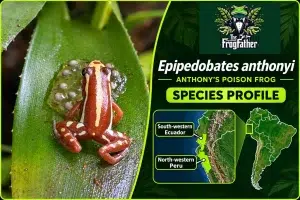
Epipedobates anthonyi: Complete Care, Natural History and Breeding Guide
By The Frogfather Quick verdict: Anthony’s poison frog is a small, active and prolific species from western Ecuador and north-western Peru. Its visible behaviour, male

The Frogfather species selector
Colour is only the beginning. Compare adult size, usable vivarium space, visibility, activity, calling volume, feeding demands and social behaviour before choosing a species. A frog that looks perfect in a photograph may be too noisy for a bedroom, too quick for a first thumbnail enclosure or unsuitable for communal housing.
Start with Oyapock, Bumblebee, Lorenzo or Splashback. They are generally easier to observe than many thumbnail frogs, although generous cover still improves confidence.
Consider a compatible Dendrobates tinctorius pair. Avoid choosing Anthony’s poison frog or Bumblebee dart frogs if frequent or carrying calls would cause a problem.
Intermedius and Borja Ridge offer fascinating vertical behaviour, but require minute live food, escape-proof construction and closer monitoring than a larger Dendrobates.
| Species or form | Adult size | Practical starting vivarium | Social guidance | Settling-in confidence | Visibility | Activity | Escape speed/risk | Calling | Feeding | Difficulty |
|---|---|---|---|---|---|---|---|---|---|---|
| Adelphobates galactonotus Splashback |
35–42 mm | 60 × 45 × 45 cm+ for a compatible pair | Pair preferred Groups need substantially more space and active monitoring. |
Moderate; usually confident once secure | Bold | High, mainly terrestrial | Moderate | Moderate | Melanogaster, suitable hydei and other cultured feeders | 3/5 |
| Dendrobates auratus Highland Bronze |
30–42 mm | 45 × 45 × 45 cm+ for a pair | Pair or cautious group Compatibility can change at maturity. |
Moderate; dense cover helps reserved animals | Moderate to shy | Moderate, terrestrial | Moderate | Moderate | Melanogaster, suitable hydei and microfeeders | 2/5 |
| Dendrobates leucomelas Bumblebee |
30–38 mm | 45 × 45 × 45 cm+; extra height is useful | Pair or cautious group Monitor females, feeding access and calling sites. |
Usually quick to moderate | Usually visible | High; terrestrial and a strong climber | Moderate to fast | Loud, carrying call | Melanogaster, suitable hydei and varied cultured prey | 2/5 |
| Dendrobates tinctorius ‘Lorenzo’ |
35–50 mm | 45 × 45 × 45 cm minimum; 45 × 45 × 60 cm preferred | Single or compatible pair Not a dependable communal frog. |
Moderate | Usually bold | Moderate, mainly terrestrial | Moderate | Quiet to moderate | Melanogaster, suitable hydei and other cultured feeders | 3/5 |
| Epipedobates anthonyi Anthony’s poison frog |
Approximately 19–27 mm | 45 × 45 × 45 cm+ for a pair or small monitored group | Pair or monitored small group Plan for high reproductive output. |
Often quick once settled | Active and visible | Very high | Fast | Frequent and conspicuous | Melanogaster, springtails and small cultured prey | 2.5/5 |
| Ranitomeya imitator ‘Intermedius’ |
17–22 mm | 45 × 45 × 60 cm+ for an established pair | Bonded pair preferred Strongly pair-oriented social biology. |
Moderate; needs dense vertical cover | Moderate | High, scansorial/arboreal | Very fast; high escape risk | Moderate | Melanogaster, springtails and minute prey | 3/5 |
| Dendrobates tinctorius ‘Oyapock’ |
Approximately 35–50 mm | 45 × 45 × 45 cm minimum; 45 × 45 × 60 cm preferred | Single or compatible pair Mature females can be strongly territorial. |
Quick to moderate | Usually bold | Moderate to high | Moderate | Quiet to moderate | Melanogaster, suitable hydei and varied cultured prey | 2/5 |
| Ranitomeya variabilis ‘Borja Ridge’ |
Usually under 21 mm | 45 × 45 × 60 cm+ for a pair; 60 × 45 × 60 cm+ for a small group | Pair simplest; cautious group possible Every frog must be monitored. |
Moderate | Moderate | High, semi-arboreal | Very fast; high escape risk | Quiet to moderate | Melanogaster, springtails and minute prey | 3/5 |
No species currently match all four filters. Relax one filter to see more options.
The score considers food size, escape risk, environmental sensitivity, social management, breeding biology and the ease of monitoring individual condition. It is not a judgement of how valuable or interesting a species is.
Poison-frog social behaviour is not captured by a simple yes-or-no label. A juvenile group may appear stable and then change after sexual maturity. Sex ratio, breeding condition, feeding access, visual barriers and individual temperament all influence compatibility. A species listed as “groups sometimes possible” still requires daily observation and suitable separation accommodation.
Dendrobates tinctorius forms such as Lorenzo and Oyapock should normally be kept singly or as one compatible male–female pair. Ranitomeya imitator is strongly pair-oriented. Highland Bronze, leucomelas, Borja Ridge and anthonyi may sometimes be maintained in compatible groups, but none should be stocked according to a universal frogs-per-litre formula.
Large terrestrial species need meaningful floor space and sight breaks. Thumbnail frogs need secure vertical structure, minute food and exceptional attention to escape gaps. A taller enclosure is not automatically larger in the way that matters to the frog. Start with the species profile, then design the enclosure around its movement, feeding and social behaviour.
New keepers should also read the complete dart frog care hub, the feeding guide and the pre-frog vivarium checklist.
For a prepared keeper, Bumblebee dart frogs, Highland Bronze auratus and Oyapock tinctorius are among the more approachable options in this comparison. The best choice still depends on enclosure size, noise tolerance, desired visibility and whether the keeper can maintain reliable live-food cultures.
Oyapock, Lorenzo, Bumblebee and Splashback are usually among the bolder display frogs. Dense planting and retreats often increase visibility because frogs move more confidently when they can reach cover quickly.
Many tinctorius calls are relatively unobtrusive compared with the carrying call of leucomelas or the frequent calling of Epipedobates anthonyi. Individual males, room acoustics and breeding condition still affect how noticeable calling becomes.
Some species can sometimes live in compatible groups, but no species should be treated as automatically communal. Tinctorius forms are generally best kept singly or as a compatible pair, while every attempted group requires visual barriers, several feeding sites and immediate access to separation accommodation.
No. Thumbnail frogs need very small food, escape-proof construction and complex vertical habitat. Their size also makes individual body condition and feeding access more difficult to monitor.

By The Frogfather Quick verdict: Anthony’s poison frog is a small, active and prolific species from western Ecuador and north-western Peru. Its visible behaviour, male
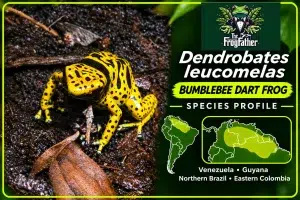
By The Frogfather Quick verdict: The Bumblebee dart frog is conspicuous, strongly patterned and comparatively adaptable within safe dart-frog conditions. It is among the better

By The Frogfather Quick verdict: Highland Bronze is a captive-kept form of the highly variable green-and-black poison frog. It combines standard D. auratus husbandry with
By The Frogfather Quick verdict: Ranitomeya imitator ‘Intermedius’ is one of the more achievable thumbnail poison frogs for a properly prepared keeper, but it should
By The Frogfather Quick verdict: Oyapock is a locality form of the dyeing poison frog, Dendrobates tinctorius. It is bold, comparatively substantial and usually straightforward
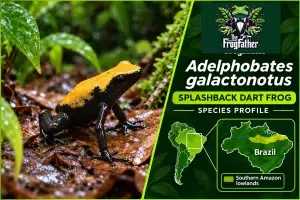
By The Frogfather Quick verdict: The Splashback is a substantial, terrestrial Brazilian poison frog available in several striking colour forms. Captive-bred animals can be confident,
By The Frogfather Quick verdict: Borja Ridge is a Peruvian locality form of Ranitomeya variabilis. It is a beautiful, active thumbnail suited to a prepared
Husbandry & Evidence Review – 6 September 2026 This article has been checked against Frogfather’s current evidence-led husbandry guidance. Specific older statements have been corrected
Vivid orange, metallic blue, and utterly fantastic! 🌿🐸
Meet Ranitomeya fantastica — one of the most beautiful and charismatic thumbnail dart frogs. Curious, confident, and a real showpiece for any bioactive vivarium. Occasionally available from UK breeders through Frogfather.
#ranitomeyafantastica #fantasticdartfrog #poisonfrogs #dartfrogforSale #frogfatheruk #bioactivevivarium #tropicalfrogs #bromeliadfrog #ukreptiles #rainforestvivarium #exoticfrogs #herplife
The fiery red and blue beauty — Ameerega bassleri! Larger, louder, and incredibly active, these frogs bring rainforest energy to your vivarium. Perfect for those who love confident frogs that thrive on the forest floor. 🐸🌿
Occasionally available in the UK — always captive-bred and responsibly sourced by Frogfather.
#ameeregabassleri #poisonfrog #dartfrogforSale #frogfatheruk #bioactivevivarium #tropicalfrogs #ukreptiles #rainforesttank #exoticfrogs #amphibiansofinstagram #froglife #herplife #peruvianfrogs
We’d hate for you to miss out — so here’s a little thank you for shopping with us.
💚 Use code EXIT10 at checkout to save 10% on your order today.
Valid for the next 15 minutes only.