
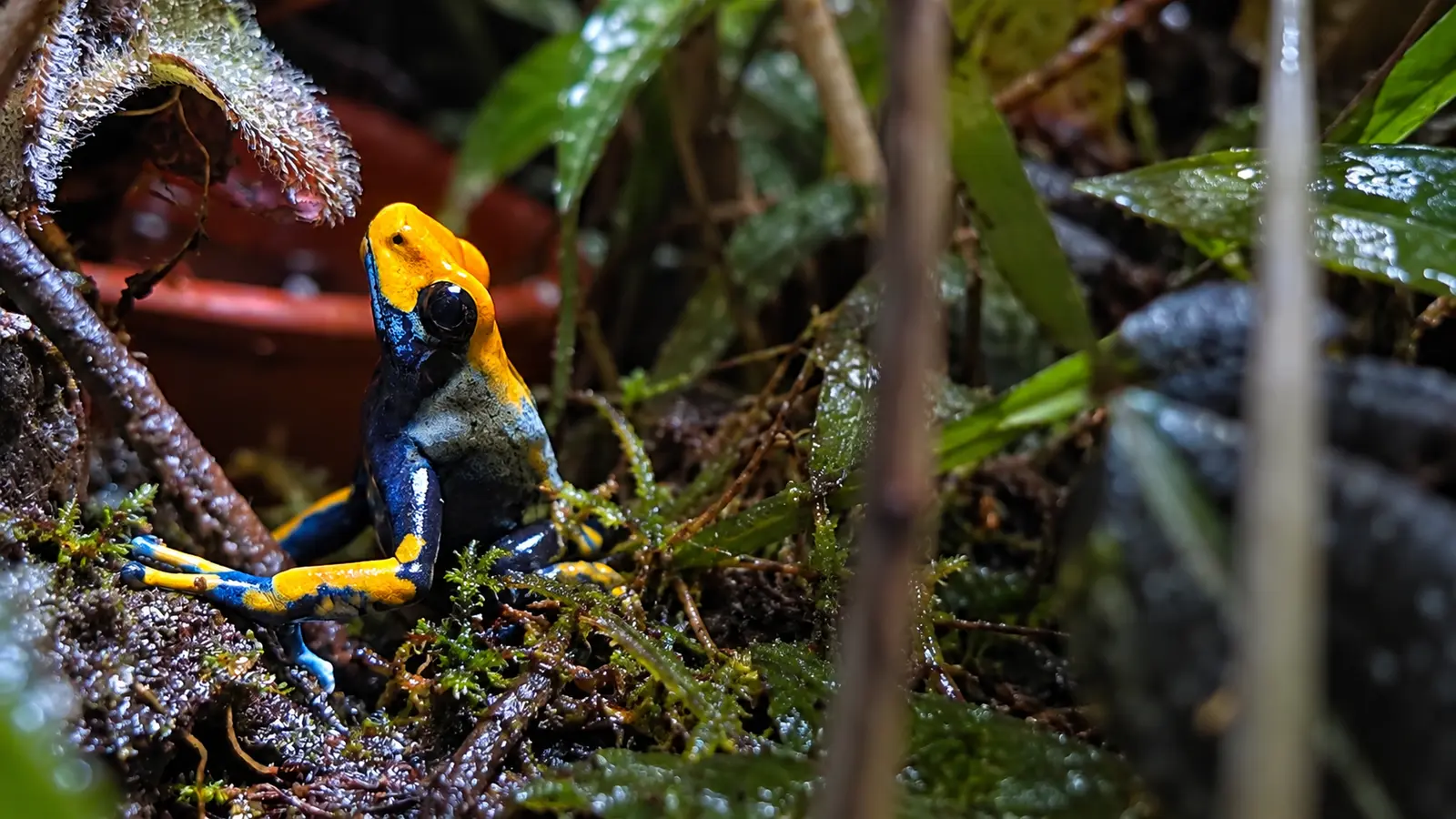
Drop a few fruit flies into a dart frog vivarium and the change can be immediate. A frog that appeared to be resting turns its head, lowers its body and becomes intensely focused. It may creep forward, reposition one foot at a time and rapidly tap the toes of a back foot. Then comes the strike: a short lunge, a tongue movement that is almost too fast to see, and a swallow.
It is tempting to describe the whole event as “the frog catches flies with its sticky tongue”. That is true, but it misses most of the behaviour. Successful hunting begins before the tongue moves and continues after the prey enters the mouth.
A dart frog must detect a tiny animal against a complicated background, decide whether it is suitable food, orient towards it, judge position and distance, approach without losing it, launch a strike, secure the prey and swallow it. The details vary with species, individual, prey and surface, but the sequence is far more sophisticated than a simple reflex.
Quick answer
Dart frogs hunt mainly by watching for small moving prey. After detecting a fruit fly, springtail or other suitable invertebrate, a frog normally turns towards it, approaches or waits, then captures it with a rapid tongue-and-body strike. A soft tongue and specialised saliva help the prey adhere. Some dart frogs tap their hind toes while hunting; experiments suggest the resulting vibration may cause stationary prey to move and become easier to detect.
After capture, the frog may use its jaws, front feet, mouth-wiping movements and eye retraction to position and swallow the prey. Not every attempt succeeds, and occasional missed strikes are normal.
The complete dart frog hunting sequence
A useful way to understand hunting is to divide it into stages. Not every frog performs every stage visibly, and several can happen almost at once.
- Detection: the frog notices a potentially edible moving object.
- Orientation: it turns its head and body to bring the prey into a useful part of the visual field.
- Assessment: it appears to evaluate position, movement, size and accessibility.
- Approach or ambush: it creeps closer, hops into position or waits for the prey to come within range.
- Pre-strike behaviour: the frog may lower its body, adjust its feet and, in some species, tap its hind toes.
- Capture: tongue projection, a forward body movement and jaw closure combine in a rapid strike.
- Manipulation: prey may be repositioned with the mouth, tongue or forelimbs.
- Swallowing: the frog swallows the prey whole, sometimes retracting its eyes as part of the process.
This sequence explains why feeding problems cannot be diagnosed from the final tongue movement alone. A frog can fail because it did not detect the prey, could not approach it, misjudged the strike, failed to retain it or could not manipulate and swallow it comfortably.
How do dart frogs detect prey?
Vision is central to ordinary dart frog hunting. Frogs are famously responsive to small moving objects, and decades of work on anuran visual systems show that movement, edge information, size, position and speed can all contribute to prey-directed behaviour.
That does not mean a frog sees the world as a simple motion detector or attacks everything that moves. A feeding decision combines several properties. A moving object may be ignored because it is too large, too far away, visually obstructed, moving unnaturally or associated with disturbance. Conversely, an appropriately sized fruit fly walking across a contrasting leaf may trigger an immediate approach.
Dart frogs are active during the day, and their bright, visually complex environment makes visual tracking particularly useful. They often pause with the head aimed towards prey before moving. Those short pauses are not necessarily hesitation or poor appetite; they may be part of locating the prey precisely and choosing a workable route.
Other sensory information may contribute to foraging, but it would be too strong to claim that captive dart frogs locate every meal by smell or vibration. The visible, repeatable relationship between moving live prey and directed hunting makes vision the clearest practical starting point.
Why prey movement matters
Live prey does two jobs. It provides food, and its movement provides the stimulus that reveals where the food is.
A fruit fly walking over a leaf produces a changing visual target. A springtail that jumps suddenly becomes conspicuous for a moment. A tiny arthropod remaining still among soil particles, moss and decaying leaves can be remarkably difficult to distinguish.
This helps explain why captive dart frogs are normally offered live feeders rather than a dish of immobile prepared food. It is not merely tradition. Movement activates normal prey-tracking and capture behaviour.
It also explains why the feeding surface matters. A pale fly on a dark leaf may be detected more readily than the same fly among pale supplement powder. A feeder disappearing into deep moss, drainage gaps or dense substrate is still present, but may no longer be available to the frog that was tracking it.
For the wider question of what to offer and how frequently, use the complete Dart Frog Feeding Guide. Hunting mechanics cannot compensate for unsuitable food or an inconsistent supplementation system.
Orienting, stalking and judging distance
Dart frogs do not always fire the tongue from the place where they first notice prey. They commonly turn, creep, make a short hop or wait for the target to enter a more useful position.
The approach can look almost cat-like in miniature. The body becomes low and still; one foot moves; the frog pauses; the head adjusts. A confident frog may close the distance directly, while a smaller or newly settled animal may hunt from cover.
Prey size, shape and speed change the decision. A slow Drosophila melanogaster on a flat leaf presents a different capture problem from a larger D. hydei climbing glass or a springtail jumping unpredictably through litter. The frog must position itself so that the expected reward justifies the strike.
Feeder suitability should therefore be judged by behaviour, not only a measurement on a packet. The Dart Frog Feeder Size Guide explains how prey width, hardness, speed and life stage affect whether a frog can handle it cleanly.
Why do some dart frogs tap their toes before striking?
Rapid movement of one or more hind toes is one of the most striking parts of dart frog hunting. It may begin while a frog watches prey and change as the prey moves or becomes accessible.
Experimental work with Dendrobates auratus supports an association between toe tapping and prey detection. More recent work with Dendrobates tinctorius found that tapping changed with prey accessibility, substrate and social context. The researchers proposed that vibrations may encourage otherwise stationary prey to move, making it easier for the frog to detect and capture.
The careful wording is important: tapping may provoke useful prey movement. The evidence does not establish that every tap by every dart frog has one universal function.
Normal feeding-related tapping is controlled and context-specific. The frog remains balanced and visually focused. A continuing tremor, whole-limb twitch, weakness or loss of coordination is different and should not be dismissed as hunting behaviour. The distinction is covered fully in Why Do Dart Frogs Tap Their Toes?
How does a frog’s tongue capture prey?
The familiar phrase “sticky tongue” understates the mechanism. Research across frogs shows that capture depends on the interaction between tongue softness, movement and saliva.
In a well-studied anuran system, the tongue was extremely soft and viscoelastic, allowing it to deform around the prey rather than contacting only one smooth point. The saliva behaved as a non-Newtonian fluid: its physical behaviour changed under force. During impact it could spread into surface irregularities, then resist separation as the tongue retracted.
This is excellent evidence for how specialised frog prey capture can be, but it should not be converted into a dart-frog-specific measurement that has never been taken. We cannot responsibly claim that every dart frog species produces identical forces, reaches identical tongue speeds or uses saliva with precisely the same measured properties. The broader mechanism provides a biologically reasonable explanation; the exact performance varies with anatomy and species.
Nor is the tongue working alone. The body may surge forward, the mouth opens, the tongue contacts the target and the jaws close in a coordinated action. At normal speed the sequence may look like a single peck.
What happens after the prey enters the mouth?
Capture is not the end of feeding. A prey item may need to be retained, repositioned and moved towards the oesophagus.
Dart frogs can make repeated mouth movements and use their front limbs around the head or lips. One controlled sweep after a strike may simply be part of prey manipulation or clearing material from the mouth. Persistent rubbing, repeated gagging or an inability to swallow is a different pattern. See Why Do Dart Frogs Wipe Their Mouths After Eating?
Many frogs also close and retract the eyes during swallowing. Experimental work in leopard frogs found that eye retraction can contribute to moving prey backwards during swallowing. That does not mean frogs literally use eyeballs as teeth, but it confirms that the visible downward eye movement is more than a cartoon-like expression. Read the dedicated guide: Do Dart Frogs Swallow With Their Eyes?
Dart frogs swallow prey whole. They do not chew a fruit fly into smaller pieces. This is why correctly sized feeders matter even when the frog is willing to attack something larger.
Why hunting looks different between species and individuals
There is no single number of steps, strikes or taps that defines a healthy dart frog.
| Variable | How it may change hunting |
|---|---|
| Species and adult size | Influence prey size, preferred vivarium level, strike distance and the surfaces used for foraging. |
| Age | Froglets usually take smaller prey and may need higher local prey density while developing coordination. |
| Individual experience | A settled frog may approach a familiar feeder or feeding area more rapidly than a newly arrived animal. |
| Body condition and breeding state | Appetite and persistence can change with growth, reproduction and recent intake. |
| Social environment | Another frog can create competition, displacement or altered tapping and approach behaviour. |
| Prey type | Speed, size, jumping ability and visibility change the capture problem. |
| Surface | Leaf, cork, glass, moss and loose litter provide different traction, contrast and vibration transmission. |
A bold Dendrobates tinctorius crossing an open feeding area for D. hydei may look very different from a small Ranitomeya picking springtails from a bromeliad. Both can be normal.
How the vivarium changes hunting success
A well-designed vivarium should allow natural foraging without making every meal impossible to monitor.
Leaf litter, broad leaves, cork and planted structure provide useful hunting surfaces. Cover can improve confidence because the frog can retreat quickly. Counter-intuitively, a frog with secure cover may spend more time visibly hunting than one displayed in a bare enclosure.
Feeding in several accessible locations can reduce competition. This matters in groups, where one confident animal may intercept most of the flies before a quieter frog feeds. Observe individuals rather than assuming that flies entering the enclosure means every frog has eaten.
A feeding ledge or leaf can make observation easier, but it should not become the only place prey ever appears. Distributing a sensible quantity encourages searching and movement while avoiding a mass of uneaten flies wandering for days.
Lighting also matters. Dart frogs need enough usable light to navigate and detect prey, while still having shade and cover. Harsh reflections, a dark enclosure or a feeder moving behind dirty glass can make an apparently simple strike more difficult.
Normal missed strikes versus a warning sign
Healthy frogs miss. Prey changes direction, a tongue contacts the surface beside it or the fly escapes at the final moment. One failed strike does not diagnose blindness, vitamin A deficiency, neurological disease or “short tongue syndrome”.
| Usually less concerning | Worth investigating promptly |
|---|---|
| An occasional miss followed by successful feeding | Repeated failure to catch appropriately sized prey |
| Difficulty with a particularly fast or large feeder | A clear decline from the frog’s previous ability |
| A strike obstructed by leaf litter or glass | Tongue repeatedly failing to extend normally |
| One prey item dropped, then another swallowed | Repeated capture followed by dropping or inability to swallow |
| Normal posture, balance and body condition | Weight loss, weakness, tremor, poor balance or abnormal posture |
| One frog temporarily displaced during a busy feed | Persistent exclusion from food by another frog |
If misses become a pattern, simplify the observation. Offer a proven, smaller feeder on a clear accessible surface and record what happens. Is the frog detecting the prey? Does it orient accurately? Does the tongue reach it? Does the frog secure it and then drop it? Can it swallow?
Those distinctions are more useful than the statement “it cannot eat”. The dedicated guide Why Does My Dart Frog Keep Missing Its Food? provides a step-by-step troubleshooting process and explains when veterinary assessment is appropriate.
A practical way to observe hunting
- Use appropriate prey. Choose a feeder the frog has previously eaten or one comfortably suited to its size.
- Watch one frog. In a group, following the first visible animal can hide the fact that another never feeds.
- Record the surface. Note whether prey is on a leaf, glass, cork, moss or loose litter.
- Separate detection from capture. Does the frog notice and track the prey before it strikes?
- Watch the whole sequence. Note orientation, approach, toe movement, strike, retention and swallowing.
- Compare over time. A consistent individual style is more reassuring than a sudden loss of an established ability.
A short slow-motion phone video can reveal details that disappear at normal speed. It can show whether the tongue misses the prey, whether the fly escapes before contact or whether capture occurs but swallowing fails. Video is also useful evidence for an amphibian-experienced veterinary professional if the behaviour becomes concerning.
The Frogfather verdict
Dart frog hunting is a coordinated sensory and mechanical sequence. The frog detects movement, chooses a position, approaches or waits, may tap its toes, launches a tongue-and-body strike, retains the prey and swallows it whole.
The behaviour is flexible rather than machine-perfect. Species, individual, age, prey and vivarium design all change what the sequence looks like. Occasional misses are normal. What matters is whether the frog can repeatedly detect, capture and swallow suitable prey while maintaining normal body condition and behaviour.
Watching the complete sequence turns feeding from a routine job into one of the best daily welfare checks available. It also reveals just how much is happening in the fraction of a second between a fruit fly moving and a frog swallowing.
Evidence and scope notes
Direct experimental evidence is strongest for particular components rather than one complete dart-frog hunting model. The toe-tapping findings cited here involve Dendrobates auratus and Dendrobates tinctorius. The tongue-material research examined broader frog prey-capture mechanics, while the experimental eye-retraction work used the northern leopard frog. These studies illuminate plausible and widely shared anuran mechanisms, but measurements from one species should not be presented as exact values for every dart frog.
- Noel et al. (2017): frog tongue and saliva mechanics
- Schulte and König (2023): toe tapping and prey detection in D. auratus
- Parrish et al. (2024): posterior toe tapping and feeding in D. tinctorius
- Levine et al. (2004): eye retraction and swallowing in frogs
Frequently asked questions
How do dart frogs find their food?
Dart frogs mainly locate suitable live prey visually, particularly by detecting movement. They turn towards the prey, track it and move or wait until it is within striking range. Other sensory information may contribute, but moving prey is the clearest trigger seen during routine captive feeding.
Do dart frogs catch insects with their tongues?
Yes. Dart frogs use a rapid tongue-and-body strike to capture small prey. Research across frogs shows that a soft tongue and specialised saliva help the prey adhere, although exact performance has not been measured identically in every dart frog species.
Why do dart frogs tap their toes when hunting?
Experimental studies in Dendrobates auratus and Dendrobates tinctorius link hind-toe tapping with feeding. The vibrations may cause stationary prey to move, making it easier to detect, but researchers have not established one universal function for every tap in every species.
Do dart frogs stalk their prey?
Yes. A dart frog may turn, lower its body, creep forward, pause or make a short repositioning hop before striking. Other times it remains still and waits for the prey to enter range. The approach depends on the frog, prey and surface.
Why does my dart frog miss fruit flies?
Occasional misses are normal because live prey changes direction and moves across difficult surfaces. Repeated misses can also involve unsuitable prey size, poor visibility, stress, competition, oral difficulty, weakness or another health problem and should be assessed as a pattern.
Do dart frogs chew their food?
No. Dart frogs swallow suitably sized prey whole. They may reposition it with mouth movements, the tongue or front feet before swallowing, but they do not chew it into smaller pieces.
Do dart frogs use their eyes to swallow?
Dart frogs can close and retract their eyes during swallowing. Experimental work in another frog species shows that eye retraction can help move prey backwards, although the eyes are only one part of a coordinated swallowing process.
Can a vivarium make hunting more difficult?
Yes. Poor lighting, reflections, inaccessible prey, unsuitable feeding surfaces, oversized feeders and competition can all reduce hunting success. A structured vivarium should combine cover with accessible surfaces where each frog can detect and capture food.
This article provides general husbandry information and is not a diagnosis. Persistent feeding failure, weight loss, weakness, abnormal coordination or difficulty swallowing requires prompt assessment, including advice from an amphibian-experienced veterinary surgeon where appropriate.


