Written by The Frogfather | UK dart frog keeper, breeder and bioactive vivarium specialist | Last reviewed: 28 September 2026
Look closely at a dart frog and you will not see ears shaped like ours. There are no projecting pinnae, no furry openings and no obvious structure that looks capable of listening. Yet a male can call from among dense plants and another frog may turn, approach, reply, court or defend a territory.
That creates an obvious question: if dart frogs have no visible outer ears, how do they hear?
The short answer is that they do have auditory systems. Sound can act on a tympanic membrane at the side of the head, pass through the middle ear and stimulate specialised sensory organs in the inner ear. The exact anatomy and performance vary among frog species, but the absence of an ear flap does not mean the absence of hearing.
For keepers, the more useful question is not simply whether a frog can hear. It is what that hearing is for, how it differs from human hearing, and whether speakers, tapping, doors, pumps or other vibration around a vivarium may affect behaviour.
Quick answer
Yes, dart frogs can hear, although they do not have projecting external ears like humans. In many frogs, a tympanic membrane at or near the surface of the head receives airborne sound. Vibrations are transferred through the middle ear to sensory structures in the inner ear, where they are converted into nerve signals.
Dart-frog hearing is particularly important for acoustic communication. Calls help with mate attraction, courtship, species recognition and territorial interactions. Frogs can also respond to vibration and disturbance, but science does not provide one universal “safe decibel” number for every dart frog, enclosure and type of sound.
Where are a dart frog’s ears?
Humans use the word “ear” for several structures at once. The visible outer flap is only the beginning of our auditory system. Frogs generally lack that projecting flap, but many retain an eardrum, a middle-ear pathway and an inner ear.
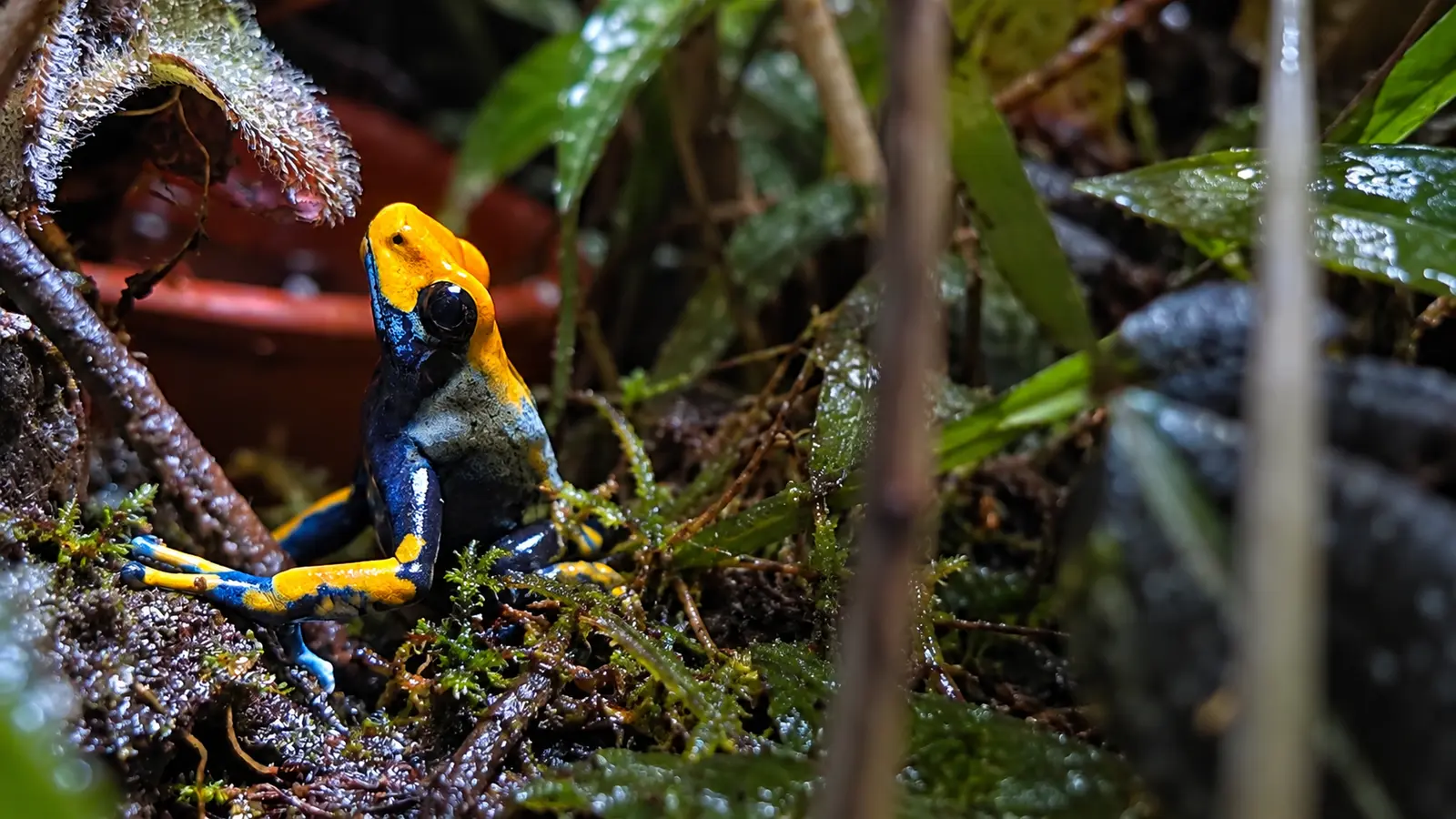
The eardrum is called the tympanic membrane or tympanum. In a textbook frog it appears as a round disc just behind the eye. On a small, patterned dart frog it may be much less obvious. Colour, skin texture, size and lighting can make it blend into the side of the head, so a keeper may be looking directly at the auditory area without recognising it.
“I cannot see an ear” is therefore not evidence that a dart frog cannot hear. Nor should a keeper expect every species to display one identical, sharply outlined external disc. Anuran ears have a complex evolutionary history, and some frogs have reduced or lost parts of the conventional tympanic middle ear while retaining an inner ear and alternative routes by which vibration can reach it.
That variation matters when we generalise. The familiar diagram of a frog ear is a useful starting point, not a promise that every dendrobatid has exactly the same visible anatomy or sensitivity.
How does frog hearing work?
Airborne sound consists of pressure changes. When those pressure changes reach a receptive surface, they can make it vibrate. In a frog with a functional tympanic pathway, the broad sequence is:
- Airborne sound reaches the head. Calls and other sounds create pressure fluctuations around the frog.
- The tympanic membrane moves. The membrane responds to sound within the range that the ear can transmit effectively.
- The middle ear transfers the movement. A small skeletal element commonly called the columella or stapes carries mechanical energy towards the inner ear.
- Fluid and sensory structures move. Mechanical energy entering the inner ear stimulates specialised receptor cells.
- Nerves carry information to the brain. The resulting signals can be processed as biologically meaningful acoustic information.
This is not a miniature human ear. Frog heads are small, their two middle ears are internally coupled, and their mouth cavity, lungs and body tissues can influence how sound reaches the auditory system. The result is a pressure-receiver system with properties very different from two independently sealed human ears.
The important practical point is that hearing depends on an entire pathway. A visible tympanum is not doing the “understanding” by itself; it is one mechanical stage in a system extending to the brain.
The amphibian papilla and basilar papilla
Within the frog inner ear are sensory regions specialised for different parts of the acoustic world. Two names regularly appear in research on airborne hearing:
- The amphibian papilla is generally associated with sensitivity to lower and middle frequencies, although exact ranges vary among species.
- The basilar papilla is generally associated with a higher-frequency region and can be important for detecting dominant components of species calls.
A field experiment involving the dart-poison frog then known as Epipedobates femoralis—now usually Allobates femoralis—tested how territorial males responded to natural and modified calls presented with masking noise. The males approached playback of calls, a behaviour known as phonotaxis. The results indicated that activation of the basilar papilla supported this response.
That experiment gives us something more substantial than the statement “frogs probably hear”. It demonstrates a behavioural response to acoustic playback in a dendrobatid-lineage frog and links the response to a region of the inner ear.
It does not give every captive dart frog the same hearing range. Call structure, body size, anatomy and ecology differ across Dendrobates, Ranitomeya, Oophaga, Epipedobates, Phyllobates and related genera. Species-specific evidence should not be converted into one precise chart for the whole hobby.
Why is hearing important to dart frogs?
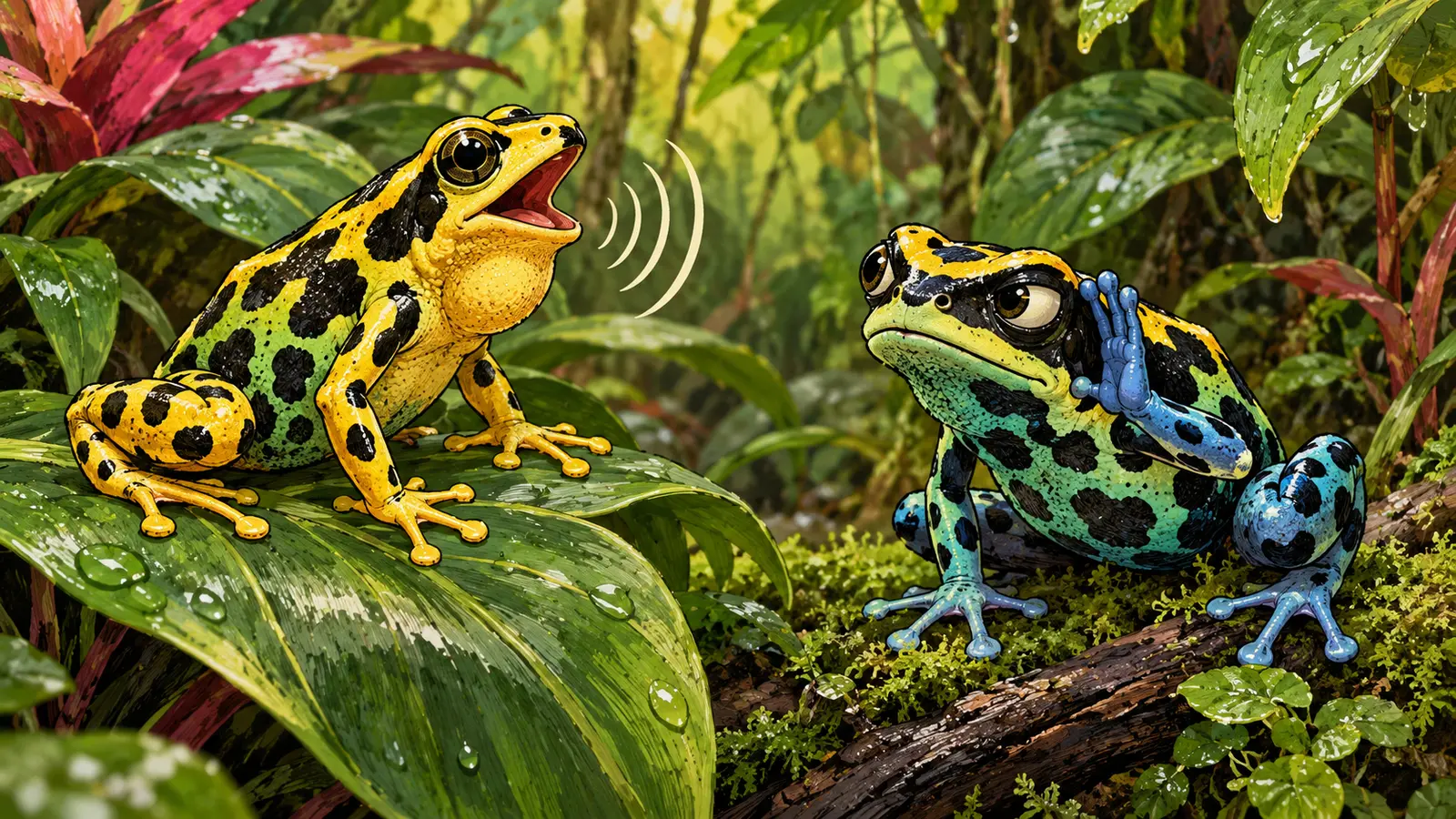
For many frogs, sound is central to reproduction and social organisation. Male calls may advertise identity, location and reproductive availability. They can also be involved in courtship or territorial encounters.
A receiver does not merely need to notice that “a noise happened”. It must extract useful information from a biologically and acoustically busy environment. A rainforest contains insects, rain, running water, wind, other frog species and echoes from vegetation. Sensitivity that overlaps with important features of a conspecific call helps a frog find the signal within that background.
Experiments using playback show that poison frogs can respond selectively to call properties and move towards a source. Calls need not sound impressive to human ears to be effective. Some dart frogs produce quiet buzzing, ticking, trilling or chirping calls that are easy to miss in a room but entirely relevant at frog scale.
Temperature, species, individual condition, breeding state and social setting can all change calling behaviour. The Frogfather guide to dart frog calls and vocalisations covers what different calls sound like and why males call.
How can a small frog tell where a call comes from?
Sound localisation is a difficult engineering problem for a small head. In humans, differences in arrival time and sound level between two separated ears provide useful directional information. A dart frog’s ears sit very close together, so those external differences are smaller.
Frogs partly solve the problem through internal coupling. The two tympana do not behave as completely isolated membranes. Sound can reach a tympanum from its outer surface and through internal pathways involving the opposite ear and mouth cavity. The interaction changes vibration according to the direction and frequency of the incoming sound.
The lungs may also affect the response of the middle ears. Research in green treefrogs found that lung-to-ear transmission could reduce the tympanic response to frequencies lying between important call components, improving acoustic contrast against interfering sound. That does not mean a frog “hears through its lungs” in exactly the same way it hears through a tympanum. It means the connected respiratory and auditory anatomy can alter the mechanical input reaching the ears.
After initial detection, a frog can turn, compare changing input and move again. Direction finding is therefore an active process. A male approaching playback does not need to calculate the caller’s position in one instant; repeated listening and movement can refine the route.
Can dart frogs detect vibration as well as sound?
Sound and vibration are related mechanical phenomena, but keepers should not use the terms as though they were identical.
Airborne sound travels through the air as pressure changes. A call from another frog or sound from a speaker is primarily airborne at the source.
Substrate-borne vibration travels through a solid structure. A door slamming, a pump touching glass, fingers tapping an enclosure or footsteps moving through a flexible floor can send mechanical energy through the vivarium stand and enclosure.
The inner ear also participates in balance and in sensing mechanical movement. Frogs can respond to substrate vibration, but the behavioural meaning depends on frequency, amplitude, repetition, context and the route through which it arrives. A brief vibration may prompt freezing or retreat. A predictable low-level equipment vibration may produce a different response. We should not claim that every detectable vibration is harmful, or that lack of a visible reaction proves it is irrelevant.
Captive dart frogs also generate vibrations themselves. Toe tapping during hunting can transmit energy through a surface and may encourage prey to move. That is a different context from a keeper knocking on the front glass. Read Why Do Dart Frogs Tap Their Toes? for the experimental evidence and the distinction between purposeful tapping and abnormal twitching.
Can dart frogs hear music, television or human voices?
A dart frog may detect parts of music, television audio and speech if those sounds contain frequencies and energy that reach its auditory system. That does not mean it experiences a song as a human listener does or understands a voice as language.
Human entertainment produces a broad mixture of frequencies, rhythms and amplitude changes. Loudspeakers also create physical vibration, particularly at lower frequencies. The vivarium may therefore receive both airborne sound and structure-borne energy from the cabinet, wall or floor.
A frog that remains visible during ordinary household sound has not necessarily “learnt to enjoy television”. More cautiously, it may have habituated to a predictable stimulus that has not been followed by an immediate threat. A frog that hides when a bass speaker starts has not supplied a diagnosis of acoustic injury; it has shown a behavioural response worth respecting.
For a detailed discussion of rooms, speakers and household disturbance, see Can Loud Music, Television or Vibrations Stress Dart Frogs?
Does loud noise stress dart frogs?
Potentially—but “loud” is not a complete exposure description.
Sound level matters, but so do frequency, duration, predictability, repetition, distance, enclosure construction and vibration transmission. A short hand clap across a room is not the same exposure as a bass speaker mechanically coupled to the vivarium cabinet for several hours.
Scientific literature does not provide one universal safe decibel figure for all captive dart frogs. A number copied from human workplace guidance, aquarium advice or a study of another animal would create false precision. Phone sound-meter applications are also not reliable enough to turn a complex exposure into a medical threshold.
A sensible welfare approach is based on avoidance and observation:
- Do not place a vivarium directly on or beside a powerful speaker or subwoofer.
- Avoid tapping the glass to make frogs move for visitors or videos.
- Prevent pumps, fans and loose panels from transmitting avoidable rattling into the enclosure.
- Provide dense planting, leaf litter, hides and visual cover so frogs can choose sheltered positions.
- Watch for changes that coincide with a new or repeated source of disturbance.
Possible behavioural responses include sudden freezing, rapid retreat, prolonged hiding, interrupted calling or feeding, and repeated attempts to move away from the disturbed side. None is specific to noise. Temperature, handling, social pressure and ordinary daily variation can produce similar changes, so context matters.
Practical vivarium placement for normal household life
Dart frogs do not require a silent recording studio. A stable household location can work well. The aim is to avoid preventable extremes and give the animals control over exposure.
| Situation | Practical response |
|---|---|
| Television at ordinary room volume | Usually manage through sensible distance and observation; do not position the vivarium against the speaker. |
| Subwoofer or powerful bass speaker | Keep it off the same cabinet and preferably away from the vivarium wall or stand. |
| Door repeatedly slamming nearby | Adjust the closer, add a buffer or move the enclosure if vibration is transmitted through the structure. |
| Pump, fan or mister rattling | Isolate the component, tighten fittings and remove direct hard contact that amplifies vibration. |
| Children or visitors tapping glass | Prevent the tapping rather than waiting for the frogs to habituate. |
| Occasional vacuuming or normal conversation | Allow retreat options and look for recovery after the temporary disturbance. |
| Busy room with constant unpredictable activity | Use planting and opaque side cover, or choose a calmer position if normal feeding and calling remain disrupted. |
Enclosure design influences how secure a frog feels. A structurally rich vivarium with shaded routes, leaf litter and several retreat sites gives the animal more choices than a bare glass box. The wider guide to environmental enrichment and natural dart frog behaviour explains why choice is a practical welfare tool rather than decoration.
Can a dart frog be deaf?
Hearing ability can vary, and developmental abnormality, injury or disease could theoretically affect any part of an auditory pathway. However, a keeper cannot diagnose deafness because a frog fails to call, ignores a recording or does not react to household noise.
Females of many species do not produce the same advertisement calls as males. A male may stop calling because temperature, season, social context, health or breeding motivation has changed. A frog may hear a stimulus without displaying a response visible to us.
Playing calls is not a valid home hearing test. The recording device changes frequency balance and amplitude; the speaker changes them again; the room and glass add reflections; and the frog’s decision not to approach may have nothing to do with detection.
If a previously active frog shows a broad change—poor balance, abnormal head position, weakness, failure to feed, weight loss or loss of normal responses—the whole animal requires assessment. It is more useful to document the pattern and seek an amphibian-experienced veterinary professional than to label the problem “deafness”.
Similarly, silence is not proof of hearing loss. Use Why Your Dart Frogs Suddenly Stop Calling to work through the more common environmental, seasonal and social explanations.
A keeper’s observation checklist
If you suspect that a sound or vibration source is changing behaviour, treat the situation as a small observation exercise rather than testing the frog with progressively louder noise.
- Identify the source. Is it airborne sound, contact vibration or both?
- Record the timing. Note when the source begins, how long it lasts and whether the behaviour starts with it.
- Watch several behaviours. Feeding, calling, position, hiding and social interactions give more information than one startle response.
- Remove or isolate the source. Move the speaker, stop the rattle or add separation beneath the equipment.
- Keep other conditions stable. Avoid changing misting, temperature, lighting and group composition at the same time.
- Look for repeatability and recovery. A consistent response and improvement after removal are more informative than a single coincidence.
- Escalate broad health changes. Do not attribute weight loss, neurological signs or persistent anorexia to noise without veterinary assessment.
Dart frogs respond to their complete environment. Hearing is one channel among vision, touch, chemical cues, temperature, humidity and social information. Good observation respects that complexity.
The Frogfather verdict
Dart frogs have no projecting external ear flaps, but they are not earless in the everyday sense and they are not deaf. Airborne sound can move a tympanic and middle-ear system, specialised inner-ear organs detect relevant frequency regions, and the brain turns that input into behaviour.
Hearing is particularly important for communication. It allows frogs to detect, distinguish and locate calls involved in territory and reproduction. Their small heads and internally connected ears make the system different from ours, while the lungs, mouth cavity and body can influence acoustic transmission.
For keepers, there is no useful reason to chase an invented universal decibel limit. Keep vivariums away from speakers and repeated impact, prevent unnecessary rattling and glass tapping, provide retreat choices and watch for consistent changes in normal feeding, calling and activity.
The absence of a human-looking ear should never be mistaken for an animal living in silence.
Evidence and scope notes
Hearing anatomy and sensitivity vary substantially among frogs. The poison-frog playback work discussed here involved Allobates femoralis under its former name Epipedobates femoralis. Research on internally coupled ears and lung-to-ear transmission includes other anuran species. These studies explain mechanisms relevant to frog hearing, but they do not establish identical thresholds for every captive dart frog species.
- Hödl, Amézquita and Narins (2004): call frequency, auditory papillae and phonotaxis in a dart-poison frog
- Goutte et al. (2017): frog middle-ear anatomy, inner-ear sensitivity and exceptional auditory mismatch
- Boistel et al. (2013): how minute frogs hear without a conventional middle ear
- Lee et al. (2021): lung-mediated auditory contrast enhancement in frogs
Frequently asked questions
Do dart frogs have ears?
Yes. Dart frogs do not have projecting external ear flaps, but they possess an auditory system that can include a tympanic membrane, middle-ear structures and specialised sensory organs in the inner ear. The tympanum can be difficult to distinguish on a small, patterned frog.
Where is a dart frog’s eardrum?
The tympanic membrane is situated on the side of the head behind the eye. Its visibility differs among species and individuals, and it may blend into the surrounding skin rather than appearing as an obvious circular disc.
Can dart frogs hear people talking?
They may detect components of human speech that fall within a frequency and intensity range their auditory system can receive. That does not mean they understand speech or experience a human voice in the way another person does.
Can dart frogs hear music or television?
Dart frogs may detect parts of music and television audio, and speakers can also transmit vibration through furniture and floors. Ordinary household sound is different from placing an enclosure beside a loudspeaker or subwoofer, which should be avoided.
Do dart frogs communicate by sound?
Yes. Males of many dart frog species produce advertisement, courtship or territorial calls. Receivers can use acoustic features to recognise and locate relevant callers, although the exact call and response differ among species.
Can vibration stress a dart frog?
Strong, repeated or unpredictable vibration can cause disturbance and may alter hiding, feeding or calling. The effect depends on its source, frequency, duration and how it reaches the enclosure. Avoid glass tapping, rattling equipment and direct contact with powerful speakers.
Is there a safe decibel level for dart frogs?
There is no well-supported universal decibel limit covering every dart frog species, frequency, duration and enclosure. Sensible distance from speakers, physical isolation from vibration and observation of normal behaviour are more defensible than a single borrowed number.
How can I tell whether my dart frog is deaf?
You cannot reliably diagnose deafness from silence or a failure to react to recordings. Calling and approach behaviour depend on species, sex, season, temperature and social context. Broader changes involving balance, feeding, posture or health require assessment by an amphibian-experienced veterinary professional.