
A cloudy, swollen or red eye on a dart frog is a sign that something is wrong, but it rarely tells you what. It may be a local injury, an infection, or the visible tip of a wider problem such as poor water quality or a nutritional deficiency. Your job is to spot it early, record what you see, correct the husbandry basics and get an amphibian-experienced vet involved, because the right medicine and dose are a vet’s decision, not a keeper’s.
TL;DR
- Eye changes in frogs are often linked to disease elsewhere in the body, so treat them as a whole-frog problem, not just an eye problem.
- Do not put human or pet eye drops, ointments or antibiotics on a frog: small amphibians can be harmed by topical medicines at the wrong dose.
- Photograph the eye, check temperature, humidity, water and diet, and contact a vet who treats amphibians the same day if the frog is off its food, lethargic or the eye is bulging.
- Prevention is mostly boring and consistent: clean water, stable humidity, a clean enclosure, correct supplementation and quarantined new arrivals and live food.
Table of Contents
- What eye problems in frogs look like
- Why you cannot diagnose it from a photo
- Possible causes at a glance
- What to do when you spot an eye problem
- What the vet will look at
- Preventing eye problems in your vivarium
- A simple weekly routine
- Building a setup that supports healthy eyes
- Our view
- FAQ
- Sources
What eye problems in frogs look like
Keepers use “eye infection” for several different things. These are the changes people most often report:
- Cloudiness or a milky film over one or both eyes.
- Swelling or bulging around the eye, sometimes with raised white bumps.
- Redness in or around the eye, or small red spots.
- A closed, sunken or half-shut eye, or a frog that keeps rubbing at its face.
- Discharge or bubbles around the eye.
- An eye that looks different from the other side, in size, position or colour.
One thing to remember is that frogs are different from us. Their eyes sit in a very different arrangement from a mammal’s, and the 2022 chapter on amphibian ophthalmology stresses how much the eyes vary between amphibian species. Advice written for dogs, cats or people does not carry across.
Signs that need a vet quickly
Contact a vet who sees amphibians as soon as possible, the same day if you can, when the eye change comes with any of these:
- The frog has stopped eating, or is losing weight.
- It is lethargic, sitting out in the open, or not responding as normal.
- The eye is bulging, swollen or visibly damaged.
- Both eyes are affected, or other areas such as the legs or mouth show red patches.
- The change is spreading or getting worse over a day or two.
These points come from how amphibian eye disease behaves, covered below, not from a single rule, so use your judgement and err towards calling.
Why you cannot diagnose it from a photo
It is tempting to match your frog to a picture online and pick a cause. The research says that is unreliable. The review Ophthalmology of Exotic Pets notes that amphibian eye disease is sparsely documented and often tied to systemic disease, including bacterial septicaemia (bacteria in the bloodstream) that can cause changes to the cornea, the clear front of the eye, and to the inside of the eye.
Even for specialists, a cloudy cornea is hard to pin down. A 2016 study in the Archives of Veterinary Science on corneal oedema (fluid swelling of the cornea) said the field conditions meant it could not rule out other causes such as corneal lipidosis, a build-up of fat in the cornea. In plain terms: the same cloudy look can have different causes.
The Association of Reptilian and Amphibian Veterinarians (ARAV) 2011 proceedings link external eye disease with generalised bacterial infection, and say that culture and sensitivity testing should guide which antibacterial is chosen. That means growing the bacteria from a sample and checking which drugs work against them.
Possible causes at a glance
This table helps you describe what you see to a vet. It is not a diagnostic tool.
| What you notice | Possible explanations | What it tells you |
|---|---|---|
| Cloudy cornea, otherwise bright and eating | Injury, irritation, shedding-related changes, early infection | Watch closely, fix husbandry, photograph daily |
| Swelling or bulging around the eye, white raised bumps | Nutritional problems such as vitamin A deficiency, or infection | Needs veterinary input; check your supplement routine |
| Redness, spots, swelling plus lethargy | Possible systemic bacterial infection | Urgent veterinary attention |
| Eye damage after a fight or a collision | Trauma, with a risk of secondary infection | Separate if needed and call a vet |
| Weight loss, difficulty eating, eye changes | Deficiency or wider illness | Vet check, review diet and supplements |
Veterinary Partner’s 2017 article on amphibian vitamin A deficiency says it can cause swelling or bulging around the eyes and raised white bumps, and that difficulty eating and weight loss can be further clues. That is a good reason to look at feeding, not only at the eye.
What to do when you spot an eye problem
1. Look closely, without handling the frog
Handling stresses a frog and strips its protective skin mucus. Use good lighting and, if you have one, a phone camera zoomed in to take clear photos of both eyes from the front and the side. Compare the two sides. ARAV’s guidance for vets looks at symmetry, the position and size of the eye, eye colour, pupil size and the tissues around the eye, alongside behaviour, body condition and hydration. You can note the same things.
2. Check the whole enclosure
Write down the temperature range, humidity, when you last changed or topped up water, what the water source is, and what you have fed and supplemented over the past few weeks. Check for sharp edges, damaged decor, aggressive tank mates and anything that could have scratched or irritated the eye. Our dart frog health guide covers warning signs and when to see a vet, and is a good companion to this checklist.
3. Keep conditions steady, not dramatic
This is where keepers wreck things by fiddling. Do not suddenly change the lighting, heat, substrate and diet all at once in a panic. Keep the temperature and humidity stable, keep the enclosure clean, and remove uneaten food and dead insects. If you keep more than one frog and the affected one is being harassed or is not getting to food, ask your vet whether separating it makes sense.
4. Do not medicate it yourself
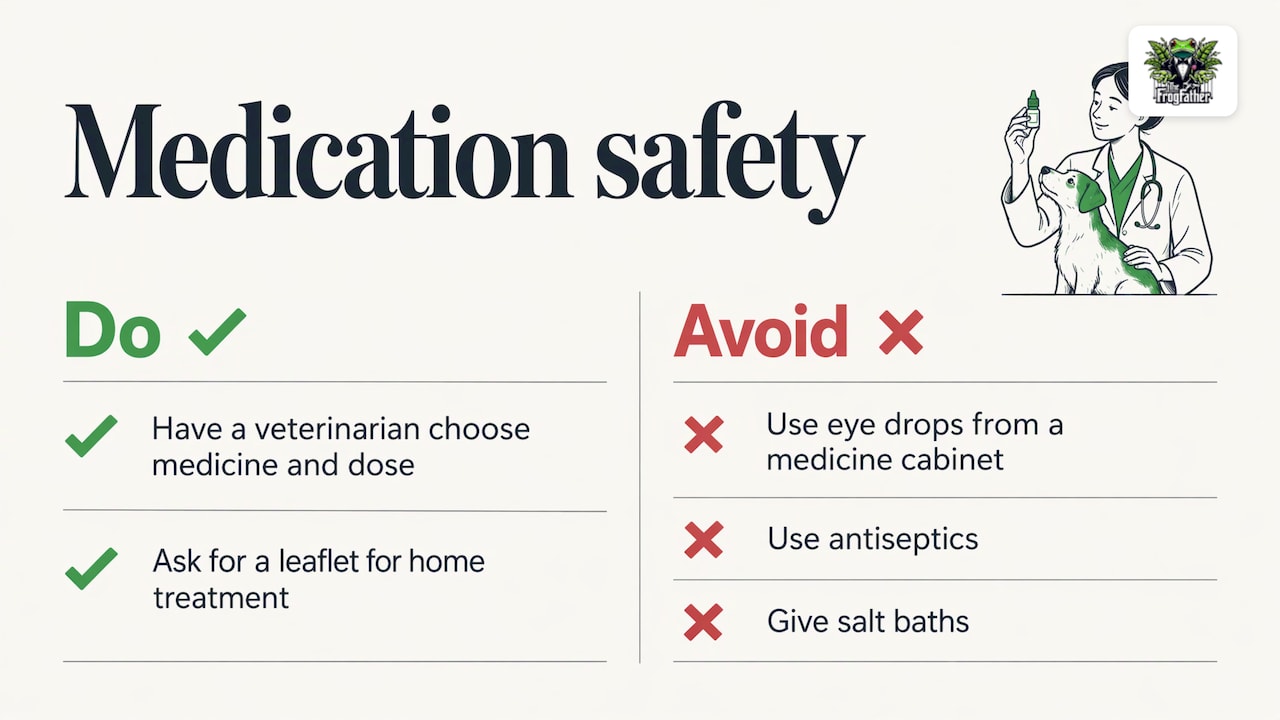
The 2009 review warns that because amphibians are so small, systemic toxicity from topical antibiotics is a real concern, so the medicine and the dose should be chosen by a veterinarian. Eye drops from a medicine cabinet, antiseptics and salt baths are not safe guesses. In the UK, the BSAVA Formulary, the reference vets use for dosing, has a 12th edition whose Part B covers amphibians and was reviewed and updated throughout 2025, so a vet has a current dosing source to work from. They also have client leaflets on giving medicines, including topical eye medication, so ask for one if you are given eye treatment to do at home.
5. Call a vet who treats amphibians
Not every practice sees frogs, so phone first and ask whether a vet there has amphibian experience, or ask for an exotics referral. Take your notes and photos with you. Give the vet your water source, supplement routine and the date you first saw the change.
What the vet will look at
Expect a hands-on, close examination. ARAV’s proceedings recommend magnification and good lighting, and describe a range of tools: fluorescein staining (a dye that highlights damage on the cornea), corneal sampling for cytology (looking at cells under a microscope), and culture and sensitivity testing. Not every case needs every test, but the notes you bring about enclosure conditions often steer which ones matter. The vet will also look at the mouth, body condition and hydration, because the eye may be reflecting a wider problem.
Preventing eye problems in your vivarium
Prevention here is mostly good husbandry, done consistently. None of it is a promise that a frog will never get ill, and no bioactive vivarium is maintenance-free, but these are the areas that count.
Water quality
Frogs absorb and are exposed to what is in their water and on their skin. The RSPCA’s laboratory welfare guidance for Xenopus laevis, an aquatic species, says water should be completely dechlorinated because chlorine damages the protective mucus layer and can predispose frogs to infection. Its numbers, such as chlorine at 0 mg/litre and un-ionised ammonia below 0.02 mg/litre, are for that species in laboratory care, so treat them as an illustration of why water matters, not as targets for dart frogs.
For UK dart frog keepers, tap water chemistry, chloramine and mineral content are the practical questions. We cover them in water for dart frogs and tadpoles in the UK, the wider water quality and chemistry guide and our piece on remineralisation.
Humidity, moss and microhabitats
A frog needs places to hide and moist areas to sit in, so it is not pressed against glass or exposed to drying air. Moss, leaf litter and layered planting help create those zones. See why moss, microhabitats and humidity matter for arrow frog health, and our tropical moss guide for choosing what to grow.
Diet and supplementation
Because nutritional deficiency can show up around the eyes, a sensible feeding and supplement routine is part of eye care. A varied diet of properly cultured insects, with a supplement schedule suited to the species, is the foundation. Our complete guide to dart frog supplementation explains how to build one. If a frog is missing its food, that is worth checking too: see why a dart frog keeps missing its food, since vision problems and feeding problems can overlap.
Clean enclosures and a working clean-up crew
A healthy culture of springtails and isopods helps keep waste and mould in check, which keeps the enclosure cleaner for a frog that spends its life in contact with the substrate. Our microfauna guide explains how to keep that balance, and the bioactive checklist lets you test whether your set-up is doing its job. You still need to spot-clean and monitor it.
Quarantine and live food
New frogs, plants and cultures can bring in problems. Keep new frogs separate before introducing them, and handle incoming insects carefully. A practical quarantine protocol for live food sets out one way to do the same for feeders, and our guide to receiving, reviving and storing livefood in the UK covers the delivery side. Wider disease risks, including the amphibian chytrid fungus, are explained in our article on the deadly frog fungus.
A simple weekly routine
- Look at both eyes of every visible frog and note anything asymmetrical.
- Check temperature and humidity against the species’ needs.
- Top up or change water as your set-up requires, using properly treated water.
- Remove uneaten food and check the culture of springtails and isopods.
- Keep a short log: feeding, supplements, any change in behaviour.
A log is the most useful thing to hand a vet. It turns “it just appeared” into a timeline.
Building a setup that supports healthy eyes
Most eye problems we hear described trace back to the basics: water, humidity, diet and cleanliness. If you are planning or rebuilding a vivarium, our Custom Bioactive Vivariums are designed as planted miniature rainforest set-ups, and we breed dart frogs in the UK. Our range includes tropical plants, springtails and isopods, supplements, live foods such as fruit fly cultures and subscriptions, and 3D-printed accessories developed in our own frog rooms.
If you are choosing a first enclosure, what to look for when buying a bioactive vivarium is a good place to start, and Complete Setups show what a ready-to-run build includes.
Our view
Most eye problems we see discussed are really husbandry questions in disguise. The eye is simply where the problem becomes visible. That is why we put so much of our effort into the unglamorous parts: water, humidity, feeding and supplements, and a clean-up crew that actually works.
We would rather you built a steady routine than reached for a quick fix. Fiddling with a sick frog usually makes things worse, and the medicine decision belongs with a vet. Our job is to give you good information, healthy UK-bred frogs, well-planted vivariums, microfauna and the supplies to keep it all consistent, and to be honest that a bioactive enclosure still needs regular attention.
Observe daily, write things down, and ask for help early.
Frogfather
FAQ
Can a frog’s cloudy eye heal on its own?
Sometimes a mild change settles once the cause is removed, but you cannot tell at home whether it is minor or the sign of a wider infection. Research on amphibian eye disease links it to systemic illness in many cases. If the frog is eating normally, keep conditions stable and photograph it daily, and book a vet check if there is no clear improvement quickly or any worsening.
Can I use eye drops or antibiotic cream on my frog?
No. Amphibians are small and absorb things through their skin, and the 2009 veterinary review warns about systemic toxicity from topical antibiotics. A vet who treats amphibians chooses the medicine and dose and can show you how to apply any eye treatment.
Is an eye infection contagious to other frogs?
It depends on the cause. An injury is not contagious, but a bacterial or other infection could be. Until a vet has examined the frog, watch all your animals closely, keep your hands and equipment clean between enclosures and avoid moving things from the affected tank to the others.
Could my supplements be causing eye problems?
Nutritional imbalance, including a vitamin A deficiency, is one recognised cause of swelling around the eyes. Review your routine and ask your vet before changing anything. Our supplementation guide explains the basics of a balanced schedule.
Sources
- Ophthalmology of Exotic Pets (PMC, 2009)
- Archives of Veterinary Science, corneal oedema study (2016)
- Ophthalmology of Amphibia, Springer chapter (2022)
- ARAV 2011 proceedings: The Amphibian Eye
- Veterinary Partner: Amphibian Vitamin A Deficiency
- BSAVA Formulary
- RSPCA welfare guidelines for Xenopus laevis
- Practical quarantine protocol for live food
Recommended
- Tadpole Fungus: Chytrid Signs, Spread And Keeper Biosecurity
- Dart Frog Health Guide UK: Warning Signs, Diseases And When To See A Vet
- Dart Frog Heat Stress: Early Warning Signs UK Keepers Should Never Ignore