Written by The Frogfather | UK dart frog keeper, breeder and bioactive vivarium specialist | Last reviewed: 2 September 2026
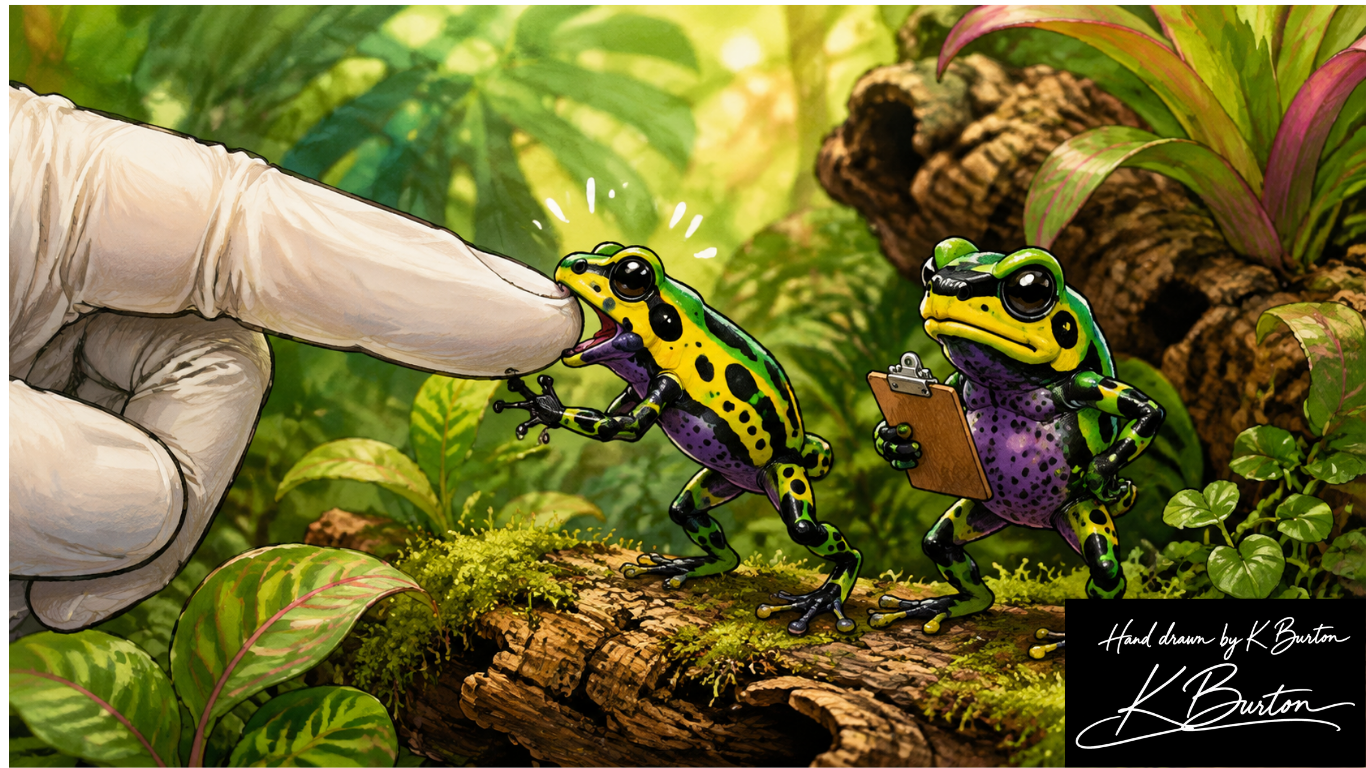
A dart frog is sitting in a transfer cup when a finger appears near its face. The frog lunges, closes its mouth against the skin and seems thoroughly pleased with its act of defiance. Has the keeper just been bitten by a poison dart frog—and is that dangerous?
Dart frogs can make defensive snaps and may close their mouths on a finger, glove or another object when restrained or cornered. However, their tiny jaws are adapted for capturing very small prey, not injuring a human. A captive-bred dart frog bite is normally startling rather than painful.
The important safety lesson is almost the reverse of what beginners expect. In routine captive care, the frog is at much greater risk from being chased, squeezed, overheated or exposed to residues on human skin than the keeper is from its mouth.
Can a dart frog actually bite?
If “bite” means deliberately closing the mouth against something, yes. A frog can make a defensive snap when it feels trapped, and an unusually bold individual may grab at a moving object during a feeding response. Keepers occasionally report a frog clamping onto a fingertip during a transfer.
That does not make dart frogs dangerous biting animals. Their normal diet consists of fruit flies, springtails, mites and other tiny invertebrates. Their skull, gape and jaw muscles are scaled to a small amphibian that swallows miniature prey whole.
A large horned frog can deliver a meaningful bite. A tiny Ranitomeya or Dendrobates is in a completely different mechanical category. “Frogs can bite” is therefore true, while “pet dart frogs present a serious bite risk” is misleading.
Is a feeding strike the same as aggression?
Not necessarily. Dart frogs visually track small moving prey and launch fast tongue-and-jaw strikes. A fingertip moving near the frog does not resemble a fruit fly in size, but sudden movement close to the face can still elicit an orienting or snapping response.
A frightened frog may also open its mouth as a defensive act. Look at context: was the frog hunting naturally, or had it been cornered, caught or repeatedly approached?
The complete dart frog feeding guide explains how normal prey capture differs from altered feeding or handling behaviour.
Do dart frogs have teeth?
“Do frogs have teeth?” sounds like a yes-or-no question, but frog dentition is extraordinarily variable. Across anurans, teeth have repeatedly been lost during evolution. Some species possess very small teeth along the upper jaw, some also have teeth on the vomer bones in the roof of the mouth, and many lineages lack particular tooth fields or adult teeth entirely.
A large comparative study covering the evolutionary history of frogs found extensive, repeated tooth loss. That means it is unsafe to describe one general frog diagram as though it represents every dart frog species.
Where small upper-jaw or palatal teeth are present, they are not mammalian chewing teeth. Frogs usually swallow prey whole. The teeth help retain or control prey rather than cut it into mouthfuls.
Can you see a dart frog’s teeth?
Not during ordinary husbandry, and you should not try. The structures are tiny, while the jaw and oral tissues are delicate. Forcing a frog’s mouth open to satisfy curiosity risks dislocation, tissue injury and aspiration.
Visible swelling, inability to close the mouth, repeated failed swallowing or abnormal material inside the mouth belongs with an amphibian-experienced veterinary surgeon. The guide to mouth wiping after feeding explains when an ordinary forefoot movement becomes a warning sign.
Do dart frogs chew?
No. A dart frog captures a suitably small feeder, brings it into the mouth, repositions it and swallows it whole. This is why prey size matters. Teeth, if present, do not make an oversized feeder safe.
Why would a dart frog bite a person?
The usual explanations are immediate context, not an aggressive personality.
Defensive response
Capture removes every escape option. A frog that cannot jump away may wriggle, brace, urinate, vocalise or snap. That is a request for distance, not bad behaviour.
Feeding excitement
A moving object near a hungry, food-responsive frog may trigger a rapid strike before the animal has gathered much information. Do not hand-feed dart frogs or encourage them to associate fingers with prey.
Transfer stress
A move between enclosures involves unfamiliar surfaces, vibration, light and restraint. A cup transfer is safer than grabbing because it reduces direct pressure and gives the frog a boundary it can move into.
Veterinary examination
A clinician may need controlled restraint to examine the skin, mouth or body. A defensive snap during that process does not predict how the frog behaves undisturbed in its vivarium.
Does biting mean a dart frog is aggressive towards its keeper?
No. Dart frogs do not maintain a human-directed dominance hierarchy. The frog is responding to an immediate stimulus or restraint. Do not punish, flick or drop it. Reduce the stressor and complete the necessary movement calmly.
Social aggression between frogs is a separate subject. The group-housing and aggression guide covers chasing, pinning and resource exclusion.
Does a dart frog bite hurt?
For a typical adult human, a small captive dart frog closing its mouth on intact skin is likely to feel like a light pinch, pressure or almost nothing. It is not comparable with the bite of a large predatory frog, reptile or mammal.
The actual experience varies with:
- the species and size of frog;
- where contact occurs;
- whether the skin is already cracked or injured;
- how quickly the person pulls away; and
- whether the frog is accidentally squeezed during the reaction.
The reflex to jerk a hand away is often more dangerous than the bite. A frog can be thrown, dropped or caught against décor. If contact occurs, remain still, lower the hand close to a safe surface and allow the animal to release rather than shaking it off.
Can a dart frog bite break the skin?
It is unlikely with most small dart frogs, but avoid absolute guarantees. Damaged skin, a sharp microscopic structure or a forceful reaction can produce a minor mark. Treat any broken skin as an ordinary contamination event: wash it thoroughly and obtain medical advice if redness, pain or swelling develops.
Can dart frog poison enter through a bite?
Dart frogs are described as poisonous, not venomous. Venom is actively delivered through a specialised apparatus such as fangs or a stinger. Poison-frog alkaloids are defensive compounds associated with skin secretions; the frog does not inject them through its teeth.
More importantly for UK keepers, dendrobatid poison frogs acquire defensive alkaloids from particular dietary arthropods. Controlled studies show that poison frogs can sequester alkaloids supplied in food, while field and laboratory research links their chemical defence to ants, mites and other alkaloid-bearing prey.
Captive-bred frogs eating cultured fruit flies, springtails and standard feeder insects do not possess the potent wild chemical profile that made certain species famous. Frogfather’s dedicated article on epibatidine and captive dart frog toxicity examines that distinction in depth.
Does captive-bred mean you can lick or handle the frog?
Absolutely not. “Not carrying wild dietary toxins” does not mean “sterile” or “designed for contact”. Amphibians and their environments can carry microorganisms, and eyes, mouths and open wounds should never be exposed. More importantly, the frog’s permeable skin can absorb contaminants from you.
Do not use wild-caught insects in an attempt to recreate toxicity. Unknown prey may carry pesticides, parasites or inappropriate chemical compounds. The aim of captive husbandry is health, not weaponising a pet.
What about wild poison frogs?
Never generalise captive-pet advice to wild animals. Alkaloid load varies among species, populations, locations and diets, but wild poison frogs should be treated as potentially chemically defended and should not be touched. Observe them without contact and follow local conservation guidance.
The greater risk: why routine handling is unsafe for the frog
Dart frogs are display and observation animals, not handling pets. Their skin is central to water balance, electrolyte exchange, protection and gas exchange. Contact can transfer:
- skin oils and sweat;
- soap or hand-sanitiser residue;
- moisturiser, perfume and cosmetics;
- cleaning products and disinfectants;
- nicotine, pesticides or workshop residues;
- heat from human skin; and
- pathogens between animals and enclosures.
Dry contact may also disturb the protective mucus layer. Veterinary guidance recommends moistened, powder-free vinyl gloves for amphibian restraint and emphasises changing gloves between patients.
The Frogfather handling, hygiene and biosecurity lesson explains the collection-level risks in more detail.
Are nitrile gloves safe?
Many amphibian professionals use suitable powder-free nitrile or vinyl gloves, moistened with amphibian-safe water. Product formulation matters, so avoid powdered, fragranced or contaminated gloves. Merck’s veterinary guidance specifically favours moistened powder-free vinyl rather than latex.
Gloves reduce risk; they do not justify recreational handling. Keep contact brief and purposeful.
Can you pick up a frog with wet bare hands?
Wet clean hands may reduce friction compared with dry hands, but they do not solve residues, heat transfer or biosecurity. For planned captive transfers, a catch cup is the first choice and appropriate gloves are the safer backup.
How should you move a dart frog without being bitten or harming it?
- Prepare the destination first. Open and secure everything before disturbing the frog.
- Use a clear catch cup. Place it gently in front of or over the frog without trapping toes.
- Guide rather than grab. Use the cup edge, a clean lid or visual pressure to encourage one controlled hop.
- Slide the lid into place. Check every limb before closing it.
- Keep the container upright. Avoid excess space, standing water and sudden temperature change.
- Release at substrate level. Let the frog leave voluntarily where possible.
- Use gloves only if direct contact is necessary. Moisten suitable powder-free gloves and keep restraint minimal.
- Change gloves and clean equipment. Never move directly between enclosures with the same wet tools or gloves.
The UK dart frog transport guide covers containers, temperature and journey preparation.
What if the frog grabs the glove?
Do not pull sharply. Lower the hand or glove into the prepared container and wait for the frog to release. Never pry the jaws apart. A dramatic response can damage the animal far more easily than its bite can damage you.
What should you do if a captive dart frog bites you?
- Stay calm and prevent the frog from falling.
- Let it release without squeezing its body or forcing the mouth.
- Return it to a secure enclosure or transfer cup.
- Wash the contact area thoroughly with soap and running water.
- Do not touch your eyes, mouth or food before washing.
- Check the frog for an injured jaw, abnormal posture or other harm caused during the incident.
- Seek human medical advice if skin was broken and redness, swelling, pain or systemic symptoms develop.
If the animal is wild-origin, recently imported or its provenance and diet are uncertain, avoid further exposure and obtain case-specific medical advice. Do not rely on a generic statement about captive-bred frogs.
Are dart frogs safe around children and other pets?
A secure vivarium containing captive-bred dart frogs is not a bite hazard to a household. The practical risks are escape, enclosure damage, contaminated hands and inappropriate handling.
Children can enjoy observing feeding, calling and courtship, but an adult should control doors and transfers. Teach four simple rules:
- look without touching;
- never open the vivarium without an adult;
- wash hands after enclosure maintenance; and
- never put frogs, décor, tools or vivarium water near the face or mouth.
Cats and dogs should not have access to the enclosure or escaped frogs. Even a playful paw or curious lick can kill a tiny amphibian, while vivarium water and substrate are not pet toys.
Are dart frogs “high-risk exotic pets”?
Captive-bred dart frogs are not meaningfully dangerous biting animals, but responsible exotic-animal care still requires secure housing, hygiene, live-food management and species-appropriate welfare. The article on whether dart frogs are genuinely high-risk pets places those hazards in proportion.
Frequently asked questions
Do dart frogs bite humans?
They can make a defensive snap or close their mouth on a finger when frightened or restrained. Because dart frogs are tiny and adapted to catching very small prey, a bite is normally startling rather than injurious.
Does a dart frog bite hurt?
Most keepers would feel little more than light pressure or a small pinch from a typical dart frog. The greater danger is jerking away and dropping, throwing or squeezing the frog.
Do dart frogs have teeth?
Frog dentition varies greatly among species. Some frogs have tiny teeth on the upper jaw or roof of the mouth, while tooth fields have been repeatedly lost during frog evolution. These structures retain prey rather than chew it.
Can a dart frog inject poison when it bites?
No. Poison frogs are not venomous and do not inject toxins through specialised fangs. Their defensive alkaloids are associated with skin secretions and are acquired from particular dietary prey in the wild.
Are captive-bred dart frogs poisonous?
Captive-bred dart frogs eating standard cultured feeders do not develop the potent alkaloid defences associated with wild diets. They should still be handled as little as possible because contact can harm the frog and good hygiene remains necessary.
Can I hold my dart frog?
Routine handling is not recommended. Dart frogs have delicate permeable skin and do not benefit from being held. Use a catch cup for transfers and suitable moistened powder-free gloves when direct contact is unavoidable.
What should I do if my dart frog bites me?
Stay calm, let the frog release without pulling it off, secure the animal and wash the contact area thoroughly. Seek medical advice if skin was broken and concerning symptoms develop.
Why did my dart frog try to bite me?
The frog was most likely frightened, restrained or reacting rapidly to movement near its face. It is an immediate defensive or feeding-type response, not an attempt to dominate its keeper.
Research and professional guidance
- Paluh and colleagues: rampant tooth loss across 200 million years of frog evolution
- Moskowitz and colleagues: poison frog dietary preference and alkaloid-bearing prey
- Alvarez-Buylla and colleagues: binding and sequestration of poison-frog alkaloids
- Merck Veterinary Manual: clinical techniques and handling in amphibians