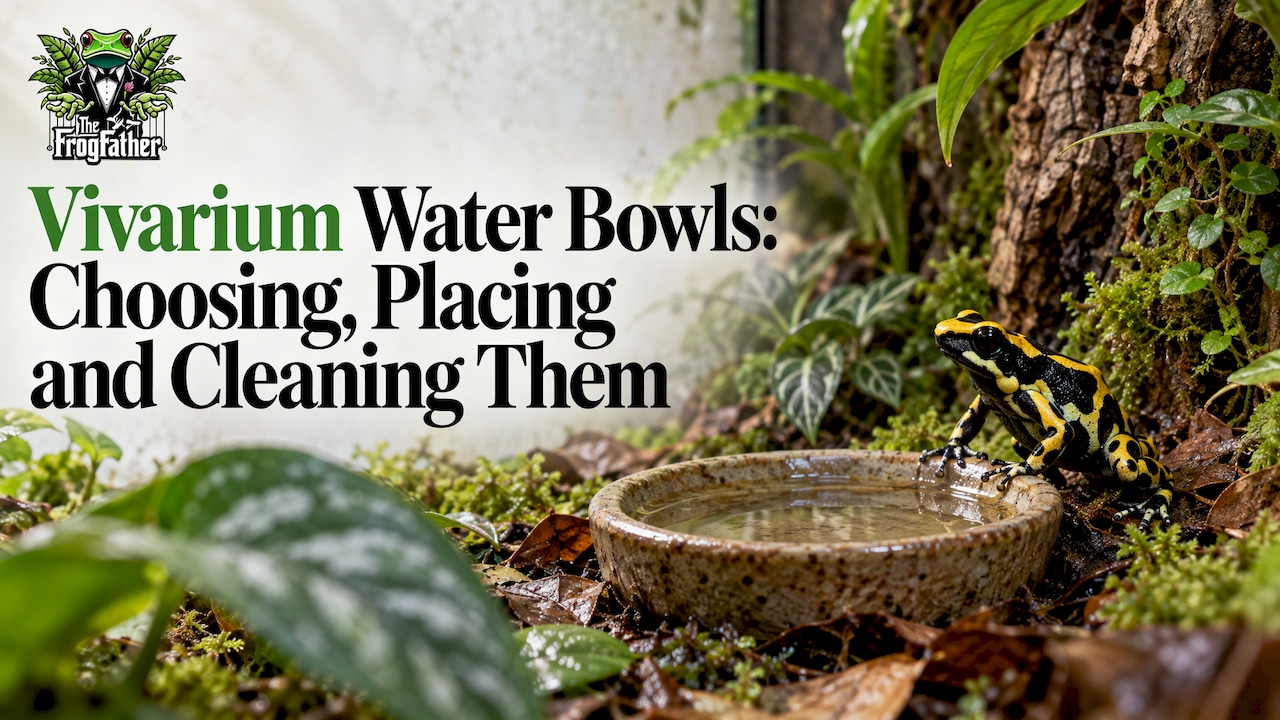
A good vivarium water bowl is shallow, stable, easy to lift out and cleaned every day. Most dart frogs do not need one, but many keepers like to offer one, and tropical amphibians such as tree frogs do need water they can sit in. This guide covers which bowl to buy, where it goes, what to fill it with and how to keep it safe. It also covers the wood that usually sits beside it, because the two decide how the corner of your enclosure behaves.
TL;DR
- Dart frogs absorb water through their skin and cannot swim well, so any bowl must be very shallow with an easy way out. Species such as White’s tree frogs need water deep enough to sit in.
- Choose a heavy, tip-proof, smooth dish with sloping sides, and add a stone or ramp so insects and frogs can climb out.
- Use dechlorinated water. UK tap water often contains chloramine, which simple standing does not remove.
- Empty, rinse and refill daily. Scrub and disinfect with an amphibian-safe product on a regular schedule.
- Use untreated hardwood, cork bark or sterilised driftwood, and never cedar or pine.
Table of Contents
- Do dart frogs need a water bowl at all?
- What makes a good vivarium water bowl
- Where to put the bowl
- What to put in the water
- A cleaning routine that keeps water safe
- Tropical vivarium wood: what to use and how to prepare it
- Spotting problems early
- Our perspective
- Setting up your vivarium with us
- FAQ
- Sources
Do dart frogs need a water bowl at all?
Not strictly. One veterinary care sheet says a shallow dish of fresh water is often appreciated by dart frogs but is not necessary, and that they should not have access to deep water. In a well-run bioactive vivarium, humidity, misting and wet leaf litter already give frogs the moisture they need.
That makes sense once you know how frogs take water in. Thin-skinned amphibians almost exclusively take up water through the skin and barely drink. We explain this further in our guide to how dart frogs absorb water through their skin. A damp surface to sit on matters more than a pool to drink from.
So the honest answer depends on the animal:
- Most dart frogs: a bowl is optional. If you add one, make it a small, shallow soaking dish.
- Terrestrial tropical amphibians: the Merck Veterinary Manual says they need a shallow container of water in the enclosure.
- Larger tree frogs: a veterinary school care sheet says water is essential and there should be enough for the frog to submerge comfortably. If you are weighing the two groups, our comparison of dart frogs and tree frogs for a bioactive vivarium goes through the differences.
If you keep dart frogs and want to know how risky even a small dish can be, read can dart frogs drown before you buy anything.
What makes a good vivarium water bowl
Most of what the shops sell is designed for reptiles. Bearded dragon and gecko dishes can be too deep and too slippery for a small frog. These are the points we look at.
Depth and edges
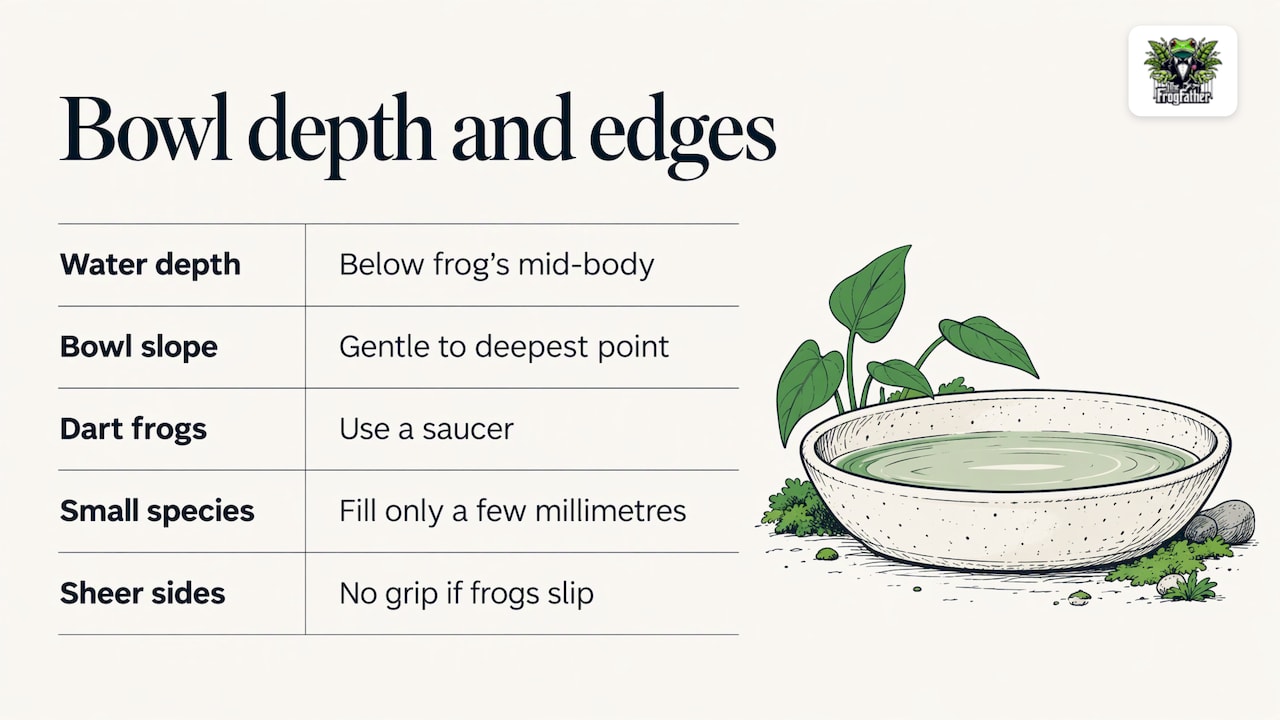
A small frog should be able to walk in and out without swimming. As a rule of thumb, the water should stay below the frog’s mid-body height, and the bowl should slope gently from the rim to the deepest point. Sheer-sided pots are the ones that cause trouble, because a frog that slips in has nothing to grip.
For dart frogs, think of a saucer rather than a bowl. Plant pot saucers, shallow ceramic dishes and the lids of jars are all common choices. Fill them only a few millimetres deep for the smaller species.
Material
Glazed ceramic, smooth plastic and heavy glass all work. What matters is that the surface is non-porous and can be scrubbed without scratching, because scratches hold bacteria. Natural stone and rough resin “rock” dishes look good but can be hard to clean properly.
| Material | Good for | Watch for |
|---|---|---|
| Glazed ceramic | Weight, so it does not tip; easy to scrub | Chipped glaze, which is hard to clean |
| Smooth plastic or PP | Light, cheap, easy to replace | Can slide or tip if not bedded into the substrate |
| Heavy glass | Smooth and easy to see through | Breakage, so only use it in a stable spot |
| Rough resin or stone effect | Looks natural | Texture that traps film and is harder to disinfect |
Size and number
Smaller is usually better in a dart frog vivarium, because every square centimetre of water takes space away from planted, climbable surface. Frogs choose spots by temperature, humidity and cover, as we cover in our piece on dart frog microhabitats. A dish that sits in a bright, open spot may simply go unused. If you keep a pair or group, one dish is plenty unless you see competition over it.
An exit for everything that falls in
Crickets, flies and springtails fall into water, and a frog that chases them can follow. Place a smooth stone, a piece of cork or a small ramp so that anything can climb out. It is a cheap change that makes any dish safer.
Where to put the bowl
Placement affects how quickly the water fouls and how easily you can reach it.
- On the substrate, not on the false bottom. Bed it level so the rim is flush with the soil or leaf litter. A frog should be able to step in without a climb.
- Away from the heaviest planting. Falling leaves and plant debris foul water quickly. Keep it near the front, where you can reach it without disturbing everything.
- Out of direct light. Warm, bright water grows algae and bacteria faster.
- Away from the drainage point or the mister. Otherwise the bowl overflows and you lose track of how deep it is.
- Near cover. Frogs are more likely to use a dish that has a plant or a piece of wood beside it.
When you are working out how much space you can give up for water, it helps to start from the right dart frog vivarium size for your species and group.
What to put in the water
Amphibian skin is permeable, so the water it sits in matters. The Merck Veterinary Manual says water must be free of toxins such as chlorine, ammonia, nitrite, pesticides and heavy metals. It also notes that chloramines must be split with specific dechlorinating agents before carbon filtration.
That matters in the UK, where many water companies use chloramine. Leaving a jug on the side overnight will not remove it. Your options in practice are:
- A water conditioner made for amphibians or aquariums, used at the dose on the label. One keeper-facing source advises adding a conditioner after filling with mains water, to neutralise chlorine and bind heavy metals.
- Reverse osmosis (RO) water, remineralised if you use it for tadpoles or for anything beyond a soaking dish.
We set out the full detail on tap water, RO and TDS in our UK water guide for dart frogs and tadpoles. Do not use distilled water on its own, and do not use bottled water without checking its mineral content.
A cleaning routine that keeps water safe
Standing water in a warm, humid enclosure turns quickly. Amphibians’ immune function relies heavily on a stable environment, and the Merck Manual points out that infectious and nutritional diseases are common in tropical amphibians kept in poor conditions. Clean water is one of the cheapest ways to reduce that risk.
Daily
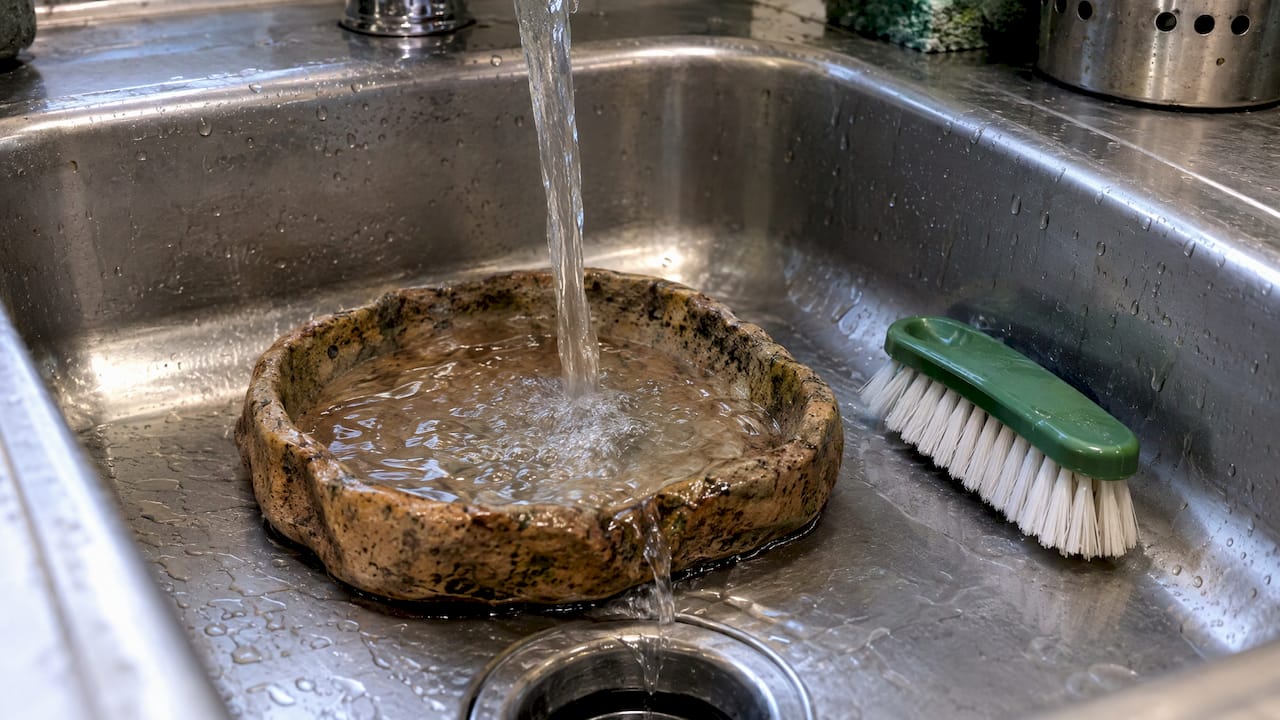
- Lift the dish out, tip out the water and remove any dead insects, shed skin, faeces or leaf debris.
- Rinse it under the tap with no soap.
- Refill with conditioned or RO water to a shallow level.
- Check the ramp or stone is still in place.
Veterinary guidance for tree frogs is to spot-clean daily and give the whole vivarium a full clean once a month with a disinfectant suitable for amphibians. In a planted bioactive setup you will not strip the whole enclosure, but the bowl is the part you can and should sterilise.
Weekly
Scrub the bowl with a dedicated brush, then disinfect it with a product sold as safe for amphibians. Rinse until there is no smell or residue, and let it air dry before it goes back. If you have two dishes, you can swap them and let one dry completely. If you want a general reference on cleaning a tank properly, the principles of removing film, rinsing well and avoiding harsh residues carry across from aquariums.
Larger water features
A waterfall or pond is a different job. One manufacturer’s guidance suggests a weekly partial change of around a third of the water volume for larger bodies of water. Most dart frog keepers avoid them altogether for good reasons: they take up surface area, they are harder to keep clean and they raise the risk of drowning.
Tropical vivarium wood: what to use and how to prepare it
Wood and water bowls go together. Branches and cork bark give frogs cover, climbing routes and the shaded corner beside the dish. The wrong wood, though, can leach toxins, rot or grow mould.
Woods that are generally used
The Merck Manual says untreated hardwood mulches and leaf litter can be used, but that cedar and pine mulches contain toxic oils and should not be used. A UK veterinary information sheet also warns about direct toxicity from certain resinous woods. Keepers commonly use:
- Cork bark, soaked well
- Cholla and mopani-type pieces sold for aquariums or terrariums
- Sterilised driftwood from freshwater sources
- Coconut husk and shell
- Untreated oak, beech or ash from a known source
Avoid anything from a roadside, a garden treated with chemicals, or the sea. Avoid live or recently cut wood, resinous conifers, and anything with paint, varnish or glue.
Preparing wood
- Scrub off loose bark, dirt and moss.
- Boil or soak it. Boiling for several hours helps to sterilise it and draws out tannins, which you will see as brown water. Large pieces can be soaked in a tub and the water changed until it runs clear.
- Dry it fully, then check it for cracks where pests can hide.
- Let it air before it goes into the vivarium.
The tannins are harmless to most species and can tint the water of a dish, but a dish that goes brown overnight is also hiding dirt, so keep to your cleaning routine.
Placing wood near water
Give frogs a way up and out. A branch that leans into the bowl area can work as a ramp, but a heavy log can also tip or trap a small frog. Make sure there are no gaps a frog can wedge into. Our plant and layout guides, including bromeliads for dart frog vivariums, show how wood and planting combine to provide cover and natural water collection points.
Remember also that wood is part of the substrate ecosystem. A good substrate should be safe, hygienic, absorbent and suited to natural behaviour, and springtails and isopods help break down wood and leaf litter. See our microfauna guide for how they fit in.
Spotting problems early
A quick daily look catches most issues. Check for:
- Cloudy water or a slimy film on the bowl, which means it needs scrubbing and not just refilling.
- A sour or musty smell, which suggests rotting food or wood.
- White or grey fuzz on wood. In a new bioactive setup, a little white mould is common and often clears as springtails get established. Persistent or spreading mould means the wood was not prepared well or the airflow is poor.
- Soft, crumbling wood that is rotting faster than your clean-up crew can handle. Replace it.
- Frogs that sit in the bowl for long periods, or look dull or thin. Contact an exotics vet with amphibian experience.
- Drowned insects collecting in the dish. Add a better exit, and review your feeding routine.
Good airflow helps all of this, and our guide to vents for vivariums and terrariums explains how to balance ventilation with humidity.
Our perspective
We keep and breed dart frogs in Nottingham, and the water bowl is one of the most over-thought and under-maintained parts of a vivarium. Keepers fuss over the shape and style, then forget about it for three days.
Our view is simple. Keep the basics boringly solid: a shallow dish, conditioned water, a way out, and a daily habit of emptying and refilling it. A bioactive vivarium is a living system that needs regular attention, and the dish is where small lapses show first.
We also think the best equipment is the sort you can lift out and clean in thirty seconds. That is why we design practical 3D-printed vivarium accessories and test them in our own frog rooms. If a part is awkward to remove, it does not get cleaned.
Before you add a pool, ask what the frog actually needs. For most dart frogs, the answer is moisture, cover and stable humidity, not deep water.
Frogfather
Setting up your vivarium with us
If you are building or upgrading an enclosure, we supply bioactive supplies, plants, microfauna, live foods and accessories, and we make custom bioactive vivariums. You can browse everything on the Frogfather shop.
For feeding, our live food range includes fruit fly culture subscriptions. If you are still deciding on a setup, read what to look for when buying a bioactive vivarium first.
FAQ
How deep should a dart frog water dish be?
Very shallow. Dart frogs are poor swimmers and can drown, so keep the water below the frog’s mid-body height, with sloping sides and a stone or ramp. For small species, a few millimetres is enough. If in doubt, make it shallower.
Can I use tap water in a vivarium water dish?
Only after treating it. Chlorine and chloramine are harmful to amphibians, and chloramine does not disappear when water stands. Use a conditioner suitable for amphibians or RO water, and read our UK water guide for the detail.
How often should I change the water?
Daily. Empty, rinse and refill it each day, and scrub and disinfect the dish on a regular schedule. Warm, humid enclosures let bacteria build quickly, especially after food, faeces or shed skin get into the water.
What wood is safe for a tropical vivarium?
Cork bark, sterilised freshwater driftwood, coconut husk and untreated hardwoods are commonly used. Avoid cedar, pine and other resinous woods, treated timber and anything collected near roads or the sea. Boil or soak new pieces before use.
Sources
- Dart Frog Care, Aurora Animal Hospital
- White’s Tree Frog Care, Royal Veterinary College
- Environment and Husbandry for Amphibians, Merck Veterinary Manual
- Supply of water and moisture, water care, JBL
- IS02 Vivarium substrates, herpvet.co.uk
- Как да почистим аквариум: наръчник 2026
Recommended
- How To Clean A Vivarium Misting Reservoir
- How To Clean Vivarium Glass: Tips For Spotless, Algae-Free, And Condensation-Free Viewing
- Removing Limescale And Watermarks From Vivarium Glass (Safely)