Written The Frogfather | UK dart frog keeper, breeder and bioactive vivarium specialist | Last reviewed: 3 September 2026
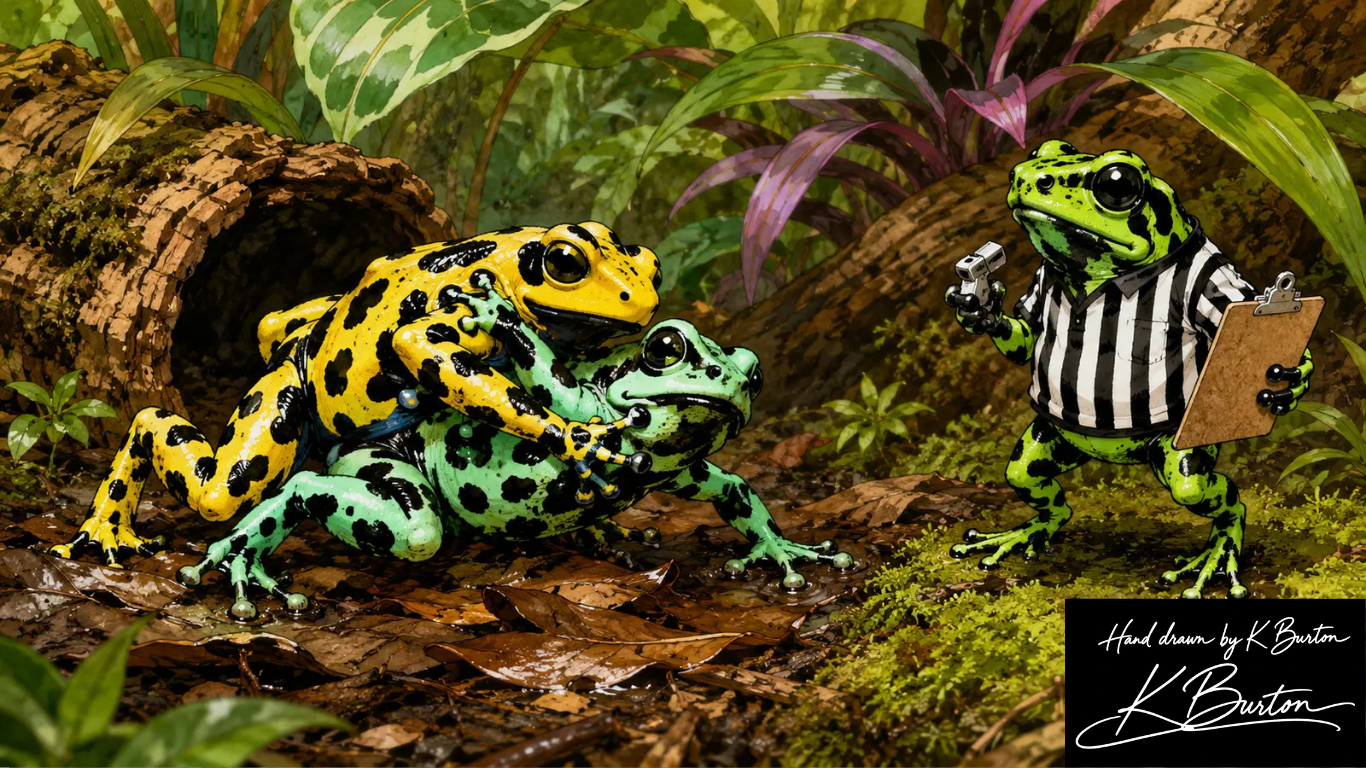
Two dart frogs meet beneath a leaf. One climbs over the other, both begin turning in a tight circle and, within seconds, one frog appears to be sitting on its tank mate. Is this courtship, mating, dominance—or a fight?
This is one of the easiest social behaviours to misread. A keeper who assumes every close interaction is aggression may separate a compatible pair during courtship. A keeper who labels wrestling “rough mating” may leave a subordinate frog trapped with an animal that repeatedly pins, displaces and exhausts it.
The answer rarely comes from a single still photograph. You need the sequence: who approached, whether the second frog chose to follow, whether either could disengage, what the limbs were doing and what happened immediately afterwards.
Why are dart frog fighting and mating so easy to confuse?
Both courtship and conflict bring frogs unusually close together. Both may include following, touching, sudden turns and one frog briefly moving over another. Viewed through plants—or reduced to a five-second clip—the context disappears.
The familiar image of frog mating creates another problem. Many people expect prolonged amplexus, in which a male grips a female. Poison-frog reproductive behaviour varies among species, but the courtship of many dart frogs is much more elaborate: calls, tactile contact, leading and following precede external egg laying and fertilisation. A prolonged wrestling pin should not automatically be interpreted as mating.
Field observations of D. tinctorius make the contrast particularly useful. Courtship consisted of repeated tactile interactions and frogs moving together, usually with a female touching and following a male. Agonistic encounters included chasing, kicking, jumping on the opponent and pressing its head or back against the substrate. Both sexes were observed fighting members of the same sex.
That research gives us behavioural clues, not a universal script. Oophaga, Ranitomeya, Phyllobates, Ameerega and other dendrobatids differ in their social systems. Always begin with the exact species, locality, ages and likely sexes rather than applying a rule learned from one popular tinctorius morph.
What does normal dart frog courtship look like?
Healthy courtship looks purposeful rather than coercive. One frog advertises or initiates, the other remains engaged, and the interaction progresses towards a suitable laying location.
Depending on the species, you may see:
- a male calling from a regular perch or near a potential oviposition site;
- a female approaching and remaining close to the caller;
- gentle forefoot contact to the partner’s back, head or limbs;
- one frog moving a short distance and pausing while the other follows;
- repeated leading and following through the enclosure;
- quiet pauses in which both frogs remain normally postured;
- attention to a leaf, film canister, coconut hide or another laying site; and
- the frogs separating normally after the sequence.
In the detailed natural-history study of D. tinctorius, females repeatedly placed a forelimb on the male and then followed as he moved away. Courtship could be interrupted by foraging and resume later. That is very different from one frog trying continuously to get away while the other forces it down.
Does climbing onto another frog always mean aggression?
No. A fleeting climb-over can happen in a cramped route, during excited following or as part of species-specific tactile behaviour. The important question is not “Was one frog ever on top?” but “Was it trying to restrain the other frog?”
Look for resistance. A courted frog may pause, turn, follow or simply move away. A pinned frog twists, braces, kicks, flattens, tries to reverse the position or repeatedly attempts to escape. The more sustained and one-sided the restraint becomes, the less useful the word courtship is.
Do dart frogs form permanent pairs?
Do not assume a male and female sold as a “pair” possess a permanent harmonious bond. Social and mating systems vary, and captive compatibility can change. Even frogs that have produced fertile clutches still need routine welfare monitoring.
The Frogfather article on lessons learned before breeding dart frogs explains why adding animals or chasing a particular sex ratio can create conflict rather than faster breeding.
What does dart frog wrestling and aggression look like?
Physical aggression is often described as “wrestling” because the frogs try to obtain the upper position. A bout may begin with staring, close pursuit or a sudden lunge. One frog jumps onto the other, hooks or braces with its limbs and pushes the opponent’s head, shoulders or back towards the ground. The lower frog turns and tries to get on top.
Watch for:
- repeated chasing after the other frog attempts to leave;
- lunging or jumping directly onto its back;
- grappling, kicking or tight circling;
- pressing the head or dorsum into leaf litter, glass or hardscape;
- one frog blocking the other’s retreat;
- the roles reversing as each tries to pin the other;
- repeated conflict around a caller, feeding point or laying site; and
- a subordinate frog fleeing upwards, hiding or abandoning a preferred area.
Wild D. tinctorius encounters ranged from short chases to continuous physical fights lasting at least 20 minutes. Captivity removes the option of leaving the territory completely, so an interaction that might end with dispersal in the forest can become chronic in a glass enclosure.
Is dart frog aggression only female-to-female?
No. Female-female conflict is particularly important in captive D. tinctorius, and females may compete around males or reproductive resources. However, males also defend territories and calling sites, and both sexes fought same-sex rivals in field observations of D. tinctorius.
Other poison-frog species have different patterns. In territorial Allobates femoralis, for example, experimental work found stable individual differences in territorial aggressiveness. Body size alone did not explain which males responded most aggressively. This is another reason not to predict compatibility from sex, size or a care-sheet label alone.
The wider Frogfather species guide is a useful starting point, but individual observation remains essential.
Can dart frogs injure or drown one another?
Yes. Persistent restraint can cause exhaustion, skin damage and loss of access to food or shelter. A fight beside a pool, drainage channel or water-filled bromeliad adds a submersion risk. Even when no wound is visible, chronic displacement and poor feeding can lead to serious decline.
Water features should never become arenas from which a pinned frog cannot escape. The guide to drowning risk in shallow water explains why depth is not the only hazard.
Courtship or aggression? Compare the whole sequence
| Observation | More consistent with courtship | More consistent with aggression |
|---|---|---|
| Approach | Caller attracts a partner; approach is measured | Direct pursuit, lunge or interception |
| Touch | Gentle, repeated forelimb contact | Grabbing, bracing, kicking or pressing down |
| Movement | Leading, following and pauses | Tight wrestling, frantic turns or repeated chase |
| Choice | Both remain engaged and can move away | One repeatedly tries to escape or is blocked |
| Top position | Brief incidental climb-over without restraint | Repeated effort to sit on and pin the opponent |
| Location | Movement towards a likely laying site | Conflict around food, territory, caller or boundary |
| Afterwards | Normal activity or continued coordinated courtship | Hiding, glass climbing, avoidance, exhaustion or exclusion |
| Pattern over days | Occasional reproductive sequence | One frog repeatedly targets the same individual |
No single row is a diagnostic test. A short video showing 30–60 seconds before and after the contact is more useful than a photograph of the most dramatic moment.
Why do previously peaceful dart frogs start fighting?
“They have lived together for months” is not proof that the group will remain compatible. The social conditions may have changed even if the enclosure has not.
Sexual maturity
Juveniles can coexist before adult territorial and reproductive behaviour appears. Conflict that seems to begin overnight may simply mark maturation. Sexing young dart frogs is uncertain, so a presumed pair may become two competing adults.
A change in sex ratio or reproductive activity
A male beginning to call, a female becoming reproductively active or a new clutch site can change the value of a territory. Two frogs may compete for access to the same caller or laying location even when food is abundant.
Enclosure renovation
Heavy pruning, moving hardscape or removing a dense plant can erase visual boundaries and concentrate the frogs in less usable space. The outside dimensions remain identical while the social map changes completely.
Competition at one resource
A single feeding station, favoured hide, calling perch or laying site creates a defendable bottleneck. Adding more flies does not help if one frog controls the location where they arrive.
A new frog
Introducing another animal changes both territory and social relationships. New arrivals also require proper dart frog quarantine; placing an unobserved newcomer directly into an established group combines disease and aggression risks.
Individual temperament
Species tendencies matter, but they do not guarantee individual behaviour. Research on territorial poison frogs has found repeatable differences between individuals. A group described as “usually tolerant” can still contain a persistent aggressor.
Subtle aggression can matter before you see wrestling
The most dangerous conflict is not always spectacular. One frog can dominate another without a daily wrestling match.
Look for:
- one frog appearing only after the dominant animal has moved away;
- repeated displacement from flies, shelters or calling sites;
- a frog spending increasing time high on the glass or at the enclosure edge;
- hesitation or retreat when another frog approaches;
- unequal feeding despite adequate prey;
- declining body condition or a widening size difference;
- loss of calling or a sudden change in normal visibility; and
- small abrasions around the head, back or limbs.
Use the body-condition and monitoring guide to compare photographs and feeding access without repeatedly chasing the frogs. A weekly memory of “they both seem fine” is much less reliable than dated observations.
Persistent escape-like climbing can also accompany social pressure. The guide to dart frogs climbing the glass explains how to interpret that behaviour in context.
What should you do when dart frogs fight?
- Record a short video if it is safe. Capture the approach and aftermath, not only the pin. Do not delay intervention to obtain better footage.
- Identify every frog. Note species, locality, age, likely sex and which individual initiates and retreats.
- Check for immediate danger. Separate at once if a frog is held down, repeatedly attacked, trapped near water, injured, exhausted or unable to escape.
- Use a cup, not bare hands. Guide the frog into a clean ventilated catch cup where possible. Amphibian skin is delicate, and a panicked wrestling pair is easily injured.
- Move one frog to a prepared enclosure. A secure, environmentally stable spare vivarium or observation tub is better than an improvised unventilated container.
- Examine both animals visually. Look for abrasions, abnormal posture, poor coordination and changes in body condition. Seek an amphibian-experienced vet if either frog is injured or unwell.
- Review the social arrangement. Recheck sex assumptions, maturity, species-specific housing and recent changes. Do not solve a suspected ratio problem by impulsively adding another frog.
- Monitor feeding and weight. Conflict may have affected the subordinate frog before the first observed fight.
Which frog should you remove?
There is no ethical rule that the weaker frog should automatically lose its established home. Choose the move that can be made most safely and leaves both animals in suitable conditions. If one animal is injured, an easy-to-monitor hospital or quarantine-style enclosure may be useful. If the aggressor can be identified and captured without tearing apart the entire vivarium, removing it may allow the displaced frog to resume normal use of the enclosure.
The long-term decision depends on sex, compatibility, space and the quality of the alternative enclosure—not on rewarding the “stronger” animal.
Should you wait to see whether they sort it out?
Do not use “sorting it out” as a plan when you have seen sustained pinning, repeated targeting or loss of access to resources. The subordinate animal cannot leave a captive territory. Brief posturing may end without combat, but an observed physical wrestling pattern warrants a separation plan and close action, not weeks of passive observation.
Can better vivarium design prevent dart frog aggression?
Good design can reduce forced encounters and competition, but it cannot make an incompatible social combination safe.
Useful features include:
- species-appropriate floor area and vertical structure;
- multiple visual barriers at frog level;
- several covered routes rather than one exposed corridor;
- more than one shelter, feeding zone and potential laying site;
- dense but usable planting rather than empty height;
- leaf litter and hardscape that create separate micro-territories; and
- an enclosure layout in which every frog can feed under observation.
The complete guide to keeping dart frogs in groups covers species choice, sex ratio and space in more detail.
More cover is not an excuse to stop monitoring. Dense planting can let a victim avoid contact, but it can also hide weight loss and make keepers believe the frog is simply shy. Structure should create choices while preserving observation points.
Will a larger enclosure fix fighting?
Sometimes additional usable space and visual separation reduce low-level competition. They do not guarantee reconciliation after repeated physical aggression. Moving the same incompatible animals into a larger vivarium without a backup plan can merely make the next fight harder to see and the frogs harder to catch.
Should separated dart frogs ever be reintroduced?
Do not reintroduce them simply because both look calm when apart. Separation removes the trigger; it does not prove the relationship has changed.
Before even considering a future attempt, establish:
- the exact species and locality;
- the most reliable sex assessment available;
- whether the original housing combination is recommended;
- whether either frog suffered weight loss or injury;
- what environmental or social change plausibly triggered the conflict; and
- whether permanent separate housing is available immediately.
For territorial pair-only species or repeated same-sex aggression, permanent separation is often the responsible outcome. Rehoming through an experienced keeper may be better than repeatedly testing animals in the hope that they eventually tolerate one another.
Never introduce a third frog as a distraction. That adds another competitor and can make identification, feeding and future separation more difficult.
Frequently asked questions
How can I tell if my dart frogs are fighting or mating?
Courtship usually involves calling, gentle touching, deliberate following and pauses. Fighting is more likely when frogs lunge, wrestle, kick, try to get on top, press one another down or prevent escape. Judge the full sequence rather than one moment.
Is it normal for one dart frog to sit on another?
A brief climb-over can be incidental or occur during close social interaction. Repeatedly jumping on another frog and holding its head or back against the substrate is pinning behaviour and should be treated as aggression.
Do dart frogs use amplexus when mating?
Many poison frogs rely on prolonged courtship, tactile contact and leading to an egg site rather than the prolonged grasp most people picture as amplexus. Behaviour varies by species, so wrestling should not be assumed to be mating.
Do female dart frogs fight each other?
Yes. Female-female aggression is especially important in Dendrobates tinctorius, although patterns vary among species. Females may chase, wrestle and pin rivals, including around males or reproductive sites.
Can male dart frogs fight?
Yes. Males of territorial species may compete over calling sites, space and access to females. It is incorrect to assume that every wrestling pair must contain two females.
Should I separate dart frogs after one wrestling match?
Separate immediately if the interaction includes sustained pinning, repeated targeting, injury, exhaustion, submersion risk or inability to escape. Even after a short bout, prepare separation and monitor both frogs closely rather than assuming they will resolve it safely.
Can more plants stop dart frogs fighting?
Plants and visual barriers can reduce forced encounters, but they cannot make an incompatible group safe. Persistent aggression requires a social-housing solution, not simply more foliage.
Can dart frogs live together peacefully for years and then fight?
Yes. Sexual maturity, reproductive activity, enclosure pruning, resource competition or a change in group dynamics can trigger conflict after a long quiet period. Previous tolerance does not guarantee future compatibility.