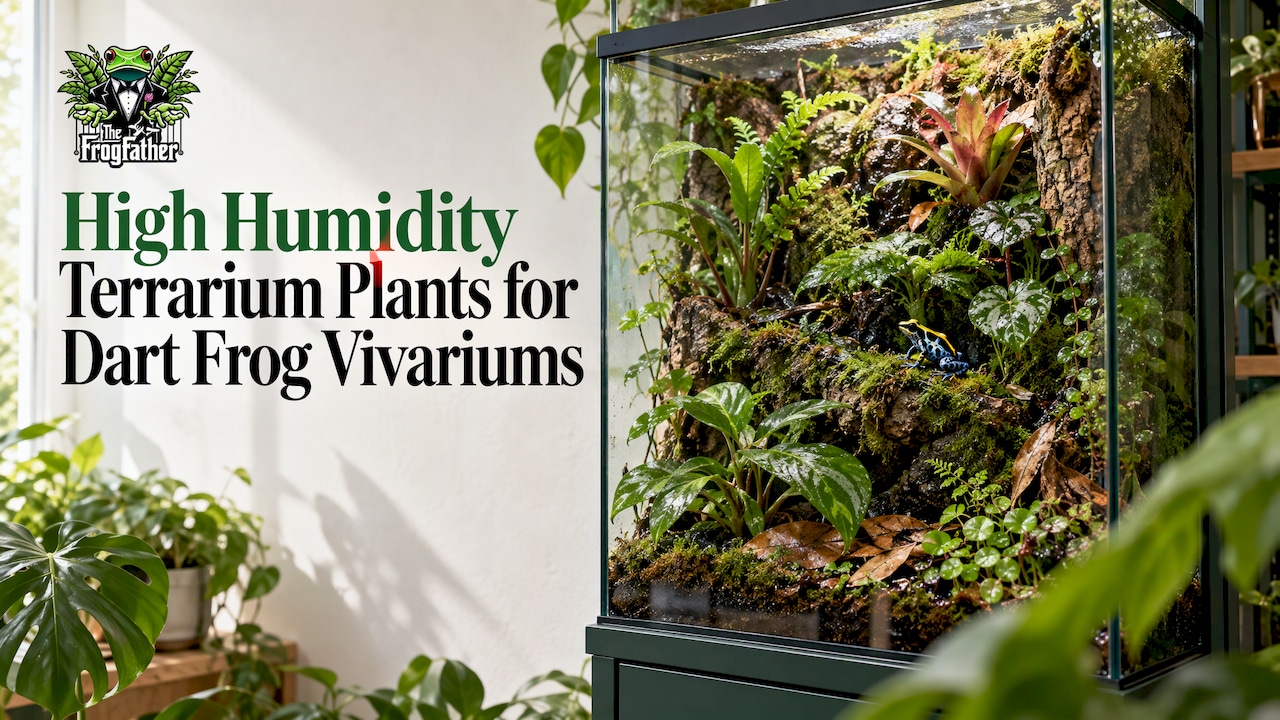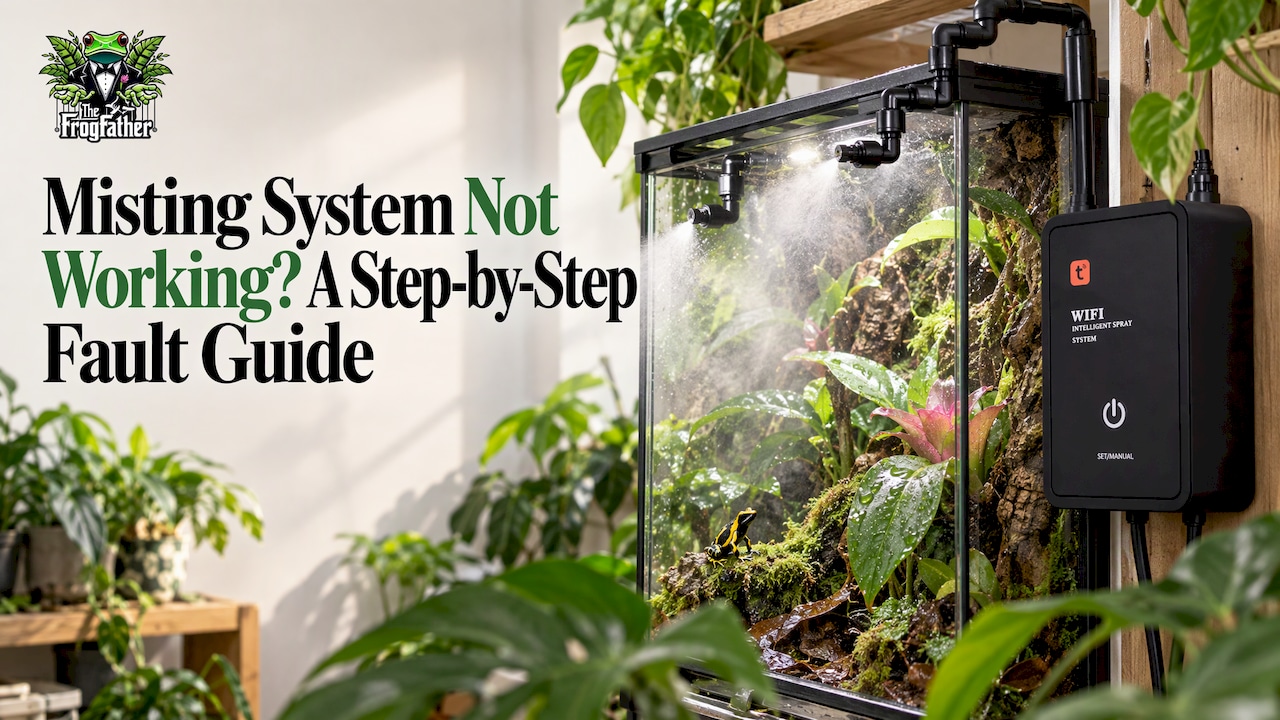

Good amphibian care comes down to five things done steadily: choosing a species you can look after for its whole life, building an enclosure with the right temperature range, humidity and clean water, feeding appropriately sized live food, quarantining newcomers, and keeping a regular routine. None of it is difficult, but none of it is effortless either. This guide covers each part for UK keepers, with dart frogs and bioactive vivariums as our main reference point, because that is what we breed and keep every day at Frogfather in Nottingham.
TL;DR
- Research the species before you buy and plan for its whole lifespan, including holidays, illness and vet costs.
- Amphibians absorb water through their skin, so humidity, ventilation and water quality matter more than almost anything else.
- Offer a temperature gradient rather than one fixed spot, and avoid sudden swings.
- Quarantine every new animal, wash your hands after contact and keep a simple record of feeding and health.
- A bioactive vivarium still needs regular maintenance: it reduces some jobs but never removes them.
Table of Contents
- Start with the species, not the tank
- Why skin drives everything
- The enclosure: temperature, humidity, ventilation and light
- Water quality
- Building a bioactive vivarium
- Feeding
- Quarantine, hygiene and health checks
- A routine that works
- Starting out with Frogfather
- Our view on amphibian care
- FAQ
- Sources
Start with the species, not the tank
The UK Good Practice Guidelines for privately kept reptiles and amphibians say owners should research the species before acquiring it. They should also consider time and financial implications, including specialist veterinary costs, and check they have the time, commitment, equipment and knowledge to meet the animal’s needs for life, with a plan for holidays or illness.
For a beginner that translates into a few practical questions:
- Is the species terrestrial, arboreal or aquatic? That decides the shape of the enclosure.
- How large does it grow, and how long does it live?
- What does it eat at each life stage, and can you keep live food cultures going reliably?
- Who will look after it if you are away or unwell?
If dart frogs are your interest, our guide to terrestrial dart frogs covers species and UK setup, and UK poison arrow frogs gives a broader introduction.
Wild amphibians are not pets
The RSPCA’s 2022 guidance on living with amphibians states that all native British amphibians are protected under the Wildlife and Countryside Act 1981, that the sale or trade of common frogs, common toads, palmate newts and smooth newts is prohibited, and that releasing non-native amphibians into the wild is an offence. Once an amphibian is in captivity, it is covered by the Animal Welfare Act 2006. Captive-bred animals from a UK breeder are the responsible route, and our guide to buying frogs responsibly in the UK explains what to look for. For the wider picture, see our legal, ethical and welfare framework.
Why skin drives everything
Amphibians do not drink in the way mammals do. The Good Practice Guidelines note that they absorb water through the skin, and that water quality must be maintained because frogs sit, swim and defecate in it. The RSPCA’s background information, drawn from a Council of Europe expert group, explains that a properly hydrated skin is essential to normal skin function and that areas of different humidity within the enclosure are beneficial.
That is why the same handful of variables decide whether an amphibian does well: moisture, temperature, air quality and clean water. Get those steady and most of the rest becomes manageable. Fiddle with them constantly and you create the problems you were trying to avoid.
The enclosure: temperature, humidity, ventilation and light
The Good Practice Guidelines describe the vivarium as normally forming the animal’s entire environment. It should offer the correct physical parameters, stimulation and variation for the species, with pools, branches and climbing surfaces where needed. It must also be secure against escape, free from hazards and kept in good repair.
Temperature
Amphibians are ectothermic, meaning they rely on their surroundings to regulate body temperature. The Council of Europe expert guidance says areas of different temperature and humidity let them choose their preferred micro-environment, and that frequent fluctuations can severely stress them and make health problems more likely.
The Merck Veterinary Manual recommends a thermal gradient within the species’ preferred optimal temperature zone, with enclosures spot-checked daily using a laser probe. Look up the range for your exact species, since a rainforest frog and a temperate species have different needs, and avoid placing any enclosure where sun or a draught can swing the temperature.
Humidity and ventilation
Merck lists several ways to provide moisture: shallow water containers, streams, waterfalls, ultrasonic humidifiers or frequent misting, with organic substrates and refugia (hiding places) limiting water loss. It also states that ventilation of one to two fresh-air changes per hour helps prevent disease. Humid does not mean stagnant: a sealed, dripping box is as much of a problem as a dry one.
A hygrometer, which reads humidity, is cheap and removes guesswork. Check it at the same times each day so you can see trends rather than single readings.
Lighting
Merck notes that diurnal species (those active in the day, which includes dart frogs) likely use UVB light in the 280 to 320 nm range for calcium metabolism. It gives a replacement interval of every 6 to 8 months for UVB bulbs and advises keeping lighting within 18 inches of the animal. Whatever you choose, provide plants and cover so the frogs can step out of the light whenever they want.
Water quality
Merck states that amphibian water must be free of chlorine, ammonia, nitrite, pesticides and heavy metals. Tap water needs treating before use: chlorine can be removed by circulating tap water through a carbon filter for at least 24 hours, while chloramines need a specific dechlorinating agent such as sodium thiosulfate before carbon filtration. Your water supplier can tell you whether your tap water contains chlorine or chloramine.
In practice, that means:
- Treat every drop that goes into the enclosure, including water for misting.
- Keep water features shallow and easy to empty and clean.
- Remove soiled water promptly rather than topping it up.
Building a bioactive vivarium
A bioactive vivarium is a planted enclosure with a living clean-up crew, usually springtails and isopods, that break down waste and mould in the substrate. It is a miniature ecosystem rather than a self-running one. You still monitor it, replace what fails and respond to what you see.
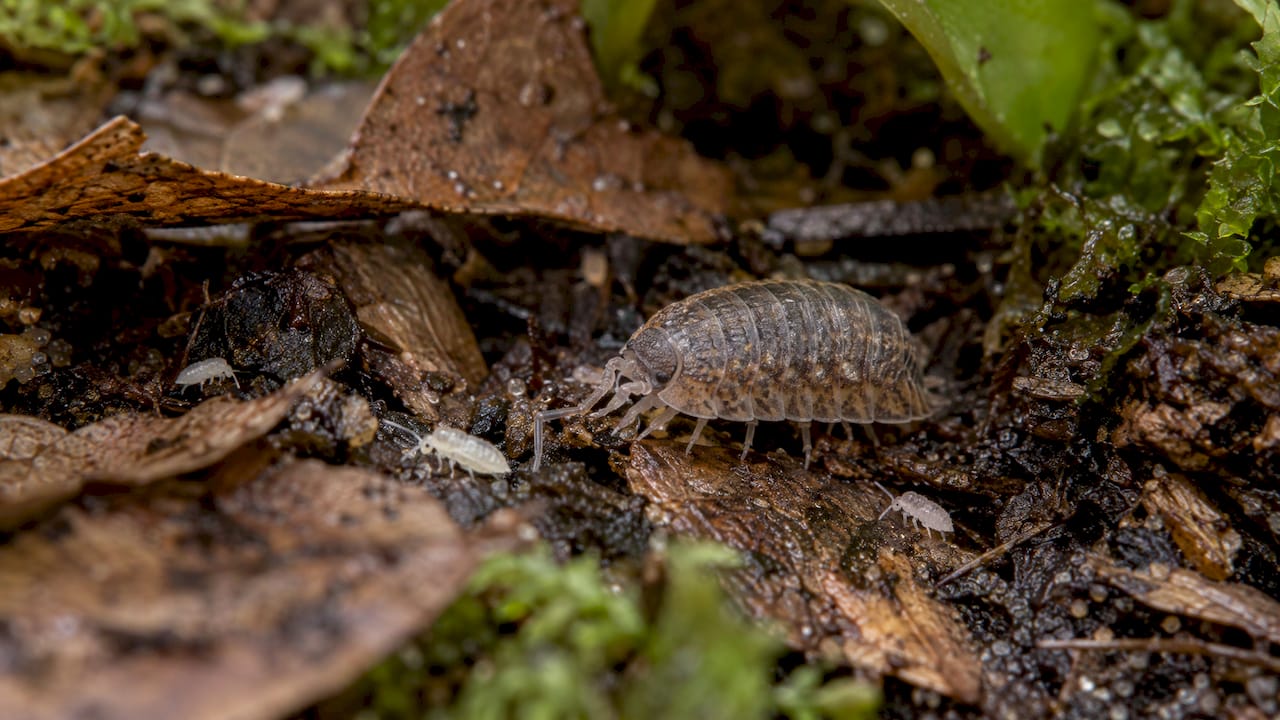
The substrate matters. Merck lists gravel (too large to swallow, or small enough to pass), soil without chemical additives, sphagnum moss and mulch as suitable, and warns that cedar and pine mulches contain toxic oils and should not be used. Choose a free-draining base, a soil layer, leaf litter and live plants that tolerate high humidity.
A sensible build order:
- Fit the drainage layer and a barrier to keep soil out of it.
- Add the substrate and shape it, leaving areas of different moisture.
- Plant, adding hides and climbing structure for cover.
- Introduce springtails and isopods, and give them time to establish.
- Run the enclosure and watch temperature, humidity and plant health before any animal goes in.
We supply tropical plants, springtails, isopods and bioactive supplies, and we build custom bioactive vivariums. Our Microfauna Nutrition Series is there to help keep your clean-up crew fed. Our free illustrated dart frog care and bioactive vivarium guide walks through the build in more detail.
Feeding
The Council of Europe expert group states that most amphibians are carnivores that prefer small living invertebrates such as larvae, insects and worms, and that captive animals should be kept on natural foods or close approximations. Daily feeding is not advisable for adults: it recommends feeding once to three times weekly to satiation. Juveniles have different needs, so check your species and stage.
The Good Practice Guidelines add that food should be prepared hygienically, uneaten food removed daily, and a specialist vitamin and mineral supplement used where needed. They also advise monitoring food intake, because a sudden change can be the first sign of a health problem.
For small frogs, the foundation is a reliable supply of flightless fruit flies. We offer fruit fly subscriptions, including Vestigial-Wing Drosophila melanogaster (Go Large Culture) and Dark-Eyed Black Drosophila hydei, so cultures arrive regularly. Our guide on how to offer food safely covers feeding technique.
Quarantine, hygiene and health checks
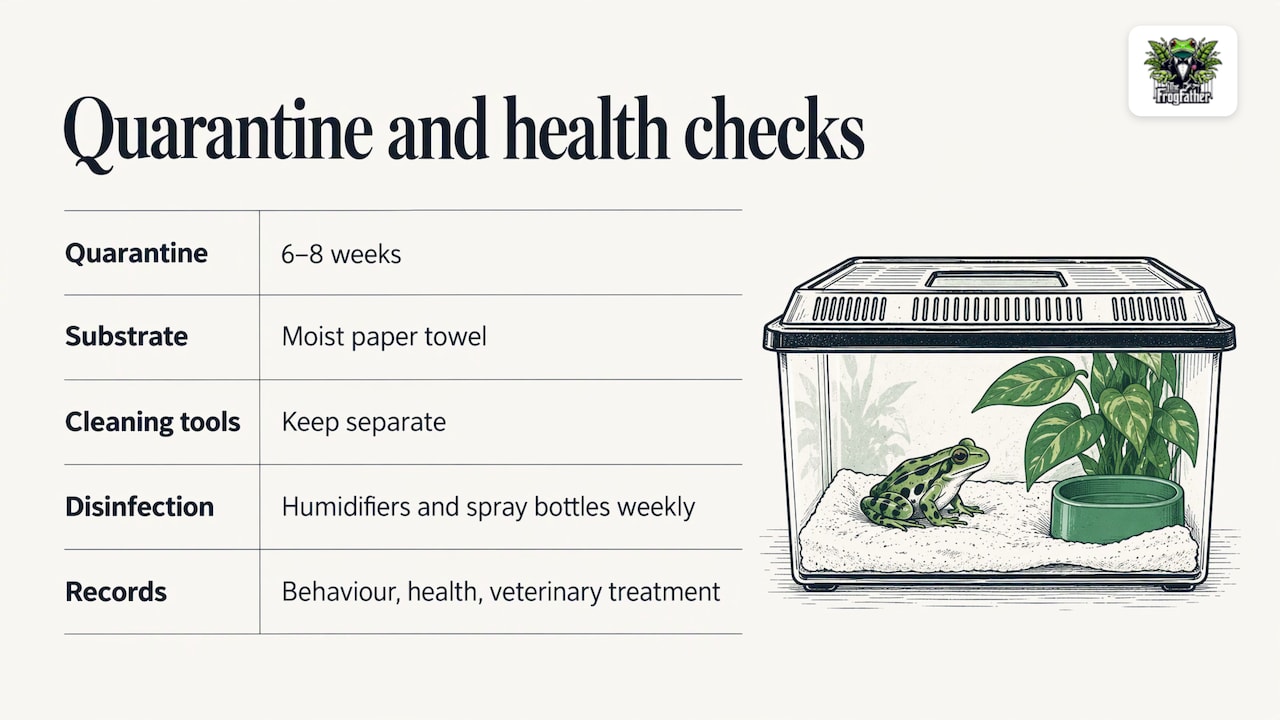
A new animal can carry problems you cannot see. Merck recommends a quarantine of 6 to 8 weeks, based on the risk of the source, with moist paper-towel substrate, separate cleaning tools, and weekly disinfection of humidifiers and spray bottles. The UK guidelines likewise recommend quarantining new reptiles and amphibians, inspecting animals regularly (metabolic bone disease and respiratory disease are the most notable issues), and keeping records of behaviour, health and veterinary treatment. Our step-by-step guide to quarantining dart frogs in the UK shows how to set this up.
See an exotic or herpetology vet if an animal stops eating, loses condition or shows breathing difficulty. It helps to find one before you need one.
Protect yourself too
The CDC (updated January 2026) states that reptiles and amphibians often carry Salmonella in their digestive tracts even when healthy, and that people can be infected through the animals or their tank water. Children under 5, adults 65 and older and people with weakened immune systems are at higher risk. Wash your hands after any contact with the animals, the enclosure or its water, and keep equipment out of the kitchen.
A routine that works
Most problems are caught early by a short, repeated routine rather than a heroic weekend clean:
- Daily: check temperature and humidity, look at each animal, remove uneaten food and soiled water.
- Weekly: clean water features and tools, check plants and microfauna, disinfect misting equipment.
- Every few months: review plant growth, replace UVB bulbs on the schedule Merck gives, and top up leaf litter.
Keep a note of what you see. Changes in appetite, behaviour or skin are easier to spot against a record than from memory.
Starting out with Frogfather
If you want a set of captive-bred dart frogs and the supplies to look after them, we breed dart frogs in the UK and also supply plants, microfauna, live foods, supplements and accessories, including 3D-printed vivarium accessories we design and use in our own frog rooms. Our new frog care package is a good place to begin, and the tadpole raising kit suits keepers ready to move on to breeding.

If you are not sure where to start, begin with the free care guide linked above, and read our guide to breeding poison dart frogs when you are ready for the next stage.
Our view on amphibian care
Most of the keepers we talk to who struggle did not lack effort. They lacked a steady baseline. They changed three things at once, chased a number on a hygrometer, and then wondered why the frogs looked unsettled.
Our approach is plain. Choose the species honestly, build the enclosure before the animals arrive, quarantine, and then keep the routine boringly consistent. We design our own 3D-printed accessories in our frog rooms because the small daily jobs, such as feeding, cleaning and tidying, are where good husbandry is won or lost.
Bioactive does not mean maintenance-free. A planted, balanced enclosure is a pleasure to keep, but it rewards patience and observation. That is why we publish free guides and courses: the better informed the keeper, the better the frogs do.
Frogfather
FAQ
Can a beginner keep frogs?
Yes, provided they choose a suitable species and research it first. The UK guidelines ask owners to consider time, cost, equipment and knowledge, and to plan for the animal’s whole life. Starting with a captive-bred species that suits your experience is the sensible route.
Do frogs need water to drink?
Not in the way mammals do. They absorb water through their skin, so they need clean water, damp areas and suitable humidity. All water, including water for misting, should be free of chlorine and other contaminants.
How often should I feed a frog?
It depends on species and age. For adult amphibians generally, expert guidance recommends feeding once to three times weekly to satiation rather than daily, and removing uneaten food. Juveniles usually need feeding more often, so check the requirements of your species.
Is it safe to handle amphibians?
Handle them as little as possible, and always wash your hands afterwards. Healthy reptiles and amphibians can carry Salmonella, and young children, adults over 65 and anyone with a weakened immune system are at higher risk, so they should take particular care around the animals and their water.
Sources
- Good Practice Guidelines for the Welfare of Privately Kept Reptiles and Amphibians
- RSPCA: Living with amphibians, 2022 update
- RSPCA: Background information on amphibians
- Council of Europe: Background information on amphibians
- Merck Veterinary Manual: Environment and Husbandry for Amphibians
- CDC: Reptiles and Amphibians
Recommended
- Complete Dart Frog Care Guide (UK) – Bioactive Vivariums, Setup & Long-Term Success
- Common Frog Keeping Mistakes That Cost Keepers The Most (UK Guide)
- Terrestrial Dart Frogs: Species, Setup And UK Care
- Best Dart Frogs For Beginners In The UK (Species That Actually Thrive)