
When a vivarium misting system stops working, the cause is almost always in one of four places: the water supply, air in the pump, a blocked nozzle, or a fitting that has moved. Work through them in that order, switch the system off while you do, and you will usually find the fault in ten minutes without replacing anything. If it keeps happening, the pattern tells you what to change, and we cover that below.
This guide is written for UK dart frog keepers, whether you are running your first bioactive vivarium or a rack of them. A misting system is a tool, not a substitute for watching your enclosure. Even a well-built setup needs regular checking, and a fault is far easier to spot when you know what normal looks like.
TL;DR
- Switch the system off first, then check the water path: reservoir level, intake filter fully submerged, and every tube connection.
- A pump that hums but delivers nothing, or nozzles that only sputter, usually means air in the line. Prime it by running the pump with the output tubing disconnected until a steady stream appears.
- Uneven or weak spray is nearly always a partly blocked nozzle, often limescale. Soak it, never poke it.
- Hard tap water is the repeat offender in much of the UK. Changing the water you use fixes the cause rather than the symptom.
- Loose tubing and nozzles that have rotated cause “faults” that are really positioning problems. Secure them properly.
Table of Contents
- First, stop the cycle and look at the water path
- Air in the system: the pump that runs but nothing sprays
- Nozzle problems: sputtering, dribbling and uneven spray
- Why your tap water keeps causing the same fault
- Uneven spray coverage: it may not be a fault at all
- Holders, clips and probes: the small parts that cause big headaches
- Working through the fault: a quick reference
- Our view: fix the cause, not just the symptom
- Replace, upgrade or rethink the setup
- Everything for the repair and the rebuild
- FAQ
- Sources
First, stop the cycle and look at the water path
A timer will keep firing whatever is going on. If a pump is running dry, each cycle does it more harm, so the first action is always to turn the system off at the controller or the plug.
Then check, in this order:
- Reservoir level. Look at the actual water level rather than assuming. A tank that looks full from the front can be nearly empty at the back if it is a different shape from what you think.
- Intake filter or pick-up. The end of the intake line must sit fully under the water. If it has floated up, slipped sideways or settled in sediment, the pump will pull air.
- Connections. Follow the line from the pump to the vivarium. Check each push-fit joint, T-piece and clip for a gap, a kink or a split. A small leak on the suction side lets air in without any water showing outside.
- Power. If the pump makes no sound at all, check the plug, the adapter and the controller before you suspect the pump. Try the controller’s manual or test mode if it has one.
A pump that is silent points to power or control. A pump that hums or buzzes without moving water points to an interrupted intake, trapped air, a blocked outlet or a failing pump. Telling those apart saves you a lot of guesswork.
A dirty reservoir is a common hidden cause, because slime and sediment collect around the intake. Our guide on how to clean a vivarium misting reservoir covers it, and cleaning it on a routine means this check rarely turns anything up.
Air in the system: the pump that runs but nothing sprays
This is the most common reason a previously working system suddenly sputters. Air gets in when the reservoir runs low, when you refill and the intake lifts, or when a tube is disturbed. Pumps designed to move liquid often cannot push a column of air through a fine nozzle, so you get hissing, spitting or nothing.
The general approach to priming is:
- Switch off and confirm the reservoir is topped up and the intake is submerged.
- Disconnect the output tubing at the pump, pointing the open end into a jug or sink so you do not flood the vivarium.
- Run the pump until a strong, continuous stream comes out with no bubbles.
- Switch off, reconnect the tubing firmly, and run a short test cycle.
Check your own pump’s instructions first, because some models prime differently or have a bleed valve. Do not leave a pump cycling in the hope it will clear itself. If a stream never appears after a minute or two of running with a full reservoir and a submerged intake, the pump or its intake has a fault, and that is the point to stop troubleshooting at home and contact the supplier you bought it from.
Nozzle problems: sputtering, dribbling and uneven spray
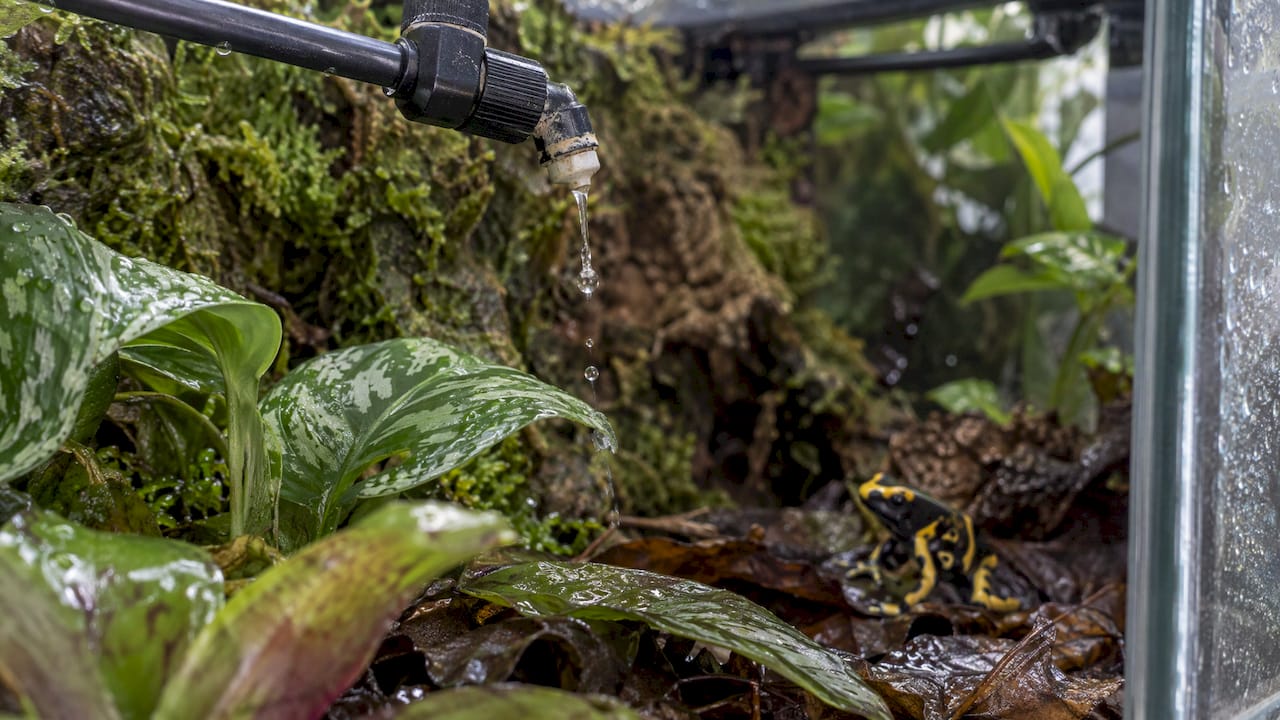
If water reaches the nozzle but the spray is thin, lopsided, or turns into drips, the nozzle is the suspect. Misting nozzles have a very small orifice, so even a little scale can distort the pattern.
Why nozzles block
The main cause in the UK is limescale. Water hardness varies a great deal across the country: one UK water hardness guide, drawing on water company test results, places the Thames catchment at around 250 to 350 mg/L of calcium carbonate, which is classed as very hard. If you are in London, the South East or East Anglia, scale builds quickly. In parts of Scotland, Wales and the north-west the water is much softer and nozzles tend to last longer between cleans.
Evaporated mist leaves dissolved minerals behind at the nozzle tip. Over weeks the orifice narrows, and spray gets weaker or uneven. Debris from a dirty reservoir can do the same job from the inside.
How to clean a nozzle without ruining it
- Switch off and release any pressure in the line.
- Unscrew the nozzle and take it out of its holder.
- Soak it in a descaling solution suited to the nozzle material. A mild acid such as diluted white vinegar is the usual choice for scale. Follow the maker’s guidance for soak times, and rinse thoroughly in clean water afterwards, because residue in a frog enclosure is not something you want.
- Rinse, refit, and run a test cycle with the output aimed away from the plants.
Do not push a pin, needle or wire through the hole. It is very easy to widen the orifice, and a widened nozzle will drip and spray coarsely for the rest of its life. If a soak does not restore the pattern, replace the nozzle. They are small, inexpensive parts and a better answer than a damaged one.
For the common MistKing-style brass nozzle, we have a full walkthrough: unclogging MistKing nozzles step by step.
Weak pressure rather than blockage
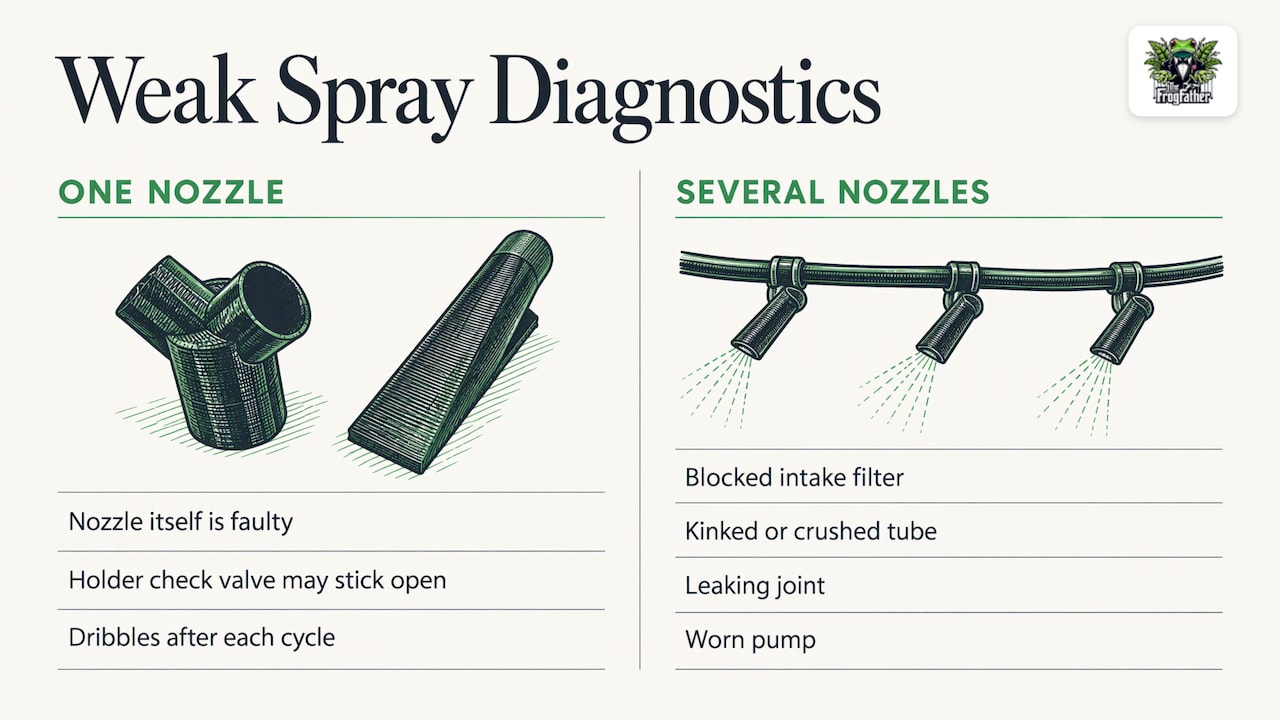
If several nozzles on one line all spray weakly, the problem is upstream of them. Look for a partly blocked intake filter, a kinked or crushed tube, a slow leak at a joint, or a pump nearing the end of its life. If only one nozzle misbehaves, it is that nozzle, or the check valve inside its holder if your system has them. A check valve that sticks open lets the line drain, so that nozzle dribbles after each cycle.
Why your tap water keeps causing the same fault
Cleaning nozzles over and over is treating the symptom. If you see scale on the glass as well as the nozzles, your water is feeding the problem, and our guide to removing limescale and watermarks from vivarium glass shows the same cause from the other side.
Many keepers move to reverse osmosis (RO) water, which has most of the dissolved minerals removed, for misting systems and then remineralise it where the frogs need it. Tap water in the UK may also contain chloramine, which behaves differently from chlorine, so it is worth reading our guide to water for dart frogs and tadpoles in the UK before you choose a source. For the reasoning behind remineralising, see why remineralisation matters in frog care.
Switching water source will not undo existing scale. Clean the nozzles and reservoir once, then change the water, and you should see the intervals between cleans stretch out noticeably.
Uneven spray coverage: it may not be a fault at all
Sometimes everything works and the vivarium is still wet in one corner and dry in another. Before you take apart a healthy system, check the layout.
- Nozzle angle. A nozzle that has rotated in its holder sprays the glass, the lid or the ceiling instead of the planting.
- Distance and direction. Mist aimed straight at a wall wets one patch. Aim across the enclosure so it spreads through the air and onto the leaves.
- Obstructions. A large leaf, a branch or a background panel can block the whole pattern.
- Number of nozzles. One nozzle on a tall or long enclosure will not cover it. Two nozzles at different positions give better distribution than one set to run for longer.
- Ventilation. Airflow carries mist. A vivarium with strong cross-flow on one side will dry out on that side first.
If you are using a humidifier-style system with a single outlet, a splitter and directional nozzles let you divide the output between two directions. Our dual-outlet splitter and directional nozzle set for the Habistat humidifier is 3D printed for this job.
Also ask whether the system is simply running too long. Over-misting makes a vivarium soggy, which is a different problem from under-misting. Our piece on whether you are overdoing misting helps you judge it, and the summer misting schedule for dart frogs in the UK gives a starting point for timing that you adjust to your own enclosure and species.
Holders, clips and probes: the small parts that cause big headaches
A lot of misting complaints turn out to be mechanical. Systems run for months, tubes sag, a nozzle gets knocked during maintenance, and the spray pattern quietly changes.
Nozzle holders. A good holder fixes the nozzle at the right angle and height and stops it rotating when you open the lid. Re-aim it after any cleaning, because unscrewing a nozzle often changes its position by a few degrees.
Tubing clips. Tubing under tension pulls on its joints. Over time that opens a tiny gap that lets air in, which brings you straight back to a priming problem. Clip tubing along the frame so its weight is carried by the clips and not by the push-fit connectors, and keep gentle curves rather than sharp bends, which can kink and restrict flow.
Probe holders. Temperature and humidity probes are how you tell whether the misting is doing its job. A probe sitting in the direct path of the spray will read far higher than the enclosure really is, and one tucked in a dead corner will read low. Position the probe at the height where your frogs spend their time, out of direct spray and away from heat sources, and hold it there so it does not drift. Tell yourself what the readings mean after the mist cycle ends, not during it.
We design and produce our own practical 3D-printed vivarium accessories, developed through everyday use in our frog rooms, so these small fixings are a part of what we make rather than an afterthought.
Working through the fault: a quick reference
| What you see | Most likely cause | First thing to do |
|---|---|---|
| Pump silent, no spray | Power, adapter or controller | Check plug, adapter and controller settings |
| Pump hums, no water out | Intake out of water, trapped air, blocked outlet | Switch off, check reservoir and intake, then prime |
| All nozzles sputter | Air in the line | Prime with output tubing disconnected |
| One nozzle weak or lopsided | Scale or debris in the orifice | Soak and rinse, do not poke |
| One nozzle dribbles after cycle | Sticking check valve or damaged nozzle | Clean or replace the nozzle or valve |
| Spray hits glass or lid | Nozzle has rotated | Re-aim and secure in its holder |
| Wet one side, dry the other | Layout, airflow or too few nozzles | Reposition or add a second nozzle |
| Probe reads wildly high | Probe in the spray path | Move and secure the probe |
Our view: fix the cause, not just the symptom
We spend a lot of time in our frog rooms, and the misting faults we meet are rarely dramatic. They are usually boring: a reservoir that has not been cleaned, a nozzle with scale on it, a tube that has crept loose. That is good news, because boring faults have boring fixes.
Our advice is to stay calm and work methodically. Do not wreck a working system by fiddling with several things at once. Change one thing, run a cycle, and watch what happens.
We would also say plainly that a misting system does not remove the need to look at your vivarium every day. Automation takes care of the routine, but you still have to check it, clean it and judge whether the humidity it creates suits your frogs. That is why we publish free husbandry guides and courses alongside the equipment we sell, and why we design our own 3D-printed accessories for the awkward little jobs, from holding a nozzle at the right angle to securing a probe, that we found needed doing in our own frog rooms.
If you are choosing or replacing a system, start with how you will clean and service it, not only how it looks when it is new.
Frogfather
Replace, upgrade or rethink the setup
Some systems are simply past their best, or the wrong size for the enclosure. If you are replacing yours, our guide to the best dart frog misting system in the UK sets out what to look for. For smaller enclosures, our Smart Spray humidifier and mysting system is one to look at.
It is also worth knowing that misting is not the only way to keep an enclosure humid. Our article on keeping dart frogs without a misting system explains the alternatives and when they fit.
Everything for the repair and the rebuild
If you are mid-fault and need parts, we supply directional nozzles and splitters, 3D-printed vivarium accessories, bioactive supplies, plants, microfauna, live food and supplements, and we build custom bioactive vivariums. We are a Nottingham-based UK specialist in dart frogs and bioactive vivariums, so we know what works in British homes, with British water.

You can browse the range on the Frogfather site, or start with the dual-outlet splitter and nozzle set if uneven spray is your problem.
FAQ
How long should I soak a misting nozzle in vinegar?
There is no single time that suits every nozzle, so follow the maker’s guidance for your nozzle material. Light scale often shifts in a short soak, while heavy build-up may need longer. Always rinse thoroughly in clean water afterwards and run a test cycle away from your frogs.
Why are my misters not working even though the tank is full?
A full tank does not prove that water is reaching the pump. The intake may have lifted out of the water, air may have entered the line, or a joint may be leaking air on the suction side. Switch off, check the intake is submerged and the connections are tight, then prime the pump.
Why is my misting nozzle spraying unevenly?
Most often the orifice is partly blocked with limescale or debris, or the nozzle has rotated in its holder. Clean the nozzle by soaking, then re-aim it and secure it. If the spray is still lopsided after cleaning, replace the nozzle rather than widening the hole.
Can I leave a faulty misting system running while I work out what is wrong?
No. Switch it off until the water path is confirmed, because a pump running dry can be damaged and an unchecked timer will keep firing. Run only short test cycles once you have made a change.
How often should I clean my misting system?
It depends on your water and your reservoir. Hard water areas need nozzle cleaning more often, and reservoirs should be cleaned on a regular routine. If you notice scale on the glass or a change in spray pattern, clean sooner.
Sources
Recommended
- The Truth About Misting Systems: Are You Overdoing It?
- Unclogging MistKing Nozzles: A Step-by-Step Guide For Optimal Performance In Your Vivarium
- How To Clean A Vivarium Misting Reservoir
- How To Set Smart Plug Timings In Seconds Using Sonoff And EWeLink (Perfect For Misting Systems)