One of the biggest misconceptions in dart frog keeping is that visibility is purely species-dependent.
People often say things like:
- “Tinctorius are bold”
- “Thumbnail frogs hide”
- “Auratus are shy”
There is some truth in that.
But after keeping and observing dart frogs for years, I do not think boldness is only about species. A huge amount of it comes down to environment, security and learned behaviour.
Two frogs from the same clutch can behave completely differently depending on how they are raised and housed.
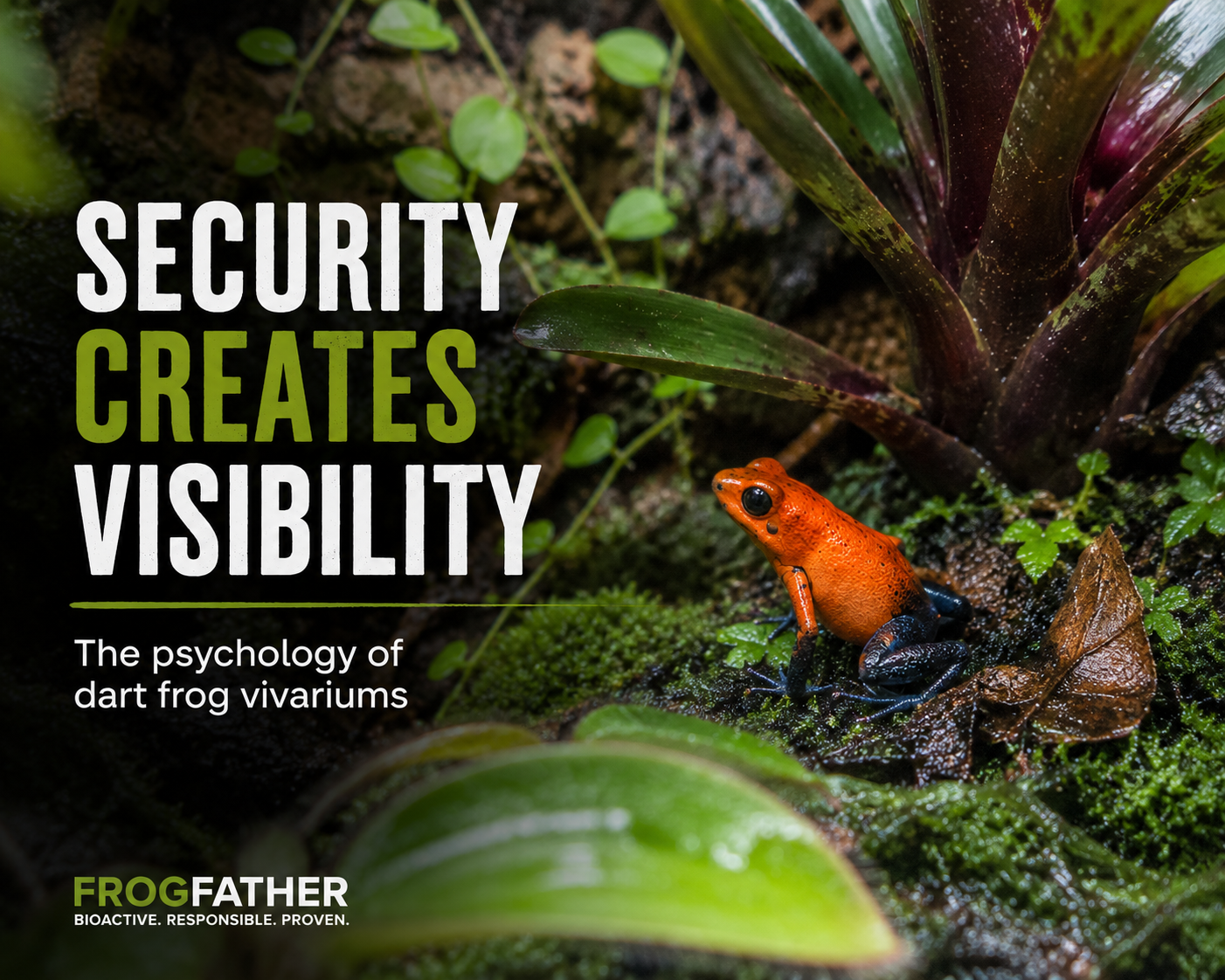
Security Creates Visibility
This sounds backwards initially.
Most people think a sparse vivarium will make frogs easier to see. In reality, the opposite often happens.
Dart frogs become more visible when they feel secure enough to move naturally.
That means:
- leaf litter cover
- visual barriers
- plant density
- multiple retreat options
- stable humidity
- predictable feeding routines
When frogs know they can disappear easily, they tend to spend more time out in the open.
This is one reason heavily planted vivariums often produce more visible frogs than sparse display setups.
Glass Boxes Create Psychological Stress
Dart frogs evolved in cluttered forest environments.
Most vivariums, even good ones, are still transparent boxes with movement outside on multiple sides.
If frogs constantly see large movement around them without enough visual cover, they often default to hiding behaviour.
This becomes especially noticeable in:
- minimalist vivariums
- overly bright enclosures
- tanks with poor planting density
- high-traffic rooms
Good background structure matters here. Cork bark, wood, moss walls and layered planting all help break sight lines.
Natural climbing structure also encourages exploratory behaviour. This is one reason textured backgrounds and planted bromeliad placement make such a difference in mature systems.
Feeding Behaviour Changes Confidence
Dart frogs learn routines surprisingly quickly.
Frogs that associate human presence with predictable feeding often become significantly bolder over time.
You can actually watch this happen.
Initially, frogs scatter when the enclosure opens. Months later, they move toward the front waiting for food.
This is especially common in frogs raised consistently on open feeding schedules using cultured fruit flies and microfauna-rich systems.
Stable feeding routines and proper supplementation also help maintain overall condition and activity levels. This is one reason I prefer structured supplementation systems such as the All-In-One Vitamin & Mineral Dust rather than inconsistent rotational dosing.
Bold Frogs Are Usually Comfortable Frogs
A frog sitting in the open is not automatically “happy”.
But frogs that consistently forage, explore and display natural movement patterns are usually more environmentally secure than frogs that remain hidden permanently.
Long-term hiding behaviour can sometimes indicate:
- poor cover
- social stress
- incorrect humidity
- overheating
- overly dry conditions
- aggressive tank mates
It is important to assess the whole enclosure rather than assuming a frog is naturally shy.
Tank Hierarchy Is Real
This is another thing people underestimate.
Dart frogs absolutely establish hierarchy and territory usage.
Sometimes one confident individual changes the behaviour of the entire enclosure.
In other situations, a dominant frog suppresses visibility in subordinate animals.
This is especially common in:
- tinctorius groups
- female-heavy pairings
- small floor spaces
- poorly structured vivariums
Adding vertical complexity and broken sight lines often reduces this tension dramatically.
Vivarium Design Shapes Behaviour
Some vivariums simply feel safer to frogs.
The most naturally active frogs are usually housed in systems with:
- deep leaf litter
- live planting
- stable humidity gradients
- soft airflow
- multiple elevated retreats
- diffused lighting
Overly sterile setups often produce cautious behaviour.
This is one reason mature bioactive systems tend to outperform freshly assembled display tanks over time.
As discussed in why some vivariums crash after 6–12 months, stable ecosystems influence everything from activity to feeding response.
Young Frogs Often Behave Differently
Froglets and juveniles are usually far more cautious than adults.
That is normal.
Smaller frogs are naturally more vulnerable and often rely heavily on cover during early growth stages.
As frogs mature and establish territory familiarity, confidence often increases naturally.
Can You Make Dart Frogs More Bold?
Sometimes.
Usually the answer is not handling them more. It is improving environmental confidence.
Things that genuinely help:
- heavier planting
- better leaf litter coverage
- consistent feeding times
- stable environmental conditions
- reduced sudden disturbance
- more climbing structure
Ironically, giving frogs more places to hide often results in seeing them more.
Sooo..
Dart frog behaviour is more dynamic than people realise.
Boldness is not simply a species trait. It is often the result of environmental security, routine and enclosure design.
The healthiest vivariums usually produce frogs that behave naturally rather than simply remaining visible for display.
Sometimes the goal should not be forcing frogs into the open.
It should be creating an environment where they choose to come out on their own.
Frequently Asked Questions
Why do my dart frogs hide all the time?
Constant hiding may be linked to insufficient cover, environmental stress, incorrect humidity, excessive disturbance or social hierarchy issues.
Do heavily planted vivariums make frogs harder to see?
Often the opposite. Frogs usually become bolder when they feel secure enough to move naturally through dense planting.
Are some dart frog species naturally bolder?
Yes, certain species tend to be more visible than others, but enclosure design and environmental stability strongly influence behaviour.
Can feeding routines affect dart frog confidence?
Yes. Frogs frequently learn predictable feeding routines and often become more confident around regular keeper interaction.
Do dart frogs establish hierarchy?
Yes. Dominance behaviour and territory usage are common, particularly in larger species and densely stocked enclosures.