Vivarium light risers might look like a simple accessory, but they solve several real problems in planted vivariums: wasted light, trapped heat, poor airflow, plant scorching and awkward UVB positioning.
At Frogfather, we originally made our own vivarium light risers for one very practical reason: we were getting too much light leakage from our vivariums. Strong LED bars were lighting the room as much as the enclosure, and we wanted more of that usable light going into the vivarium where the plants, moss, bromeliads and animals actually benefit from it.
After testing different versions across our own setups, we now use light risers on our vivariums as part of our normal lighting approach. They are not just a neat 3D-printed add-on; they are a simple way to improve ventilation, convection, light direction and overall vivarium performance.
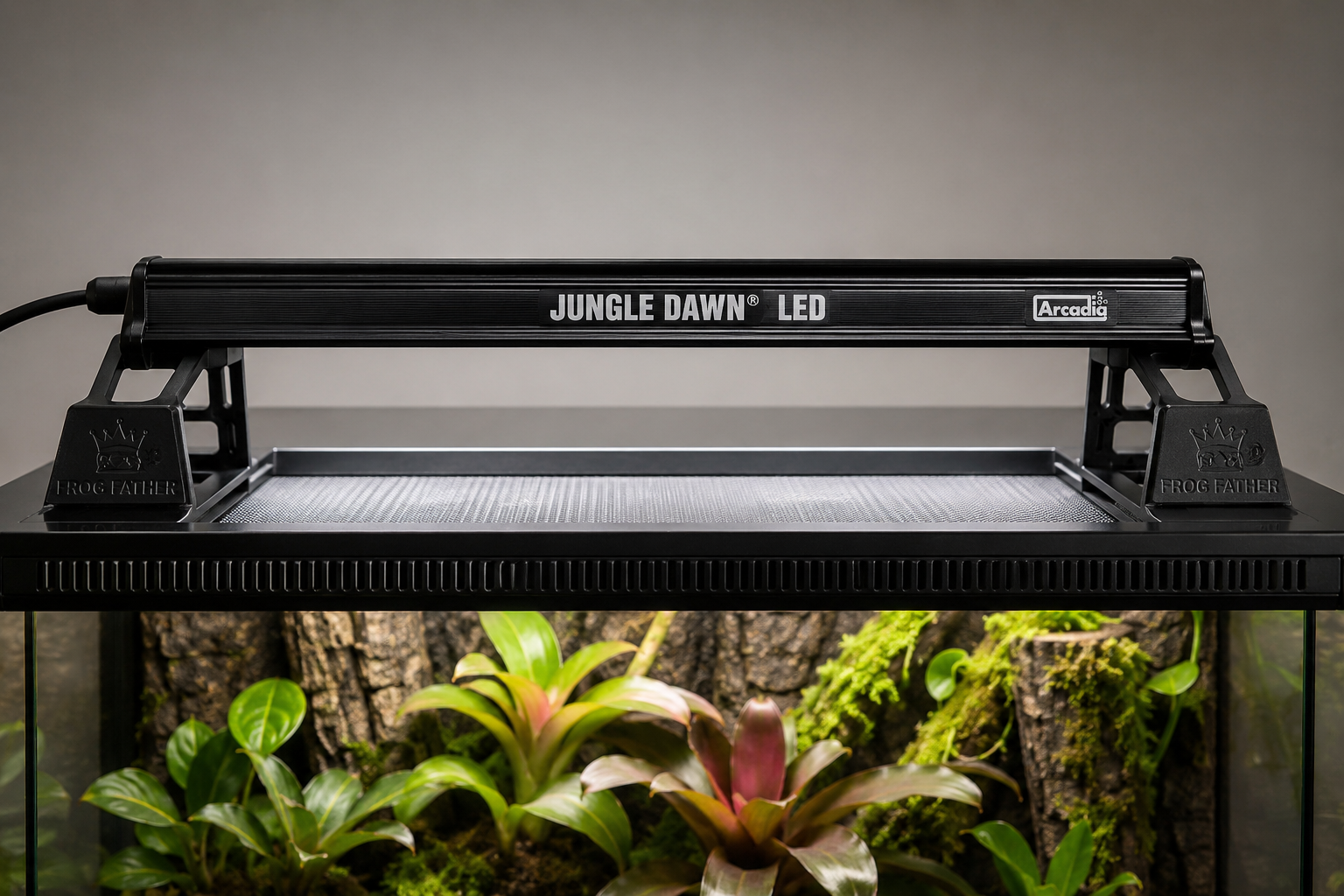
We make several versions depending on the light and setup, including our Arcadia Jungle Dawn LED 3D printed light risers, our angled light riser for Arcadia Jungle Dawn LED units, and our Arcadia Lumenize T5 light risers.
What Is a Vivarium Light Riser?
A vivarium light riser, sometimes also called a vivarium light stand, terrarium light riser, light spacer or vivarium lighting mount, is a small stand or bracket that raises a lighting unit above the top of a vivarium.
They are commonly used with:
- Arcadia Jungle Dawn LED bars
- Arcadia Lumenize lighting
- T5 UVB fixtures
- LED plant lights
- Bioactive vivarium lighting
- Terrarium grow lights
Instead of the light sitting directly on the glass, mesh or top panel, the riser creates a controlled gap. That gap allows air to move, heat to escape, and light to spread more naturally into the vivarium.
Why We Started Making Light Risers for Our Own Vivariums
Like a lot of useful vivarium accessories, our light risers started as a simple fix to a problem we were having ourselves.
We run a lot of vivariums, and when you have multiple strong lights running at once, light leakage becomes obvious. LED bars can spill light sideways into the room, create glare, and waste a lot of useful output. That might not sound like a big issue on one vivarium, but across several setups it becomes annoying and inefficient.
We wanted to:
- reduce sideways light leakage
- focus more light into the vivarium
- improve airflow around the light fitting
- reduce heat trapped above the enclosure
- protect plants close to the top of the vivarium
- create a cleaner and more controlled lighting setup
So we began designing and testing our own 3D printed vivarium light risers. The result was a small but genuinely useful upgrade that we now use across our own Frogfather vivariums.
Better Ventilation Above the Vivarium
One of the biggest benefits of using a vivarium light stand is improved airflow above the enclosure.
When a powerful LED or T5 unit sits directly on top of a vivarium, heat can become trapped between the fixture and the lid. This is especially noticeable with glass tops, tight-fitting canopies, or setups where the lighting unit covers a large area.
By raising the light slightly, you create space for air to move. Warm air can rise and escape, while cooler air can move underneath the light. This natural movement of air is called convection.
That improved airflow can help with:
- reducing heat build-up
- improving passive ventilation
- reducing stagnant warm air
- limiting condensation above the vivarium
- helping lights run in a better airflow zone
This is especially useful for dart frog vivariums and tropical bioactive setups where you want stable humidity inside the vivarium, but not unnecessary heat trapped directly above it.
Reducing Plant Scorching from Strong Lights
Modern vivarium lighting is powerful. That is great for growing tropical plants, mosses, bromeliads and shingling species, but it can also create problems if the light is too close.
Plants near the top of the vivarium may show signs of stress, including:
- browning leaf edges
- bleached patches
- crispy new growth
- moss drying back
- bromeliads becoming stressed directly under the light
A terrarium light riser increases the distance between the fixture and the plants. This helps soften harsh hotspots and spread the light more evenly across the enclosure.
This does not mean weakening the setup. In many cases, it makes the light more usable. Instead of one very intense hotspot, you get a more balanced spread that supports healthier plant growth throughout the vivarium.
If you are growing plants such as Marcgravia, Ficus pumila, bromeliads, miniature orchids, Begonia species or shingling plants, a better lighting position can make a noticeable difference. You can also support plant growth with our bioactive vivarium plant bundle and paint-on tropical moss starter.
Angled Light Risers Help Focus Light Into the Vivarium
Not all light risers are just straight spacers. Angled designs can be particularly useful because they help direct more of the light into the vivarium rather than allowing it to escape sideways.
This is one of the main reasons we like them.
With planted vivariums, you often want light reaching:
- the back wall
- vertical planting areas
- bromeliads
- moss panels
- epiphytic plants
- lower planting zones
- shingling plants
An angled vivarium light riser can help focus the beam where it is actually needed. In taller vivariums, even a small change in angle can alter where the brightest area lands.
Our angled light riser for Arcadia Jungle Dawn LED units was designed with exactly this kind of practical use in mind: reducing wasted light and helping more of the output reach the vivarium.
Do Light Risers Help Plant Growth?
Yes, they can help support plant growth when used with a suitable light.
A riser will not turn a poor light into a good one, but it can help a good light work more effectively. By improving distance, airflow, angle and spread, more of the vivarium can receive useful light.
In our own vivariums, the goal is not simply to blast the enclosure with as much brightness as possible. The goal is to create balanced, usable light that supports plant growth without overheating the top of the vivarium or scorching delicate plants.
This is especially important in bioactive builds where plants are not just decoration. They help stabilise the environment, support humidity, use nutrients, provide cover and make the vivarium feel more natural.
For background planting and naturalistic setups, our bioactive terrarium and vivarium background clay is often used alongside strong lighting and moss growth to create more established-looking displays.
Using Light Risers with Arcadia Jungle Dawn LEDs
The Arcadia Jungle Dawn is one of the most popular LED lights for planted vivariums, dart frog enclosures and tropical bioactive setups. It produces strong visible light and is widely used for plant growth.
However, because Jungle Dawn LEDs are powerful, many keepers find that they benefit from being raised slightly above the vivarium. A Jungle Dawn light riser can help reduce glare, improve airflow and create a better spread of light across the enclosure.
For standard setups, see our Arcadia Jungle Dawn LED 3D printed light risers. For setups where you want to direct light more deliberately into the vivarium, see our angled Arcadia Jungle Dawn light riser.
Using Light Risers with Arcadia Lumenize and T5 UVB Units
T5 UVB units and Arcadia Lumenize lighting are also commonly used above vivariums. These setups often need more careful positioning because UVB output and light intensity depend on distance, angle, mesh obstruction and the species being kept.
A T5 vivarium light stand helps hold the unit in a more controlled position rather than having it sit directly on top of the vivarium.
This can help with:
- stable fixture placement
- improved airflow around the unit
- better spacing from the vivarium top
- more controlled UVB positioning
- reduced heat transfer into the enclosure
For these setups, see our Arcadia Lumenize T5 light risers and our 3D printed Arcadia T5 light risers.
If you run both plant lighting and UVB together, our double light riser for Arcadia Jungle Dawn LED and T5 units is designed for mixed lighting setups.
Do Vivarium Light Risers Help with UVB?
They can help with positioning, but they should be used sensibly.
UVB is affected by bulb strength, reflector type, distance, mesh, glass, angle and species requirements. A riser is not a replacement for correct UVB planning, but it can help place the fixture in a more consistent and controlled position.
This is particularly useful for keepers using T5 UVB over arboreal reptiles, tree frogs, day geckos or other species where careful exposure matters.
Always check the requirements of the animal being kept, and where possible, use proper measuring equipment to confirm UVB levels.
Wall Mounts and Alternative Lighting Options
Some setups benefit from wall-mounted lights rather than top-mounted risers. This can be useful where space is tight, where the lid design is awkward, or where the light needs to be positioned in a specific way.
For these setups, we also make Arcadia Jungle Dawn LED wall mounts and 3D printed wall mounts for Arcadia T5 lights.
The best option depends on the vivarium, the light, and what you are trying to achieve. Some keepers need more airflow. Some need less glare. Some want to angle the light into a planted back wall. Others simply want a neater and more stable lighting setup.
Why Light Risers Are Useful for Dart Frog Vivariums
Dart frog vivariums are usually humid, heavily planted and carefully balanced. They need good plant growth, but they also need sensible temperatures, stable humidity and decent air exchange.
A vivarium light riser can support that balance by:
- keeping strong lights slightly away from the vivarium top
- reducing heat transfer into the enclosure
- allowing better airflow above the lid
- reducing harsh lighting directly on delicate plants
- focusing more usable light into the vivarium
- reducing light leakage into the room
This is why we use them on our own Frogfather vivariums. They are a simple upgrade, but they solve several common issues at once.
If you are setting up a larger display, you may also be interested in our Euro bioactive vivariums or our custom bioactive vivarium builds.
Are 3D Printed Vivarium Light Risers Safe?
3D printed light risers can be safe and effective when they are designed properly and used with suitable lighting.
The main things to consider are:
- the material used
- the temperature of the light fitting
- the weight of the light
- the stability of the riser
- whether the riser is suitable for that specific fixture
- whether the light produces excessive heat
Most LED vivarium lights run far cooler than traditional heat lamps, but they can still become warm. Light risers should not be used with inappropriate heat sources, and all equipment should be checked regularly as part of normal vivarium maintenance.
Our risers are designed around the types of lighting we use ourselves, including Arcadia Jungle Dawn, Arcadia Lumenize and T5-style fixtures.
Light Risers Are a Simple Fix for a Common Vivarium Problem
The reason we like light risers is simple: they solve real problems without making the setup complicated.
They help reduce light leakage, improve ventilation, support convection, protect plants from scorching, improve fixture positioning and focus more usable light into the vivarium.
We originally made them for our own vivariums, tested them in daily use, and now use them across our own setups because they make lighting easier to manage.
If you are already using strong plant lights, UVB or Jungle Dawn LEDs over a planted enclosure, a vivarium light riser or vivarium light stand is one of the simplest upgrades you can make.
Explore our current light risers here: Arcadia Jungle Dawn LED light risers, angled Jungle Dawn light risers, Arcadia Lumenize T5 light risers, and double LED and T5 light risers.
FAQ: Vivarium Light Risers
What is a vivarium light riser?
A vivarium light riser is a stand, spacer or bracket that raises a lighting unit above a vivarium. It helps improve airflow, reduce heat build-up, reduce light leakage and improve the way light enters the enclosure.
What is the difference between a vivarium light riser and a vivarium light stand?
The terms are often used in a similar way. A light riser usually lifts the fixture slightly above the vivarium, while a light stand may describe a taller or more structural support. In practice, both are used to position lighting more effectively.
Do vivarium light risers reduce heat?
Yes. By lifting the light away from the vivarium top, a riser allows warm air to escape more easily and improves natural convection above the enclosure.
Can a light riser help stop plants scorching?
Yes. Raising the light can reduce harsh hotspots and spread the light more evenly, which may help protect sensitive tropical plants, mosses and bromeliads from scorching.
Do angled light risers improve plant growth?
Angled light risers can help direct more usable light into the vivarium, especially towards back walls, planting zones and vertical surfaces. This can support better plant growth when paired with suitable lighting.
Are vivarium light risers useful for dart frog vivariums?
Yes. Dart frog vivariums benefit from strong plant growth, stable temperatures and good ventilation. Light risers can help support all three by improving airflow and reducing excess heat from lighting.
Can I use a vivarium light riser with an Arcadia Jungle Dawn?
Yes. Many keepers use risers with Arcadia Jungle Dawn LED bars to reduce glare, improve airflow and create a better spread of light across the vivarium.
Can I use a light riser with a T5 UVB unit?
Yes, but UVB positioning should always be planned carefully. A riser can help position the unit, but you should still consider species requirements, mesh obstruction, distance and UVB output.
Are 3D printed light risers suitable for vivariums?
3D printed light risers can be suitable when made from appropriate material and used with compatible lighting. They should be stable, heat-aware and checked regularly like any other vivarium accessory.
Do light risers stop light leakage?
They can help reduce light leakage, especially angled designs that direct more of the light down into the vivarium instead of allowing it to spill sideways into the room.