
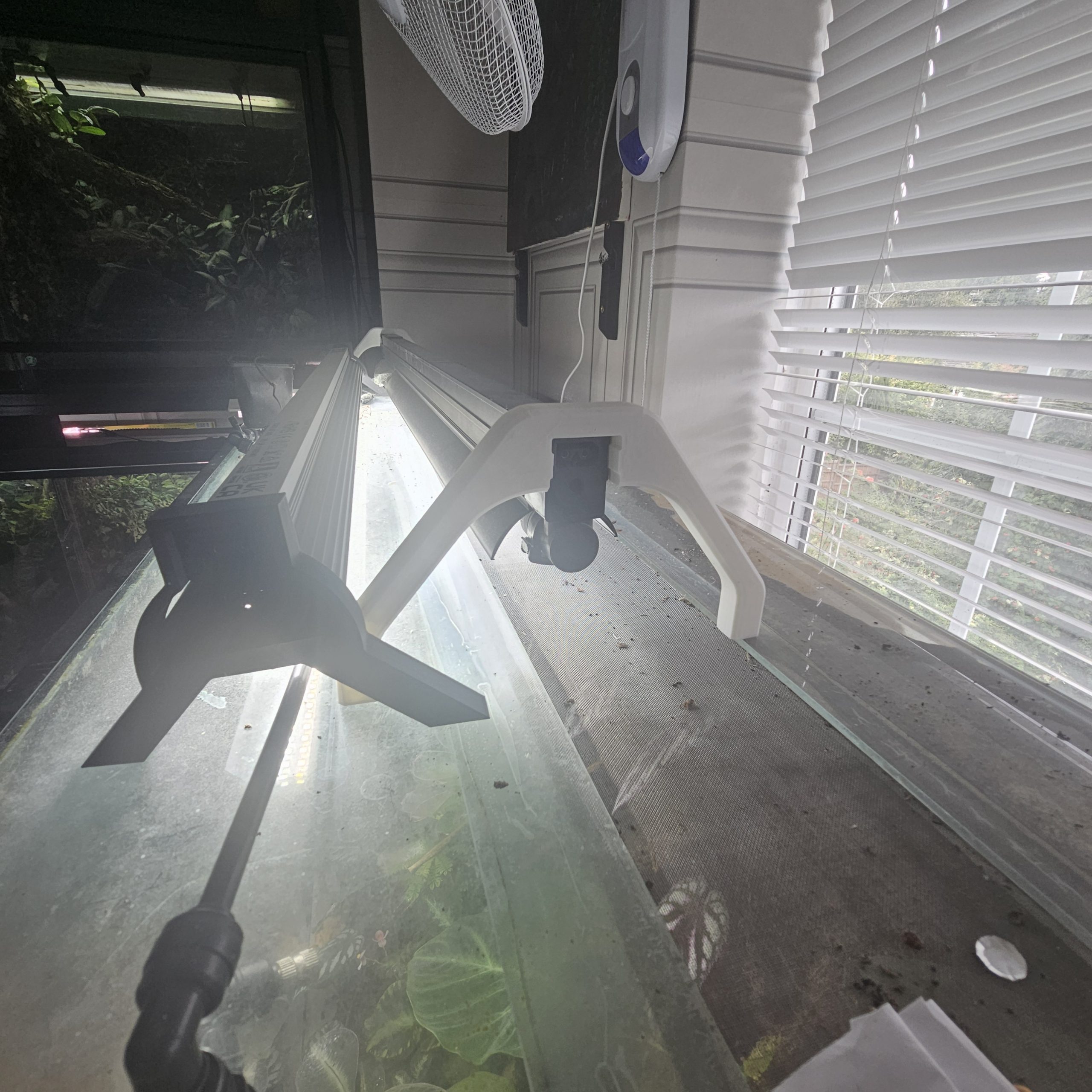
Description
Arcadia LumenIZE® T5 Light Risers – a practical way to lift your Arcadia LumenIZE® T5 lighting unit for better heat dissipation, improved spread, and a professional vivarium display. Designed and 3D printed in the UK by The Frogfather, these risers give your enclosure lighting the clearance it needs without the wobble of makeshift supports.
Why use light risers?
- Lighting position – raises your Arcadia LumenIZE® T5 fitting so light reaches plants, reptiles, or amphibians evenly.
- Better airflow – helps prevent overheating by allowing air to circulate around the fitting.
- Protects your enclosure – reduces direct heat on mesh tops and plastic frames.
Key features
- Compatible with Arcadia LumenIZE® T5 lighting units.
- Sold as a pair (one for each end of your unit).
- 3D printed from durable, heat-resistant PETG.
- Made in the UK by The Frogfather – supporting small business innovation.
Perfect for bioactive enclosures
These light risers are ideal for dart frog, gecko, snake, and planted terrarium setups. Whether you keep poison dart frogs, tropical lizards, or rare orchids, your LumenIZE® T5 will sit securely above your tank, giving your lighting the perfect elevation for lush growth and healthy animals.
Installation
Simply slot the Arcadia LumenIZE® T5 fitting into the risers, place them on your vivarium or terrarium top, and enjoy an instant upgrade to your lighting setup.
Experience the Frogfather difference
We don’t just sell products – we use them. Every design is tested in real-life enclosures to make sure it’s safe, sturdy, and does the job right.
UVB & Lighting Safety Review
Last reviewed: 5 September 2026
This product guidance has been reviewed against peer-reviewed amphibian UVB/vitamin D research and current Frogfather husbandry guidance.
Important: a riser, stand or mount positions a lamp; it does not by itself establish a safe or appropriate UVB exposure. UVB reaching an animal depends on the lamp and reflector, distance, mesh or other obstruction, angle, enclosure layout and the species being kept. Where UVB is used, provide a gradient with effective shade and assess exposure at animal level rather than choosing a setup from the percentage printed on the lamp alone.
Published amphibian evidence supports a biological role for UVB and vitamin D3, but does not establish one universal UVB requirement or one fixed lamp percentage/distance for all amphibians or all dart frogs.
Evidence & further reading
- Antwis & Browne (2009) – Ultraviolet radiation and vitamin D3 in amphibian health
- Tapley et al. (2015) – Meeting ultraviolet B radiation requirements of amphibians in captivity
- Ferrie et al. – Nutrition and Health in Amphibian Husbandry


