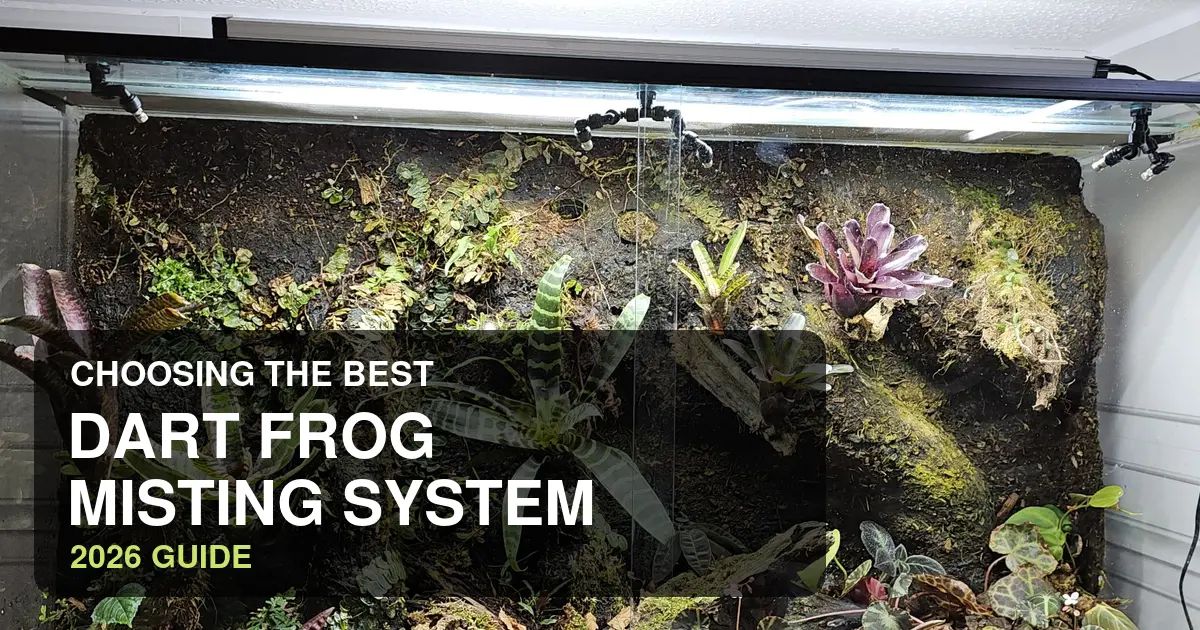

“Once it’s bioactive, it pretty much looks after itself.”
Honestly… this single idea has probably caused more slow-burn dart frog vivarium failures than almost anything else.
It sounds believable too.
Add substrate. Chuck in springtails. Sprinkle isopods. Plant it heavily. Mist it. Maybe add leaf litter. Stand back and admire your tiny rainforest.
And to be fair… at first?
It often looks brilliant.
Plants settle in. Humidity feels stable. Glass fogs nicely. Microfauna seem active. Frogs explore.
So people assume:
“Perfect. Nature’s doing its thing now.”
Not quite.
Because bioactive does not mean self-sustaining.
It means biologically active.
That’s a massive difference.
A proper bioactive dart frog vivarium is more like managing a functioning ecosystem than building a decorative terrarium. It absolutely can become more stable, more resilient, and healthier than sterile setups… but “maintenance-free” is mostly fantasy.
And this myth catches loads of keepers out because bioactive systems often fail slowly, quietly, and in ways that look fine… until they really aren’t.
The biggest misunderstanding: bioactive isn’t magic
Bioactive has become one of those hobby words that sometimes gets treated like a cure-all.
But here’s the reality:
Bioactive doesn’t remove maintenance — it changes the type of maintenance.
Instead of constantly deep-cleaning sterile waste, you’re managing:
- Biological balance
- Moisture gradients
- Microfauna populations
- Substrate health
- Nutrient cycling
- Leaf litter replenishment
- Plant growth
- Airflow
- Long-term decomposition
That’s often better for dart frogs… but only if you understand what’s actually happening.
Otherwise, “bioactive” can become a slow decline hidden under green plants and damp moss.
What bioactive actually means
At its best, a bioactive dart frog vivarium is a living system where:
- Microfauna break down organic waste
- Plants utilise nutrients
- Leaf litter supports decomposition
- Moisture cycles stabilise
- Beneficial microbes outcompete some harmful imbalances
- Frogs benefit from naturalistic cover and humidity
Notice something important there?
None of that says:
“No intervention required forever.”
Because every part of that system can shift.
Sometimes brilliantly.
Sometimes badly.
The “set and forget” mistake
This is where people usually go wrong.
They build a nice-looking dart frog setup, then assume the ecosystem will indefinitely regulate itself without structured observation.
Common pattern:
Month 1–3:
- Looks amazing
- Humidity high
- Plants decent
- Microfauna visible
Month 4–8:
- Leaf litter thinning
- Substrate compacting
- Plant growth slowing
- Springtail numbers fluctuate
- Hidden waste pockets form
Month 9–18:
- Drainage inefficiency
- Biological slowdown
- Dry pockets or anaerobic zones
- Microfauna crashes
- Plant decline
- Frog behaviour shifts
And because decline is gradual, many keepers don’t notice until symptoms are obvious.
Substrate collapse: the silent issue nobody talks about enough
Substrate isn’t immortal.
This one matters massively.
Over time, even well-built substrate layers break down physically and biologically.
Organic materials decompose. Fine particles compact. Air pockets reduce. Water movement changes. Nutrient ratios shift.
This can lead to:
- Compaction
- Root suffocation
- Wet pockets
- Dry pockets
- Anaerobic areas
- Reduced microfauna efficiency
- Mould spikes
From above, the vivarium may still look lush.
Underneath?
It may be gradually losing function.
This is why mature bioactive substrate systems still need periodic assessment and occasional intervention.
Microfauna booms… and crashes
Springtails and isopods are brilliant.
But they aren’t invincible.
A lot of people treat them like permanent little janitors that just endlessly multiply.
Reality’s more nuanced.
Microfauna populations fluctuate based on:
- Moisture
- Food sources
- Temperature
- Competition
- Predation
- Substrate age
- pH shifts
- Mould levels
Common issues:
- Overly wet = drown-outs or imbalance
- Too dry = crashes
- Leaf litter depletion = food bottleneck
- Protein overload = mould
- Poor diversity = weak resilience
This is why even excellent springtail systems often need active support.
Bioactive means dynamic… not permanent autopilot.
Leaf litter: not decoration, but fuel
Leaf litter often gets treated like garnish.
It really isn’t.
In many dart frog vivariums, leaf litter is foundational infrastructure.
It provides:
- Microfauna food
- Humidity buffering
- Frog cover
- Decomposition layers
- Microbial complexity
- Nutrient cycling
When litter fully breaks down and isn’t replenished, systems often quietly weaken.
This can trigger:
- Reduced microfauna
- Drier surfaces
- Lower behavioural security
- Biological slowdown
That’s why products like proper tropical leaf litter aren’t cosmetic upsells — they’re part of maintaining function.
Drainage layers aren’t immunity shields
There’s also this weird beginner assumption:
“I added drainage, so water problems are solved.”
Not necessarily.
Drainage layers help… but they don’t automatically fix:
- Overmisting
- Poor substrate structure
- Compaction
- Airflow issues
- Nutrient stagnation
A neglected drainage layer can eventually become more like a hidden reservoir than a true management tool.
Bioactive still needs monitoring.
Plants can hide ecosystem decline
This one catches loads of people.
Plants can survive while your biological system underperforms.
So a green vivarium doesn’t automatically mean a healthy vivarium.
You may still have:
- Substrate degradation
- Weak nutrient cycling
- Microfauna reduction
- Poor root oxygenation
- Excess waste accumulation
This is why “looks good” can be misleading.
Function matters more than aesthetics.
Frogs often show problems last
Here’s the dangerous bit:
Dart frogs often don’t immediately scream “system failure”.
Instead, you may see subtle changes:
- More hiding
- Reduced boldness
- Lower calling
- Poor breeding
- Dry skin issues
- Feeding inconsistency
By the time frogs visibly struggle, environmental issues may have been brewing for months.
This is why proactive system maintenance matters so much more than reactive fixes.
What real bioactive maintenance actually looks like
Healthy bioactive keepers usually:
Weekly:
- Check moisture gradients
- Observe frog behaviour
- Assess microfauna visibility
- Spot mould trends
- Monitor plant growth
Monthly:
- Top up leaf litter
- Prune plants
- Check drainage
- Support springtail cultures
- Inspect substrate condition
Long-term:
- Refresh biological zones
- Address compaction
- Rebuild weak areas
- Replenish clean-up crew
Notice that?
Not sterile cleaning.
Ecological management.
Bioactive maturity vs bioactive stagnation
A mature vivarium improves over time.
A stagnant vivarium slowly degrades.
The difference is usually active stewardship.
Mature systems often show:
- Stable plant growth
- Reliable microfauna
- Healthy litter cycling
- Good frog visibility
- Balanced moisture
Stagnant systems often show:
- Static plants
- Thin litter
- Wet/dry extremes
- Population crashes
- Behaviour shifts
Signs your bioactive vivarium is quietly failing
- Persistent smell
- Compacted substrate
- Sudden mould spikes
- Dry lower layers
- Surface-only humidity
- Weak springtail numbers
- Plant stagnation
- Increased frog hiding
- Drainage flooding
The honest truth most people need to hear
Bioactive is not a shortcut.
It’s usually a better long-term system… but only when actively understood.
You’re not building a self-cleaning box.
You’re building a living enclosure that needs ecological guidance.
That might sound like more work… but honestly?
Once you actually understand it, it usually becomes easier, more rewarding, and dramatically healthier than constantly firefighting bad setups.
The Frogfather perspective
The goal shouldn’t be “maintenance-free”.
It should be:
Stable, thriving, resilient, and understood.
That’s where real dart frog care starts separating from surface-level setup trends.
If you’re building or rebuilding a bioactive dart frog vivarium, understanding this myth early can prevent substrate crashes, humidity issues, and behavioural problems before they become expensive lessons.
FAQ: Bioactive dart frog vivarium myths
Is a bioactive vivarium self-sustaining?
No. It can become more stable and naturalistic, but still requires monitoring, replenishment, and ecological maintenance.
Do springtails and isopods remove all waste?
No. They help process organic material, but systems still require balance and oversight.
How often should bioactive substrate be replaced?
Not on a fixed timer, but substrate condition, compaction, smell, and function should guide intervention.
Why does my bioactive vivarium still smell?
Usually imbalance, trapped waste, airflow issues, or substrate decline.
Can plants alone keep a vivarium healthy?
No. Plants help massively, but full ecosystem health depends on substrate, microfauna, moisture, and maintenance.
What’s the biggest bioactive mistake?
Assuming “bioactive” means “ignore it now”.