
Yes, most frogs can swim, and many are very good at it. Their long hind legs and webbed feet are built to push water backwards. But “frog” covers hundreds of very different animals, and the dart frogs in our vivariums are not the strong swimmers you might picture. If you keep tropical amphibians, the useful question is which kind of frog you have and how deep its water can safely be.
TL;DR
- Most frogs swim by kicking both hind legs backwards together. The webbed feet work as independent paddles.
- Frogs can breathe through their skin, but adults still need to reach the surface or a way out of the water.
- Species differ. Clawed frogs are fully aquatic, many true frogs are semi-aquatic, and dart frogs are terrestrial.
- In a dart frog vivarium, keep water shallow, give easy exits and put plenty of cover around any water feature.
- Tadpoles are the exception: they live entirely in water and need it to be clean and stable.
Table of Contents
- How frogs swim
- Can frogs go under water, and how do they breathe?
- Not every frog swims equally well
- What this means for a dart frog vivarium
- Tadpoles: the part of the life cycle that does swim
- Starting with frogs that suit your setup
- Where we can help
- Our view
- FAQ
- Sources
How frogs swim
The classic frog stroke looks a lot like a human breaststroke. The frog draws its legs up, then extends them hard. Heavily muscled hind limbs and webbing between the toes give a large foot area, so each kick pushes a lot of water backwards.
Researchers have measured what happens in the water. In a 2005 Journal of Experimental Biology study of swimming green frogs, each foot left its own ring-shaped vortex in the wake. The average thrust from both kicking legs was about 0.10 newtons. The feet did not clap together to jet water out, so the two legs behave as independent propellers.
Gait also changes with speed. Work reported in Nature in 2002 found that frogs usually kick both legs at once, but use alternating kicks when swimming slowly. Why they switch is still debated: it may save energy, or it may be needed to produce enough power at speed.
The forelimbs help too. When a frog paddles leisurely, the front legs can move alternately to assist and steer. When it surfaces to breathe, only the tip of the snout with the nostrils may break the surface.
Tadpoles swim differently. They have no legs to kick, so they use a large tail fin moved from side to side for thrust, and they breathe with gills until metamorphosis.
Can frogs go under water, and how do they breathe?
Yes. Frogs have moist, thin skin, and the RSPCA notes that common frogs can breathe through their skin as well as their lungs, which is how they can stay under for a long time. A physiology study from 2013 found that amphibians routinely take 20% to 85% of their oxygen needs through the skin. In frogs that hibernate underwater, skin is the only route for oxygen during that time.
How long is long? Figures you will see online, such as 4 to 7 hours for most frogs, are a rough guide for species that overwinter in water, and they depend heavily on temperature and activity. Warm, active frogs use far more oxygen than cold, resting ones. In the same physiology paper, adult African clawed frogs dived for about 40 minutes and then needed roughly 20 minutes to recover, because skin exchange alone could not cover their full needs.
The practical point is that skin breathing is not a licence to leave an adult frog in deep water. The Victorian government’s wildlife guidance says frogs are great swimmers but must come up to breathe, or they drown. Wildlife rescuers see the same thing: Tiggywinkles warns that putting a frog or toad in a waterproof box full of water is a common mistake, because they will drown if they cannot get out. Damp vegetation or a damp sponge is the safer choice.
Not every frog swims equally well
Common names are a poor guide to behaviour. A paper on amphibian biology and husbandry in the ILAR Journal points out that some animals called frogs are fully aquatic, some are semi-aquatic and some are fully terrestrial. It names Xenopus as aquatic, the Ranidae as semi-aquatic and the Dendrobatidae, the dart frogs, as terrestrial.
| Group | Lifestyle | What it means for water |
|---|---|---|
| Clawed frogs (Xenopus) | Fully aquatic | Live in water; deep tanks are normal |
| True frogs (Ranidae, such as common and green frogs) | Semi-aquatic | Strong swimmers that move between land and water |
| Dart frogs (Dendrobatidae) | Terrestrial | Need moisture and shallow water, not swimming space |
Some species swim poorly even by amphibian standards. The Brazilian pumpkin toadlet has tiny inner-ear canals that impair its balance and is almost incapable of swimming. The lesson for keepers is to research your actual species rather than assume that a frog is a swimmer.
What this means for a dart frog vivarium
Dart frogs belong to the terrestrial group. They hop, climb and forage on leaf litter, bromeliads and bark. They are not built to paddle for long, and a tired frog in deep water is at real risk. Our guide to why even shallow water can be dangerous for dart frogs goes into this in more depth.
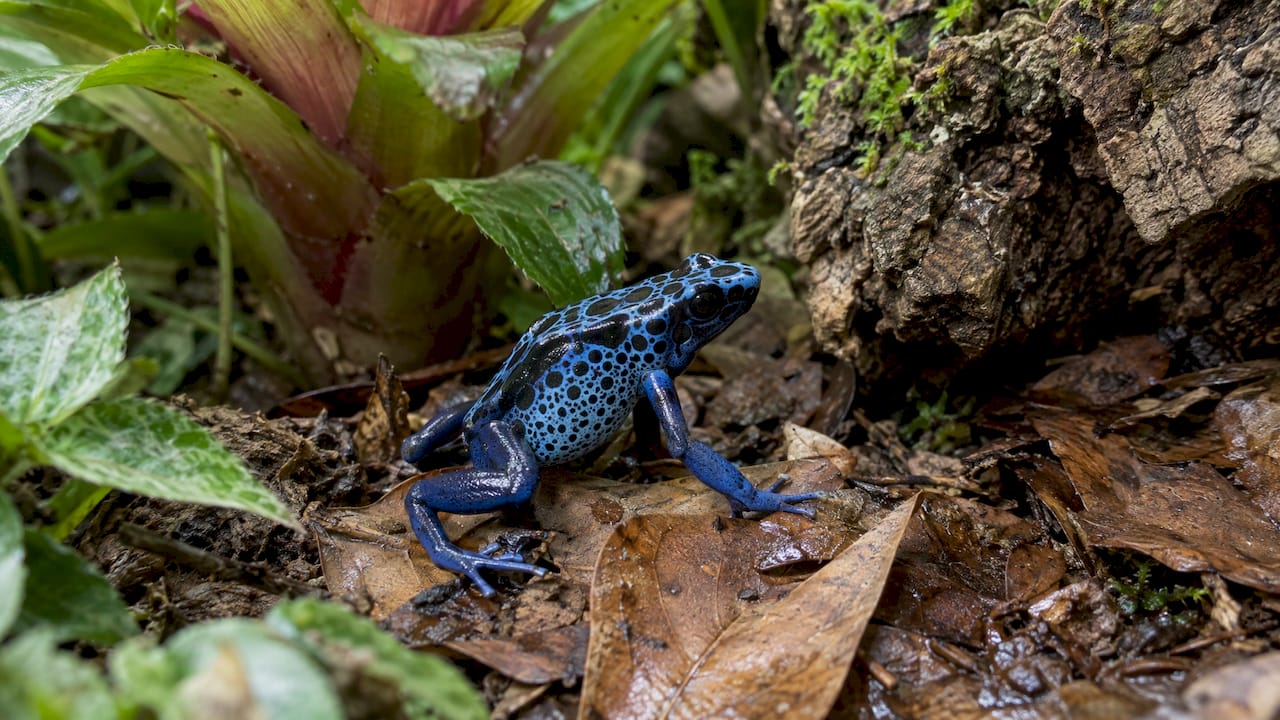
That does not mean water is a problem. Dart frogs do use water: they soak, they need humidity, and many species deposit tadpoles in small pools. Seeing a frog sitting in water is often normal, and our article on why a dart frog sits in water helps you tell normal soaking from a warning sign.
A sensible checklist for water in the enclosure
- Keep it shallow. A water dish or pool should be shallow enough that the frog can stand with its head clear. Judge by the smallest, weakest frog in the enclosure, including newly morphed froglets.
- Give every edge an exit. Use gently sloping stones, cork, or leaf litter and plants leading to the rim, so a frog can climb out from any point.
- Avoid slippery, steep sides. Smooth glass or plastic walls are hard to climb with wet feet. Add texture or placed materials.
- Use clean, suitable water. Water quality matters for a skin-breathing animal. Our piece on the role of remineralisation in frog care explains why.
- Check often. Look at water features daily. Debris, a collapsed plant or a moved stone can turn a safe pool into a trap.
- Keep the lid secure. A frog that escapes ends up in unfamiliar surroundings, so it pays to prevent it. See what to do about an escaped frog.
Bioactive enclosures are not maintenance-free. Water features, drainage layers and plants all need regular checking, and steady, observant care beats clever setups every time.
Tadpoles: the part of the life cycle that does swim
Dart frog tadpoles are fully aquatic until metamorphosis, so the rules reverse. They need water deep enough to stay immersed, stable and clean, with something to hold onto as they develop. Small pools such as our tadpole deposition pool are designed for the way dart frogs deposit tadpoles. If tadpoles are struggling, our guide to tadpoles dying in a vivarium walks through the usual causes in order.

Once a tadpole becomes a froglet, the situation flips again. It loses its tail and gills, starts breathing air and leaves the water. From that point it is a terrestrial animal, and the water in its grow-out space needs to be minimal. Our article on why young dart frogs die in grow-out tubs covers the risks keepers miss at this stage.
Starting with frogs that suit your setup
If you are new to the hobby, choosing a species and setting up the enclosure before the frogs arrive is the single best way to avoid water mishaps. Our dart frog care sheet covers the basics, and our guide to buying frogs in the UK responsibly explains what to look for in a seller.
Where we can help
We are a Nottingham-based specialist in dart frogs, bioactive vivariums and tropical animal care. We breed dart frogs in the UK, build custom bioactive vivariums and supply plants, springtails, isopods, live foods, supplements and enclosure supplies, plus our own 3D-printed vivarium accessories. If you want a setup with sensible water features from the start, start with our range. You can also look at captive-bred juveniles such as Ameerega bassleri “Sisa” or Dendrobates tinctorius ‘Azureus’ tadpoles.

Feeding matters as much as water. Our fruit fly and live food range includes subscription cultures so you are not caught short.
Our view
Most water problems we hear about come from the same assumption: a frog is a swimmer, so water is harmless. Dart frogs are not swimmers. They are small, terrestrial animals that happen to love humidity and a good soak.
In our frog rooms we think about water from the point of view of the smallest frog in the enclosure. Shallow, easy to leave, easy to check. That is the habit we try to pass on through our care articles, our free resources and the accessories we design from everyday use.
There are no shortcuts here. A well-planted bioactive vivarium rewards patient, observant keeping, and the basics should be boringly solid before you add anything clever.
Frogfather
FAQ
Can frogs swim as soon as they hatch?
Tadpoles swim from the start, using a tail fin moved side to side, and they breathe through gills. Legs develop later, and the kicking stroke only becomes useful once the frog has its hind limbs.
Can dart frogs swim?
They can paddle if they fall in, but dart frogs are a terrestrial family and are not adapted to spend time in water. Treat any water feature as a place to soak, not to swim, and keep it shallow with easy exits.
How long can a frog stay underwater?
It depends on the species, temperature and activity. Some aquatic and hibernating frogs can stay under for hours or longer by absorbing oxygen through the skin. Terrestrial species such as dart frogs should not be expected to cope with submersion at all.
Do frogs drown?
Yes. Adult frogs that cannot reach the surface or climb out of the water can drown, even though they can breathe through their skin. That is why steep-sided containers and deep pools are a risk.
Sources
- Propulsive force calculations in swimming frogs II, Journal of Experimental Biology
- Frogs in and out of phase, Nature
- Frog, Wikipedia
- Frogs and Toads, RSPCA
- Pulmonary and cutaneous O2 gas exchange, Advances in Physiology Education
- Can Frogs Breathe Underwater?, Hepper
- Amphibians, Victoria wildlife
- Amphibians Factsheet and Rescue Advice, Tiggywinkles
- Amphibian Biology and Husbandry, ILAR Journal
- Can a Frog Swim?, EnviroLiteracy
Recommended
- Can Dart Frogs Drown? Why Even Shallow Water Can Be Dangerous
- Dart Frogs Do Not Drink Like We Do: How They Absorb Water Through Their Skin
- Best Dart Frogs For Beginners In The UK (Species That Actually Thrive)