
The most dependable way to control vivarium humidity is to build it into the enclosure and use misting only to top it up. A deep, damp substrate, live plants and ventilation that keeps air moving will do far more than any spray bottle. For most dart frogs, the usual advice is to keep humidity above 70% while allowing enough airflow for leaf litter to dry between mists. Readings that spike after misting and then slide away are normal. What you are managing is the shape of the whole day, not one number. If you would rather start with a setup that is already established, we build custom bioactive vivariums, and the rest of this guide shows you how to keep any of them steady.
TL;DR
- Aim for humidity above 70% for most dart frogs, with moving air so leaf litter and plants can dry between mists.
- Build humidity in first: deep damp substrate, live plants and leaf litter. Treat misting as an adjustment, not the foundation.
- Judge readings over several days at frog level, using a digital hygrometer, not a single glance after misting.
- Wet and stagnant is worse than slightly dry. Fix ventilation before you seal the enclosure.
- Expect to adjust in winter, when UK central heating dries the room.
Table of Contents
- What humidity dart frogs actually need
- Why vivarium humidity fluctuates
- How to measure humidity so the numbers mean something
- Build humidity into the enclosure first
- Misting: a schedule to start from, not to obey
- Ventilation: moving air, not wet air
- Troubleshooting: too low, too high or unstable
- Our view on humidity control
- Start with a setup built to hold humidity
- FAQ
- Sources
What humidity dart frogs actually need
Dart frogs do not drink. Amphibians take in moisture through their skin, and the RSPCA’s background document on the European Convention on animals states that water loss is an especially critical problem for captive terrestrial and semi-terrestrial amphibians. That is why humidity is not a cosmetic detail in a rainforest vivarium.
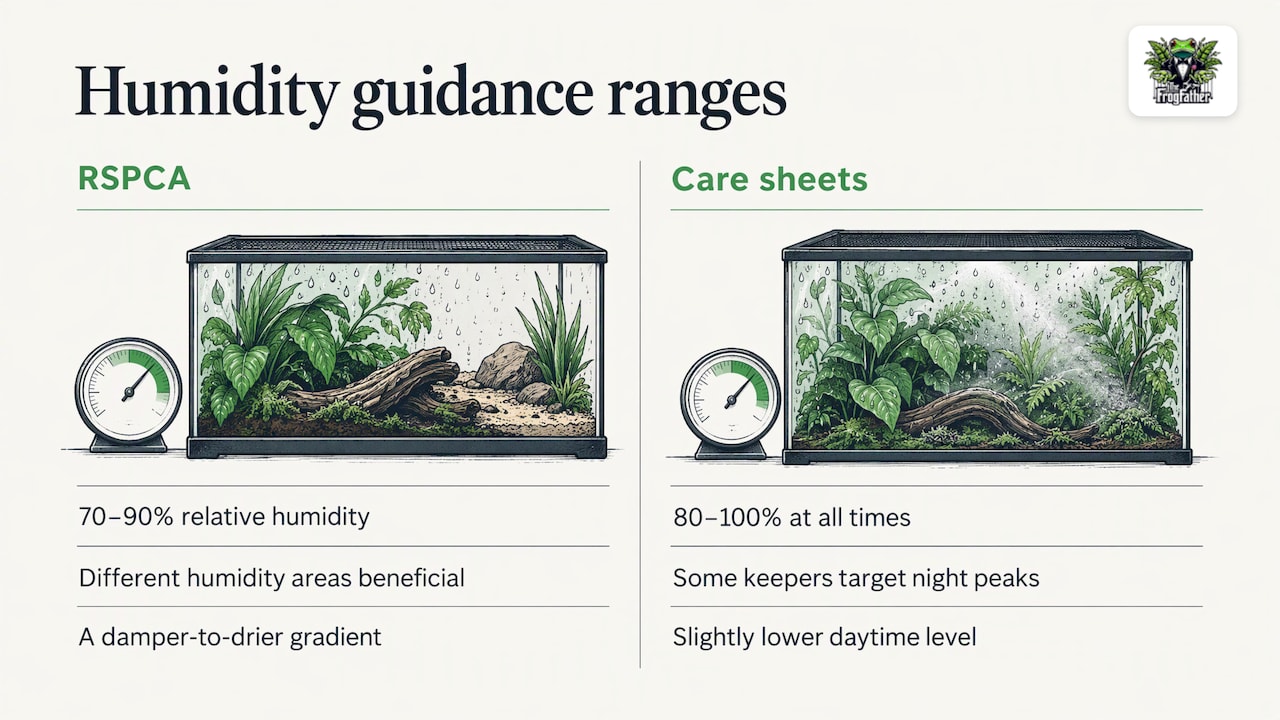
The same document says a relative humidity of 70-90% can be maintained by evaporating water, and that areas of different humidity within the enclosure are beneficial. So think in terms of a range and a gradient, not a fixed target. A frog that can move between a damper corner and a drier, airier spot can regulate itself.
You will see higher figures quoted. Some care sheets suggest 80-100% at all times, and some keepers aim for a night-time peak with a slightly lower daytime level. Species, enclosure size, plant density and room conditions all change what is realistic, so treat any single number as a starting point. Our own dart frog humidity guide goes through the ranges by type of frog if you want the detail for your species.
Why vivarium humidity fluctuates
A hygrometer reading is a snapshot, and several things move it.
Misting. A mist produces a spike that falls away over the following hours. Humidity readings move sharply after misting and settle over the next hours, so one spot reading tells you almost nothing.
Temperature. Relative humidity compares the water in the air with how much the air could hold at that temperature. Warm the air and relative humidity falls even if you add no water. Cool it at night and the figure climbs. That is why the reading under a light is lower than in a cool corner, and why night readings can look higher than daytime ones without anything having changed.
The room. British houses are considerably drier in winter once the heating is on, and a vivarium that held steady all summer may struggle by November. If a setup struggles every winter, the room is often the cause rather than the enclosure.
Airflow. More ventilation carries moisture out faster. Less ventilation holds it in, but it can also leave everything wet. We come back to this below, because it is where most UK keepers go wrong.
Our article on why 80% doesn’t always mean a vivarium is actually humid explains why a single reading can mislead you.
How to measure humidity so the numbers mean something
Good control starts with good measurement. Work through these steps.
- Use a digital hygrometer, ideally two. Petcare Basics advises digital hygrometers over the analogue dials that come with starter kits, which are inaccurate. Placing two at different heights or ends of the enclosure shows you the gradient.
- Place sensors at frog level. Readings from the top of the enclosure, near the vents, are lower than what the frogs experience. Keep the probe away from direct mist, standing water and fans.
- Log the cycle. Note the peak after misting, the level it settles to, and the low point before the next cycle. A week of notes at the same times each day is more useful than any single check.
- Read temperature alongside humidity. The two cannot be interpreted separately, so record both.
- Check the physical signs. Terrarium Quest suggests that, after a day’s cycle, there should be no water droplets coating the glass or plants by the next morning. If there are, you are adding too much water.
A hygrometer tells you what the air is doing. Leaf litter, glass and your frogs’ behaviour tell you whether it suits them. Use both.
Build humidity into the enclosure first
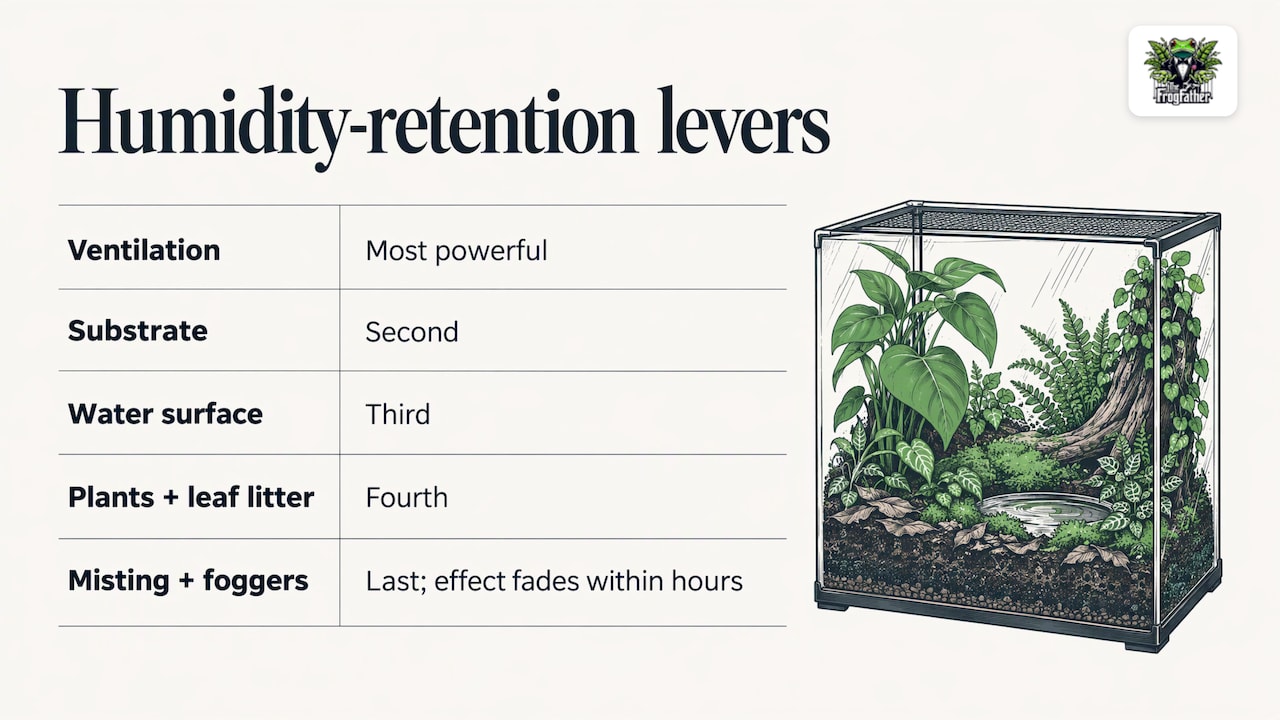
This is the part that makes the difference between a vivarium you mist constantly and one that holds its own. Terrarium Nest ranks the levers: reducing ventilation is the most powerful, then a deep moisture-retentive substrate acting as a slow reservoir, then water surface, then plants and leaf litter, with misting and foggers last because their effect fades within hours.
Substrate and drainage
A typical dart frog build uses a drainage layer, a barrier, then a well-draining substrate kept damp but not wet. One veterinary care sheet describes a hydroton drainage layer, a mesh barrier, and at least 2-3 inches of coco coir and sphagnum or ABG-style mix, topped with long-fibre sphagnum or leaf litter. The depth is what lets the substrate release moisture slowly through the day.
Our bioactive terrarium layers guide gives the build order, and the substrate and drainage guide covers depths and materials for UK setups. If you are comparing materials for moisture retention without waterlogging, a look at reptile substrates for vivariums shows the range of bedding types on the market, but for a dart frog bioactive build, the layered approach above is the one to follow.
The water you add matters too. The same care sheet notes that amphibian skin is very porous and absorbs toxins easily, so tap water should be treated for chlorine and chloramines, or you can use bottled water.
Plants, leaf litter and microfauna
Live plants and leaf litter both hold and release moisture, and a dense planted layer helps stabilise humidity and temperature. Springtails and isopods keep the leaf litter and substrate processing waste, which helps the damp layers stay healthy rather than sour. Our microfauna guide explains how they fit into a balanced vivarium.
Bioactive does not mean maintenance-free. A planted, drained, microfauna-stocked enclosure still needs checking, topping up and trimming. It simply gives you a stable base to work from.
Misting: a schedule to start from, not to obey
Frog.care notes that most people mist twice a day for 15-30 seconds, but that the right schedule depends on ambient humidity, air movement, temperature, plant density, drainage-layer water and vent setup. Treat that as a starting point and let your logged readings steer you.
A simple way to tune it:
- Start with two short misting sessions a day.
- Log humidity at frog level for a week, noting peak, settled level and low point.
- If the low point sits well below 70%, lengthen the session slightly or add a third, before touching anything else.
- If glass and plants are still beaded the next morning, cut the amount of water.
- Change one thing at a time and give it several days.
Automatic misting systems and humidifiers take the repetition out of this, but the same logic applies: they supply moisture, and the enclosure still has to be able to hold it and clear it. If you use one, keep checking the cycle with your hygrometer rather than trusting the timer.
Ventilation: moving air, not wet air
This is the point that surprises many keepers. When humidity is low, the instinct is to seal the lid. The RSPCA document does say that high humidity can be reached with partial blocking of ventilation ports, and that ventilation should never be blocked completely. Frog.care adds a practical reason: continuously wet leaf litter and no dry place to stand put frogs at risk of foot rot.
Petcare Basics puts it bluntly: stagnant humid air is considerably more dangerous than slightly low humidity, causing respiratory infections and mould. The aim is humid air that is moving, not still air that is wet. If you have blocked ventilation to gain humidity, the setup needs rethinking rather than sealing.
In practice:
- Provide crossflow, with air entering low and leaving high, so plants and leaf litter dry between mists.
- Small USB fans on lid vents can pull air out, drawing fresh air in through front vents. For top-opening enclosures, air in one side of the lid and out the other is a common approach.
- Keep a dry place for frogs to stand, even in a very humid enclosure.
We cover the detail in our dart frog ventilation guide and in why airflow is the piece many UK keepers ignore.
Troubleshooting: too low, too high or unstable
Humidity too low. Work down this list before reaching for the mister:
- Check the substrate is deep enough and actually damp throughout.
- Add or enlarge a water feature, which increases evaporation.
- Add live plants and leaf litter.
- Reduce ventilation in small steps, watching the leaf litter for signs it stays wet.
- Adjust misting last.
Humidity too high or constantly wet. Work in reverse: increase ventilation, use a drier top layer of substrate, move the water bowl to the cooler end and check the room itself. Persistent condensation, mould and sour-smelling substrate all say the same thing: too much water and not enough air movement.
Unstable readings. If the numbers swing hard between cycles, the usual cause is a setup that relies on misting rather than a reservoir. Deepen the substrate, increase planting and then tune airflow. Check the hygrometer position as well, since a probe sitting in the mist path will always exaggerate the swing.
Winter dips. When the heating comes on, expect to lengthen mist sessions or reduce vent openings slightly, and review in spring. Keep the enclosure away from radiators and draughty windows.
Watch your frogs too. Petcare Basics lists the consequences for reptiles of sustained humidity problems as skin and respiratory problems and mould growth. In amphibians, if a frog looks lethargic, has skin problems or is breathing abnormally, contact an exotics vet promptly rather than adjusting the enclosure and waiting.
Our view on humidity control
Most humidity problems we are asked about are not misting problems. They are build problems: too little substrate depth, too little planting, or ventilation that was either sealed or wide open.
That is why we write our UK dart frog husbandry guides around the whole enclosure, and why our established bioactive vivariums are built to hold a stable rhythm rather than lean on constant spraying. Live plants, a proper drainage layer, springtails and isopods all do quiet work on humidity every day.
Our approach is steady and observant. Make one change at a time, log it, and give the vivarium a few days to answer. We also design our own practical 3D-printed vivarium accessories, developed through everyday use in our frog rooms, because small, well-made parts make routine care easier to keep up.
No bioactive vivarium is maintenance-free. A good one is simply easier to read and easier to correct.
Frogfather
Start with a setup built to hold humidity
If you are planning your first bioactive vivarium, or replacing one that never quite settles, we breed dart frogs in the UK, build custom bioactive vivariums and supply the plants, springtails, isopods, live foods, supplements and enclosure supplies that go with them.

See the full range at Frogfather, or read our guide to what to look for when buying a bioactive vivarium.
FAQ
Is 70% humidity too high for a dart frog vivarium?
No. For most dart frogs, 70% is closer to the lower end of what keepers aim for, and the RSPCA document cites 70-90% as achievable. What matters more is that the air moves and leaf litter dries between mists, so the enclosure is humid without staying soaking wet.
Why does my vivarium humidity drop to 65% between mistings?
A fall between misting sessions is normal, because the spike from a mist fades within hours. If the low point is regularly well under 70%, deepen the substrate, add planting or a larger water surface, and check ventilation before adding more misting. Log readings at frog level to confirm the change.
Why is my vivarium humidity high even when I have stopped misting?
The room, the substrate and the water feature can all keep humidity high without misting. Increase ventilation, use a drier top layer, move any water bowl to the cooler end and check the hygrometer is not sitting beside wet substrate or a water source.
Does humidity change through the day?
Yes. It peaks after misting, settles through the day and often rises at night as the temperature falls. The average across the day matters more than any peak, so compare readings taken at the same times over several days.
Sources
- Humidity | Frog.care
- RSPCA background information on amphibian housing (ETS 123, 2004)
- How Do You Measure and Control Humidity? | Petcare Basics
- Humidity Control Basics for Terrariums and Vivariums | Terrarium Nest
- How to Control Humidity and Water in a Tropical Vivarium | Terrarium Quest
- Dart Frog Care | Aurora Animal Hospital
Recommended
- Keeping Dart Frogs Cool In Summer: Practical UK Heatwave Measures
- Beyond The Vitrine: How To Replicate Microclimates Inside A UK Dart Frog Vivarium
- Keeping Dart Frogs Cool In A UK Summer Without Drying Out The Vivarium
- How To Maintain Optimal Humidity Levels In Your Dart Frog Vivarium