
A good dart frog breeding setup is a settled, well-structured bioactive vivarium for one compatible pair, with plenty of cover, several egg-laying sites you can reach, and a separate, simple tadpole station. Frogs breed when the basics are boringly solid, not when you fiddle with them. Below is the setup we would build, what goes wrong at each stage, and how to plan for the froglets before the first clutch appears.
TL;DR
- Keep one male and one female per enclosure. Males compete and females may eat other females’ eggs, so groups make breeding harder.
- Surface area and cover matter more than raw volume: a well-planted 45 × 45 × 60 cm vivarium with branches, leaf litter and bromeliads beats a bare, larger box.
- Offer several egg and tadpole sites (coconut hides, petri dishes, bromeliads) that you can check and lift out easily.
- Eggs and tadpoles need their own small, clean containers and a steady water-change routine. Plan space for every tadpole before you pair frogs.
- A bioactive vivarium still needs regular maintenance. Settled and observant care is what produces clutches.
Table of Contents
- Start with the pair, not the glass
- Enclosure size and layout
- Bioactive substrate and drainage
- Planting for egg sites and tadpole pools
- Egg-laying sites: what to offer and how to check
- Incubating eggs
- Tadpole rearing
- Plan for froglets before you pair frogs
- Maintain the setup, do not just build it
- Where we can help
- Our view
- FAQ
- Sources
Start with the pair, not the glass
Before you buy anything, decide which species you are keeping and whether you have a true pair. The species changes everything about the setup. Veterinarian Alec Brown notes that Oophaga pumilio breed readily and are indiscriminate about egg-laying and tadpole-rearing sites, while large obligate broodcare species are far more particular and may not raise tadpoles if they dislike the bromeliads on offer.
Behaviour tells you when a pair is ready. Sexually mature males court by calling often, females lay eggs on damp surfaces, and the female later carries the tadpoles to small water pools, normally in bromeliads. The same source recommends one male with one female, because males compete and females may eat the eggs of other females.
Two practical points save a lot of disappointment:
- Source frogs of known origin. Captive-bred UK frogs from a breeder who can tell you the locality and morph are the sensible start. We breed dart frogs ourselves, and you can see what is currently available in our dart frog listings.
- Do not mix morphs or localities. Much of the hobby community considers cross-breeding bad for the hobby, because it produces hybrid or cross-morph frogs nobody can identify later. Keep records of every pair.
Enclosure size and layout
The usual advice is to give breeding pairs more room than a minimum-size display. Alec Brown suggests at least 18 × 18 × 24 inches (about 45 × 45 × 60 cm) for two Oophaga pumilio and 24 × 18 × 24 inches (about 60 × 45 × 60 cm) for two large obligate broodcare species, with most pairs kept in 36 × 18 × 36 inch (roughly 90 × 45 × 90 cm) enclosures.
Do not treat those numbers as the whole story. The German DGHt guidelines for keeping anurans in captivity stress that dimensions alone do not guarantee good husbandry: a smaller terrarium with a well-structured interior can suit the animals better than a large one with a poor layout. The same guidelines call for climbing opportunities (rocks, branches, bark), retreats (crevices, plants, leaf litter) and, for dart frog-type species, bromeliads or similar funnel structures.
In practice:
- Build vertical structure. Even terrestrial species use height. Add branches, cork and shelves so the frogs have routes through the whole tank.
- Create cover everywhere. Alec Brown observes that many frogs are bolder when they are never far from a hiding place. Confident frogs call, court and lay.
- Leave a screened vent strip. He recommends 1 to 3 inches (about 2.5 to 7.5 cm) of screen ventilation along the lid, with humidity around 90% overnight and about 80% by day. A solid glass lid over the rest holds moisture in.
- Plan access. You must be able to reach every egg site and bromeliad without ripping out planting. Put the working side at the front and keep tall plants away from it.
If you want the finished article rather than building from scratch, our Premium Bromeliad Dart Frog Vivarium, 45 × 45 × 60 cm is an established bioactive setup. For wider habitat reading, see our guide to the poison dart frog habitat and UK vivarium setup.
Bioactive substrate and drainage
A breeding vivarium is occupied for years, so the substrate has to stay healthy without being torn up. The layers that work, as described by veterinarian Susan Horton, are a 1 to 2 inch (about 2.5 to 5 cm) drainage base of gravel or LECA, a barrier layer of fabric, activated charcoal, then 4 to 5 inches (about 10 to 13 cm) of chemical-free organic soil. Her page recommends gently tilling the soil every two to three months and renewing it fully about every six months, which is a reminder that a bioactive tank is a living system you maintain, not a set-and-forget box.
On top of the soil goes leaf litter. It gives cover, hosts microfauna and gives frogs places to lay. Collecting and preparing it safely is covered in our leaf-litter guide for dart frog vivariums.
Clean-up crew
Springtails and isopods break down waste and mould and feed small froglets. Start the colony before the frogs arrive, so numbers are established. We supply a mixed springtail culture with springtail food and a range of bioactive clean-up crew animals. If you are unsure whether your tank is really working as a bioactive system, our real-world bioactive checklist walks through it.
Planting for egg sites and tadpole pools
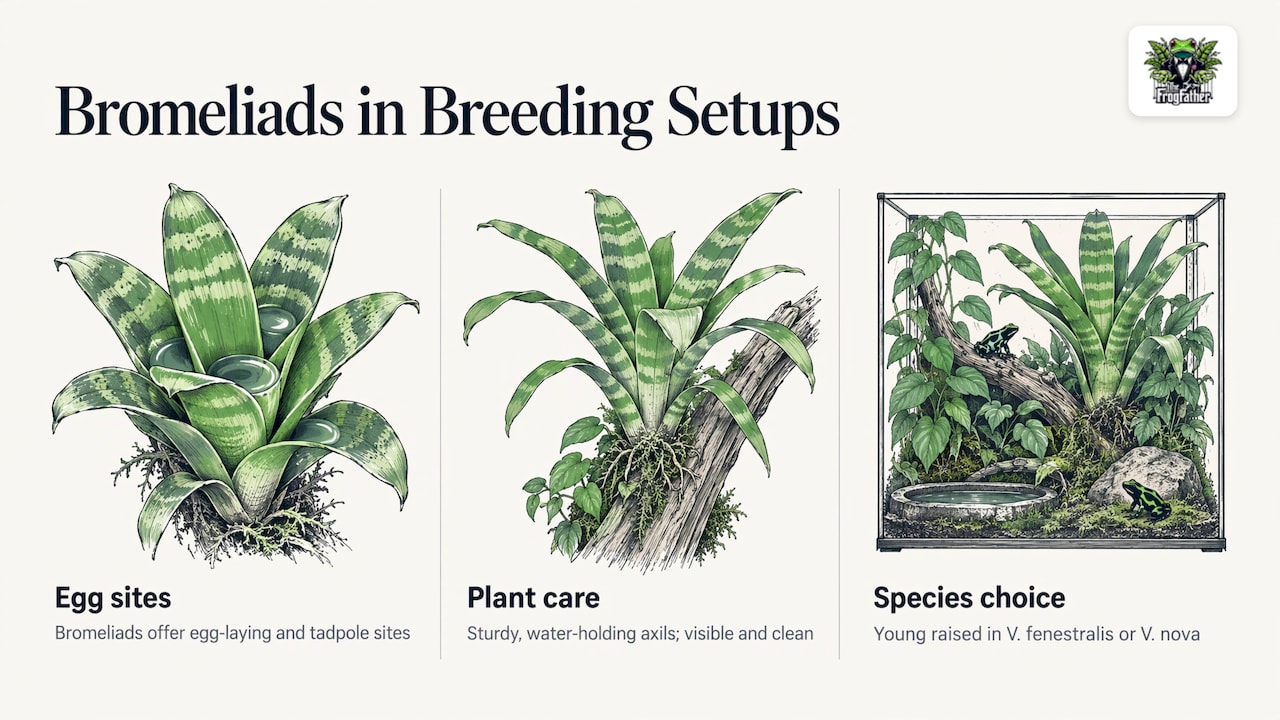
Bromeliads do two jobs in a breeding setup: they give egg-laying and tadpole-deposition sites, and they hold the humidity and structure frogs like. The DGHt guidance names bromeliads or comparable funnel structures as part of a proper dart frog interior. Choose plants with sturdy, water-holding leaf axils, set them at a height you can see into, and keep them clean. Our bromeliad guide for dart frog vivariums covers choices for UK keepers, and the guide to selecting and maintaining vivarium plants covers wider planting. You can browse tropical plants for vivariums or start with a 12-plant bioactive bundle. For the quicker route, our top five plants for a thriving dart frog habitat is a short list.
Species preference matters. Alec Brown reports that his large obligate frogs mostly raise young in Vriesea fenestralis or Vriesea nova, so if a pair of a fussy species is not raising tadpoles, bromeliad choice is the first thing to review.
Egg-laying sites: what to offer and how to check

Do not rely on one spot. Citizen Conservation’s breeding guidelines for Epipedobates tricolor say frogs particularly like bromeliad leaf axils and large leaves, and that artificial burrows work well: a halved coconut shell on a saucer or petri dish with a smooth dead leaf, or a purpose-made spawning house. Smooth surfaces are generally favoured, and several sites should be provided so eggs can be removed easily.
A sensible egg-site kit looks like this:
- Two or three coconut hides or similar caves, each on a petri dish or saucer
- Broad, smooth leaves at different heights
- Flat cork bark leaning against the glass
- Bromeliads you can look into
We also design and print breeding accessories for use in frog rooms, and the full set is in our dart frog breeding accessories range.
Reading the signs
Calling changes before clutches appear. John P. Clare, writing on FrogForum, describes breeding R. imitator calling in a more subdued pattern, with shorter calls at closer intervals. Some species hide eggs very well. A small dental mirror is a cheap way to look into bromeliad axils without disturbing them. Check the sites on a set rhythm, quickly, and leave the frogs alone the rest of the time.
As a safety point, avoid handling dart frogs. Susan Horton advises coaxing a frog into a tub, using nitrile gloves only if touching is unavoidable.
Incubating eggs
You can leave eggs with the parents in some species, but pulling them gives you control over survival and numbers. The method is simple, and the details are where it goes wrong.
- Lift the egg and its surface together. Slide the piece of leaf, plastic or shell the eggs sit on into a small container. Do not peel eggs off.
- Keep the eggs wetted, not drowned. An old British Herpetological Society bulletin describes a petri dish with 2 to 3 mm of vivarium-temperature water just touching the base of the eggs, which must not be covered. Citizen Conservation likewise advises a closed plastic container with a little osmosis or rainwater, kept at around 22 to 24 °C with a slight night-time drop and no ventilation.
- Be patient. The BHS bulletin gives hatching after 10 to 14 days, depending on species and temperature, while Citizen Conservation gives about two weeks for E. tricolor. After about a week, it suggests raising the water level by a few millimetres.
- Label everything. Write the pair, species and lay date on each container.
Opening containers constantly is the commonest mistake. Check, record, close.
Tadpole rearing
Tadpole rearing is where a breeding setup becomes a small project of its own. Both the BHS bulletin and Citizen Conservation recommend keeping most tadpoles separately, because they can cannibalise one another. The bulletin notes that some species, including Dendrobates auratus, can be raised communally in an adequately sized container if well fed.
A workable station:
- Individual small tubs with a leaf and, if you like, a little aquatic plant
- Dechlorinated water that has stood for 24 hours, in the bulletin’s method, at a shallow depth of about 1.5 cm for newly moved tadpoles
- Water changes once or twice a week according to Citizen Conservation, by pouring off the old water and spooning the tadpole into a fresh tub (the bulletin describes daily changes for its method)
- Space on a shelf in a room with steady temperature, and a labelled record of each tadpole
For feeding, species-specific advice and common problems, our complete guide to caring for dart frog tadpoles and dart frog breeding guide go step by step.
Plan for froglets before you pair frogs
A healthy pair can produce a clutch every few weeks. Work out the next stage first:
- Space. Each tadpole needs a tub, then each froglet needs a small grow-out enclosure.
- Food. Froglets eat tiny live prey. A reliable supply of fruit flies is what keeps them growing, and our live food range includes subscription cultures so you do not run short. Our live food receiving and storage guide helps you handle deliveries.
- Destination. Know where surplus froglets will go. Selling or rehoming them responsibly means identifying species and locality accurately, which is why keeping morphs separate matters.
Maintain the setup, do not just build it
Bioactive does not mean maintenance-free. Plan a routine:
- Mist or fog daily so humidity stays high. Susan Horton’s page recommends 75% or above, with temperatures of 70 to 78 °F (about 21 to 26 °C).
- Trim plants so you keep access to egg sites.
- Top up leaf litter as it breaks down.
- Watch the microfauna. If springtails and isopods thin out, feed and replenish them.
- Record clutches, hatches and tadpole outcomes.
If a frog looks thin, lethargic or unwell, see an exotics vet rather than guessing.
Where we can help
We breed dart frogs in the UK, build custom bioactive vivariums and supply plants, springtails, isopods, live foods, supplements and enclosure supplies from Nottingham. You can see all of it on our main shop, including complete setups if you want an established enclosure.
If you are choosing between buying ready-made and building, our guide on what to look for when buying a bioactive vivarium is a good starting point.
Our view
Most failed breeding projects we hear about are not failures of equipment. They are failures of patience and planning: too many frogs in one tank, too few places to lay, no plan for the tadpoles.
Our approach is to get the vivarium right first. That means real structure, leaf litter, bromeliads and a colony of springtails and isopods that is already working. Then you add a compatible pair and leave them alone long enough to settle.
We design our own 3D-printed breeding accessories because we use them in our frog rooms and know what is irritating about the alternatives. Egg sites you can lift cleanly and tadpole kit that is easy to keep clean make the routine sustainable.
None of this is effortless. It is steady, observant care, and it is very rewarding when a pair starts to raise young.
Frogfather
FAQ
How big should a dart frog breeding vivarium be?
For two Oophaga pumilio, veterinarian Alec Brown suggests at least 18 × 18 × 24 inches (about 45 × 45 × 60 cm), with larger obligate species needing more and most pairs kept in 36 × 18 × 36 inches. Layout counts as much as size, so plan branches, cover and bromeliads from the start.
Can I keep more than one pair together?
The usual recommendation is one male and one female per enclosure. Males compete, and females may eat other females’ eggs. Keeping pairs apart also protects morph and locality records.
How long do dart frog eggs take to hatch?
The British Herpetological Society bulletin gives 10 to 14 days depending on species and temperature, and Citizen Conservation gives about two weeks for E. tricolor. Keep eggs damp but not submerged and avoid opening the container often.
Do I need to remove the eggs?
Not always, because some pairs raise young themselves. Removing eggs to your own containers gives you control over water quality and tadpole numbers, but it also means committing to the water-change routine and space for every tadpole.
Sources
- Husbandry, Alec Brown DVM
- Standard Guidelines for the Captive Keeping of Anurans, DGHt
- Basic information and care recommendations for Epipedobates tricolor, Citizen Conservation
- Herpetological Bulletin issue 55, British Herpetological Society
- Dart Frog Care, Exotic Pet Vet
Recommended
- The Complete Guide To Breeding Dart Frogs
- Dart Frog Breeding Guide (UK) – Eggs, Triggers, Tadpoles & Common Problems
- How To Raise Dart Frog Tadpoles From Egg To Froglet (UK Edition)
- Collecting & Incubating Dart Frog Eggs | Complete Guide