
The best tropical cuttings for a vivarium come from fast, forgiving plants such as pothos, Philodendron scandens and trailing Peperomia. Take them 8 to 10cm long, root them somewhere humid and bright but out of direct sun, and give them a settling period before they go near your frogs and clean-up crew. Tissue culture plants are a different job: they arrive soft and sheltered, and they need to be toughened up gradually. Below you will find what to take, how to root it, how to avoid the usual failures and when a plant is ready for a bioactive enclosure.
TL;DR
- Choose cuttings from tough, trailing or creeping plants (pothos, Philodendron, Peperomia, Fittonia) rather than fussy species.
- Cut 8 to 10cm just below a leaf joint, leave 2 to 3 leaves and root in an airy mix or in water for roughly 3 to 4 weeks.
- Rot and drying out cause most failures: keep the mix airy and the air humid, not the mix soggy.
- Tissue culture plantlets need gradual acclimatisation to lower humidity before they join a working vivarium.
- Keep new plants apart and inspect them before they go in with frogs, springtails and isopods.
Table of Contents
- Why cuttings suit a vivarium
- Which plants make good cuttings
- How to take and root a cutting
- Why cuttings fail, and what to change
- Tissue culture plants: a different starting point
- Settling new plants before they join the frogs
- Planting rooted cuttings in the enclosure
- Where to get cuttings
- What we do about plants at the Frogfather
- Building the rest of the vivarium
- FAQ
- Sources
Why cuttings suit a vivarium
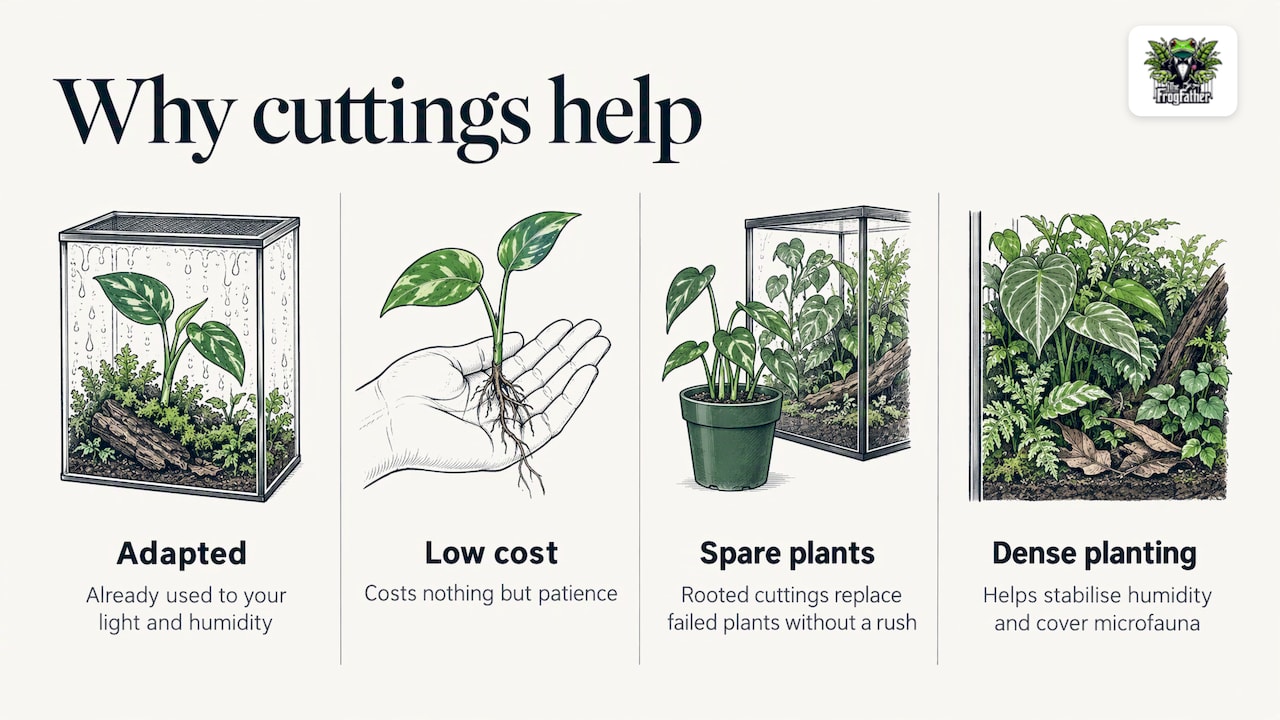
A vivarium plant has a hard life. It sits in constant humidity, gets moderate light, is walked over by frogs and is regularly trimmed back. Over a year or two, plants outgrow their space or get shaded out, and you need replacements that are already used to your conditions. Cuttings give you that. A cutting taken from a plant that has thrived in your own enclosure is already accustomed to your light and humidity, and it costs you nothing but patience.
Cuttings also help with the practical side of bioactive keeping. Planting a new enclosure densely at the start helps stabilise humidity and gives your microfauna cover, and a pot of rooted cuttings on standby means a failed plant can be replaced without a rush. Bioactive vivariums are not maintenance-free, and a steady supply of spare plants is part of keeping one in good order.
Which plants make good cuttings
Not every vivarium plant propagates well from a stem. Think in layers, as a rainforest does. Pondlet’s vivarium plant guide describes bromeliads as the canopy, ferns, Fittonia, Peperomia and Begonia in the midground, moss and Selaginella on the floor, and pothos and Philodendron for the vertical layer. Of those, the stem-forming plants are the ones to propagate by cutting:
- Pothos and Philodendron scandens: vigorous climbers that root readily from a node. They are the easiest place to start, but they can take over a small enclosure, so plant one rather than five and trim before it shades the bromeliads.
- Peperomia (such as trailing jade): compact, tolerant of moderate light and quick to root from short stem pieces.
- Fittonia: a creeping midground plant that roots where stems touch damp substrate, so small pieces can be pinched off and pushed in.
- Ferns and Selaginella: these are better divided than cut. Split a clump rather than looking for a stem.
Bromeliads are a special case. They multiply by producing offsets, called pups, at the base rather than by stem cuttings, and they are the plants frogs actually use for egg and tadpole sites. Our bromeliad guide for UK vivariums covers choosing them, and why dart frogs choose bromeliads explains what the frogs do with them. For a broader shortlist, see our UK safe-plant guide for dart frog vivariums.
If you are unsure whether a plant is safe for frogs, check it against a safe-plant list before it goes in, not after. Do not put in anything you cannot identify.
How to take and root a cutting
The method below follows the RHS advice on houseplant cuttings, adapted for vivarium plants.
1. Choose a healthy parent stem
Take material from a plant that is growing well, with no yellowing, spotting or visible pests. A stressed parent produces stressed cuttings. If the parent is in your frog enclosure, remove the piece with clean, sharp scissors or a blade so that you do not crush the stem or tug at roots that frogs and microfauna are living around.
2. Cut below a node
The RHS suggests cuttings 8 to 10cm long, cut just below a leaf joint. The node is where roots form, so a cutting with no node in the rooting medium will stay firm and green but never root. This is one of the most common reasons for a cutting that seems fine and then does nothing.
3. Strip the lower leaves
Remove the lower leaves so that 2 to 3 remain at the top. Leaves below the surface rot, and large leaves lose water faster than a rootless stem can replace it. Purdue’s extension guide goes further for stressed material and suggests removing around a half to two thirds of the leaf area so the cutting loses less water.
4. Root it in water or an airy mix
You have two sensible options:
- Water: stand the cutting in clean water with the nodes submerged and the leaves clear. Change the water when it clouds. Pothos and Philodendron do this reliably. Move rooted cuttings into substrate once the roots are a few centimetres long and branching.
- Mix: the RHS recommends a 50:50 blend of peat-free multipurpose compost and perlite. Purdue suggests a well-drained mix such as equal parts vermiculite and perlite, with the pot enclosed in a plastic bag held off the leaves.
Whichever you choose, keep the cutting bright but out of direct sun. The RHS says cuttings should root in about 3 to 4 weeks, and that late spring and early summer are best, though many work through most of the year. In a heated, lit room you can propagate in winter too, but expect slower progress when it is cold and dark.
5. Keep humidity high and the mix aerated
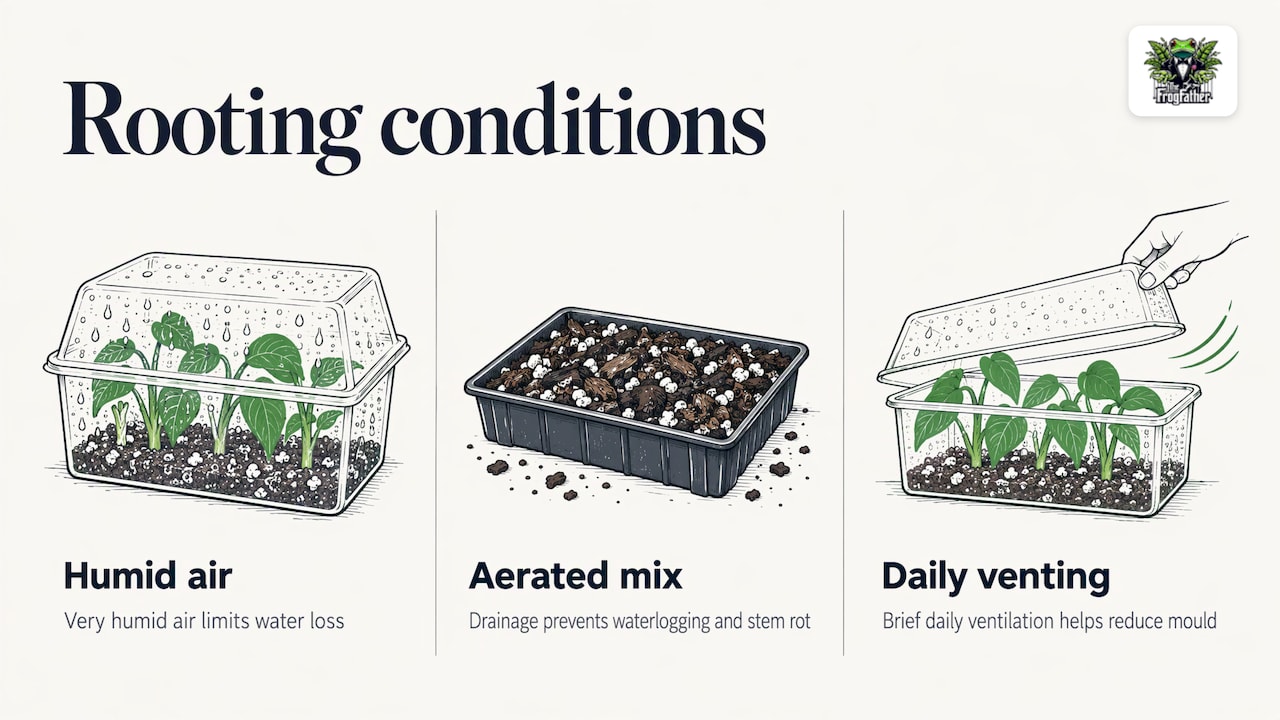
This is the balance that matters. The cutting needs very humid air because it has no roots to replace lost water. The mix must still drain, because a waterlogged medium starves the stem of air and it rots rather than roots. A propagation box, a clear tub with a lid or a plastic bag held off the leaves all do the job. Vent it briefly every day or so to reduce mould.
Blooming Expert’s rooting summary suggests misting the walls of the dome rather than the cutting itself, because wet leaves invite botrytis, a grey mould. That fits what most keepers find: wet foliage in still air is where fungus starts.
Why cuttings fail, and what to change
When a cutting fails, it is usually one of a few causes. Work through them in order rather than changing everything at once.
| What you see | Likely cause | What to change |
|---|---|---|
| Stem firm, leaves fine, no roots after several weeks | No node below the surface | Re-cut below a node and reset |
| Leaves wilt within days | Humidity too low or too many leaves | Enclose the cutting, trim leaves |
| Black, mushy stem base | Waterlogged mix, too little air | Cut back to clean tissue, use a more open mix |
| Fuzzy grey or white mould | Stagnant, wet air | Remove affected material, vent daily |
These causes match Purdue’s extension notes, which cite excessive water loss, disease entering the cut and a waterlogged rooting mix as the main reasons for failure. The same logic applies to the final move: a rooted cutting dropped into saturated substrate can rot just as an unrooted one does.
If a cutting fails once, try again before blaming the plant. Plant propagation rewards the keeper who adjusts one thing at a time and watches the result.
Tissue culture plants: a different starting point
Some plants for vivariums are sold as tissue culture plantlets, usually in a small cup or pot of gel. Tissue culture grows many identical plantlets from a tiny piece of a parent plant under sterile laboratory conditions. They are often clean of pests and fungus when they leave the lab, which is a real attraction for a bioactive setup.
The catch is that they have lived in near-saturated air. The University of Florida’s propagation guide describes acclimatisation as the stage where plantlets are gradually moved to lower humidity and higher light, and notes that large losses can occur if this is rushed. Treat a new plantlet as you would a fragile cutting:
- Rinse off the gel gently and plant it in an open, free-draining medium, such as loosely packed sphagnum moss or a coarse mix, at the right depth: crowns at the surface, rhizomes above it.
- Keep it under a lid or dome at high humidity with a moist but never soggy medium.
- Open the vents a little more each day, then remove the lid for longer periods as the leaves stay firm.
- Move it into the vivarium only once it copes with open air without wilting.
Some species harden in a week or two. Slower or woody plants can take much longer, so judge by the plant, not the calendar.
Settling new plants before they join the frogs
This step protects your animals. A new plant, whether a cutting from a friend, a shop plant or a rooted pup, can carry hitchhikers: slugs, aphids, mealybugs, mites, fungus or leftover treatments from commercial growing.
- Keep it apart. Grow new plants in a separate container or tub for a few weeks, away from your frog enclosure and your other plants, so that anything hidden has time to show itself.
- Inspect closely. Check leaf undersides, stem joints and the surface of the substrate for insects, webbing and damaged leaves.
- Wash the roots and leaves. Rinse under lukewarm water and remove old potting mix, especially if it contained slow-release fertiliser.
- Ask about treatments. If you are buying plants, ask whether they have been treated with pesticides, and avoid any plant that has been. Frogs absorb substances through their skin, and a plant coming from general horticulture is not automatically vivarium safe.
If a frog has a health problem you cannot explain, or you suspect a chemical exposure, speak to an exotics vet.
Planting rooted cuttings in the enclosure
Once a cutting has a good root system and new growth, it is ready. Plant it into bioactive substrate at the same depth it was growing, firm it gently and leave it alone. Pin trailing stems to the background with a little moss or vivarium clay, or tuck them into cork bark. Our background clay is made for planted backgrounds, and our aged bioactive substrate comes with live microfauna.
New plants in an established bioactive enclosure will not hurt your springtails and isopods, but they do change the light and humidity gradient. Place climbers where they will not shade bromeliads, and check low-light zones with our low light plant guide or the high humidity plants guide for plants that match each part of the tank.
Where to get cuttings
The best source is your own enclosure or another keeper’s established vivarium. Plants that have lived in a frog setup have already been through years of the same conditions you will give them. If you are building your first setup, start with plants rather than relying on cuttings alone: we supply tropical plants alongside bioactive supplies and microfauna, and you can see the range in our bioactive supplies section. When you receive plants, quarantine them as above.
What we do about plants at the Frogfather
Most plant problems in a frog room come from rushing. A cutting stuck straight into wet substrate, a new plantlet thrown into open air, or a plant dropped in without inspection are all quick ways to lose a week’s work, and sometimes more.
In our own frog rooms we treat plants as part of the husbandry, not decoration. We plant densely, keep spares growing, and settle new growth before it goes in. Everything else, from the clean-up crew to the springtail cultures, depends on the plants doing their job.
The same practical approach shapes our range. We breed dart frogs, build planted bioactive vivariums, and supply tropical plants, microfauna and the small accessories that make daily care easier. We would rather you build slowly and keep a stable enclosure than add everything at once.
Frogfather
Building the rest of the vivarium
Plants are one part of a living system. If you are setting up or topping up an enclosure, we offer custom bioactive vivariums built and planted by us, along with UK-bred dart frogs, microfauna, live foods and our own 3D-printed accessories.
If you would rather start with a finished, planted setup, browse our complete setups. For ongoing live food, our Drosophila subscriptions keep cultures arriving so that you do not run short. For a bromeliad breeding site that does not rot, see our 3D-printed bromeliad egg-laying site.
FAQ
Can I put cuttings straight into the vivarium substrate?
It can work with tough climbers such as pothos if the substrate is moist and humidity is high, but success is less reliable than rooting first. A fresh cutting has no roots to replace lost water, and a wet, dense substrate can rot the stem. Rooting in water or an airy mix first and planting once roots have formed gives you more control.
How long do cuttings take to root?
The RHS says houseplant cuttings should root in around 3 to 4 weeks. In a warm, humid, well-lit propagation tub most vivarium climbers will be close to that, while slower species may take longer. Look for fresh leaf growth as a sign that the roots are working.
Are tissue culture plants better than cuttings for a vivarium?
They are different rather than better. Tissue culture plantlets usually start clean but are delicate, and they need gradual acclimatisation to lower humidity. A cutting from a healthy plant in your own enclosure is already used to your conditions and is the simplest way to fill gaps.
Do I need to quarantine plants if they look healthy?
Yes. Pests and fungus can be too small to notice at first, and keeping a new plant apart for a few weeks gives any problem time to appear. Inspect leaf undersides and stems, rinse off old potting mix and avoid plants that have been treated with pesticides.
Sources
- RHS: How to take cuttings from houseplants
- University of Florida IFAS: Tissue culture and micropropagation
- Pondlet: Plants for a dart frog vivarium
- Blooming Expert: Why cuttings won’t root
Recommended
- How to Propagate Marcgravia: Cuttings and Layering
- Vivarium Plants Losing Roots? Causes & Solutions
- Plant Propagation Rooting Ball
- Selecting and Maintaining Vivarium Plants: A Scientific Guide for Dart Frog Setups