By The Frogfather
Quick verdict: Oyapock is a locality form of the dyeing poison frog, Dendrobates tinctorius. It is bold, comparatively substantial and usually straightforward to feed, making it an excellent first dart frog when housed as a compatible pair. Its principal husbandry complication is social: mature females can be strongly territorial, so communal housing is not recommended.
Oyapock at a glance
Scientific species: Dendrobates tinctorius (Cuvier, 1797)
Locality name: ‘Oyapock’—also encountered as Oiapoque/Oyapok in geographical spelling
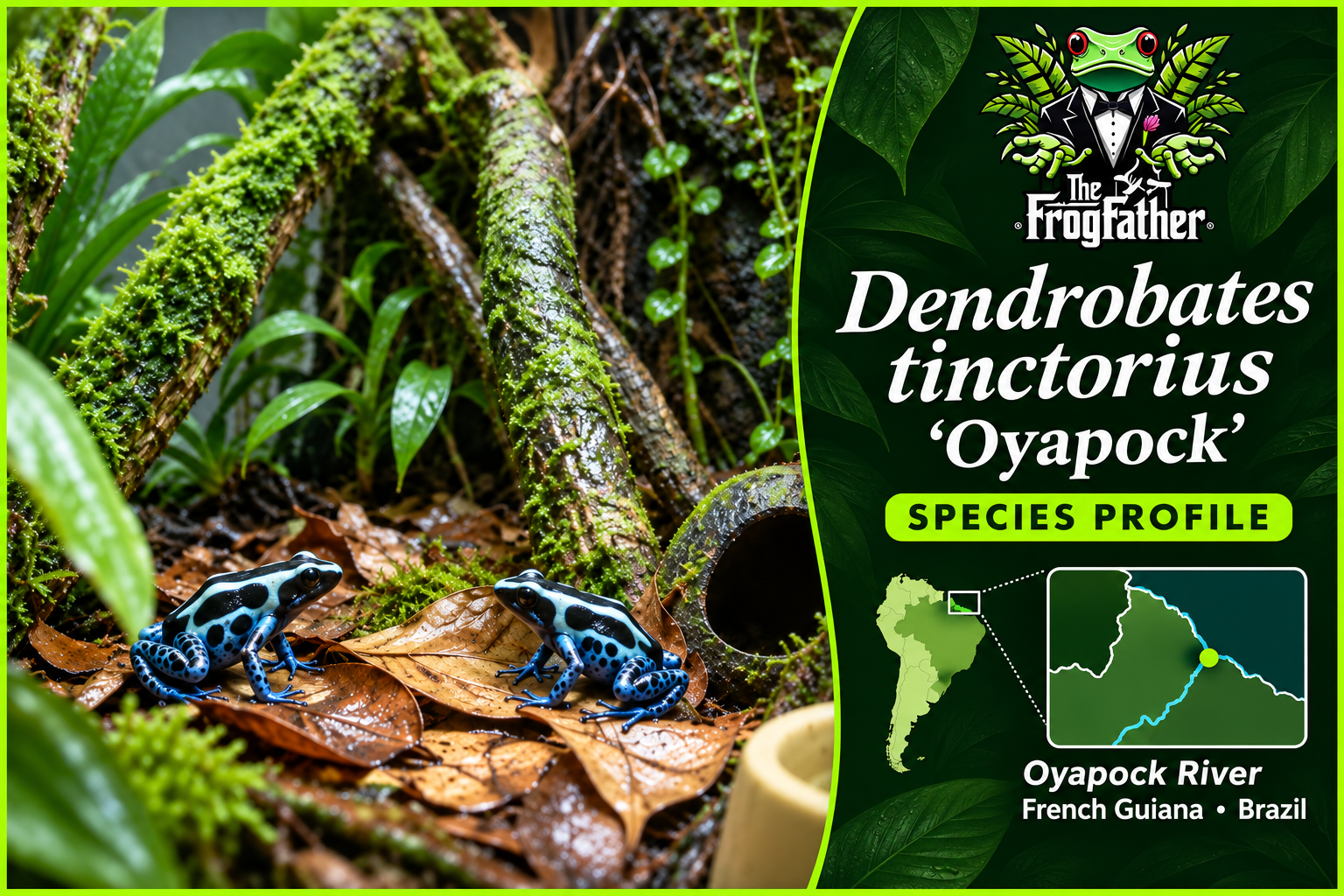
Natural association: the Oyapock/Oiapoque drainage on the French Guiana–Brazil frontier, within the eastern Guiana Shield
Adult size: generally a medium-sized tinctorius; approximately 35–45 mm for many males and 40–50 mm for many females, with individual and lineage variation
Activity: diurnal and primarily terrestrial, but an able climber
Housing: singly or as one compatible male–female pair
Preferred minimum vivarium: 45 × 45 × 45 cm for a pair; 45 × 45 × 60 cm preferred
Temperature: 22–25 °C by day; approximately 18–21 °C at night
Humidity: a ventilated daily cycle of roughly 75–95%
Diet: flightless fruit flies and other appropriately sized live invertebrates
Breeding: small terrestrial clutches, paternal egg attendance and male tadpole transport; no trophic-egg feeding
Beginner suitability: 2/5—one of the more forgiving dart frogs, provided social housing is managed correctly
Taxonomy and locality integrity
Oyapock is not a separate species or recognised subspecies. It is a captive-hobby locality name within the extremely variable species Dendrobates tinctorius. The species occurs across the eastern Guiana Shield and shows striking geographical variation in colour, pattern and body size.
The name is associated with the Oyapock, or Oiapoque, river system forming part of the border between French Guiana and Brazil. Because captive locality names represent lineages as well as appearances, Oyapock should never be crossed with Azureus, Cobalt, Tumucumaque, Lorenzo or any other tinctorius form. Similar colour is not evidence of identical provenance.Responsible breeding: label offspring as Oyapock only when both parents have traceable Oyapock lineage. Keep permanent breeding and transfer records.
Natural habitat and ecology
Dendrobates tinctorius is an eastern Guiana Shield frog associated with humid terra-firme forest, often in a patchy distribution linked to ridges, massifs and canopy gaps. Field research in French Guiana records animals using the forest floor, fallen timber, buttress roots and tree-fall openings. Males may travel vertically to deposit tadpoles in water-filled tree holes or palm bracts.
The captive enclosure should therefore combine deep visual structure at ground level with safe climbing opportunities. It should not be designed as a bare terrestrial box. Leaf litter, cork, roots, shaded retreats and planted vertical surfaces allow the frogs to express both terrestrial foraging and climbing behaviour.
Wild frogs acquire defensive alkaloids through their diet. Properly maintained captive-bred animals lack the same alkaloid profile, but their permeable skin remains easily damaged by handling and contaminants.
Appearance and size
Oyapock is normally recognised by pale cream, yellow or near-white markings over a black ground colour, with blue to blue-grey limbs and varying dark reticulation. Pattern varies between individuals and should not be used alone to verify lineage.
The wider species shows extensive size variation: published field measurements across populations span roughly the high 20s to upper 50s in millimetres. Captive Oyapock are normally regarded as medium-sized tinctorius. Females commonly become broader and larger than males, but size alone cannot reliably sex a juvenile or an unusually large male.
Temperament and social housing
Oyapock can be confident, visible and responsive at feeding time once settled. A well-planted enclosure generally produces more natural visibility than a brightly lit, exposed one because the frogs can move between cover without crossing open ground.
Tinctorius are not communal frogs in the ordinary sense. Both sexes may show aggression, and mature females are particularly capable of wrestling, pinning, excluding or chronically stressing other females. Aggression may appear only when animals mature or breeding begins.
Recommended arrangement: one frog or one confirmed, compatible male–female pair. Do not keep multiple adult females together. Do not mix Oyapock with another species or locality. Keep a prepared separation enclosure because even an established pair can become incompatible.
Vivarium size and design
A 45 × 45 × 45 cm vivarium is a sensible minimum for a pair, although 45 × 45 × 60 cm is preferable because it creates more planting, climbing and temperature options. Larger is valuable when the usable space is well structured.
- Seal cable, drainage, door and misting gaps.
- Use a drainage layer that cannot become stagnant.
- Provide a biologically active substrate beneath generous leaf litter.
- Create multiple hides, feeding areas and sight breaks.
- Use broad leaves, cork, roots and low branches rather than an empty floor.
- Offer several sheltered egg-laying locations such as smooth leaves, petri dishes beneath hides or suitable breeding shelters.
- Avoid deep, steep-sided open water.
Allow the enclosure to cycle before frogs are introduced and use the pre-frog checklist.
Temperature
Maintain approximately 22–25 °C during the day, with a night reduction to around 18–21 °C. Stable access to cooler retreats is more important than creating a hot basking spot. Sustained readings approaching 27–28 °C are a warning, particularly in a closed vivarium where heat and humidity cannot escape.
Measure temperatures at the floor, mid-level and upper planting rather than relying on the room thermostat. If heating is required, control it by thermostat and prevent direct contact with hot glass.
Humidity, water and ventilation
Aim for high but cycling humidity: commonly about 75–95%, rising after misting and overnight and falling as ventilated leaves begin to dry. Leaf litter and retreats should remain humid without turning the whole enclosure into standing water.
Persistent condensation is not a substitute for measurement. Waterlogged substrate, stagnant air and dirty reservoirs increase husbandry risk. Use amphibian-safe water and maintain the system using the misting-reservoir guide, ventilation guide and UK water guide.
Lighting and UVB
Use a consistent day–night cycle, normally close to 12 hours, and plant lighting that does not overheat the enclosure. Provide deep shade as well as brighter planted areas. Carefully measured low-level Ferguson Zone 1 UVB can be offered, but it must have shaded escape routes and cannot replace dietary supplementation. See Do Dart Frogs Need UVB?.
Feeding and supplementation
Flightless Drosophila melanogaster are a suitable staple. Larger hydei may be accepted by full-sized adults, but prey size should always be judged against the individual frog. Springtails, bean weevils, pea aphids and other safe cultured invertebrates can add variety where appropriately sized.
Offer controlled portions on most feeding days and assess each frog’s body condition rather than feeding by a rigid count. Juveniles need smaller, more frequent food. Remove accumulating waste and do not allow uneaten flies to overwhelm the vivarium.
Dust every fruit-fly feed with a correctly formulated complete amphibian supplement according to its instructions. Frogfather’s All-in-One Vitamin & Mineral Dust and small fruit flies provide the natural commercial pathway. See the feeding guide and supplementation guide.
Breeding and tadpole care
Courtship in tinctorius is comparatively quiet: the species lacks the conspicuous advertisement call heard in many poison frogs. Females may follow, touch or stroke a male as the pair investigates a laying site. Field clutches are commonly around four or five eggs, although captive clutches can vary and may occasionally be larger.
The male moistens and attends the clutch. Hatching is usually around two weeks, after which tadpoles climb onto his back. He transports one or a small number at a time to water-filled cavities. Unlike R. imitator, the female does not provision tadpoles with trophic eggs.
Tinctorius tadpoles are opportunistic, strongly carnivorous and cannibalistic. Raise them individually unless using a carefully designed system that prevents contact. In field observations, metamorphosis occurs after roughly two to three months, but captive duration varies with temperature, nutrition, water quality and locality.
The Tadpole Raising Kit and Tadpole Growth food can be linked here without suggesting that equipment replaces water-quality monitoring.
Sexing Oyapock
Mature females are often larger, broader and more pear-shaped. Males may have wider toe discs, but overlap exists and neither feature is infallible. Courtship, egg production and repeated adult observation provide stronger evidence. Allow sufficient time: tinctorius may take a year or longer to mature fully.
Health and welfare
Monitor feeding accuracy, posture, limb use, skin condition and body profile. Standardised photographs or weights help reveal gradual loss. Persistent hiding combined with weight loss, abnormal soaking, poor coordination, bloating, marked lethargy or skin lesions require investigation and, where appropriate, an experienced exotics veterinarian.
Quarantine every new amphibian for 30–45 days or according to veterinary risk assessment. Use separate tools and never move substrate, water or microfauna from quarantine into established enclosures.
Seasonal management and breeding condition
Oyapock does not need an artificial reptile-style hibernation. Instead, keep the basic thermal range safe throughout the year while allowing modest changes in misting frequency, photoperiod and feeding that reflect the room and the frogs’ condition. Never create a severe dry season for the purpose of forcing breeding.
Continuous heavy breeding can deplete a female. If body condition declines, remove eggs, reduce breeding triggers or separate the pair temporarily while maintaining normal nutrition and observation. More food is not a substitute for rest when a female is producing repeated clutches.
Breeding animals need especially consistent supplementation, but “more” is not automatically safer. Use one complete programme, follow the product dose and replace powder before vitamins deteriorate. Record clutch dates, fertility, hatching, tadpole development and parent identity. These records reveal gradual fertility problems and preserve confidence in the lineage.
Introducing a pair safely
Introduce frogs only after quarantine and preferably into a neutral, fully established vivarium rather than placing a new animal inside another frog’s long-held territory. Provide duplicate hides and feeding points from the first day. Observe feeding and position several times daily during the first week without repeatedly disturbing the enclosure.
Normal courtship contact should not be confused with sustained aggression. Warning signs include repeated wrestling, one frog being pinned or pursued, exclusion from food, persistent hiding in an exposed upper corner, weight loss or one animal remaining in water. Separate immediately when harm or chronic exclusion is suspected; waiting for visible injury is not good pair management.
Beginner rating: 2/5
Oyapock is a strong beginner choice because adults are large enough to observe easily, take common cultured foods and tolerate normal dart-frog temperature ranges. The rating is not 1/5 because humidity, supplementation, quarantine and social aggression still require active management. A keeper who follows those fundamentals should find Oyapock more forgiving than most thumbnail species.
Buying captive-bred Oyapock
Choose captive-bred animals with documented locality lineage and established feeding. Ask how sex was determined, what supplement and prey they currently receive and whether the proposed pair has lived together. The Frogfather Oyapock tadpole listing should link to this profile, and this profile should link back to the live stock only when available.
Frequently asked questions
Is Oyapock a separate species?
No. It is a locality form of Dendrobates tinctorius.
Can Oyapock dart frogs live communally?
No communal group is recommended. Keep one frog or one compatible male–female pair, avoiding multiple adult females.
What vivarium size does a pair need?
Use at least 45 × 45 × 45 cm; 45 × 45 × 60 cm is preferred.
What temperature and humidity are suitable?
Use approximately 22–25 °C by day and 18–21 °C at night, with a ventilated humidity cycle around 75–95%.
Are Oyapock suitable for beginners?
Yes. They are rated 2/5 for difficulty, provided the keeper understands supplementation, humidity and pair management.
Do Oyapock tadpoles receive food eggs?
No. The male transports them, but they are not dependent on female trophic-egg feeding and should normally be reared individually because of cannibalism.
Scientific basis
- Amphibian Species of the World: accepted taxonomy of Dendrobates tinctorius.
- Rojas & Pašukonis (2019): habitat use, social behaviour, clutch development and tadpole transport.
- Noonan & Gaucher and Wollenberg et al.: geographical and genetic variation across the Guiana Shield.