
By The Frogfather
Quick verdict: Borja Ridge is a Peruvian locality form of Ranitomeya variabilis. It is a beautiful, active thumbnail suited to a prepared keeper who can supply tiny live foods and stable, relatively cool rainforest conditions. Pairs are simplest; carefully planned small groups can work, but this species is promiscuous rather than pair-bonded and every animal must be monitored.
Borja Ridge at a glance
Scientific species: Ranitomeya variabilis (Zimmermann & Zimmermann, 1988)
Locality name: ‘Borja Ridge’
Origin: Peruvian Amazon; Borja, Loreto, Peru is represented in published taxonomic material for the highland-pattern form
Adult size: a thumbnail poison frog, normally under 21 mm snout–vent length
Activity: diurnal and semi-arboreal
Housing: pair preferred for simplicity; a carefully monitored small group is possible in a larger, heavily structured vivarium
Preferred minimum: 45 × 45 × 60 cm for a pair; at least 60 × 45 × 60 cm for a small group
Temperature: approximately 21–24 °C by day and 18–21 °C at night
Humidity: a ventilated cycle around 75–95%
Diet: Drosophila melanogaster, springtails and other minute cultured invertebrates
Breeding: clutches of roughly 1–6 eggs, male tadpole transport and separate deposition; no trophic-egg feeding
Beginner suitability: 3/5—reasonable as a first thumbnail, but less forgiving than a larger Dendrobates
Taxonomy and what ‘Borja Ridge’ means
Borja Ridge is not a separate species or subspecies. It is a locality or captive-line designation within Ranitomeya variabilis, the variable poison frog. The species has a complicated taxonomic history and encompasses visibly different highland and lowland pattern forms across a broad Amazonian distribution.
The 2011 revision of Ranitomeya illustrates animals from Borja, Loreto, Peru among the highland-pattern material. The captive name should therefore be used to preserve lineage, not treated as a formal taxonomic rank. Never cross Borja Ridge with another variabilis locality or with lookalike Ranitomeya.
Distribution and natural habitat
Ranitomeya variabilis occurs across Amazonian rainforest in parts of Peru, Ecuador, Colombia and Brazil, with eastern populations now also recognised in French Guiana and adjacent Brazil. Borja Ridge belongs to the Peruvian tradition of the species.
The species is diurnal and semi-arboreal. Published observations place it in primary and secondary rainforest, ground vegetation, leaf litter and vertically growing plants near streams and small rivers. Breeding relies on phytotelmata—small water bodies held by plants—particularly bromeliad axils.
A captive enclosure must therefore provide vertical planting and many small routes through vegetation, not simply damp substrate. Bromeliads, climbing foliage, cork and fine branches should connect the lower and upper zones.
Appearance and adult size
Ranitomeya are defined by their diminutive adult size, generally below 21 mm snout–vent length. Borja Ridge frogs show the characteristic dark nose marking and a variable yellow-to-orange and greenish reticulated pattern over black, often including a dorsal Y-shaped element. Exact colour and pattern vary naturally between individuals.
Pattern should never be used as the sole proof of locality. Purchase records and breeder provenance are more important than resemblance to an online photograph.
Behaviour and communal suitability
Unlike the socially and genetically monogamous R. imitator, R. variabilis is promiscuous and does not rely on biparental trophic-egg care. Males provide the main parental care by attending and transporting tadpoles. Adults can use overlapping space, but that does not make every group automatically compatible.
A pair is the most manageable arrangement for a newer keeper. Experienced keepers may maintain a small group in a larger, densely planted enclosure with multiple feeding, calling, laying and retreat sites. Avoid crowding, watch for exclusion and maintain an immediate separation plan.
Communal rating: cautiously possible, not guaranteed. For a group, use at least 60 × 45 × 60 cm, provide multiple visual territories and confirm that every frog feeds and maintains condition. Never mix species or locality forms.
Vivarium size and furnishing
Use at least 45 × 45 × 60 cm for a pair. Height is valuable only when it contains usable planting and branches. For a small group, start at 60 × 45 × 60 cm and enlarge further if the structure or group composition requires it.
- Fit genuinely fruit-fly- and frog-proof doors, vents and cable ports.
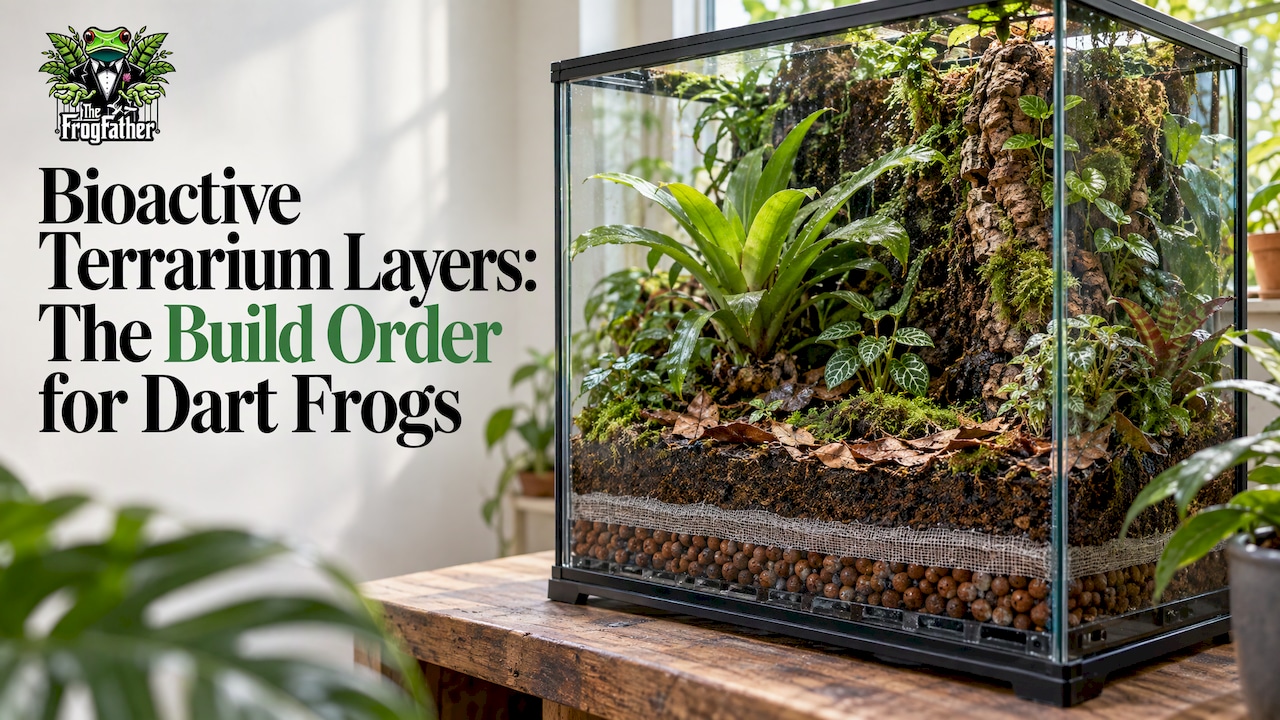
- Use drainage, a mature bioactive substrate and leaf litter.
- Plant densely at several heights while retaining airflow.
- Provide multiple bromeliads and other small water-holding deposition sites.
- Create several feeding stations so one animal cannot monopolise prey.
- Include shaded retreats and visual barriers throughout the enclosure.
- Avoid deep open water and inaccessible drainage spaces.
Cycle and test the enclosure before introduction using the pre-frog checklist.
Temperature
A conservative target for Borja Ridge is approximately 21–24 °C during the day with a night reduction to around 18–21 °C. This is deliberately cooler than a generic “tropical” setting. Avoid sustained readings above approximately 26 °C, particularly when ventilation is limited.
Measure temperatures in upper foliage, central cover and near the substrate. The enclosure needs a gradient and shaded cooler retreats, not a reptile-style basking point.
Humidity, water and ventilation
Maintain a daily humidity cycle, often around 75–95%. Humidity should rise after misting and overnight, then decline as ventilated leaves partially dry. Persistent saturation is not the goal: roots, microfauna and frogs all benefit from oxygen exchange and drainage.
Bromeliad axils and designated tadpole sites need clean, appropriate water, but the whole substrate should not be flooded. Use amphibian-safe water and maintain the equipment using the reservoir-cleaning, ventilation and water-quality guides.
Lighting and UVB
Use roughly a 12-hour photoperiod and plant lighting that does not heat the upper foliage excessively. Provide shaded travel routes. Carefully controlled low-level Ferguson Zone 1 UVB may be offered, with abundant shade, but it is not a replacement for supplementation. See Do Dart Frogs Need UVB?.
Diet and supplementation
Borja Ridge requires reliably tiny prey. Flightless Drosophila melanogaster are the practical staple; springtails are essential support, especially for froglets. Pea aphids and other minute cultured foods can add variety. Standard hydei may be too large for some individuals.
Feed small portions frequently enough to maintain condition and ensure every group member eats. A group vivarium must have more than one feeding area. Growing juveniles should have near-continuous access to springtails without allowing larger flies to accumulate unchecked.
Dust every fruit-fly feed with a properly formulated complete amphibian supplement according to instructions. Link naturally to All-in-One Vitamin & Mineral Dust, small fruit flies and the mixed springtail culture.
Breeding biology
Clutches normally contain a small number of eggs; scientific accounts report approximately 1–6. Eggs are placed close to small plant-held water bodies or on protected surfaces. The male attends the clutch and later transports one or two hatchlings at a time, usually depositing tadpoles separately.
Separate deposition is important because variabilis tadpoles can be cannibalistic. Unlike R. imitator, the species is not monogamous and the female does not return to feed individual tadpoles trophic eggs. Tadpoles feed on detritus and available animal material in their nursery pools.
A 2023 captive-development study recorded 79–91 days from early embryo to metamorphosis in a French Guiana population. That is valuable species-level evidence, but it should not be presented as an exact Borja Ridge timetable: temperature, nutrition, water and population all affect development.
When rearing manually, house tadpoles individually and monitor water quality closely. Link this section to the Tadpole Raising Kit and appropriate tadpole food.
Sexing Borja Ridge
Calling is the best practical indication of a male. Mature females may be broader, but body shape is unreliable in juveniles. Toe-disc and size comparisons can support an assessment but should not be treated as proof. Use repeated behaviour over time and do not overcrowd unsexed juveniles while waiting for maturity.
Health monitoring
Because these frogs are tiny, deterioration can be missed. Record standardised photographs or weights, confirm feeding by each animal and watch for loss of climbing ability, persistent hiding with declining condition, repeated missed strikes, abnormal soaking, skin lesions or poor coordination.
Quarantine new frogs for 30–45 days or according to veterinary risk assessment, with dedicated tools and no transfer of substrate or water. Seek an experienced exotics veterinarian when disease or unexplained decline is suspected.
Managing a pair or group in practice
Population density must be judged by behaviour, not simply by dividing enclosure volume by the number of frogs. Two visually similar vivariums can function very differently depending on planting density, the number of feeding stations and whether animals can leave one another’s sight.
For a group, record each frog’s pattern so individuals can be recognised. Watch all animals feed at least several times each week and take standardised photographs or weights. Add more food access points rather than one oversized feeding station. If one frog consistently occupies the only productive area while another becomes thin or reclusive, the enclosure is not functioning communally even if no wrestling has been seen.
Juvenile groups may appear entirely peaceful and change after maturity. Keep a cycled spare enclosure or appropriate temporary separation setup ready before that happens. Never add a single newcomer directly to an established adult group without quarantine and a deliberate introduction plan.
Seasonality and responsible breeding
Borja Ridge does not require extreme seasonal manipulation. Stable temperatures, a healthy humidity cycle and modest variation in misting are safer than imposing a prolonged dry period. Breeding should be the consequence of excellent condition, not repeated environmental shocks.
Provide several laying and deposition options so males are not forced to use one pool already occupied by another tadpole. Check bromeliad axils without damaging plants or repeatedly disrupting the adults. If tadpoles are pulled, label each container with parentage and date and never combine unfamiliar tadpoles merely to save space.
Track fertility, hatch dates, development, deformities and froglet survival. These data help distinguish a one-off failed clutch from persistent nutritional, genetic or environmental problems and make the resulting captive-bred lineage more valuable.
How Borja Ridge differs from Intermedius
The two can be confused by inexperienced buyers because both are small, patterned Peruvian Ranitomeya. Their reproductive systems are fundamentally different. R. imitator Intermedius forms a strongly pair-oriented system in which both parents repeatedly care for individual tadpoles and the female provides trophic eggs. R. variabilis Borja Ridge is promiscuous; males transport tadpoles to comparatively larger pools, after which the tadpoles feed without repeated parental provisioning.
That distinction affects housing and breeding design. Intermedius should normally be maintained as a pair with tiny parent-accessible nursery pools. Borja Ridge can sometimes be managed in a carefully structured group, but deposition choices must reduce tadpole contact and cannibalism. The locality names must never be used interchangeably.
Beginner rating: 3/5
Borja Ridge is a reasonable first Ranitomeya for a keeper who already cultures melanogaster and springtails and can maintain a cool, escape-proof planted vivarium. It is not as forgiving as a larger Dendrobates because small frogs lose condition quickly, exploit minute gaps and require very small prey. A pair is considerably easier to monitor than a group.
Buying Borja Ridge responsibly
Buy captive-bred animals with documented Borja Ridge lineage. Ask what they eat, how old they are, whether sex is confirmed and how the breeder manages groups. The Frogfather Borja Ridge tadpole listing should link back to this profile.
Frequently asked questions
Is Borja Ridge a separate species?
No. It is a locality form of Ranitomeya variabilis.
Can Borja Ridge live in groups?
A pair is simplest. A small group can be attempted in a larger, heavily structured enclosure with careful monitoring and a separation plan.
What size vivarium is required?
Use at least 45 × 45 × 60 cm for a pair and at least 60 × 45 × 60 cm for a carefully managed small group.
What temperatures are suitable?
A conservative target is approximately 21–24 °C by day and 18–21 °C at night, avoiding sustained high temperatures.
Are they beginner frogs?
They are rated 3/5: suitable as a first thumbnail for a prepared keeper, but less forgiving than larger Dendrobates.
Do females feed the tadpoles eggs?
No. Males transport tadpoles, but the species does not use the intensive trophic-egg provisioning seen in R. imitator.
Scientific basis
- Amphibian Species of the World: taxonomy and distribution.
- Brown et al. (2011): taxonomic revision, highland/lowland forms and Borja material.
- Brown, Morales & Summers (2010): mating-system and parental-care comparison with R. imitator.
- Regnet et al. (2023): captive breeding and embryonic/larval development.