By The Frogfather
A springtail culture can look wonderfully busy just before you need it most. You tap out a generous harvest for froglets, seed another vivarium and assume the remaining population will carry on supplying everything.
Then the surface looks quieter. You feed a little more, harvest a little less and realise that the tub you have been relying on is also the only tub you have.
A backup culture gives you another route when production slows or a container develops a problem. The useful part is keeping that reserve genuinely separate from everyday harvesting. This guide explains how to organise reserve and production cultures without repeating the whole business of general springtail care.
Quick answer
Keep a clearly labelled reserve culture alongside the cultures used for routine harvesting. Establish it before your main supply is failing, maintain it appropriately for the springtails involved and avoid using it as the default extra feeding tub.
Use clean dedicated equipment, retain source information and record transfers. A backup reduces dependence on one container; it does not guarantee independence from shared heat, contamination or handling problems. Keep alternative suitable livefood available where animals depend on regular tiny prey.
Define what the reserve is for
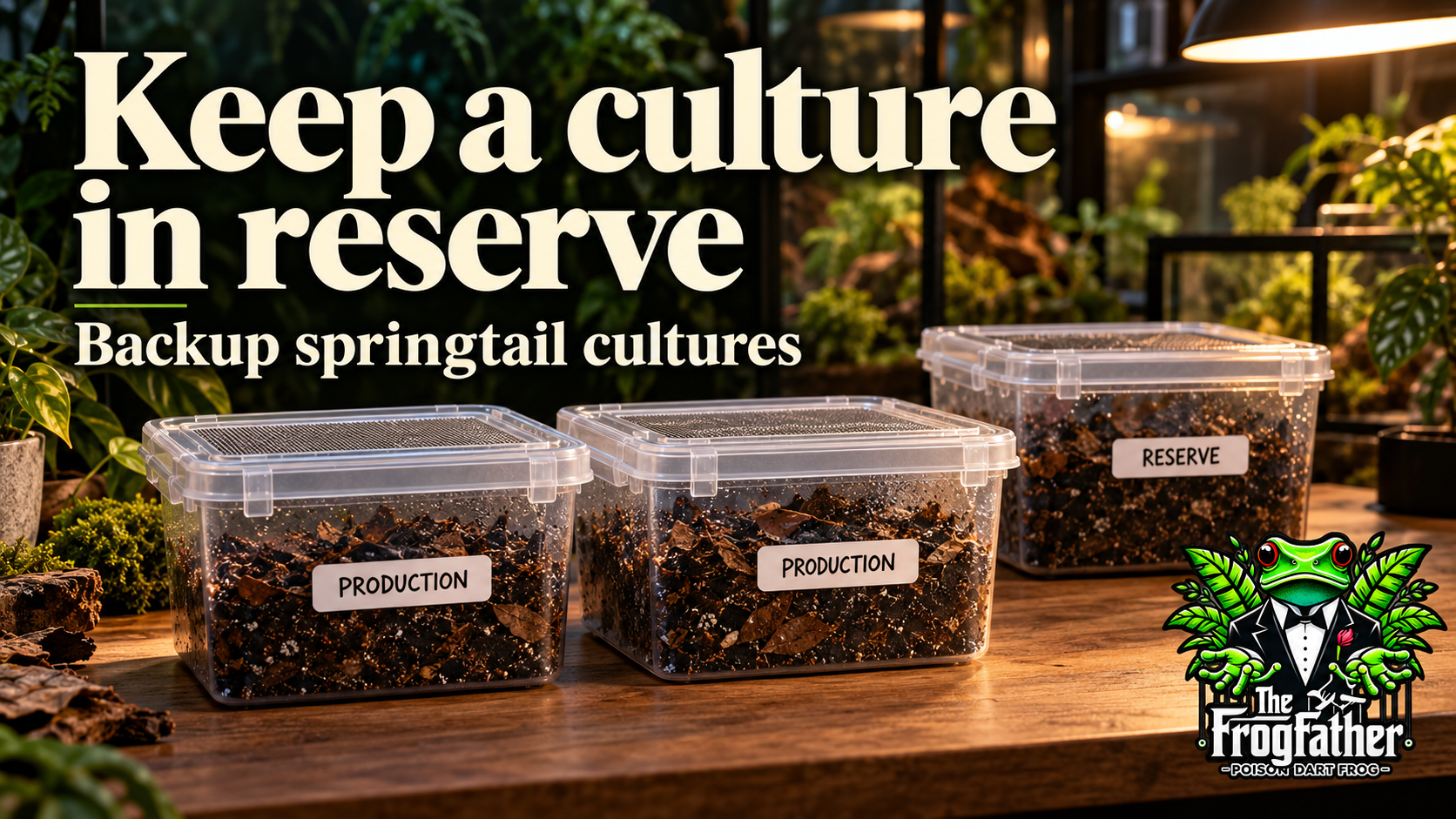
A production culture supplies springtails for feeding or seeding enclosures. A reserve culture is maintained primarily as a source from which production can be restarted. It still needs routine inspection, moisture management and feeding.
These are roles you assign to containers, not biological differences between the springtails. The label only works if your handling follows it. A reserve that is heavily harvested whenever the production tub looks low is effectively another production tub.
For a small collection, the arrangement can remain simple: a labelled reserve and one or more working cultures. Larger collections may need several separate lines and more production capacity. There is no universal number of tubs that guarantees sufficient supply.
Plan around actual demand and the ability to maintain each container. Ten neglected tubs are not automatically a stronger system than a few well-managed, clearly identified cultures.
Know which springtails you are maintaining
Springtails are a diverse group. A colour-based trade label does not establish a species identity or prove that two cultures have identical needs.
Retain the supplier’s exact identification and care information. If no species identification is supplied, record the trade name and source without inventing a scientific name. Do not assume that every white springtail sold in the hobby is the same taxon.
The OECD’s laboratory guidance uses identified springtail species and species-specific culture information [1]. That provides a useful contrast with treating all hobby cultures as interchangeable. Laboratory methods are references for particular organisms, not universal instructions for every tropical springtail.
Our springtail care guide provides the broader husbandry route. For a reserve system, the additional task is preserving identity and continuity as cultures are split, replaced or moved.
Establish the backup while you have healthy stock
The most useful time to start a reserve is when the source culture is performing normally. Waiting until the only tub smells unusual or contains very few visible springtails leaves fewer options.
Prepare a suitable clean container and medium before transferring stock. Use conditions appropriate to the identified springtails or the supplier’s documented line. A reserve is not the best place to test a new substrate, food and ventilation design all at once.
Transfer a useful founder group using a method suited to the medium. Avoid describing a fixed founder count as universally sufficient, particularly where identification, reproduction and age structure are uncertain.
Label the new tub immediately and record the source container and date. Continue observing both cultures. The new reserve should not be counted as dependable simply because some springtails were visible on the day it was started.
Check establishment before assigning a critical role
A transferred culture needs time and appropriate conditions to establish. Look for continued activity, evidence consistent with reproduction and a stable usable medium rather than relying on the original adults remaining visible.
Where the species and container permit it, seeing different size classes can be a useful observation. It does not give an exact population count, and limited visibility should not be mistaken automatically for failure.
Keep records of inspections without repeatedly digging through the entire medium. Use a consistent accessible observation area or removable collection surface where appropriate. Disturbing every corner to prove that the reserve is alive can make maintenance unnecessarily disruptive.
If establishment is doubtful, retain the original productive culture and review the transfer conditions. Do not retire your established supply on the assumption that a newly labelled reserve is already capable of replacing it.
Give every container a simple identity
Use labels you can read without lifting lids or guessing which stack the tub came from. A practical label includes a culture code, springtail identification as supplied, source, start date and role.
For example, a code such as ST-A-R1 can identify a reserve, while ST-A-P1 identifies a related production culture. The exact code is unimportant; consistency is what makes it useful.
Keep transfer notes outside the tub as well. A small notebook or spreadsheet can record which reserve started each working culture, when a culture was retired and why. If a problem appears, the transfer history helps identify connected containers.
Do not relabel a culture’s age by topping it up with fresh medium. Record that as maintenance. A new start, a partial refresh and a transfer from another line are different events and should remain distinguishable.
Separate the workflow as well as the labels
Work with clean reserve cultures before handling questionable or heavily used production containers. Keep tools clean and avoid moving debris from one tub to the next.
Where practical, use dedicated collection equipment for each line or a documented cleaning process between uses. Do not rest a dirty scoop on the reserve lid and then use the same surface for clean preparation.
Never return unused springtails, collection surfaces or feeding cups from an occupied vivarium to the reserve. That transfer would connect the reserve directly with the enclosure and everything carried on the returned material.
These handling precautions apply general biosecurity principles to a culture workflow [4]. They do not make a home culture system sterile. It reduces unnecessary connections. A reserve is most useful when its handling history is clear, rather than when it is repeatedly exposed to whatever happened during the last feeding round.
A second tub can still share the same failure
Two containers on the same shelf can both be affected by excessive heat, drying, a contaminated food batch or an unsuitable change in routine. A backup is not completely independent just because it has a separate lid.
Review shared risks. Keep cultures away from direct sun and uncontrolled heat sources. Use suitable storage conditions for the springtails involved and inspect the place where the tubs actually sit.
If maintaining a reserve in another appropriate location is practical, it can reduce dependence on one storage position. It does not justify moving a line into conditions outside its needs merely to put distance between containers.
Likewise, separate containers do not remove the need to check fresh food, medium and water before use. If every tub receives the same unsuitable input, the reserve may reproduce the production problem rather than provide a way around it.
Harvest from production with a recovery plan
Before harvesting, look at the working culture and consider recent removals. A busy patch near food is not necessarily evidence of the total population available throughout the container.
Use a method that suits the medium and allows repeatable small collections. Removable surfaces or appropriate collection risers can make handling easier, but the number gathered will vary with culture condition and the springtails involved.
The Frogfather collection riser is an optional tool for creating an accessible collection point. It does not establish a universal harvest quantity or make a depleted culture replenish immediately [2].
Record unusually large harvests and reduce demand when the working culture appears to be declining. Avoid repeatedly taking the remaining visible springtails just because the next froglet group also needs feeding.
Avoid a fixed harvest percentage without evidence
A rule such as ‘take half every week’ sounds convenient, but it assumes you know the population, its reproductive rate and the proportion removed. In a hobby culture, those quantities are often not measured.
Instead, start conservatively and judge the response over repeated observations. Retain enough established stock to maintain the culture, and increase the number of working cultures if demand persistently exceeds what the current routine provides.
Do not respond to heavy harvesting by adding a large extra feed automatically. Food, moisture and ventilation still need to suit the population and medium. An increase in food left uneaten is a reason to review feeding rather than keep increasing it.
For general culture problems, use the springtail-culture troubleshooting guide. The reserve system manages supply dependence; it does not remove the biological limits of production.
Build production ahead of predictable demand
Froglet emergence and new vivarium builds can create a sudden need for small prey or seeding stock. Start additional working cultures in advance where possible rather than dividing the reserve on the same day demand rises.
Use your own records to learn the time between starting a culture and obtaining reliable usable harvests. That interval will depend on the springtails, method and conditions. Do not borrow a fixed timetable from a different species or supplier and assume it applies unchanged.
Keep more than one suitable feeder option in the wider plan. Springtails may be useful tiny prey for appropriate animals, but they should not be represented as a nutritionally complete universal froglet diet.
Our feeder-size guide helps connect the culture plan with the animals being fed. Supply planning begins with suitable food, not simply whichever culture is easiest to produce.
When a production culture develops a problem
Separate the questionable container from clean preparation and stop using it as a source for new cultures while you investigate. Avoid transferring its material into the reserve to ‘save whatever is left’ without understanding the risk.
Check recent changes, source inputs, moisture, temperature and handling history. An apparent decline does not identify a particular cause. Use the guide to disappearing springtails to distinguish visibility issues from evidence of a genuine population problem.
If replacement is needed, prepare clean production containers and use an established reserve whose condition you have checked. Retain a record of the failed culture and its connections rather than erasing the history by moving everything into a new tub.
A purchased replacement can also be useful when your reserve is doubtful. Inspect and keep it separately at first according to the supplier’s instructions rather than immediately mixing it with every surviving line.
Maintain the reserve without turning it into an experiment
Inspect the reserve regularly enough to catch drying, flooding, food accumulation or unexpected organisms. The interval should fit the container and husbandry method; ‘backup’ does not mean ‘ignore until needed’.
Keep routine care consistent and document meaningful changes. If trialling a new food, substrate or container, use a separate small test culture while retaining the established reserve method.
If a reserve becomes old, difficult to inspect or unreliable, establish a successor while healthy stock remains. Keep the original until the replacement is demonstrably established. That overlap is the purpose of the system.
Do not keep adding new springtails to a deteriorating tub without reviewing the conditions. A reserve label cannot compensate for an unsuitable environment, and repeated top-ups can obscure whether the population is actually sustaining itself.
Plan an ordinary week in a few minutes
A simple weekly review can begin with the reserve: check its condition, food and moisture without harvesting routinely. Next inspect production cultures and note which are suitable for collection and which need recovery.
Compare expected demand with those working cultures. If a new froglet group is approaching, decide whether to start additional production rather than assuming the reserve will cover the difference later.
Check labels, transfer notes and supplies. Prepare the next containers before the current stock is exhausted. Set aside any questionable culture for investigation and keep it out of clean preparation.
This is an organisational example, not a universal once-weekly care schedule. Some cultures need attention more often, and a change in condition should trigger a check when it happens rather than waiting for the next calendar entry.
Where purchased cultures fit
A mixed springtail culture may be useful for suitable bioactive purposes, but a mixed culture should be recorded as mixed. Do not treat it as a verified single-species line or assume every constituent will remain equally abundant [3].
If your aim is to maintain identifiable cultures, choose documented stock and retain the original source information. Ask the supplier about the medium, care and identification rather than inferring those details from colour alone.
A collection tool can improve convenience, while suitable food and containers can support the routine. None guarantees indefinite production. Our microfauna hub places cultures within the wider managed vivarium system.
At Frogfather HQ, separate cultures support ongoing husbandry. This article does not claim a new measured production trial, a guaranteed crash-proof system or a universal output per tub.
Keep a reserve you can actually rely on
A useful backup has known origins, suitable conditions, a clear label and a handling history that keeps it separate from everyday demand. It is established before trouble, checked during normal weeks and replaced deliberately when needed.
That arrangement makes a culture problem easier to manage. You still need to investigate what happened, maintain appropriate livefood and care for the animals. But you can do so with another healthy starting point available, instead of asking your only remaining tub to solve the whole problem.
References and further reading
The checking and management workflows are practical editorial guidance. Manufacturer documents apply to their stated equipment; general horticultural and biosecurity sources do not validate every vivarium application.
- OECD (2016) — Test No. 232: Collembolan Reproduction Test in Soil. Identified laboratory species and culture methods. Laboratory conditions are not presented as universal hobby husbandry.
- The Frogfather — Springtail collection riser. Optional collection tool; its marketing does not establish a safe harvest rate.
- The Frogfather — Mixed springtail culture. Existing mixed-culture listing; article makes no current price, constituent identity or availability claim.
- IUCN/SSC CBSG (2017) — Control of infectious diseases in amphibian assurance colonies. General biosecurity principles concerning indirect contact and equipment. Reserve/production workflow is practical husbandry synthesis, not an experimentally validated crash-prevention system.