
Written by The Frogfather | UK dart frog keeper, breeder and bioactive vivarium specialist | Last reviewed: 9 September 2026
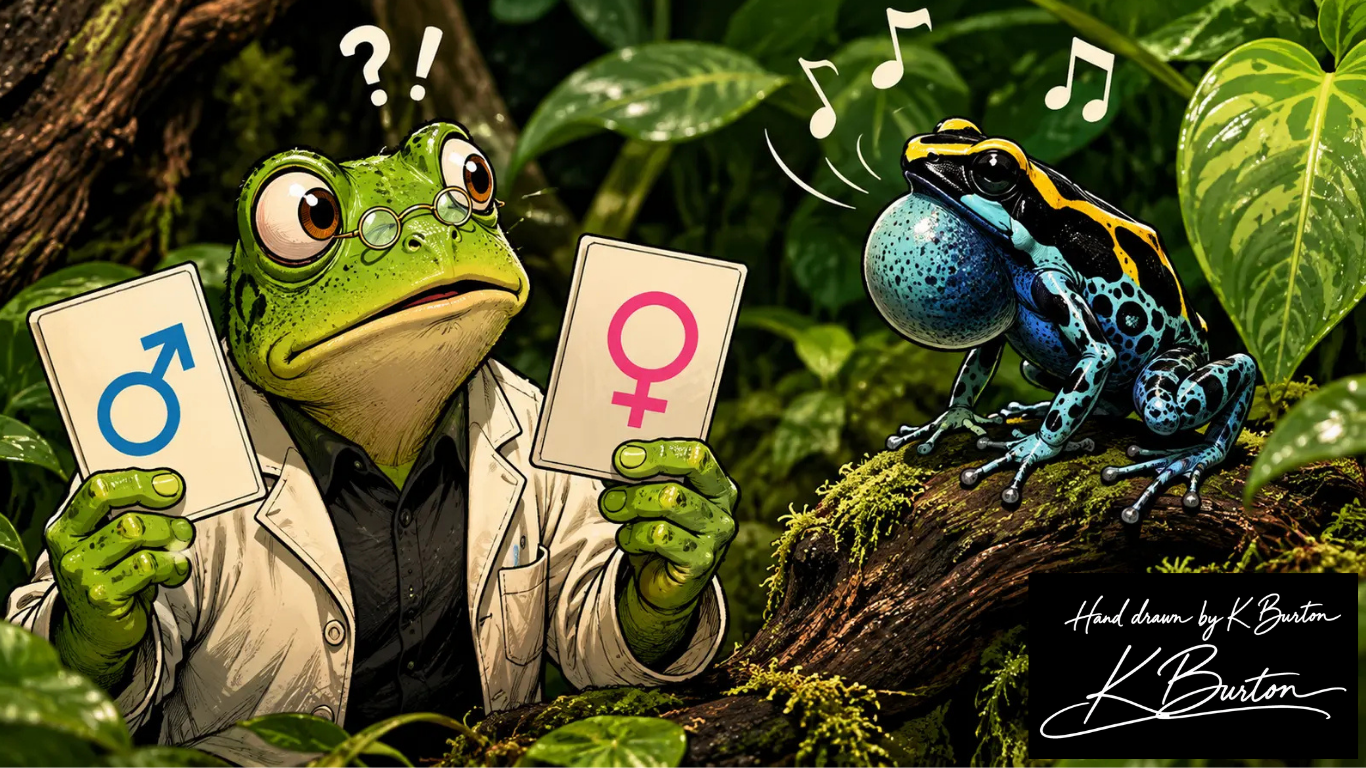
You buy what appears to be a male and female pair. For months one frog calls while the other remains quiet, broader and apparently female. Then the quiet frog climbs onto a favourite perch, inflates its throat and begins producing a clear repeated call.
Has it changed sex?
Probably not. Amphibian sex determination is genuinely complex, and biological sex reversal has been documented in some frog species. That scientific fact is often compressed online into the much less accurate claim that frogs can casually swap sex during adult life.
For a captive dart frog that “changes” after several months, the ordinary explanation is much stronger: it was sexed too young, one visual feature was given too much weight, or a male matured and began advertising later than expected. The frog’s biology has become easier to read; it has not necessarily been rewritten.
What do people mean when they say a frog changed sex?
Several very different events are routinely described with the same phrase. Separating them removes most of the mystery.
The frog was mis-sexed
A keeper or seller made a reasonable visual estimate that later proved wrong. This is especially common with juveniles and species whose adult differences are subtle. Nothing changed inside the frog; the label changed when better evidence arrived.
The frog matured
A young male developed larger toe pads, adult body proportions, territorial behaviour or a recognisable call. Sexual maturity does involve biological development, but it is not a switch from female to male.
The frog changed its behaviour
An already mature male that rarely called became vocal after misting, a seasonal shift, a move, the arrival of another frog or improved breeding condition. Silence never proved it was female.
Developmental sex reversal occurred
The animal’s phenotypic or gonadal sex developed differently from its genetic sex. This is a genuine scientific phenomenon documented in some amphibian species. Demonstrating it requires genetic and anatomical evidence; it cannot be diagnosed because a captive frog looked female and later called.
The species shows reversed reproductive roles
In behavioural ecology, “sex-role reversal” concerns which sex competes more strongly for mates or supplies more parental investment. It does not mean that either animal changed its anatomical sex.
Why might a presumed female dart frog suddenly start calling?
The simplest explanation is usually the correct one: the frog was male all along.
It was sold or assessed before sexual maturity
Young dart frogs are commonly available before reliable adult characters develop. Two similarly sized juveniles may be described as a “probable pair”, but probability is not confirmation. Even an experienced breeder cannot obtain adult behavioural evidence from a frog that has not yet produced it.
The Frogfather guide to sexing male and female dart frogs explains why age, species and several converging signs matter more than one photograph.
It matured later than its tank mate
Frogs raised together do not necessarily mature on the same date. Growth, food access, temperature history, individual development and social environment can all influence when adult behaviour becomes obvious. The first caller can make every quiet frog look female by comparison, even when another male is simply later.
It had little reason to advertise
Calling has a function. A male may advertise territory, court a female or respond to a rival. Calling can increase with changes in moisture, light cycle, enclosure structure, nearby calls or breeding condition. A lone or subordinate male may remain quiet for long periods.
Its call was previously missed
Some dart frog calls are soft, brief or produced from concealed positions. A call can be confused with another enclosure, a pump, fan or tiny mechanical vibration. Once you see the throat moving in synchrony with the sound, the caller becomes far easier to identify.
The social arrangement changed
Removing a dominant animal, adding a frog, pruning a visual barrier or moving the enclosure can change access to calling sites. A male that was behaviourally suppressed may become conspicuous. The apparent transformation is social, not sexual.
Why are juvenile dart frogs so difficult to sex?
Dart frogs do not arrive with one universal external marker. The useful clues vary in strength between Dendrobates, Oophaga, Ranitomeya, Phyllobates, Ameerega, Epipedobates and individual species.
Keepers commonly consider:
- age and confirmed sexual maturity;
- species and locality;
- regular advertisement or territorial calling;
- relative size and body shape among comparable adults;
- width and shape of toe pads;
- courtship roles and following behaviour;
- territorial interactions;
- egg laying or observed reproductive history; and
- repeated evidence rather than one moment.
Each clue has limitations. A well-fed male can look broad. A female can have substantial toe pads. A mature male can be quiet. Two females can display territorial behaviour, and eggs confirm that at least one frog is female without identifying the other animal.
Why body shape causes mistakes
Adult females of many commonly kept dart frogs tend to be larger or broader, but recent feeding, hydration, body condition, angle and reproductive state change the silhouette. Comparing a mature female with a younger male may be useful; comparing unrelated photographs from different localities is far less so.
The guide to gravid, overweight and abnormally swollen dart frogs explains why roundness alone neither confirms sex nor diagnoses a health problem.
Why toe pads are useful but not perfect
Males of some species develop noticeably broader adhesive discs on particular front digits. The distinction can be valuable in mature animals viewed clearly alongside comparable frogs. It becomes weaker when the frog is juvenile, the photograph is blurred, the toes are at different angles or the species shows substantial overlap.
Why one behaviour is not a complete answer
Calling is one of the strongest non-invasive clues, but the exact sound and context matter. Wrestling does not automatically identify two males; female-female aggression is well recognised in some dart frogs. Following does not always prove a male-female pair. Interpret a sequence, not a pose.
Does calling prove that a dart frog is male?
A repeated, species-typical advertisement or territorial call is strong practical evidence that a captive dart frog is male. In the species commonly kept as dart frogs, those conspicuous breeding calls are principally a male behaviour.
That statement still needs precision. “It made a noise” is not equivalent to “it produced a male advertisement call”. Frogs can generate incidental sounds during movement or disturbance, and vocal behaviour across the enormous diversity of frogs is more complicated than the shortcut “females are always silent”. Some non-dendrobatid female frogs are known to vocalise, and different call types serve different purposes.
Use the Frogfather dart frog call guide with sounds to compare the pattern for the species. Look for:
- a repeated recognisable call rather than one squeak;
- movement of the throat or vocal sac in synchrony;
- a regular calling perch;
- calling after lights, misting or seasonal triggers;
- territorial or courtship behaviour around the call; and
- the same individual producing it on multiple occasions.
Can a male remain silent?
Absolutely. Immaturity, season, temperature, moisture, recent transport, social suppression, lack of breeding stimulus and individual variation can all affect vocal activity. Silence is an absence of evidence, not evidence of femaleness.
If a confirmed caller becomes quiet, use the separate guide to why dart frogs stop calling. That change should be interpreted alongside appetite, activity, environment and recent disturbances rather than as a change of sex.
What is sex reversal in amphibians?
Biological sex determination describes the processes that direct an animal towards ovarian or testicular development. Mammals give many people an overly simple model: one familiar chromosome system followed by a largely fixed developmental path. Amphibians display much greater diversity.
Different amphibian lineages use different sex chromosomes and sex-determining mechanisms. Their sex chromosomes can be visually similar, and systems have changed repeatedly through evolution. In some studied species, temperature, hormones or endocrine-disrupting chemicals during sensitive developmental windows can influence sexual differentiation.
Researchers describe sex reversal when genetic markers indicate one sex while the gonads or reproductive phenotype develop as the other. Molecular work in wild green frogs, Rana clamitans, found discordance between genotypic and phenotypic sex in both suburban and forest populations. Experimental work in several amphibians has also induced sex reversal through hormone exposure or unusual developmental temperatures.
Does that prove dart frogs change sex?
No. “An amphibian can do this” is not evidence that every amphibian species does it in the same way. Green frogs, African clawed frogs and European tree frogs differ substantially from dendrobatids in ancestry, ecology and development.
There is currently no basis for telling a dart frog keeper that an established adult changed sex because it began calling. Proving such a case would require far more than photographs: dependable genetic markers, gonadal or reproductive evidence, a documented history and exclusion of ordinary misidentification.
Can temperature turn a captive dart frog male or female?
There is no responsible husbandry temperature that should be used to manipulate dart frog sex. Studies of temperature-associated sex reversal concern particular species, sensitive developmental stages and experimental conditions. They do not provide a safe dart frog breeding technique.
Temperature should remain within the appropriate welfare range for the species. Deliberately exposing eggs or tadpoles to extremes risks developmental harm or death and still would not produce a predictable result.
Can chemicals or hormones change a dart frog’s sex?
Endocrine-active substances can disrupt amphibian sexual development, which is a conservation and toxicology concern—not a husbandry tool. Never expose frogs, eggs or tadpoles to hormones, pesticides or unprescribed chemicals. Use amphibian-safe water and control contamination because these animals have permeable skin and aquatic early stages.
Sex reversal is not the same as sex-role reversal
This phrase creates particular confusion in poison-frog literature. A species may be described as having conventional or reversed sex roles according to parental investment, mate availability and which sex competes more intensely for partners.
Poison frogs show remarkable diversity in parental care. Depending on the species, males or females may guard eggs, transport tadpoles, defend resources or provision tadpoles with unfertilised eggs. In some systems, high male parental investment can influence female competition and mate choice.
None of that requires an individual to change its physical sex. A female competing strongly for access to caregiving males remains female. A male transporting tadpoles remains male. “Role reversal” describes reproductive strategy, not transformation.
| Phrase | What it means | What a keeper might observe |
|---|---|---|
| Mis-sexing | The original identification was incorrect | A presumed female later gives a regular male call |
| Sexual maturation | Adult features and behaviour become apparent | Toe pads broaden or calling begins with age |
| Behavioural change | An existing behaviour starts, stops or becomes visible | A quiet male calls after a seasonal or social change |
| Sex reversal | Phenotypic sex differs from genetic sex during development | Cannot be confirmed by ordinary visual observation |
| Sex-role reversal | Patterns of competition or parental investment differ | One sex competes more for access to caregiving mates |
How should you reassess a presumed pair or group?
Do not rush from one unexpected call to a complete reshuffle. Collect better evidence while remaining ready to act if aggression develops.
- Identify the caller. Watch for throat movement in synchrony with the sound. Nearby enclosures can be deceptive.
- Record the call. Capture at least 20–30 seconds of normal-speed audio or video without opening the vivarium.
- Confirm species and locality. Compare the sound only with appropriate examples.
- Review ages. A frog bought as a juvenile may simply have reached maturity.
- Take comparable photographs. Record front toe pads, body shape and size without repeatedly catching the frogs.
- Observe the social sequence. Note calling, following, touching, displacement, chasing and wrestling.
- Check reproductive history. Eggs prove a female is present, but they do not automatically tell you which non-laying frog fertilised them.
- Update confidence honestly. Use confirmed male, confirmed female, probable or unknown rather than forcing certainty.
What counts as strong evidence?
| Evidence | What it supports | Important limitation |
|---|---|---|
| Repeated species-typical advertisement call | Strong practical evidence of a male | Identify the individual and call type correctly |
| Observed egg laying | Confirms the laying frog is female | An unattended clutch does not identify the layer |
| Fertile clutches from an isolated pair | Supports a male-female pairing | Stored sperm and prior history may complicate recent introductions |
| Adult toe-pad differences | Useful supporting evidence in some species | Overlap, angle and age reduce certainty |
| Adult body shape | Useful supporting pattern | Condition, feeding and reproductive state affect shape |
| Aggression or following | Provides social context | Both sexes can be territorial and behaviour varies by species |
What should change if your presumed female starts calling?
The label on your records should change first. The environment should change only if the new information reveals a welfare problem.
If you now appear to have two males, that arrangement may be acceptable in some species and enclosures but unsafe in others. Monitor calling sites, food access, hiding, body condition and any escalation. If the frogs chase, grapple, pin or exclude one another, follow the guide to distinguishing dart frog aggression from courtship.
Do not:
- add a female immediately to “fix” the ratio;
- assume two calling males must fight in every species;
- assume a large vivarium automatically prevents conflict;
- raise temperature or soak the enclosure to force breeding;
- expose eggs or tadpoles to temperature extremes to influence sex;
- use hormones, pesticides or endocrine-active chemicals;
- sell the frog as a sex-changed biological rarity; or
- separate a stable group solely because an old label was wrong.
Do two males need separating?
Species and behaviour decide. Some dart frogs can live in suitable groups; others are safest in pairs or carefully chosen arrangements. Sexual maturity can alter a group that appeared peaceful as juveniles.
The complete guide to keeping dart frogs in groups covers usable space, visual barriers, sex ratios and hidden competition. Always keep a suitable spare enclosure available when raising an unsexed group.
What does this mean for a dart frog breeding project?
A probable pair is not a failed breeding pair simply because it has not produced eggs. It may be immature, incorrectly sexed, seasonally inactive, incompatible or not yet established. Those possibilities require different responses.
If both frogs call, you probably have two males rather than a sex-changing female. If neither calls, you may have two females, two quiet or immature males, a pair outside breeding condition or a species whose call you have not detected. Buying another unsexed juvenile adds another unknown; it does not solve the equation.
Before changing animals, confirm husbandry, maturity and behaviour using the UK dart frog breeding guide. If eggs appear, the guide to collecting and incubating dart frog eggs covers the next stage.
How should breeders describe juvenile sex?
Honestly. “Unsexed”, “probable male”, “probable female” and “confirmed calling male” communicate different levels of evidence. A visual estimate should not be marketed as certainty.
Keeping dated records of calls, photographs, clutches and pairings protects both breeder and buyer. When an assumed female later calls, the record shows a normal revision of confidence—not an extraordinary adult transformation.
Evidence and further reading
The scientific position needs two boundaries. Amphibian sex reversal should not be dismissed as a myth, but evidence from one frog species should not be universalised to dart frogs.
- Nakamura’s review of sex determination in amphibians describes the diversity of amphibian systems and experimentally induced gonadal sex reversal.
- Molecular evidence from wild green frog populations documents discordance between genotypic and phenotypic sex in both developed and forested landscapes.
- Comparative experimental work in three amphibian species demonstrates that sensitivity to hormone-induced sex reversal differs substantially between species.
- Research on sex differences in poison-frog parental care and space use illustrates why reproductive roles vary among dendrobatids without implying anatomical sex change.
The Frogfather verdict
Can amphibian sex development be more flexible than most keepers realise? Yes. Can you conclude that your adult dart frog changed sex because it began calling? No.
In the frog room, a new caller is overwhelmingly a reason to revise an earlier identification. Treat juvenile sexing as a developing evidence file: age, call, toe pads, shape, courtship and reproductive history gradually increase confidence. That answer is less sensational than a spontaneous sex change, but it is far more useful for managing the frogs in front of you.
Frequently asked questions
Can dart frogs change from female to male?
There is no good evidence that established adult dart frogs routinely change from female to male in captivity. When a presumed female begins calling, delayed maturity or an earlier sexing error is a much more likely explanation.
Why has my female dart frog started calling?
A repeated species-typical advertisement call strongly suggests the frog is a male that was previously immature, quiet or misidentified. Confirm which individual is calling and reassess several sexing clues together.
Is sex reversal real in frogs?
Yes. Genetic, hormonal and environmental research has documented sex reversal in some amphibian species. It usually concerns sexual differentiation during development and does not prove that every frog species can switch sex during established adult life.
Can temperature determine the sex of dart frog tadpoles?
There is no validated, safe temperature method for controlling sex in dart frogs. Temperature effects are species- and stage-specific, and deliberately using extremes risks developmental harm or death.
Does calling always mean a dart frog is male?
A regular species-typical advertisement or territorial call is strong practical evidence of a male dart frog. One unidentified squeak is not enough; confirm the sound, throat movement and individual over repeated observations.
Can a male dart frog remain silent?
Yes. Juvenile, subordinate, recently moved or seasonally inactive males may remain quiet, and calling varies with species, environment and social context. Silence by itself does not confirm a female.
Does sex-role reversal mean a poison frog changed sex?
No. Sex-role reversal describes patterns of mate competition, parental investment or courtship. A female competing for caregiving males and a male transporting tadpoles retain their respective sexes.
Should I separate two dart frogs if both start calling?
Not solely because both call. Review the species and monitor pursuit, wrestling, food access, hiding and body condition. Separate if conflict, exclusion, injury or sustained stress develops.