
Written by The Frogfather | UK dart frog keeper, breeder and bioactive vivarium specialist | Published: 8 September 2026
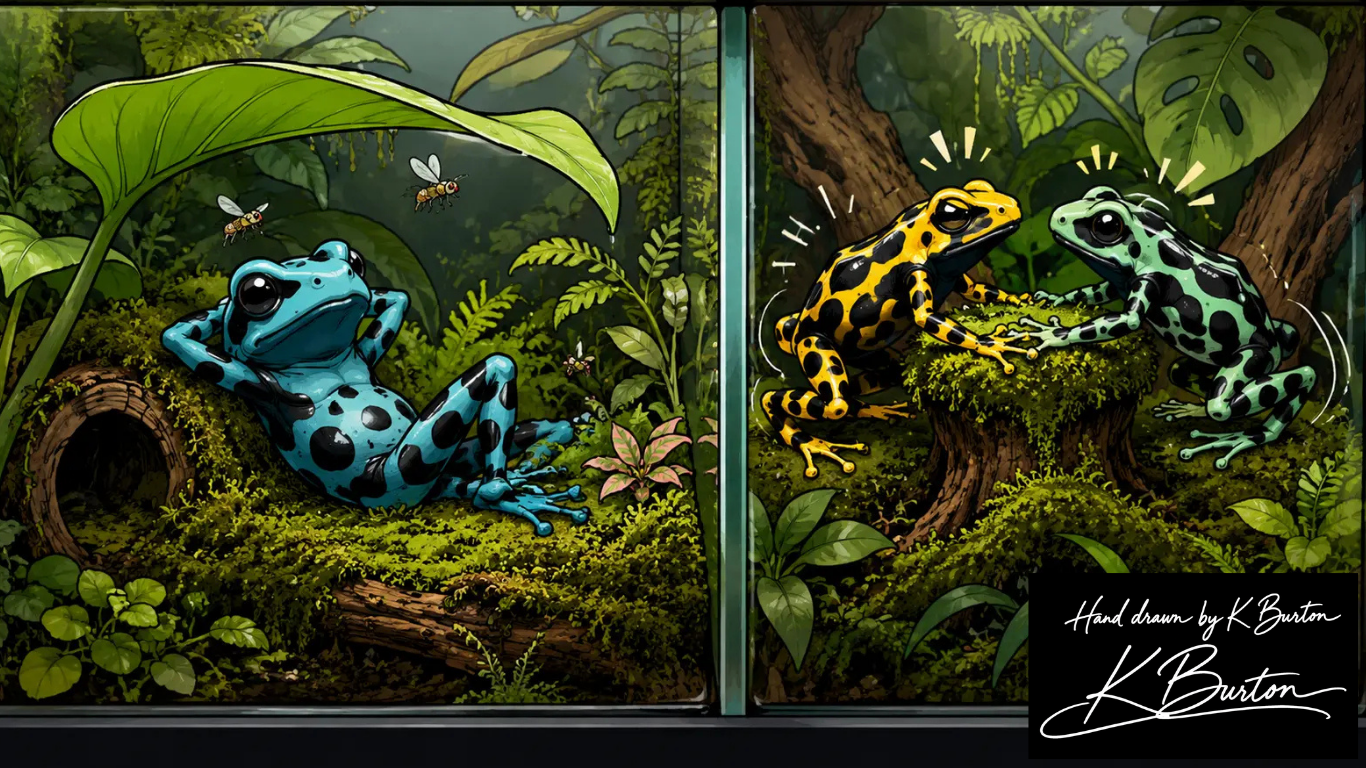
A single dart frog sits beneath a leaf while two frogs call and move around in the vivarium next door. It is easy to look at the lone animal and imagine that something is missing. Does it need a friend? Would adding another frog make its life richer—or are we applying a human emotion to an animal with very different social rules?
Dart frogs are not one uniform social type. The family includes territorial species, frogs that gather around resources, flexible mating systems, dedicated parents and at least one exceptionally well-studied species that forms socially and genetically monogamous pairs. “They are social” and “they are solitary” are both too crude.
The welfare question is not whether two frogs look nicer together. It is whether the exact species and individuals choose, tolerate or depend upon particular interactions—and whether captivity allows an unwanted companion to be avoided.
Can we tell whether a dart frog feels lonely?
“Loneliness” is a subjective emotional state: distress caused by a gap between the social contact an animal wants and what it receives. Humans can describe it. A dart frog cannot, so the claim needs behavioural and physiological evidence rather than a facial expression or our reaction to an empty-looking enclosure.
Poison frogs clearly perceive and respond to other frogs. They advertise with calls, defend territories, court, choose mates, attend eggs, transport tadpoles and—in some species—coordinate parental care. Those facts prove that social information matters. They do not prove that every species requires continuous companionship or that a frog experiences isolation in a human-like way.
Captive research specifically comparing long-term welfare in singly and socially housed adult dart frogs is limited. The honest answer is therefore narrower than “yes” or “no”:
- some dart frogs have important social relationships;
- some interactions are cooperative, reproductive or parental;
- many interactions are competitive or territorial;
- social needs and tolerance vary between species and life stages; and
- absence of a companion is not automatically a welfare problem.
This is one reason the question “Does my frog look sad?” is unreliable. Posture, appetite, activity and body condition can be observed; a human interpretation of its expression cannot. The guide to whether dart frogs are thriving rather than merely surviving provides a more useful welfare framework.
When can one dart frog live alone?
Single housing can be an entirely legitimate long-term arrangement. It is particularly sensible when adding another frog would introduce uncertainty or known risk.
After persistent aggression
A frog removed because it was pinning, chasing or excluding a tank mate does not need an immediate replacement companion. The separation has removed a welfare problem. Recreating the same social pressure to avoid “loneliness” defeats the purpose.
When sex is unknown
Adding an unsexed juvenile to another unsexed frog can eventually create an incompatible same-sex combination. Juveniles that coexist quietly may change after maturity. If there is no safe backup enclosure, waiting is better than gambling.
For territorial species or individuals
Some adult dart frogs are commonly maintained singly or in carefully selected pairs because competition can be severe. A lone frog with secure territory, appropriate husbandry and normal behaviour is not a failed setup.
During quarantine or medical observation
A new or unwell frog should not be given company as reassurance. Quarantine protects the collection and makes appetite, droppings and behaviour easier to monitor. The UK dart frog quarantine guide explains the separation and biosecurity process.
When a suitable match is unavailable
Wrong species, uncertain locality, unknown health history or unsuitable sex are not improved by urgency. Maintaining locality integrity and welfare matters more than producing a visually satisfying pair.
When the frog is elderly or disabled
An animal with reduced mobility, vision or feeding ability may struggle against even mild competition. Accessible single housing can protect feeding and allow an older frog to maintain its normal routine.
When might keeping a pair or group be appropriate?
The alternative to anthropomorphism is not forcing every frog to live alone. Social housing can allow courtship, communication, parental behaviour and other species-typical activity when the combination is appropriate.
A companion or group may be reasonable when:
- reliable information supports that arrangement for the exact species;
- the frogs’ sex, maturity and locality are understood;
- every new frog has completed proper quarantine;
- the enclosure provides adequate usable territory and visual barriers;
- food, shelter, calling sites and laying sites are not controlled by one animal;
- every frog can be identified and monitored;
- a separate suitable enclosure is immediately available; and
- the keeper is willing to separate permanently if the arrangement fails.
The practical limits are covered in the existing guide to keeping dart frogs in groups. This article answers whether company is needed; that guide answers how particular social housing arrangements may work.
Does breeding make pair housing essential?
If your aim is breeding, a compatible reproductive combination is obviously necessary. That is a breeding requirement, not proof that every non-breeding individual suffers alone. It also creates responsibilities: egg management, tadpole space, live-food capacity and long-term homes for froglets.
Are groups more enriching?
They can create more observable behaviour, but “more activity” is not automatically better welfare. Calling, following and courtship may be positive or neutral; frantic climbing, repeated displacement and hiding can be signs that the group is not working.
What does pair bonding mean in poison frogs?
Ranitomeya imitator is the clearest reason not to claim that all dart frogs are essentially solitary. Field experiments and molecular parentage analyses found social and genetic monogamy in this species. Males and females cooperate in biparental care: the male attends eggs and transports tadpoles, while the female returns to provision tadpoles with unfertilised eggs.
The ecological explanation is particularly revealing. R. imitator uses very small nursery pools in which tadpoles depend on continuing parental provisioning. Research comparing related species concluded that this demanding care system helped drive the evolution of monogamy.
More recent work has identified partner-specific physiological coordination in pair-bonded R. imitator. This is evidence of a biologically meaningful relationship—not merely two frogs tolerating the same space.
Does a pair bond prove that a lone frog feels lonely?
No. Pair bonding demonstrates selective affiliation and coordinated reproduction. It makes social context especially important for that species, but it does not allow us to label every solitary state with a human emotional term or justify an unsafe introduction.
A widowed or separated pair-bonded frog presents a more nuanced question than a territorial tinctorius removed from an aggressor. Even then, the appropriate response is to stabilise husbandry, observe welfare and source any future partner carefully—not to add the first available thumbnail frog.
Can this evidence be applied to every Ranitomeya?
No. Genera are not single social units. Closely related species can differ in parental care, nursery ecology and mating system. Research on R. imitator supports species-specific thinking; it does not establish mandatory pairs for every thumbnail dart frog.
Why adding a “friend” can make welfare worse
The new frog is treated as an intruder
An established frog already knows the enclosure and may defend its preferred areas. The newcomer enters without an established retreat or feeding route. A large vivarium does not help if one animal controls the only useful territory.
The sex combination is unsafe
Two presumed females may become competing mature females; two males may contest calling space; a trio can focus reproductive or territorial pressure on one individual. Use the guide to sexing dart frogs, while remembering that juveniles remain uncertain.
Disease is introduced
A bright, feeding frog can still carry parasites or pathogens. Social contact, shared water and contaminated tools make transmission easier. Loneliness is not an exemption from quarantine.
The frogs compete without fighting visibly
One animal may take the best feeding point, displace the other from cover or make it emerge only when the dominant frog has moved. No wrestling is required for body condition to diverge.
Different species are mixed for company
A dart frog does not need a differently coloured neighbour chosen for display. Mixed-species housing adds mismatched social signals, disease risk, dietary competition and possible hybridisation. Read why mixing dart frog species usually fails before treating another species as companionship.
The keeper waits for blood
By the time a wound appears, the subordinate frog may already have lost access to food and secure space. Persistent pinning, pursuit or escape behaviour deserves action. The guide to fighting versus courtship explains how to read the sequence.
How can you tell whether a single dart frog is doing well?
Do not judge the empty space beside it. Judge the frog’s function and its use of a suitable environment.
Reassuring signs include:
- stable body condition over time;
- confident hunting and successful prey capture;
- normal activity for that species and individual;
- controlled posture, climbing and jumping;
- use of several parts of the enclosure;
- appropriate hiding and re-emergence;
- normal skin, eyes, breathing and droppings;
- calling where expected for a mature male, while recognising that calling varies; and
- no sustained decline following separation from another frog.
Concern rises when a change persists: reduced appetite, weight loss, abnormal hiding, frantic boundary behaviour, weakness, skin changes or altered breathing. Those signs are not proof of loneliness. Check temperature, moisture, lighting, security, nutrition, recent disturbance and health.
Is a quiet frog lonely?
No conclusion follows from quietness alone. Males call for reproductive and territorial communication, and calling varies with maturity, season and environment. Females may be quiet as part of their normal behaviour. A previously vocal male that stops deserves a whole-system check, not an automatic companion.
Is hiding evidence that it wants another frog?
No. Hiding can be normal, especially after relocation or disturbance, and it can also indicate excessive exposure, environmental problems, social stress or illness. A companion can make hiding worse if the true cause is competition.
Does recognising the keeper replace frog company?
Human presence is not a substitute for a species-appropriate social relationship. Equally, a frog approaching at feeding time does not prove an emotional bond. The article on whether dart frogs recognise their keepers explains how learned feeding cues can produce apparently personal behaviour.
Should you keep one dart frog, a pair or a group?
| Situation | Most cautious starting point | Why |
|---|---|---|
| Territorial adult with aggression history | Single housing | Prevents repeat pressure and injury |
| Unknown species, sex or locality | Keep separate while information is resolved | Avoids incompatible or inappropriate pairing |
| New arrival | Individual quarantine | Protects the collection and permits monitoring |
| Compatible, correctly sexed pair of a pair-suitable species | Pair housing may be appropriate | Allows courtship and species-typical interaction |
| Pair-bonding species such as R. imitator | Research species-specific pair management | Social and biparental biology is unusually important |
| Group-tolerant species | Species-appropriate group with backup housing | Tolerance depends on maturity, ratio, space and individuals |
| Disabled or easily outcompeted frog | Single or carefully monitored compatible housing | Protects access to food and usable space |
| Keeper wants more visible activity | Do not add frogs for this reason alone | Display preference is not a welfare justification |
There is no universal number of frogs per litre or per centimetre. Usable territory, species, sex and temperament matter more than a crude stocking calculation. A spacious, structured single-frog vivarium is not wasted space; it is territory.
Does a single frog need a smaller vivarium?
No. Removing competition does not remove the need for gradients, foraging space, cover and choice. Do not reduce an enclosure to make it look less empty. A single frog should still be able to choose between exposed and concealed routes, wetter and drier surfaces, and different heights appropriate to the species.
How should another dart frog be introduced?
- Confirm identity. Check species, morph or locality, age and source.
- Estimate or confirm sex honestly. Record whether it is confirmed, probable or unknown.
- Complete quarantine. Use separate tools and monitor feeding, body condition and droppings.
- Prepare permanent backup housing. A travel cup is not a separation plan.
- Review the enclosure. Create multiple feeding areas, hides, visual barriers and usable routes.
- Avoid assuming neutral territory solves everything. Rearranging can disrupt boundaries but cannot make incompatible frogs compatible.
- Observe the full sequence. Record approach, following, retreat, feeding and resting—not only whether they sit together once.
- Monitor over weeks and through maturity. Compatibility on the first day does not guarantee adult compatibility.
- Separate at the early welfare signs. Persistent pursuit, pinning, exclusion, falling condition or escape behaviour is enough.
Should separated frogs be reintroduced?
Not simply because one looks alone. If separation followed sustained aggression, reintroduction can recreate it. Consider species, sex, maturity, cause, enclosure changes and the severity of the previous conflict. Permanent individual housing is often better than repeated cycles of introduction and removal.
What does the scientific evidence show?
Research gives us excellent evidence that poison-frog social systems are diverse, but very limited evidence for diagnosing subjective loneliness in captive dart frogs.
- Brown and colleagues’ research on Ranitomeya imitator used field experiments and molecular analysis to demonstrate essential biparental care and genetic monogamy.
- Experimental work on biparental care and monogamy tested why exclusive parental cooperation benefits offspring in this species.
- A 2024 study of pair-bonded poison frogs reported partner-specific physiological state matching in males.
- Detailed natural-history research on Dendrobates tinctorius documents flexible courtship, parental care and aggressive interactions in the wild.
- Research on territorial poison frogs shows that individuals can differ consistently in aggressive responses.
These studies justify species-specific social management. They do not produce a simple experimental test for whether a lone pet dart frog feels lonely.
The Frogfather verdict
One dart frog in one well-designed vivarium is not an incomplete collection. If that frog feeds, moves, maintains condition and uses its environment normally, do not manufacture a social problem because the enclosure looks empty to human eyes.
Some dart frogs can live successfully in compatible pairs or groups, and pair bonding is biologically important in particular species. Respect that diversity without turning it into the claim that every frog needs a friend. The kindest number is the number that the species, individuals and enclosure can support without hidden competition—and sometimes that number is one.
Frequently asked questions
Do dart frogs get lonely when kept alone?
There is no good evidence that every lone dart frog experiences loneliness. Social biology varies by species, and many territorial adults can be maintained singly with normal feeding, activity and body condition.
Can one dart frog live alone permanently?
Yes. Permanent single housing can be appropriate for a territorial frog, an animal with an aggression history, a disabled frog or one for which a safe compatible partner is unavailable. It still needs a full, complex and species-appropriate vivarium.
Do dart frogs need a friend?
Not as a universal rule. Some species permit pairs or groups and a few have specialised pair bonds, but an unsuitable companion can cause competition, stress and injury. Choose by species and compatibility rather than human ideas of friendship.
Are dart frogs happier in pairs?
A compatible pair can express courtship and reproductive behaviour, but pair housing is not automatically better welfare. Incompatible frogs may compete subtly or fight, and a stable single frog may be safer alone.
Which dart frogs form pair bonds?
Ranitomeya imitator is the best-established example: field and genetic research demonstrates monogamy and coordinated biparental care. This evidence should not be extended automatically to every dart frog or every Ranitomeya.
Should I buy another frog because mine hides?
No. Hiding may reflect normal temperament, recent disturbance, insufficient security, environmental conditions or illness. Investigate the frog and enclosure first, because adding another frog may increase social pressure.
Can two male dart frogs live together?
Sometimes, depending on species, maturity, enclosure and individual behaviour. Calling males may compete for territory, so monitor pursuit, food access, hiding and condition and keep suitable separation housing ready.
Should a frog separated after fighting be given a new companion?
Not automatically. First allow the frog to stabilise and determine why the previous arrangement failed. Safe permanent single housing is better than repeatedly testing unsuitable companions because the frog appears alone.

Dart frogs do not share one social system
“Dart frog” covers many genera and a wide range of natural histories. An instruction written for a territorial adult Dendrobates tinctorius should not be copied automatically to a pair-bonded Ranitomeya imitator, an Oophaga with specialised parental care or a more group-tolerant Epipedobates.
Territorial contact is still social behaviour
A frog calling to a rival, defending a perch or displacing another animal is participating in a social system—but that does not make close cohabitation beneficial. In the wild, losers can often retreat beyond a territory. Glass walls remove that final option.
This distinction matters because keepers sometimes interpret any natural interaction as enrichment. Fighting is natural too. A captive animal does not benefit merely because the pressure resembles something that can happen in a forest.
Breeding contact may be periodic
Some adult dart frogs spend much of their time in individual activity and come together for courtship. A compatible male and female may share an enclosure successfully, but reproduction is not proof that they require constant proximity. Nor does it guarantee permanent compatibility.
Parental care creates stronger coordination in some species
Dendrobatids are famous for attending terrestrial eggs and carrying tadpoles. Care can be male-only, female-only or biparental, depending on the species. Where both parents must coordinate to raise offspring, selection can support a stable pair relationship.
Species tendencies are not individual guarantees
A species described as group-tolerant can still contain an aggressive individual. A species usually kept in pairs can produce two animals that do not coexist peacefully. Start with the Frogfather dart frog species guide, then judge the frogs actually using the enclosure.