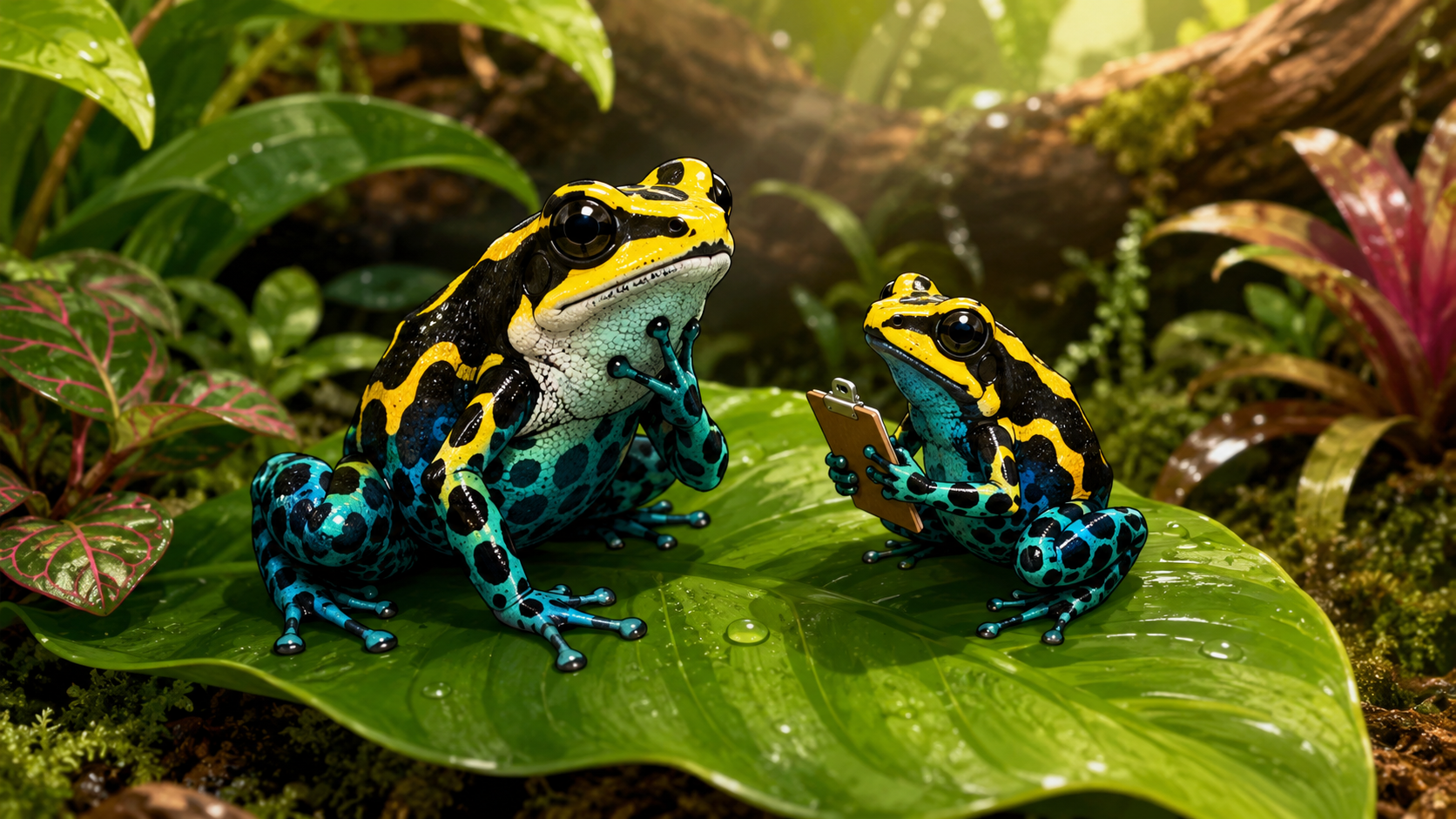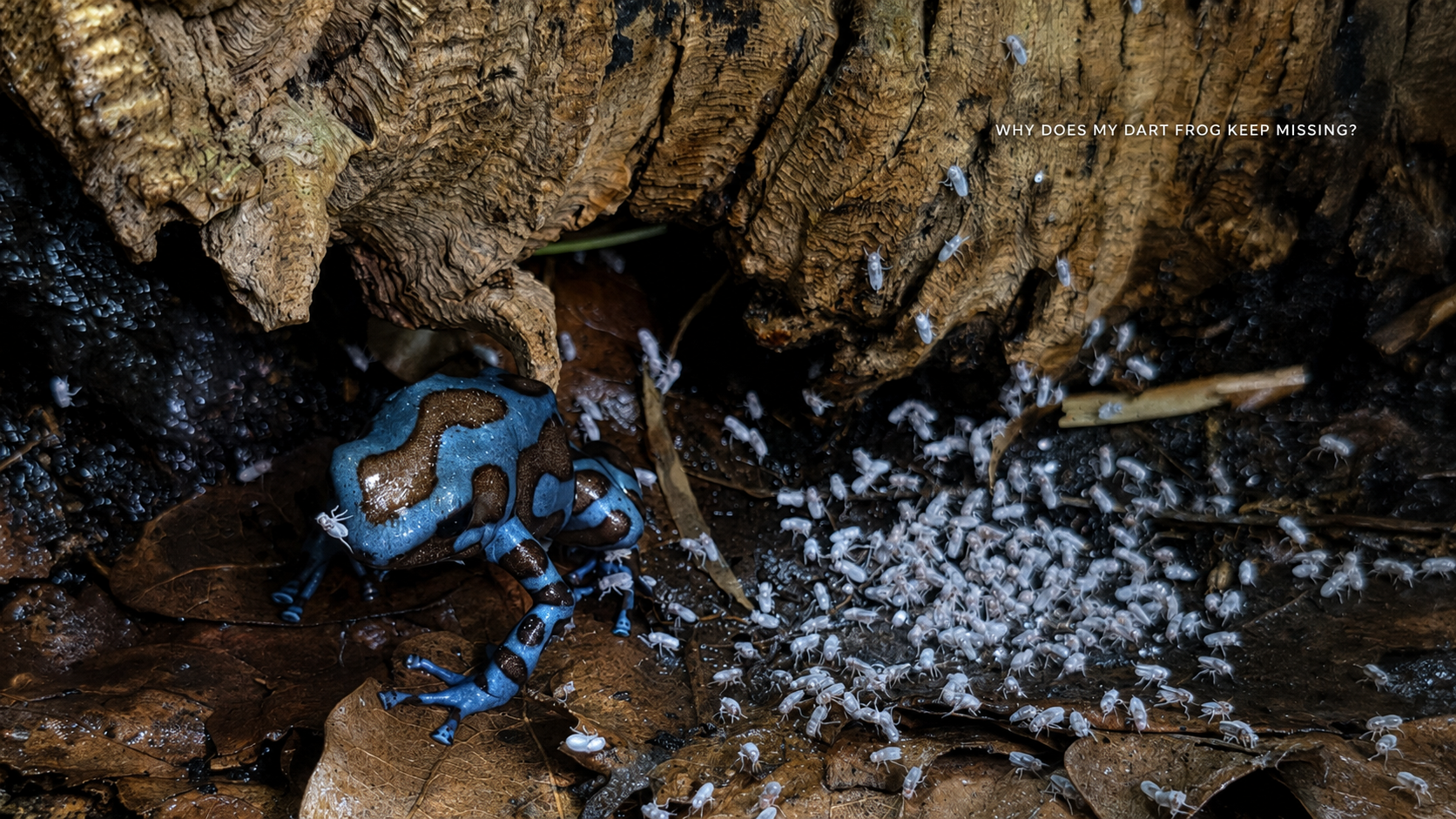
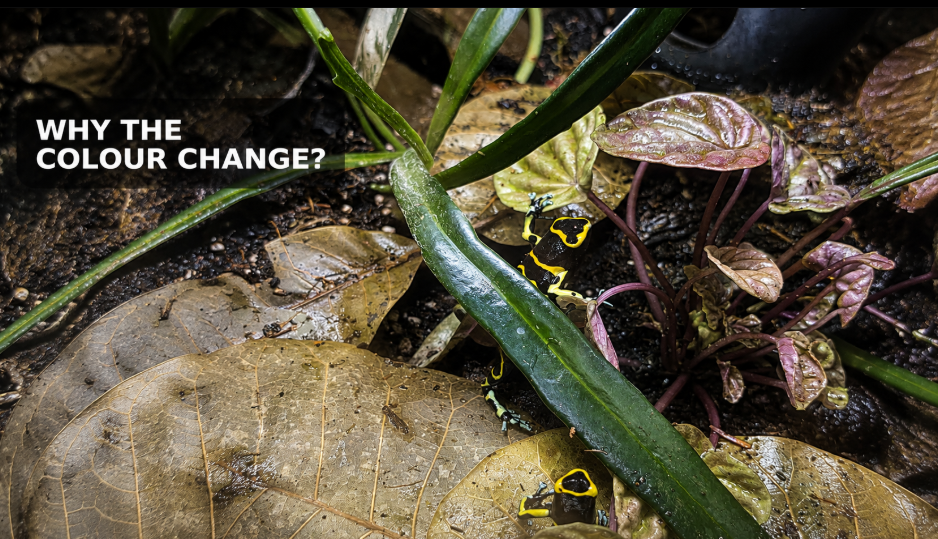
A dart frog that looked vivid yesterday can appear darker, washed out or almost dusty today. The immediate fear is often that its colour has “gone”, that supplements have failed or that the frog is becoming seriously ill.
Sometimes the frog has genuinely changed its visible appearance. Amphibian skin contains pigment-bearing and light-reflecting cells, and colour expression can respond to environmental and physiological influences. Just as often, however, the apparent change comes from wet skin, approaching shed, a different perch, altered lighting, reflections or a phone camera quietly changing its processing.
The useful first question is therefore not simply “Why has my frog changed colour?” It is: did the frog change, did the surface of its skin change, or did only the viewing conditions change?
How is dart frog colour produced?
Amphibian colour is not equivalent to paint sitting on the skin. It results from light interacting with layers of specialised cells called chromatophores. These commonly include melanophores containing dark pigment, xanthophores associated with yellow-to-red pigments and iridophores that reflect light through microscopic structures.
The colour a keeper sees depends on the pigment present, how pigment-containing structures are arranged, reflected wavelengths, the condition of the skin surface and the light illuminating it. Different dart frog species and populations use these components in different combinations, producing blue, green, yellow, orange, red, bronze, white and black patterning.
Some colour variation is fixed by genetics and development. A frog may gradually mature into stronger markings or a different balance of colour. Other changes are more immediate and reversible, involving pigment movement within chromatophore cells or changes in how light is reflected.
A comprehensive review of atypical amphibian colouration stresses that visual appearance can involve several chromatophore types at once. That makes confident diagnosis from a photograph especially unreliable.
Do all dart frog species change colour equally?
No. Amphibians vary greatly in the speed, extent and function of physiological colour change. Many tree frogs are famous for dramatic transformations between green and brown. Dart frogs usually retain their identifying pattern, but the brightness, darkness, contrast and apparent hue can still vary.
Do not expect an Oophaga, Dendrobates or Ranitomeya to follow an exact colour rule demonstrated in an unrelated tree frog. General chromatophore biology explains what is possible; the individual frog’s established appearance remains the most useful practical baseline.
Did the frog change—or did the light change?
Lighting is the most common reason a healthy frog appears different between observations. Light intensity, colour temperature, spectrum, direction and reflection all alter the wavelengths reaching your eyes or camera.
A frog may look:
- darker beneath dense foliage than on an exposed leaf;
- warmer or more yellow under a warm-white lamp;
- cooler or bluer under a high-colour-temperature LED;
- more saturated immediately beneath a powerful plant light;
- washed out through condensation or dirty glass; or
- higher contrast against a pale background than a dark one.
Your eyes adapt to the room. Cameras go further by changing exposure, white balance, contrast, sharpening, HDR and saturation automatically. Two photographs taken seconds apart can imply a biological change that never occurred.
The existing Frogfather guide to why dart frog photographs can be misleading examines this problem in detail. When assessing health, do not compare one flash-lit macro photograph with another image taken beneath a leaf.
Background contrast can fool the eye
The surrounding scene changes perceived brightness. A pale frog against black cork can appear brighter; the same frog against a shiny wet leaf may look comparatively dull. Reflections from green foliage can also introduce a green cast into pale skin and white markings.
Some amphibians can adjust pigmentation in response to background conditions, although the evidence varies by species and life stage. Whatever the frog’s physiology is doing, contrast alone can change the keeper’s judgement before the frog changes at all.
Why do dart frogs look brighter after misting?
Water changes how light behaves at the skin surface. A thin wet layer can reduce diffuse scattering and increase apparent saturation or contrast, making markings look deeper and cleaner. Droplets, shiny leaves and darker wet surroundings can strengthen the effect.
As surfaces dry, the same frog may appear flatter or less glossy. This normal optical change should not be confused automatically with dehydration.
Can dehydration make a dart frog look dull?
A dehydrated or generally unwell frog may look dull, dry, wrinkled or poorly conditioned, but colour alone cannot diagnose dehydration. A frog can look less vivid because the lamp changed; another can remain colourful while experiencing an environmental problem.
Consider surface moisture alongside behaviour and physical signs:
- Is the frog alert and moving accurately?
- Is the posture normal rather than flattened or weak?
- Does the skin appear intact rather than abnormally dry or wrinkled?
- Is it feeding and maintaining body condition?
- Are exposed surfaces, sheltered retreats and leaf litter offering appropriate moisture choices?
Dart frogs absorb water through specialised skin rather than drinking like mammals. The guide to how dart frogs absorb water explains why moisture, ventilation and usable microclimates need to be considered together.
Do not respond to a dull photograph by saturating the entire enclosure. Excess water, stagnant air and waterlogged substrate create their own risks. If the frog is sitting in water repeatedly, use the dedicated dart frog soaking and dehydration guide rather than assuming it simply wants more mist.
Can temperature make frogs darker or paler?
Temperature can influence amphibian colouration. In some species, darker appearance at cooler temperatures may aid heat absorption, while lightening under warmer conditions may reflect more radiation. Hormonal and cellular responses can also connect temperature, background and stress to pigment distribution.
This does not provide a universal dart frog thermometer. A dark-looking frog is not proof that it is cold, and a pale frog is not proof that it is overheating. Species-specific evidence is limited, and lighting often changes at the same time as temperature during the daily cycle.
Measure temperature at frog level with suitable equipment rather than reading colour as a gauge. Check several times and locations, especially after changes to lamps, room heating, ventilation or enclosure position.
If colour change accompanies rapid or effortful breathing, weakness, unusual posture, reduced feeding or poor coordination during warm conditions, follow the dart frog heat-stress guidance promptly.
Colour is evidence, not a temperature reading
The same principle applies throughout this article. Appearance can tell you to investigate, but it cannot identify the cause alone. Confirm the variable directly wherever possible: measure temperature, inspect moisture, compare photographs consistently and observe behaviour.
Can shedding make a dart frog look pale or cloudy?
Yes. Before or during a shed, the outer skin layer may make a frog look temporarily greyish, cloudy, dusty or less sharply patterned. Dart frogs normally remove and often consume the loosened layer using characteristic wiping and swallowing movements.
A normal shed is generally brief. The frog should return to its usual appearance and behaviour once the old layer has been removed. You may never observe the whole event because it can happen quickly or beneath cover.
Retained shed is different. Translucent or greyish material may remain around toes, feet, limbs or patches of the body. Repeated incomplete shedding can occur alongside environmental, nutritional or health problems and should not be treated as a purely cosmetic colour issue.
Use the full guide to normal dart frog shedding and retained shed before attempting intervention. Do not pull skin from a struggling frog or improvise concentrated baths.
Does stress make dart frogs darker or paler?
Stress and physiological state can influence amphibian colour mechanisms, but “stress colour” is not a reliable standalone diagnosis. Transport, capture, social conflict, exposure, temperature change and illness may occur alongside visible changes. They also affect posture, movement, appetite and hiding.
A recently moved frog may look subdued beneath unfamiliar lighting while spending more time in cover. If it is alert, feeding and gradually settling, that pattern differs from progressive decline.
When colour change may be part of illness
Concern rises when an appearance change is persistent, localised, worsening or accompanied by:
- reduced appetite or repeated missed feeds;
- documented weight or body-condition loss;
- weakness, wobbling, poor coordination or inability to right;
- flat or abnormal posture;
- laboured or open-mouth breathing;
- swelling, asymmetry or bloating;
- redness, sores, ulceration, unusual patches or damaged skin;
- persistent retained shed;
- abnormal droppings alongside other deterioration; or
- social exclusion, chasing or physical injury.
Skin infection, trauma, systemic disease, nutritional problems and environmental damage can overlap visually. A photograph cannot distinguish them reliably. New lesions, spreading discolouration or physical decline warrant amphibian-experienced veterinary assessment.
Use the dart frog behaviour and warning-sign guide to place colour alongside the rest of the animal rather than interpreting one feature in isolation.
Normal colour variation versus a warning sign
| More consistent with normal variation | More concerning |
|---|---|
| Changes between shade and direct vivarium lighting | Remains abnormal under the same neutral lighting |
| Looks brighter immediately after misting | Skin appears persistently dry, wrinkled, damaged or inflamed |
| Temporary cloudiness followed by a normal shed | Repeated incomplete shed or material restricting toes and limbs |
| Alert, coordinated and feeding normally | Weakness, poor coordination, abnormal posture or reduced appetite |
| Whole frog looks slightly lighter or darker | New localised patch, sore, redness, swelling or spreading lesion |
| Difference appears only in one camera image | Visible consistently to the eye and progressing across observations |
| Stable body condition and normal routine | Documented weight loss or wider behavioural deterioration |
The distinction is not “bright equals healthy, dull equals sick”. A vivid frog can still be unwell, while a healthy frog can look temporarily dark beneath a leaf. Evaluate change, duration, distribution and accompanying signs.
What should you do when a dart frog looks different?
- Observe with your eyes first. Decide whether the change is visible in person or only in a photograph.
- Use consistent lighting. Compare the frog in the same area, at the same time of day and without flash.
- Clean the viewing panel. Condensation, mineral deposits and algae can create a false haze or colour cast.
- Check recent events. Note misting, shedding behaviour, lamp replacement, enclosure moves, transport, temperature changes and social disturbance.
- Measure the environment. Confirm temperature at frog level and assess moisture, ventilation and usable microclimates.
- Watch the complete frog. Record feeding, posture, coordination, breathing, skin integrity and interaction with enclosure mates.
- Take comparable photographs. Use the same phone, angle, lamp and exposure where possible. Disable beautification or vivid filters.
- Track body condition. The guide to monitoring dart frog weight and condition explains how to build useful evidence without frequent catching.
- Escalate when signs combine. Seek veterinary advice when persistent colour change occurs with physical or behavioural decline.
Should you change supplements immediately?
No. Colour can be influenced by genetics, age, diet and pigment availability over time, but a sudden visual change does not identify a particular deficiency. Adding concentrated vitamin A, D3, calcium or colour enhancers on top of an established complete system can create new risks.
Review the complete diet, feeder quality, storage and dosing routine instead of treating colour alone. Nutritional deficiencies require evidence and, where illness is suspected, professional assessment.
Should you isolate the frog?
Not for every harmless lighting change. Isolation may be appropriate when there is a new lesion, physical decline, suspected contagious disease, social aggression or a need to collect samples and monitor feeding. Prepare a suitable secure observation or quarantine enclosure before moving the frog, and avoid direct handling where a catch cup will work.
Frequently asked questions
Why has my dart frog suddenly become darker?
A dart frog may look darker because of shade, background contrast, cooler conditions, wet surroundings, physiological pigment adjustment or camera exposure. Check it under consistent lighting and assess behaviour, temperature, skin and body condition before assuming illness.
Why does my dart frog look pale or washed out?
Warm or intense lighting, camera processing, dry surface appearance and an approaching shed can make a frog look pale or washed out. Persistent pallor accompanied by weakness, poor feeding, damaged skin or weight loss requires closer investigation and veterinary advice.
Do dart frogs change colour when stressed?
Stress and physiological state can influence amphibian colour mechanisms, but appearance alone cannot diagnose stress. Look for a repeatable change alongside hiding, altered feeding, abnormal posture, social pressure or another behavioural difference.
Why does my dart frog look brighter after misting?
Water changes light reflection at the skin surface and can make colours appear more saturated and markings more contrasting. Darker wet leaves and stronger reflections inside the vivarium can intensify the effect.
Can shedding make a dart frog look grey or cloudy?
Yes. The loosening outer skin layer may temporarily make a dart frog look greyish, cloudy or dull before a normal shed. Concern rises when shed remains attached, repeatedly fails to clear or occurs with other signs of poor health.
Can temperature make a dart frog darker?
Temperature affects colour expression in several amphibians, but a dark dart frog is not a reliable thermometer. Measure the enclosure directly because species, lighting, background, moisture and individual physiology all influence appearance.
Does a dull dart frog need more vitamins?
Not automatically. A sudden dull appearance does not identify a vitamin or mineral deficiency. Review lighting, shedding, temperature, hydration, feeder quality and the complete supplementation system, and do not add concentrated products without evidence.
When should a dart frog colour change worry me?
Seek advice when the change persists under consistent lighting or involves a new patch, sore, redness or swelling, especially when accompanied by poor appetite, weight loss, weakness, abnormal breathing, retained shed or deteriorating behaviour.