Husbandry & Evidence Review – 5 September 2026
Froglet care is now framed around moisture access, ventilation, prey size, growth and monitoring rather than a fixed humidity or feeding formula.
Watching a tadpole complete metamorphosis and emerge onto land as a tiny froglet is one of the most rewarding moments in dart frog breeding. Although the most dramatic changes have already taken place, this is also one of the most vulnerable stages in a frog’s life.
Freshly morphed froglets require reliable access to moisture, abundant cover, useful ventilation, appropriately sized live food and careful observation while they complete the transition to terrestrial life. “High humidity” should not mean keeping every surface permanently saturated.
In this guide we’ll explain how we raise captive-bred dart frog froglets at Frogfather, covering housing, feeding, supplements, environmental conditions and the early weeks that set the foundation for healthy adult frogs.
What Is a Froglet?
A froglet is a young frog that has recently completed metamorphosis. At this stage the hind legs and front legs are fully developed, the tail has been almost completely absorbed and the animal has transitioned from breathing primarily through gills to functioning as a terrestrial amphibian.
Although they resemble miniature adult dart frogs, froglets remain delicate and continue developing rapidly during the following weeks.
When Should a Tadpole Be Moved Onto Land?
Timing is important.
Once the front legs have emerged and the tail has reduced to a small stump, the froglet should have easy access to land while still being able to return to shallow water if required.
Moving them too early can cause unnecessary stress, while leaving them entirely aquatic for too long may also create problems.
🐸 Frogfather Philosophy
We allow the froglet to dictate the transition. Rather than forcing it onto land, we provide both shallow water and easy terrestrial access so it can move naturally as metamorphosis completes.
Choosing a Grow-Out Enclosure
Freshly morphed froglets thrive in simple, secure environments that are easy to monitor.
Most breeders begin with small grow-out tubs containing damp substrate, leaf litter, hiding places and established microfauna before eventually moving the young frogs into larger bioactive vivaria.

Next: Humidity, temperature, lighting and creating the ideal froglet environment.
Humidity
Freshly morphed froglets lose moisture much more quickly than adults because of their small size.
During the first weeks, provide moist refuges and prevent desiccation while maintaining useful air exchange. Manage the enclosure from surface moisture, frog behaviour and actual environmental measurements rather than a permanently high RH target.
Temperature
Most commonly kept dart frogs thrive under the same temperature range used throughout breeding and tadpole development, with stability being far more important than chasing exact figures.
Hiding Places
Young froglets spend much of their time concealed beneath leaves, cork bark and moss.
Providing numerous hiding places reduces stress and encourages natural behaviour.
Microfauna
A well-established clean-up crew provides both environmental stability and an additional source of naturally occurring live food.
Springtails are particularly valuable during the first weeks after metamorphosis because they remain available continuously and are the perfect size for newly morphed froglets.
🐸 Frogfather Tip
We always introduce froglets into established enclosures that already contain thriving springtail populations. This ensures food is available even before the first scheduled feeding.
Next: Feeding, supplementation and monitoring growth.
Feeding Froglets
Froglets have fast metabolisms and should have access to appropriately sized live food every day.
Springtails form an excellent staple during the earliest stages, with melanogaster fruit flies introduced as the froglets grow.
Supplementation
Proper vitamin and mineral supplementation remains just as important after metamorphosis as it is for adult frogs.
A balanced supplementation routine supports healthy skeletal development, growth and long-term health.
Monitoring Growth
Healthy froglets gradually become more confident, begin hunting actively and show steady increases in size and body condition.
Regular photographs make it easy to monitor development over time.

Common Problems
- Poor feeding response.
- Low humidity.
- Insufficient live food.
- Overcrowding.
- Poor supplementation.
- Stress caused by excessive handling.
Next: When to move froglets into permanent vivaria and frequently asked questions.
When Can Froglets Move Into Their Permanent Vivarium?
Once froglets are feeding confidently, growing consistently and have become more robust, they can usually be transferred into larger bioactive enclosures appropriate for their species.
Introducing them too early into oversized enclosures can make monitoring more difficult, so gradual progression is often preferable.
Frequently Asked Questions
What should baby dart frogs eat?
Springtails are usually the ideal first food, followed by melanogaster fruit flies as the froglets increase in size.
Can froglets live together?
Many species can be raised communally for a period, provided sufficient space, food and hiding places are available.
How often should froglets be fed?
At Frogfather we commonly offer freshly metamorphosed froglets frequent opportunities to take tiny live prey, often daily while they are growing. Adjust frequency to prey size, actual intake, body condition and species rather than treating daily feeding as a universal rule.
Continue Learning
- Complete Guide to Breeding Dart Frogs
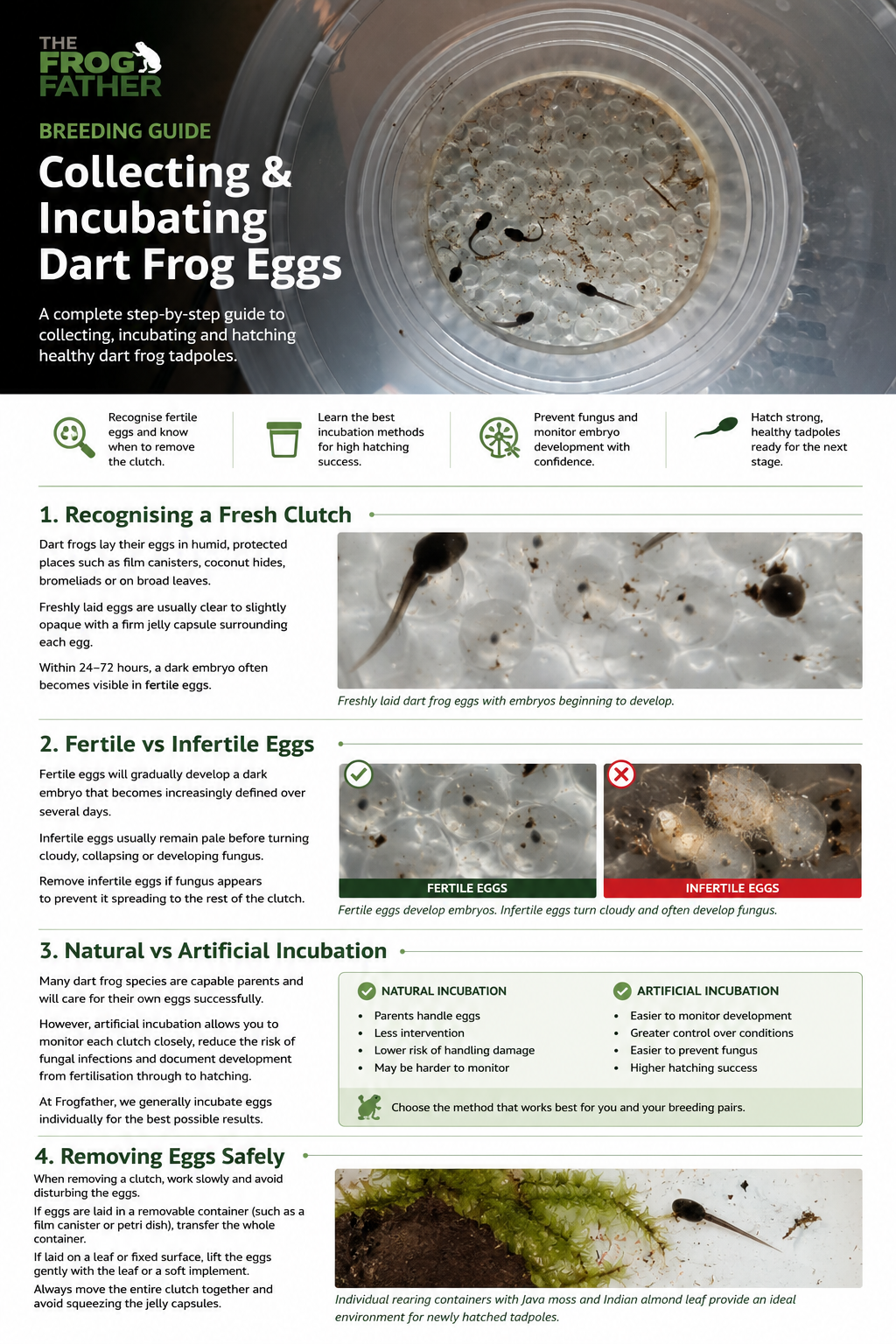
- Collecting & Incubating Dart Frog Eggs
- Complete Guide to Caring for Dart Frog Tadpoles
- Complete Guide to Feeding Dart Frogs
- Complete Guide to Dart Frog Supplementation
Final Thoughts
The froglet stage bridges aquatic and terrestrial life, making it one of the most rewarding periods of captive breeding. By providing stable conditions, abundant live food and minimal stress, you’ll give your young dart frogs the strongest possible start before they mature into healthy breeding adults.