Husbandry & Evidence Review – 5 September 2026
This is Frogfather’s current complete breeding pathway. Universal maturity windows and high-humidity/misting-as-trigger wording have been qualified.
Successfully breeding dart frogs is one of the most rewarding aspects of keeping these remarkable amphibians. Watching a compatible pair court, lay eggs and eventually produce healthy froglets provides a fascinating insight into behaviours that are rarely seen outside their natural rainforest habitats.
Although many dart frog species will breed readily in captivity, successful breeding is rarely accidental. Healthy adults, correct environmental conditions, appropriate nutrition and patience all play an important role in encouraging consistent reproduction.
This guide explains the complete breeding process, from selecting compatible frogs through to raising healthy froglets. Whether you are hoping for your very first clutch of eggs or looking to improve breeding success, this article will walk you through every stage.
Can Dart Frogs Be Bred in Captivity?
Yes. Many species of dart frog are now bred routinely in captivity and, in fact, the vast majority of animals available within the UK hobby are captive bred.
Responsible captive breeding can reduce demand for wild-caught animals and produces frogs already accustomed to captive conditions. Captive-bred status alone does not guarantee that an individual animal is healthier.
With appropriate husbandry, numerous species—including Dendrobates tinctorius, Dendrobates auratus, Dendrobates leucomelas, Ranitomeya species and many Oophaga—can all reproduce successfully in captivity.
When Do Dart Frogs Reach Breeding Age?
Many commonly kept dart frogs may reach sexual maturity around the end of their first year or later, but age varies substantially with species, sex, growth and husbandry. Treat 10–18 months as a broad captive-hobby observation rather than a universal maturity window.
Rather than focusing solely on age, breeders should assess overall condition. Healthy, well-fed adults with good body weight and strong feeding responses are far more likely to breed successfully than younger or underconditioned animals.
🐸 Frogfather Philosophy
Our aim is never simply to produce more frogs.
Responsible breeding starts with healthy, mature adults, appropriate nutrition and a well-managed species-appropriate enclosure. Good parental condition supports reproduction, but offspring outcome also depends on genetics, fertilisation, egg/tadpole environment, water, diet and chance; healthy parents do not guarantee every clutch.
Choosing Compatible Breeding Pairs
The first step towards successful breeding is selecting compatible adults.
This means choosing healthy frogs of the same species and locality while understanding the social behaviour of that particular species.
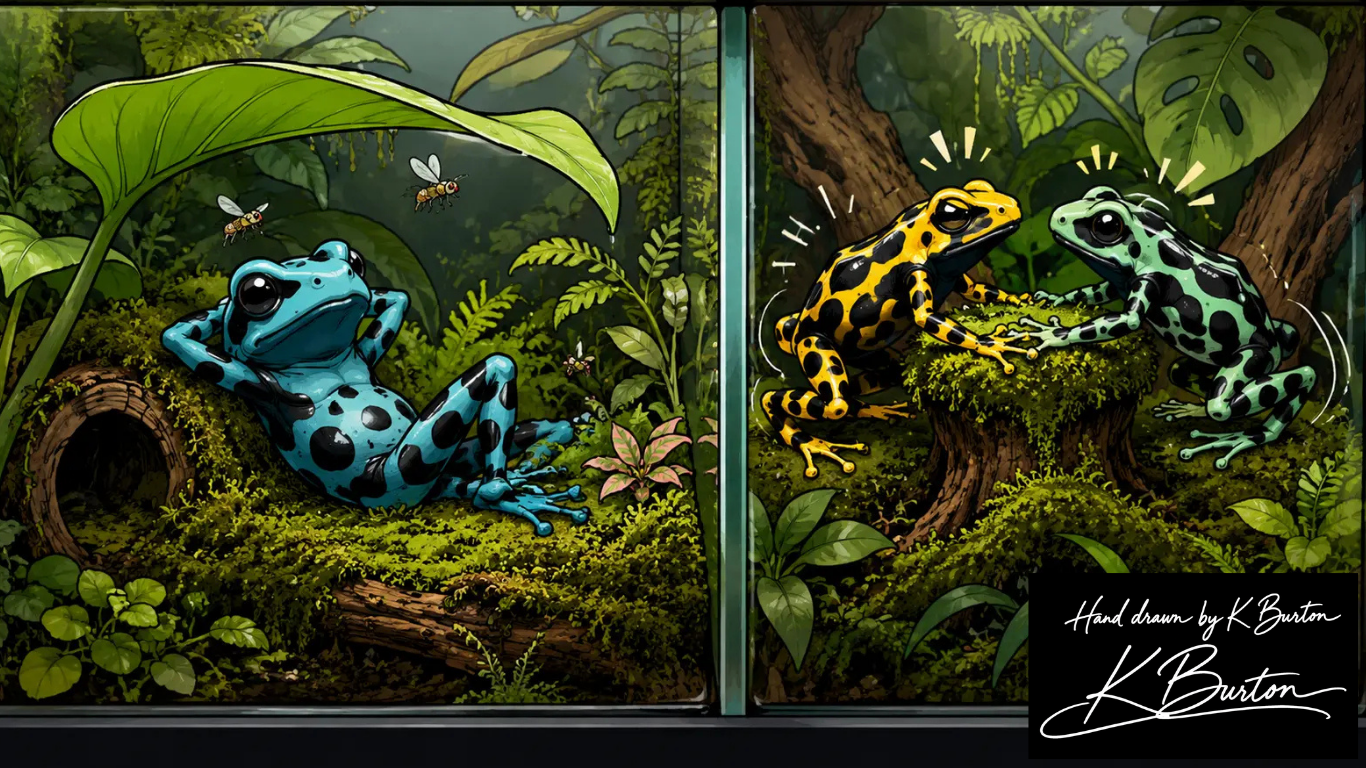
Some dart frogs naturally live comfortably in groups, while others—particularly many Dendrobates tinctorius—can become aggressive, especially between females.
Understanding these behavioural differences is often just as important as providing the correct environmental conditions.
What Encourages Dart Frogs to Breed?
In the wild, breeding is closely linked to seasonal environmental changes.
Captive breeders aim for appropriate nutrition, species-suitable temperature and moisture cycles, useful ventilation and secure structured enclosures. Some species/populations may also respond to seasonal changes in rainfall or food, but there is no universal high-humidity + regular-misting breeding formula.
Many species begin calling, courting and laying eggs once they feel secure and environmental conditions remain consistently favourable.
Signs That Breeding May Be About to Begin
- Males calling more frequently.
- Increased interaction between compatible adults.
- Females becoming noticeably plumper with eggs.
- Regular inspection of film canisters, leaves or other laying sites.
- Territorial behaviour around preferred breeding locations.
Next: We’ll look at courtship behaviour, calling, selecting egg-laying sites and what happens during the breeding process.
Courtship Behaviour
Before eggs are ever laid, dart frogs perform a fascinating courtship ritual that helps ensure both animals are receptive and suitable breeding partners.
Although the exact behaviour varies between species, the overall sequence is remarkably similar. The male attracts the female, she follows him through the vivarium, and together they inspect potential egg-laying sites before spawning.
Courtship may last only a few minutes or continue over several hours depending on the species and the individual frogs.
The Male’s Call
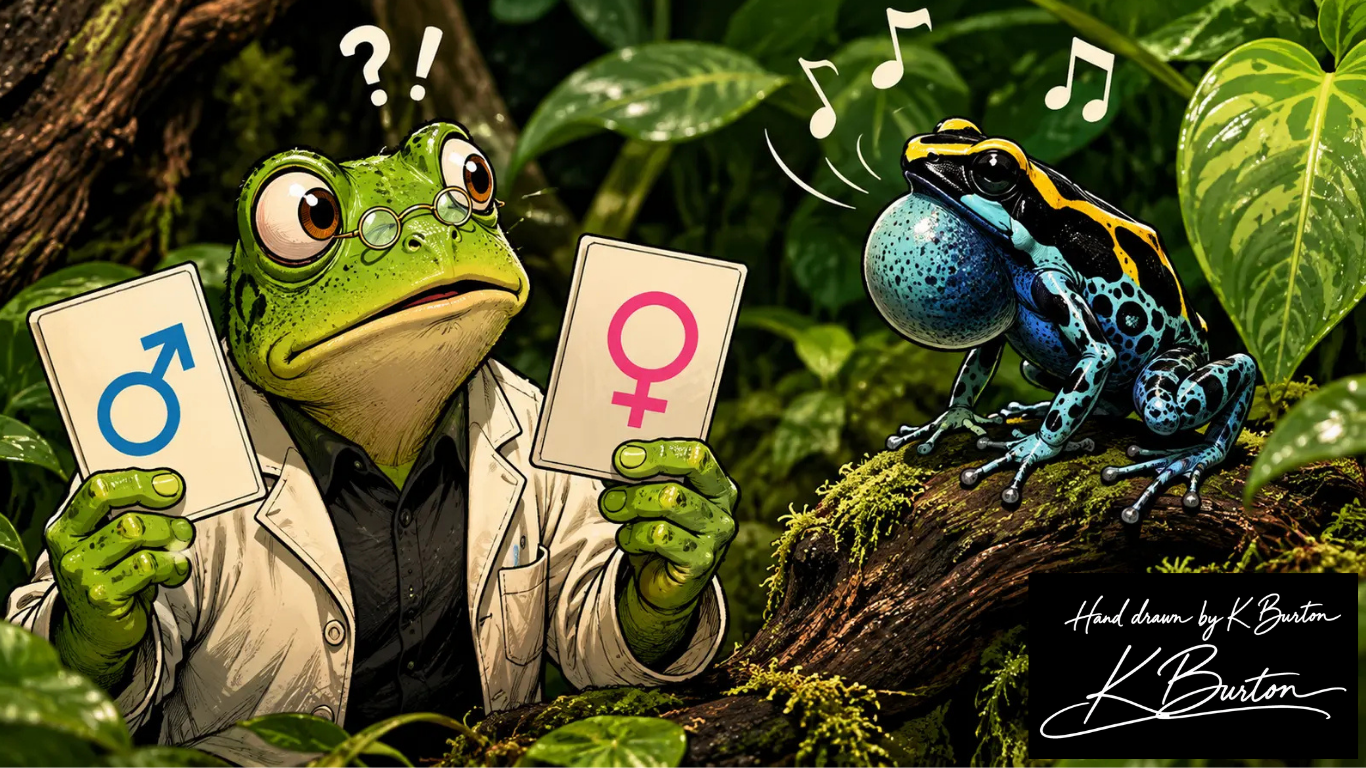
In many species, breeding begins with the male calling.
Dart frog calls are usually very quiet compared with tree frogs, often sounding like a gentle electronic buzz, chirp or soft trill. The purpose is not simply to attract females but also to advertise territory and signal that the male is healthy and ready to breed.
Some males call throughout the day, while others become more vocal after misting or during periods of higher humidity.
🐸 Frogfather Tip
If your male suddenly begins calling regularly after weeks or months of silence, it’s often one of the earliest signs that breeding conditions are becoming favourable. Calling doesn’t guarantee eggs, but it’s usually an encouraging indication that the frogs are comfortable and well established.
Following and Courtship Displays
Once interested, the female often begins following the calling male around the vivarium.
The pair may slowly circle one another, gently touch noses or repeatedly investigate several potential egg-laying locations before finally choosing one.
This stage is often overlooked because it can appear subtle, but experienced keepers soon recognise the increased interaction between compatible breeding pairs.
Choosing an Egg-Laying Site
Different dart frog species have different preferences when selecting where to lay their eggs.
Common locations include:
- Film canisters.
- Coconut hides.
- Petri dishes.
- Smooth leaves.
- Bromeliad axils.
- Flat pieces of cork bark.
- Artificial breeding caves.
The chosen site is usually sheltered, humid and protected from excessive disturbance.
Preparing a Breeding Vivarium
A mature, well-established bioactive vivarium provides the best environment for breeding.
Heavy planting, numerous hiding places and stable environmental conditions help frogs feel secure enough to reproduce naturally.
Providing several suitable egg-laying locations also gives the frogs a choice, often improving breeding success.
Many breeders position multiple film canisters or laying sites throughout the enclosure, allowing pairs to select their preferred location.
Temperature and Humidity
Most commonly kept dart frog species breed well under the same environmental conditions used for everyday maintenance.
As a general guide:
- Day temperatures between 22–25°C.
- Night temperatures around 20–22°C.
- Provide species-appropriate moisture cycles and humid refuges with useful ventilation; there is no universal 80–100% breeding target.
- Good ventilation to prevent stagnant air.
Consistency is often more important than chasing exact figures. Healthy frogs kept under stable conditions are far more likely to breed than those experiencing frequent environmental fluctuations.
Nutrition Before Breeding
Conditioning adult frogs before breeding is one of the most important steps in producing healthy eggs.
A varied diet consisting of appropriately supplemented fruit flies, springtails, bean beetles, pea aphids, grindle worms and other suitable live foods helps ensure adults receive the nutrients required for successful reproduction.
Females, in particular, benefit from excellent nutritional status before producing repeated clutches of eggs.
For more information, see our Complete Guide to Feeding Dart Frogs and Complete Guide to Dart Frog Supplementation.
Next: We’ll cover egg laying, what freshly laid eggs should look like, how to inspect them safely and when to decide whether to leave eggs with the parents or incubate them artificially.
Egg Laying
Once courtship is complete and the female has selected a suitable laying site, spawning usually takes place in a sheltered, humid location. Depending on the species, this may be inside a film canister, beneath a coconut hide, on a broad leaf or within another protected cavity.
Most dart frogs lay relatively small clutches, with anywhere from two to ten eggs being common, although this varies considerably between species and individual females.
Freshly laid eggs are surrounded by a clear jelly capsule that helps protect the developing embryo from drying out while allowing oxygen to diffuse through the membrane.
What Healthy Eggs Look Like
Fresh, fertile dart frog eggs are usually clear to pale cream in colour, with a distinct dark centre that gradually develops as the embryo grows.
Over the following days, the embryo becomes increasingly visible, eventually forming a recognisable tadpole curled within the jelly capsule.
Healthy eggs generally remain firm, translucent and free from excessive fungal growth.
🐸 Frogfather Tip
Resist the temptation to handle freshly laid eggs immediately. The jelly capsule is delicate, and unnecessary disturbance during the first few days can increase the risk of damage. A quick visual inspection is usually all that’s required.
How to Tell if an Egg Is Fertile
During the first few days, fertile eggs begin to change noticeably as the embryo develops.
Signs of fertile eggs include:
- A clearly defined dark embryo.
- Gradual enlargement of the embryo over several days.
- Visible body shape developing.
- Movement inside the egg during later stages.
Infertile eggs usually remain pale, become cloudy or opaque, or begin to develop fungal growth without showing any obvious embryonic development.
Should You Leave Eggs with the Parents?
There is no single correct approach, and many successful breeders use both methods depending on the species and their objectives.
Leaving eggs with the parents allows natural behaviours to continue and is often successful in stable, well-established vivariums where disturbance is kept to a minimum.
Artificial incubation, however, allows the breeder to monitor development closely, reduce fungal losses and control environmental conditions more precisely.
Many hobbyists choose artificial incubation because it provides greater consistency and makes it easier to observe each stage of development.
When Should Eggs Be Removed?
If you intend to incubate eggs artificially, many breeders wait until the jelly capsule has firmed slightly before moving them.
This reduces the likelihood of damaging the clutch during transfer.
Care should always be taken to move the entire clutch together whenever possible rather than attempting to separate individual eggs.
Artificial Incubation
Artificial incubation is one of the most reliable methods of raising dart frog eggs.
Typically, the clutch is transferred to a clean incubation container containing a moist, but not waterlogged, substrate. Many breeders use damp paper towel, while others prefer specialised incubation media or shallow water incubation methods.
The goal is to maintain consistently high humidity while ensuring the eggs receive adequate oxygen and are not submerged.
Preventing Fungus
Fungal growth is one of the most common causes of egg loss.
Good hygiene, clean incubation containers and removing obviously infertile eggs promptly all help reduce the likelihood of fungus spreading through the clutch.
Stable temperatures, adequate airflow within the incubation container and avoiding excessive moisture are equally important.
Monitoring Development
One of the most enjoyable aspects of breeding dart frogs is watching the embryos develop day by day.
As incubation progresses, the embryo gradually transforms into a recognisable tadpole. The eyes become visible, the tail lengthens and gentle movement can often be seen within the jelly capsule shortly before hatching.
Regular observation allows breeders to identify healthy development while avoiding unnecessary disturbance.
Next: We’ll cover hatching, caring for newly emerged tadpoles, water quality, feeding and raising healthy tadpoles through to metamorphosis.
Hatching and Tadpole Care
After successful incubation, the embryos continue developing inside their jelly capsules until they are ready to hatch. Depending on species and temperature, this usually occurs within one to three weeks.
As hatching approaches, the tadpole becomes highly active inside the egg. The tail is fully developed, the eyes are clearly visible and regular movement can often be seen as it prepares to emerge.
Once the jelly capsule breaks down, the tadpole wriggles free and enters the water.
Preparing Tadpole Containers
Each tadpole should ideally be raised individually unless you are working with a species known to tolerate communal rearing.
Individual containers allow you to monitor growth, feeding and water quality far more accurately while eliminating competition and reducing the risk of injury.
Many breeders use small plastic tubs containing clean, shallow water and a small piece of Indian almond leaf to provide natural tannins and additional biological stability.
🐸 Frogfather Tip
Label every tadpole container with the species, clutch number and hatch date. It takes only a few seconds but becomes invaluable when you’re raising multiple clutches at different stages of development.
Water Quality
Good water quality is one of the single most important factors in successful tadpole rearing.
The water should always be clean, stable and free from chlorine or other contaminants. Many breeders use reverse osmosis (RO) water that has been remineralised appropriately, while others successfully use conditioned tap water depending on their local supply.
Small, regular water changes are generally preferable to infrequent large changes, helping maintain stable conditions throughout development.
Feeding Tadpoles
Dart frog tadpoles require a varied and nutritious diet to support healthy growth.
Commercial tadpole diets, quality fish foods and other suitable prepared foods are commonly used, provided they are offered sparingly to avoid polluting the water.
Uneaten food should be removed where practical, and feeding should always be balanced against maintaining excellent water quality.
Monitoring Growth
Healthy tadpoles grow steadily over several weeks or months depending on the species.
As development progresses, several exciting milestones become visible:
- The mouthparts become clearly defined.
- The tail increases significantly in length.
- The hind legs begin to emerge.
- The front legs appear shortly afterwards.
- The tail gradually shortens as metamorphosis approaches.
Each stage provides reassurance that development is progressing normally.
Signs of Healthy Development
- Strong swimming behaviour.
- Regular feeding.
- Clear eyes.
- Smooth skin.
- Gradual increase in body size.
- Steady limb development.
Individual tadpoles rarely develop at exactly the same speed. Small differences between siblings are perfectly normal.
When Does Metamorphosis Begin?
As the tadpole approaches metamorphosis, the hind legs become fully formed, followed by the emergence of the front legs. At the same time, the tail begins to shrink as its stored nutrients are reabsorbed by the developing froglet.
This is one of the most critical stages of development and signals that the animal will soon leave the water permanently.
Preparing for Froglets
Before metamorphosis is complete, prepare a simple grow-out enclosure with high humidity, plenty of cover and easy access to tiny live foods such as springtails and Drosophila melanogaster.
A clean, well-established bioactive setup gives newly emerged froglets the best possible start while reducing stress during this major life transition.
Final Thoughts
Breeding dart frogs is a process rather than a single event. From courtship and egg laying through to hatching, tadpole development and metamorphosis, every stage offers valuable insight into the remarkable life cycle of these rainforest amphibians.
Success comes from consistency—maintaining healthy adult frogs, providing excellent nutrition, ensuring stable environmental conditions and exercising patience throughout each stage of development.
At Frogfather, we believe responsible breeding is about producing healthy, well-started animals rather than simply producing more frogs. Careful husbandry at every stage results in stronger froglets and contributes positively to the long-term sustainability of the hobby.
Continue Learning
- Collecting & Incubating Dart Frog Eggs
- The Complete Guide to Caring for Dart Frog Tadpoles
- Raising Healthy Dart Frog Froglets
- Complete Guide to Feeding Dart Frogs
- Complete Guide to Dart Frog Supplementation
Article Summary
Successful dart frog breeding begins with healthy, compatible adults and continues through courtship, egg laying, incubation, tadpole care and metamorphosis. By maintaining excellent husbandry, providing varied nutrition and monitoring each developmental stage carefully, keepers can consistently raise healthy captive-bred dart frogs while observing one of the most fascinating life cycles in the amphibian world.