
Captive tree frogs are insectivores. A good diet is a varied rotation of appropriately sized live invertebrates, gut-loaded beforehand, dusted with the right supplements, and offered in measured amounts rather than whenever the frog looks hungry. Get those four things right and most feeding problems never start. This guide covers what to feed, what size, how often, and the mistakes we see most often.
TL;DR
- Feed a variety of live insects, such as crickets, cockroaches and locusts. Don’t rely on one food.
- Prey should be no larger than the distance between the frog’s eyes.
- Juveniles are usually fed daily. Adults are fed every other day or a few times a week, and overfeeding is common.
- Gut-load feeders for around 24 hours, then dust with calcium and a multivitamin in rotation and feed straight away.
- Remove uneaten prey within about 30 minutes.
Table of Contents
- What tree frogs eat in captivity
- Choosing live prey and the right size
- How often and how much to feed
- Gut-loading and supplements
- How to offer food safely
- How tree frogs catch and swallow
- Common tree frog feeding mistakes
- Our perspective on tree frog feeding
- Getting started with Frogfather
- FAQ
- Sources
What tree frogs eat in captivity
In the wild, tree frogs take whatever small invertebrates pass within reach. In captivity your job is to recreate that variety. The Royal Veterinary College’s UK care sheet says White’s tree frogs are mainly insectivores, and should be offered a variety of invertebrates such as crickets, cockroaches and locusts. The same principle applies to the other species UK keepers commonly see, including American green tree frogs and European green tree frogs.
The word to hold on to is variety. A single feeder, however well fed, gives a narrow nutrient profile. Rotating two or three staple insects, with the occasional extra, covers more gaps and keeps the frog interested.
Life stage matters
What a frog eats changes as it grows. Adult White’s tree frogs are primarily insectivorous, but tadpoles consume algae, mosquito larvae, drowned insects and even other tadpoles. If you keep captive-bred froglets or juveniles, the diet is the same type of food in a smaller size and fed more often. If you ever breed your frogs, tadpoles are a separate project with their own feeding needs.
Species differences
Care sheets for different species broadly agree, but details vary. Frogs that are less active, including the Litoria genus that White’s tree frogs belong to, are prone to obesity and need adjusted portions. A slimmer, more active green tree frog may tolerate a larger meal than a sedentary White’s. Watch the animal, not just the schedule.
Choosing live prey and the right size
Size is the rule that matters most. The RVC says prey should never be larger than the distance between the frog’s eyes, to reduce the risk of gastrointestinal impaction. A frog will often try to eat something too big, so don’t let appetite set the limit for you.
Prey also has to be big enough to be worth eating. Veterinary-reviewed guidance notes that fruit flies cannot sustain a White’s tree frog, while a thawed mouse is far too large even for the largest dart frog. The takeaway is to match the feeder to the frog, which you will need to revisit as it grows.
| Feeder | Where it fits | Notes |
|---|---|---|
| Crickets | Staple for most species | Gut-load and dust; choose a size matched to the frog’s head |
| Cockroaches | Staple or rotation food | Commonly recommended alongside crickets |
| Locusts | Rotation food for larger frogs | Recommended in UK care sheets for White’s tree frogs |
| Small hornworms, calci-worms | Occasional variety | Listed by PetMD among suitable foods for green tree frogs |
| Mealworms, waxworms | Occasional treat only | Hard exoskeletons may harm the gastrointestinal system if fed often |
| Fruit flies | Very small froglets, or a supplement to a diet of larger prey | Too small to sustain larger adults on their own |
What to avoid
- Wild-caught insects. These should be limited because they can transmit disease. Garden insects may also carry pesticide residue.
- Oversized or very hard prey. If you are unsure, go smaller.
- Fatty feeders as a staple. Waxworms and similar insects are fine as a rare extra, not a daily meal.
- Vegetables or fruit offered to the frog directly. They are carnivores. Greens and vegetables belong in the feeder insects’ food, which brings us to gut-loading.
How often and how much to feed
Published guidance is consistent in its broad shape. The RVC recommends feeding juveniles daily and adults every other day, and warns that overfeeding is common. A veterinary information sheet from LafeberVet suggests adults two to three times weekly. The two overlap in practice: an adult White’s on an every-other-day or two-to-three-times-a-week schedule is within accepted advice.
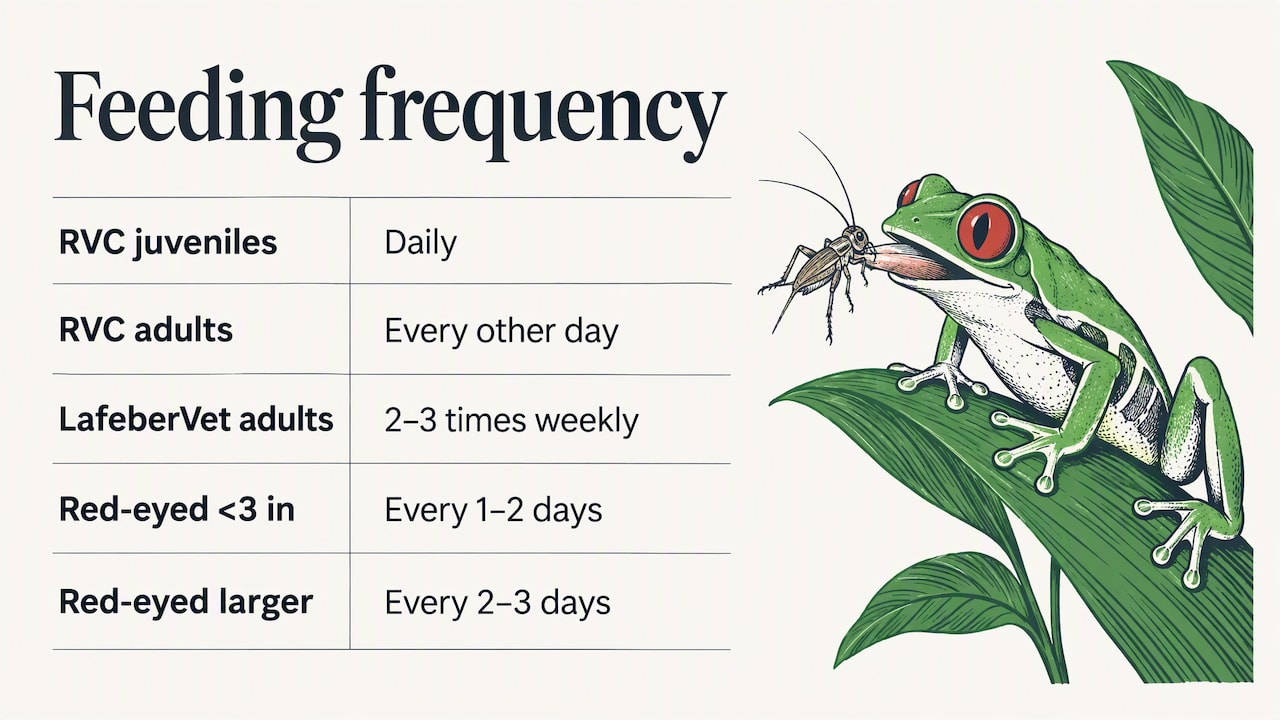
For quantity, PetMD advises offering only what the frog can eat within 15 minutes. For red-eyed tree frogs, its guidance is that adults under 3 inches eat every one to two days, larger adults every two to three days, and generally no more than three to six insects per feeding.
A simple starting plan
- Start from the care sheet for your exact species.
- Feed juveniles daily with correctly sized prey, and a modest number of insects per meal.
- Move adults to every other day or a few times a week as they mature.
- Check body condition every week or two. A frog with fat pads over the head and a broad, bulging body is getting too much. A frog with a narrow body and visible hips needs a vet’s advice, as well as more food.
- Adjust one thing at a time, and give each change a few weeks to show.
Temperature changes the equation
Amphibian nutrition research notes that temperature affects digestion, assimilation and metabolic rate. A cool, poorly heated enclosure slows digestion, so the same meal sits longer. Feeding schedules only work when the husbandry underneath them is right. If your frog is repeatedly refusing food or regurgitating, check temperature and humidity first and see an exotics vet if it continues.
Gut-loading and supplements
Feeder insects are only as nutritious as what they have eaten. Bought crickets that have been sitting in a tub for days are mostly empty shells. Gut-loading fixes this.
Gut-loading
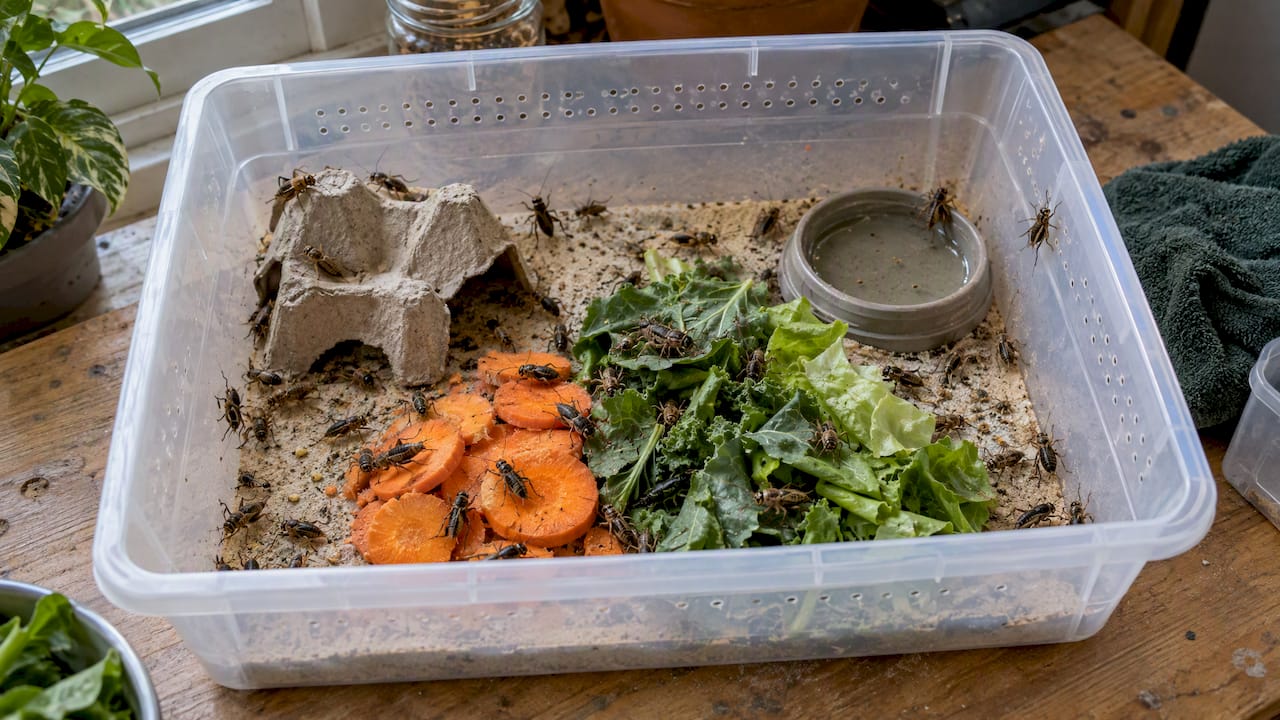
The RVC recommends feeding live food a complete invertebrate diet for 24 hours before they are fed on. PetMD’s guidance gives a window of at least 24 to 72 hours before dusting. In practice, give the insects a quality commercial gut-load, fresh vegetables such as carrot and greens, and a water source, and don’t skip it because you are in a hurry.
Dusting
Calcium and vitamins are the second half of the picture. The RVC advises alternating calcium dusting with a combined vitamin and mineral supplement, then feeding immediately. PetMD’s schedule is more specific: calcium with vitamin D and an amphibian multivitamin, with juveniles getting both daily, while adults get calcium at each feeding and multivitamins two to three times weekly.
Those are two sources that differ in detail, so treat them as a range. Your vet, or a care sheet written for your species, should settle the exact rotation. Whatever the schedule, use a light coating, not a snowball, and feed straight away, because the dust falls off as the insects groom.
Our own all-in-one vitamin and mineral dust for feeder insects is built around making this routine simpler. For the principles behind it, our guide to supplementation and our guide to gut-loading and macronutrients are written for dart frogs, but the feeder-insect fundamentals carry across.
How to offer food safely
Timing and hygiene matter as much as the menu.
- Feed late in the day. Tree frogs are nocturnal, and nutrition research recommends feeding nocturnal amphibians late in the day to match their natural activity.
- Offer dusted food immediately, and take out anything uneaten after about 30 minutes, as the RVC advises. Loose crickets can stress a frog or nibble at it overnight.
- Use a feeding dish or tongs to keep track of what is eaten. A shallow dish also stops insects vanishing into the substrate.
- Keep water clean. Clean and disinfect food and water dishes daily, and provide shallow, clean, dechlorinated water at all times.
- Use tongs sparingly. Hand-feeding can be useful for a shy frog, but a frog that grabs at tongs with force can injure its mouth.
How tree frogs catch and swallow
It helps to know what normal looks like. Small prey is caught with the sticky tongue, while larger prey is caught by pouncing and using the hands to push it into the mouth. Don’t be alarmed by the hand-stuffing: it is a natural behaviour. Frogs also blink and press the eyes down to help swallow, which is normal too.
What isn’t normal is a frog that repeatedly misses, drops prey or can’t swallow. That points to prey that is too big, a cold enclosure, or a health problem worth taking to a vet.
Common tree frog feeding mistakes
- One feeder forever. Crickets only, for years, is a narrow diet. Rotate in roaches or locusts.
- Skipping gut-load. Dusting cannot make up for empty insects.
- Overfeeding adults. An every-day schedule suits juveniles, not a mature White’s.
- Oversized prey. Always apply the eye-width rule.
- Leaving prey in overnight. Remove it after about 30 minutes.
- Fiddling with everything at once. Change one variable, then wait and watch.
Our perspective on tree frog feeding
We breed and keep amphibians at Frogfather HQ in Nottingham, and the pattern we see repeatedly is that feeding problems are usually system problems. A keeper who has a steady routine, correctly sized prey, a reliable gut-load and a consistent supplement schedule rarely needs to troubleshoot anything. A keeper who changes the menu every week trying to fix a picky frog often makes it worse.
Our advice is to build the basics first. Pick two or three staple feeders, find a supplier you trust, and write your supplement rotation down so it doesn’t depend on memory. Then watch the frog’s body condition and leave the routine alone long enough to judge it. This is the same approach we describe in our dart frog feeding guide, and the logic holds for tree frogs: stability, a system and patience beat clever tweaks.
A good enclosure also helps feeding. A planted, humid, properly heated setup, such as the paludarium approach for tree frogs, keeps a frog active and eating normally, and live plants and microfauna give it a more natural environment.
— User
Getting started with Frogfather
If you are planning a tree frog and want to start on the right foot, we offer captive-bred White’s tree frogs, American green tree frogs and European green tree frogs, along with the supplements and live food cultures to keep them well fed.

For feeder-side support, browse our live fruit fly cultures and subscriptions, or have a look at everything else, including custom bioactive vivariums, on the Frogfather shop.
FAQ
What do tree frogs eat?
Captive tree frogs eat live invertebrates. Crickets, cockroaches and locusts are the usual staples, with occasional extras such as small hornworms. Insects should be gut-loaded and dusted with supplements before feeding.
How often should I feed a tree frog?
Juveniles are generally fed daily and adults every other day or two to three times a week, depending on species and body condition. Offer only what the frog can eat in about 15 minutes. If your frog is gaining fat easily, cut back the portions before the frequency.
Can tree frogs eat mealworms?
Only as an occasional treat. Their hard exoskeletons may harm the gut if fed often, so use them to add variety rather than as a staple. Keep the size within the distance between the frog’s eyes.
Should I feed my tree frog in the morning or at night?
Late in the day is best, because tree frogs are nocturnal and are naturally active after dark. Remove any uneaten insects after about 30 minutes.
Can I feed my tree frog insects from the garden?
It is best not to. Wild-caught insects can carry disease, and may have been exposed to pesticides. Feeder insects from a trusted source, gut-loaded and dusted, are the safer choice.
Sources
- RVC Exotics Service: White’s tree frog care
- Aquarium of the Pacific: White’s tree frog
- LafeberVet: Basic information sheet, White’s tree frog
- PetMD: Green tree frog care sheet
- PetMD: Red-eyed tree frog care sheet
- PetMD: What do frogs eat?
- Amphibian Ark: Amphibian diet and nutrition
Recommended
- Dart Frog Feeding Guide UK | Food, Frequency & Supplements
- Dart Frog Nutrition Beyond Eggs: Macronutrients, Gut-Loading, And Supplementation Guide (UK 2025)
- Complete Guide To Dart Frog Supplementation
- Pea Aphids For Dart Frogs: Complete Culture Guide