
Description
Red & Green Spike Moss (Selaginella sp.) – Vivarium Plant
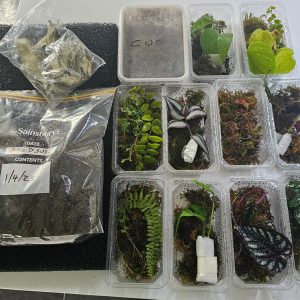
A colourful, mat-forming Selaginella supplied for humid planted terrariums and vivariums. Despite the common name “spike moss”, Selaginella is not a true moss; it is a vascular plant.
Why use it?
- Low, spreading growth that can provide attractive ground cover.
- Colour may range from green to bronze/red depending on the particular plant and growing conditions.
- Can provide cover and structure around leaf litter, wood and other planted areas.
- Suitable for humid terrarium planting when its light, moisture and airflow needs are met.
Moisture and humidity
This plant prefers consistently moist conditions and relatively high humidity, but we have removed the previous fixed “80–100% humidity” recommendation. Plant performance should be judged from the plant itself and the enclosure conditions rather than a single RH number. Keep the growing medium moist but not permanently waterlogged and provide useful air movement.
Bioactive claims
Living ground cover can help retain local surface moisture and roots can help hold growing media together. However, we no longer describe this plant as an “essential” component of a bioactive vivarium or claim that it independently regulates enclosure humidity, prevents substrate erosion or maintains soil health. Those outcomes depend on the whole enclosure system.
Animal-enclosure use
Frogfather uses Selaginella in planted amphibian vivaria. We do not describe any plant as automatically “safe” solely because of its species name: the plant should be free from inappropriate pesticide, fertiliser and chemical residues before being introduced to an animal enclosure.
Care
- Bright filtered to moderate indirect light.
- Moist, freely draining substrate.
- High humidity can be useful, together with good air circulation.
- Avoid prolonged drying and persistent waterlogging.
Botanical & Vivarium Use Review
Last reviewed: 5 September 2026
Plant performance depends on species or cultivar, light, temperature, substrate, airflow, water availability and the conditions in the individual enclosure. We therefore avoid treating one humidity percentage or care schedule as a universal requirement.
For animal enclosures, the most important safety issue is not simply the plant name: plants should be obtained from a known source and checked for pesticide, fertiliser or other chemical residues before introduction. Rinse and quarantine plants where appropriate.
Sources & further reading
- Royal Horticultural Society – Selaginella cultivation guidance
- Royal Horticultural Society – terrarium planting and moisture guidance