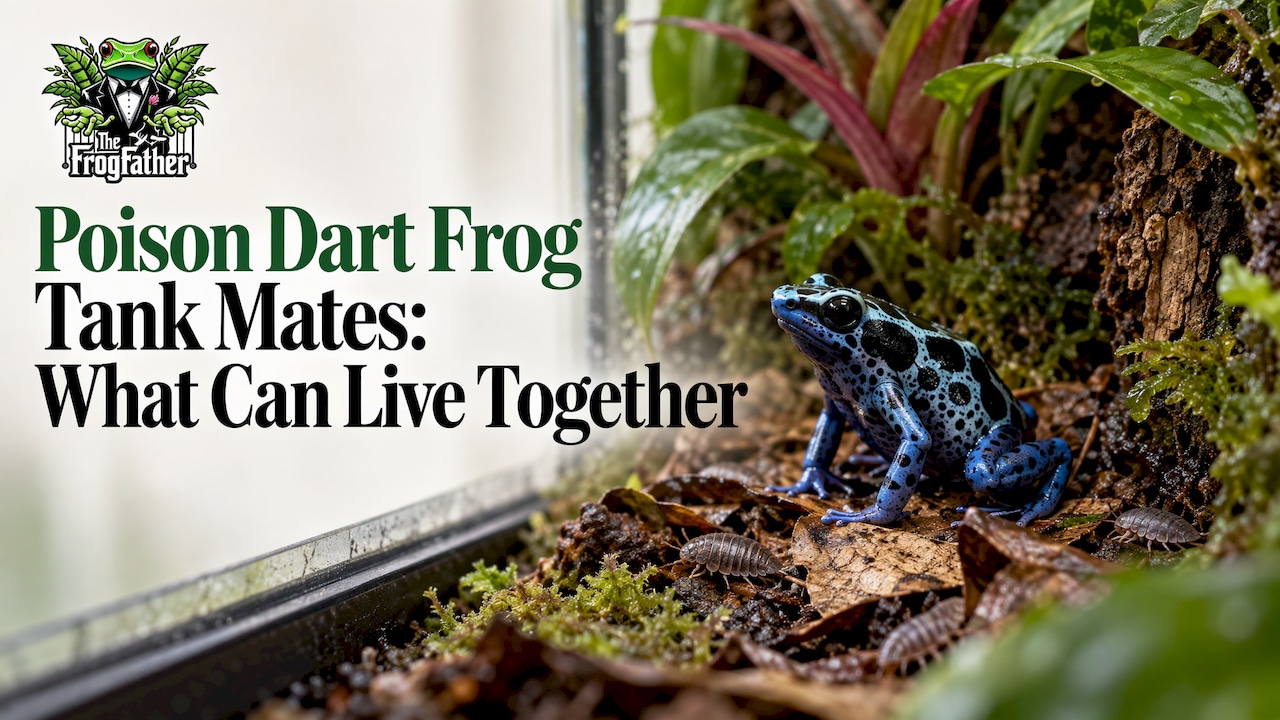

There is no reliable rule saying that you can keep one dart frog for every X litres or gallons of vivarium space. How many dart frogs you can keep together depends primarily on the species, sex of the frogs, their age, individual behaviour and the usable space and structure within the enclosure.
A large vivarium does not automatically make an incompatible group compatible. Equally, some dart frog species can live successfully in carefully managed groups when provided with sufficient space, feeding opportunities, visual barriers and places to retreat.
The Frogfather rule:
Do not decide how many frogs you want and then find a tank to fit them. Choose the species and appropriate social arrangement first, then build or select a vivarium capable of supporting them.
How Many Dart Frogs Can I Keep Together?
For many dart frog species, a pair is the simplest and safest starting point—but not every dart frog needs to be kept as a pair.
Some species can be successfully maintained in groups. Others become increasingly territorial as they mature and are much more reliably kept as compatible pairs.
The biggest mistake is assuming that because four or five juvenile frogs happily share an enclosure today, they will necessarily remain compatible when sexually mature.
Adult social behaviour matters far more than how peaceful a group of juveniles appears when you purchase them.
Why Isn’t There a Simple Dart Frog Stocking Rule?
You will occasionally encounter rules suggesting a particular number of dart frogs per gallon, litre or square centimetre of vivarium.
We do not recommend using them.
Two vivariums with identical external dimensions can provide completely different amounts of usable habitat. Planting density, hardscape, leaf litter, visual barriers, feeding areas, climbing surfaces and sheltered retreats all affect how frogs actually use an enclosure.
More importantly, different dart frog species have fundamentally different social behaviour.
A vivarium physically large enough to contain four adult frogs is not necessarily socially suitable for four adult frogs.
Dart Frog Group Size: Quick Comparison
| Species/group | Safest starting arrangement | Can groups work? | Main consideration |
|---|---|---|---|
| D. tinctorius | Compatible pair | Not our normal recommendation for adults | Strong same-sex aggression can develop |
| D. leucomelas | Pair or carefully managed group | Yes | Monitor territorial behaviour and feeding access |
| D. auratus | Pair or carefully managed group | Yes | Behaviour varies between individuals and populations |
| P. terribilis | Pair or appropriately sized group | Yes | Large frogs require substantial usable space and food |
| E. anthonyi | Pair or group | Yes | Breeding activity, calling and competition still require monitoring |
| Ranitomeya | Species dependent | Sometimes | Do not apply one stocking rule to the entire genus |
| Oophaga | Usually pair-focused | Species and circumstances dependent | Territorial and reproductive behaviour requires careful management |
These are starting principles rather than guaranteed stocking formulas. Individual animals can behave differently, and every group requires observation and a realistic plan for separating animals if necessary.
How Many Dendrobates tinctorius Can Live Together?
For adult Dendrobates tinctorius, our normal recommendation is a compatible male-and-female pair.
Young tinctorius are frequently raised together successfully. This sometimes gives new keepers the impression that they are naturally suitable for permanent group housing.
The problem often appears as the frogs mature.
Both males and females can display aggression towards members of the same sex, and female-to-female aggression can become particularly serious. Wrestling, pinning, chasing and preventing another frog from accessing food or preferred areas of the vivarium should not be dismissed as harmless behaviour.
Important:
A group of juvenile tinctorius living peacefully together is not proof that the same animals will remain compatible as adults. If purchasing several youngsters, have a realistic separation plan before they mature.
Can Dendrobates leucomelas Live in Groups?
Dendrobates leucomelas is one of the species for which group housing can be a realistic option.
That does not mean that an unlimited number can simply be placed together. Males can be territorial, particularly around calling and breeding sites, and individual animals may still become dominant.
A group enclosure should provide numerous sheltered areas, visual barriers, climbing opportunities and multiple feeding locations so that one frog cannot easily control the resources used by the entire group.
Watch the animals rather than assuming that the absence of obvious wrestling means everything is fine.
Can Dendrobates auratus Live in Groups?
Dendrobates auratus can often be maintained in appropriately designed groups and is another species commonly considered when somebody wants more than a pair.
However, social tolerance is not absolute. Females can display aggression and individual animals can behave differently.
Dense planting, substantial leaf litter, visual barriers and numerous retreats become increasingly important as the number of frogs increases.
If one frog is consistently hiding, losing condition or being displaced at feeding time, reconsider the social arrangement rather than assuming that it is simply a shy individual.
Can Phyllobates terribilis Live in Groups?
Phyllobates terribilis can make an impressive group display when housed appropriately.
The important consideration is their size. These are substantial dart frogs with strong feeding responses, so a group requires considerably more usable habitat and food than an equivalent number of much smaller frogs.
More frogs also means more competition at feeding time. Spread food across a broad area and make sure that every animal maintains good body condition.
Do not interpret their ability to live socially as permission to crowd them.
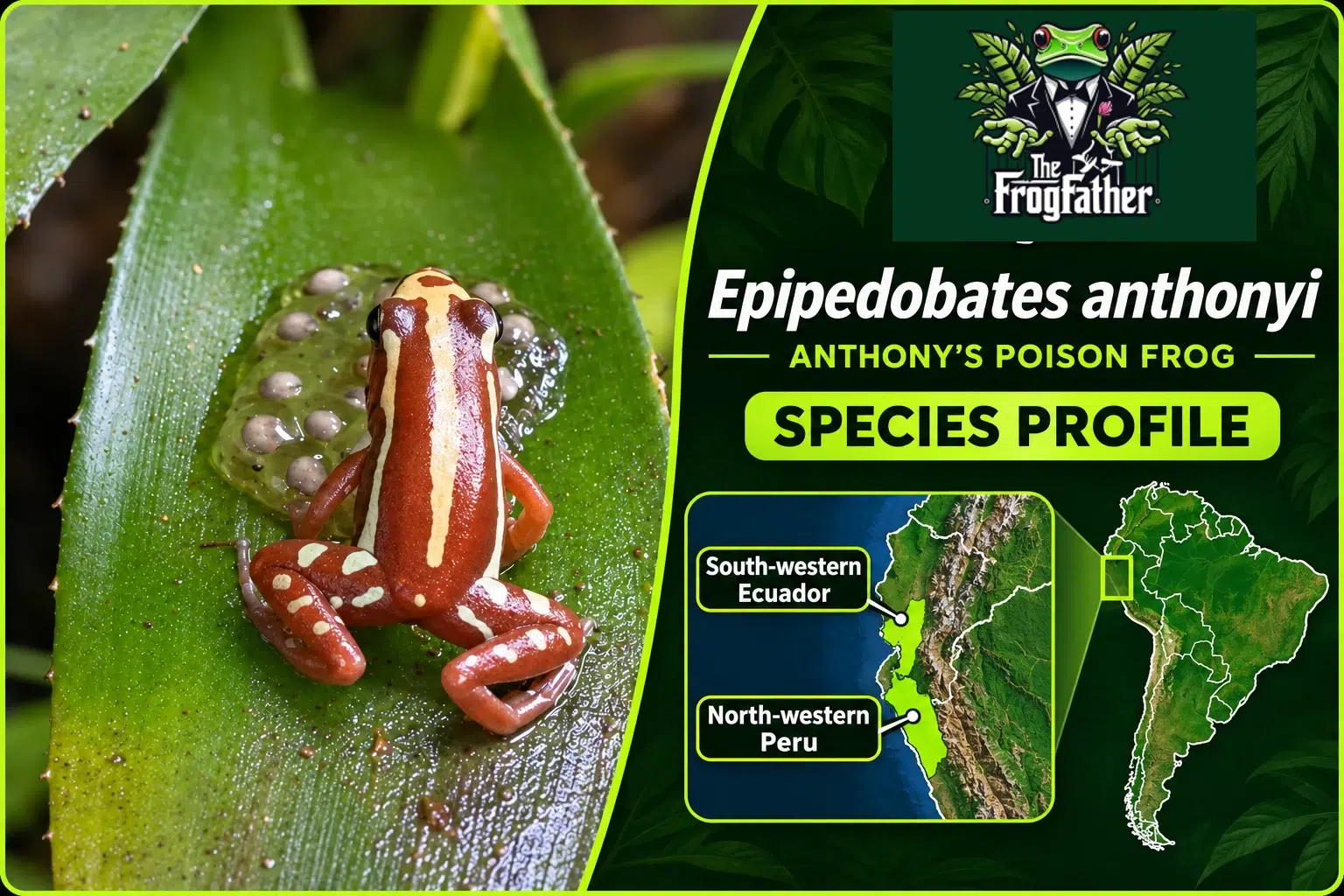
Can Epipedobates anthonyi Live in Groups?
Epipedobates anthonyi can generally be maintained in groups when given suitable space and structure.
They can also be enthusiastic breeders and males can be extremely vocal. Consequently, the question is not simply whether the frogs tolerate one another but whether the keeper is prepared for the activity that a mature group can generate.
As with any group, monitor feeding, body condition, courtship pressure and whether particular animals are being repeatedly excluded from preferred areas.
How Many Ranitomeya Can Live Together?
There is no sensible answer that applies to every Ranitomeya.
This is exactly why generic dart frog stocking rules cause problems.
Different species display different territorial and reproductive behaviours. Some can be maintained in carefully selected small groups; others are much more reliably managed as pairs.
Thumbnail frogs also introduce another consideration: their small physical size does not mean their social or husbandry requirements are proportionally smaller.
Select the exact species first and investigate its adult social behaviour before deciding how many animals to purchase.
Can Oophaga Live in Groups?
Oophaga should not be approached as a straightforward communal dart frog.
Many species display significant territorial behaviour alongside specialised reproductive strategies. For a new keeper, a compatible pair is generally a much more sensible starting arrangement than attempting to establish a group.
Species-specific research is particularly important here. Do not transfer group-housing advice from Dendrobates, Phyllobates or Epipedobates directly to Oophaga.
How Many Dart Frogs Can I Keep in a 45 × 45 × 45 or 45 × 45 × 60 Vivarium?
This is one of the most common questions we receive—and the dimensions alone are not enough to give a responsible number.
A 45 × 45 × 60 cm vivarium provides additional height compared with a 45 cm cube, but that additional vertical space is not equally valuable to every species.
Many larger Dendrobates make substantial use of the forest floor and lower levels of the enclosure. Smaller arboreal species may exploit vertical planting and structure differently.
Therefore:
- do not assume that adding height automatically allows another terrestrial frog;
- consider usable floor area as well as total volume;
- provide visual barriers and separate retreats;
- make sure every frog can access food without persistent competition; and
- choose the species and intended social arrangement before choosing the vivarium.
We will cover individual enclosure dimensions in more detail in our separate dart frog vivarium size guide.
Can I Keep Just One Dart Frog?
Whether solitary housing is appropriate depends on the species and circumstances.
Dart frogs are not all socially identical, and the statement that every dart frog must have a companion is too simplistic.
Temporary solitary housing can also be necessary for quarantine, observation, aggression management or health reasons.
If your intention is permanent solitary housing, investigate the natural and captive social behaviour of the exact species rather than applying a general rule to all dart frogs.
Can I Keep Two Male Dart Frogs Together?
Again, this is species dependent.
Male dart frogs commonly use calling and territorial behaviour in competition with other males. In some species and sufficiently structured enclosures, multiple males may coexist; in others, repeated territorial conflict makes that arrangement unsuitable.
Sex alone therefore does not determine compatibility—the species matters.
Can I Keep Two Female Dart Frogs Together?
Do not assume that females are automatically less aggressive than males.
Dendrobates tinctorius is the classic example. Females can display substantial aggression towards other females, particularly as the frogs mature and breeding behaviour develops.
Female aggression can also occur in other dart frog species.
Can Different Dart Frog Species Live Together?
We recommend keeping one dart frog species and locality per vivarium.
Mixing species introduces unnecessary complications involving competition, differing social behaviour, disease management and potentially hybridisation where closely related animals are involved.
A mixed-species display may look attractive to the keeper, but the priority should be providing an environment designed around the welfare and natural behaviour of the animals.
Can I Add Another Dart Frog Later?
Potentially—but introducing another frog into an established enclosure is not the same as establishing a group from the beginning.
The existing animals may already use particular feeding areas, shelters and breeding sites. A newcomer can alter that social balance.
Quarantine, species, sex, age, enclosure structure and the behaviour of the established frogs all need consideration.
Read our separate guide to adding a new dart frog to an established group before attempting an introduction.
How Do I Know If My Dart Frogs Are Fighting?
Some aggression is extremely obvious. Other problems are much easier to miss.
Watch for:
- wrestling or pinning another frog;
- repeated chasing;
- one frog continually climbing onto or pressing another frog down;
- persistent territorial calling associated with confrontation;
- one animal being driven away from food;
- a previously visible frog spending most of its time hiding;
- weight loss or deterioration in body condition;
- one frog repeatedly occupying an unusual corner or upper area as though avoiding the rest of the enclosure; and
- persistent stress or behavioural change following sexual maturity.
Do not wait for physical injury before acting. A subordinate frog can be adversely affected by chronic stress and restricted access to food long before obvious wounds appear.
Always have a Plan B
If you keep dart frogs in a group, you should have a practical way of separating an animal if the social arrangement changes. Compatibility is something you continue to observe—not something permanently established on the day the frogs are introduced.
Does More Space Prevent Dart Frog Aggression?
More usable space can certainly help by allowing additional territories, retreats, visual barriers and feeding areas.
It cannot, however, guarantee compatibility.
If the fundamental social arrangement is inappropriate for the species or particular individuals, simply buying a larger vivarium may not solve the problem.
This is why we treat enclosure size and social compatibility as related—but separate—questions.
Frequently Asked Questions
What dart frogs are best for keeping in groups?
Dendrobates leucomelas, Dendrobates auratus, Phyllobates species and Epipedobates anthonyi are among the frogs commonly considered for appropriate group housing. Exact numbers should still be based on species, enclosure and individual behaviour rather than a universal formula.
Should dart frogs be kept in pairs?
Pairs are a useful and comparatively simple starting arrangement for many species, but not every dart frog must be kept as a pair. Some species can live successfully in groups, while the appropriate social arrangement for others is much more restrictive.
Can I keep three dart frogs together?
Potentially. Three Dendrobates leucomelas, for example, presents a very different husbandry question from three adult Dendrobates tinctorius. The species and sexes need to be known before the number becomes meaningful.
Can I keep three Dendrobates tinctorius together?
We would not normally plan a permanent adult tinctorius setup around a group of three. Juveniles may coexist successfully before sexual maturity, but aggression can develop as they mature. A compatible adult pair is our preferred long-term starting arrangement.
Does a taller vivarium mean I can keep more frogs?
Not necessarily. Additional height only increases useful habitat if the species makes effective use of it. For predominantly terrestrial frogs, floor area, structure and access to resources may matter considerably more than total litres.
Can dart frog siblings live together?
Being siblings does not override adult territorial behaviour. Related juveniles may grow up together peacefully and still become incompatible as they mature.
Do dart frogs get lonely?
It is misleading to interpret dart frog social behaviour using human ideas of loneliness. Different species interact for courtship, breeding, territorial defence and other reasons in different ways. Housing decisions should be based on the known behaviour and welfare requirements of the species rather than assuming that every frog requires companionship.
Final Recommendation
There is no universal answer to “How many dart frogs can I keep?”
Start with the species.
Understand how that species behaves as an adult. Decide whether a pair or group is appropriate. Then provide an enclosure with sufficient usable space, planting, retreats, visual barriers and feeding opportunities for that arrangement.
Most importantly, continue watching the frogs.
A group that works today may change as animals mature, breeding begins or social relationships alter. Responsible group housing means being prepared to intervene when the frogs tell you that the arrangement is no longer working.
Choosing your next dart frogs?
Compare species first, understand their social behaviour and build the vivarium around the animals—not the other way around.
Compare Dart Frog Species
Beginner Dart Frog Guide
View Current Availability
Husbandry review: October 2026. Social behaviour varies between species and individuals. Always research the exact species and locality and be prepared to separate incompatible animals.