Husbandry & Evidence Review – 6 September 2026
This sale/profile page contains practical captive-care starting points. Temperature, moisture, enclosure size, grouping, feeding and breeding behaviour vary by locality, sex, life stage and individual; the current species/care guides take priority over any older fixed formula below.
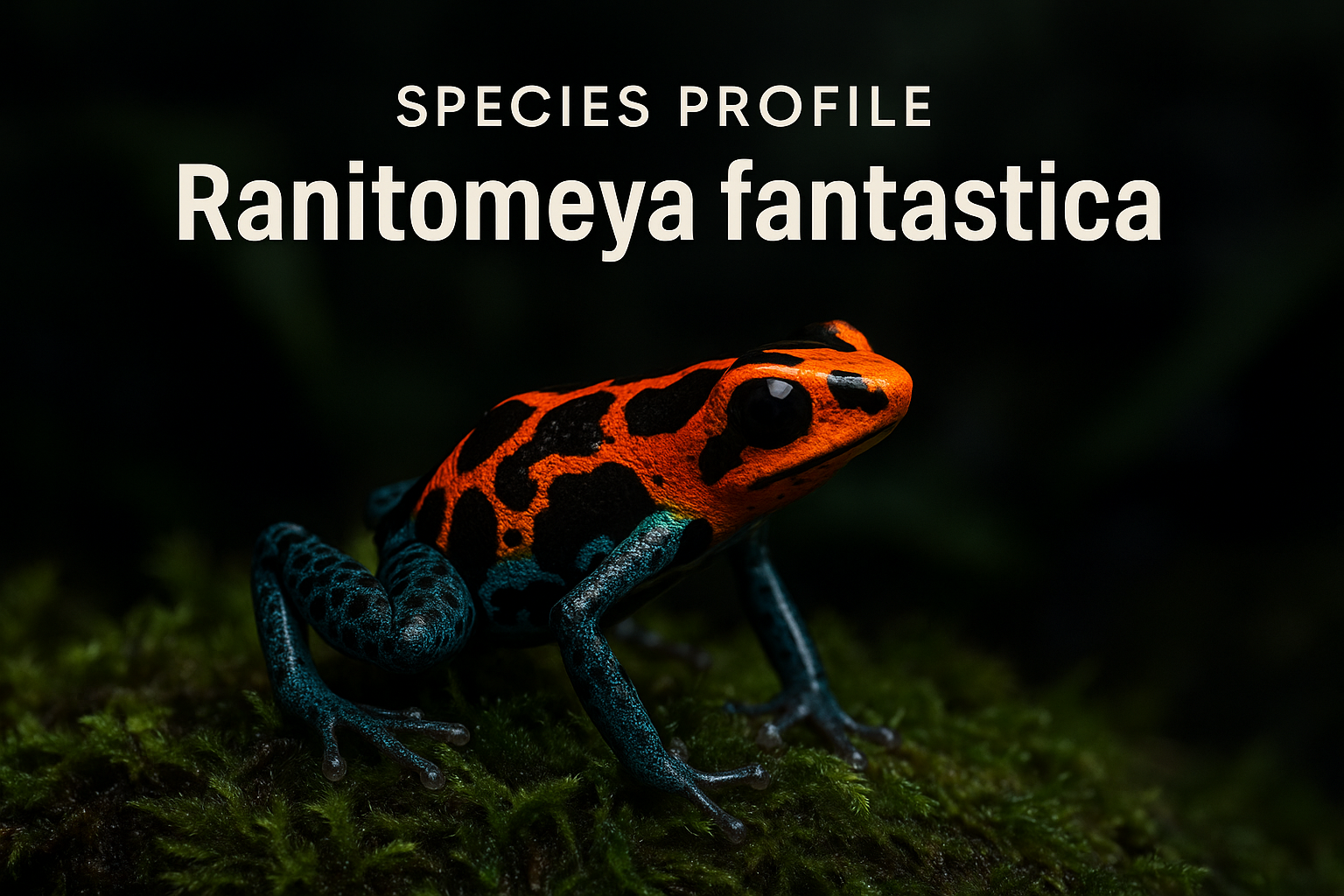
Ranitomeya fantastica, also known as the Fantastic Poison Dart Frog, is one of the most striking members of the Ranitomeya genus. With its glowing orange and black head pattern and metallic blue limbs, this thumbnail dart frog truly lives up to its name. Curious, intelligent, and eye-catching, it’s an incredible addition to any advanced vivarium setup.
Origin & Distribution
R. fantastica originates from the lowland rainforests of northeastern Peru, particularly around the San Martín and Loreto regions. It inhabits humid forest floors and low vegetation layers, often near bromeliads and leaf litter where humidity remains high.
Size, Lifespan & Appearance
- Adult size: 17–20 mm
- Lifespan: typically 8–12 years in captivity
- Appearance: orange to red head and shoulders with black reticulation, dark body, and iridescent blue legs; distinct pattern varies by locale (notably “Fantasticus Nominal” and “Varadero” forms)
Temperature & Humidity
- Daytime: 22–25 °C
- Night: 20 °C
- Moisture: provide humid refuges and species-appropriate cycles with useful airflow rather than a permanent 85–100% RH target or mandatory twice-daily misting
Vivarium Setup (Semi-arboreal)
This is a semi-arboreal thumbnail species that loves to climb. A vertical/cube enclosure can work for a compatible pair when it provides sufficient usable structure; 30×30×45 cm is a minimum-style hobby reference rather than a universal optimum. Include bromeliads, cork bark, moss, and leaf litter. Dense planting with Philodendron, Peperomia, and Pilea helps maintain humidity. A vented 3D vivarium provides excellent airflow while holding moisture.
Diet
Offer appropriately sized small prey frequently enough to maintain condition: fruit flies, springtails, and micro-crickets. Use All-in-One Vitamin & Mineral Dust according to its current formulation-specific directions; no supplement guarantees complete nutrition or vivid colouration by itself.
Social Behaviour & Visibility
Active and alert. Keep as pairs or trios (one male, two females) in well-planted tanks. Once established, they are inquisitive and visible, often sitting on elevated leaves or bromeliad axils. Males will call softly throughout the day.
Calling
Males produce a gentle insect-like buzz — subtle and rhythmic. The sound adds natural ambience without being loud or intrusive.
Breeding & Parental Care
Females lay eggs on smooth leaves or inside film canisters. The male guards and hydrates the clutch until hatching, then carries tadpoles to water-holding plants. Tadpoles are non-obligate egg feeders and can be raised on standard tadpole diet. Metamorphosis usually takes 10–14 weeks.
Availability in the UK
Ranitomeya fantastica dart frogs for sale in the UK are occasionally available from experienced captive breeders. Frogfather UK only works with verified, UK-based keepers to ensure healthy, acclimated stock with no wild-caught imports.
Quick Care Summary
- Type: Semi-arboreal thumbnail
- Group size: Pair or trio
- Temperature: 22–25 °C
- Moisture: species-appropriate humid refuges and useful ventilation; avoid a permanent fixed-RH target
- Behaviour: Active, visible, inquisitive
- Breeding: Male transports tadpoles; non-obligate egg feeding
- Call: Soft, buzzing trill
FAQs
Is Ranitomeya fantastica suitable for beginners?
Better for confident beginners or intermediates with experience maintaining high humidity.
Can they live in groups?
Pairs are a cautious default. Trio/group compatibility varies and should be monitored with separation space available.
Do they climb?
Yes — semi-arboreal and frequently seen on leaves and bromeliads.
How loud is the call?
Soft, insect-like buzz — noticeable up close but not loud.