Husbandry & Evidence Review – 6 September 2026
This sale/profile page contains practical captive-care starting points. Temperature, moisture, enclosure size, grouping, feeding and breeding behaviour vary by locality, sex, life stage and individual; the current species/care guides take priority over any older fixed formula below.
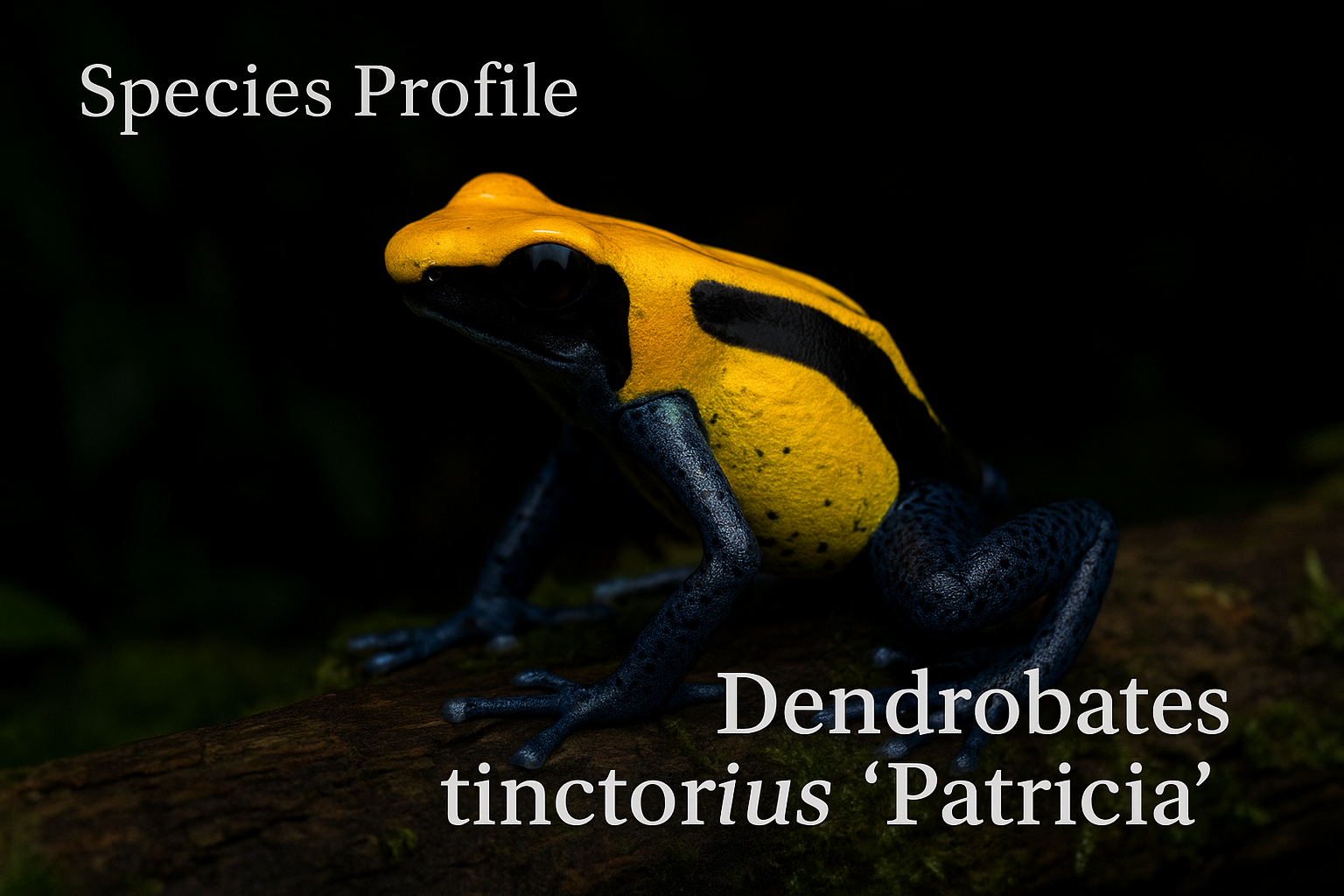
Dendrobates tinctorius ‘Patricia’ is a classic, large-bodied dyeing dart frog with a bright yellow back, bold black banding and blue-mottled limbs. Confident, visible and wonderfully photogenic, this morph is a fantastic centrepiece for a planted, bioactive vivarium. If you’re after colour, personality and reliability, ‘Patricia’ is a superb choice.
Origin & Distribution
D. tinctorius originates from the Guiana Shield region of Suriname, French Guiana and northern Brazil. ‘Patricia’ is a captive line/morph developed in the hobby and valued for its clean yellow cap and contrasting body pattern.
Size, Lifespan & Appearance
- Adult size: 40–50 mm (one of the larger dart frogs)
- Lifespan: typically 10–15 years in captivity
- Look: bright yellow dorsum (“cap”), black body bands and blue legs with black mottling
Temperature & Humidity
- Day: 22–26 °C (night drop to ~20 °C)
- Moisture: provide humid refuges and species-appropriate moisture cycles with useful ventilation rather than a permanent 80–100% RH target
- Moderate ventilation to avoid stagnant air; maintain moist but well-drained substrate
Vivarium Setup (Terrestrial)
A horizontal footprint with plenty of floor space suits ‘Patricia’. A 60×45×45 cm enclosure is a practical starting point for a compatible pair. Adult D. tinctorius can be territorial, so trio/group housing should not be a default and separation space must be available. Provide deep leaf litter, patches of sphagnum, cork hides and sturdy plants (Philodendron, Pothos, Scindapsus). A vented 3D vivarium keeps humidity high with good front airflow.
Diet
Offer appropriately sized prey according to age, intake and body condition: fruit flies (melanogaster & hydei), springtails, micro-crickets and small isopods. Use All-in-One Vitamin & Mineral Dust according to its current formulation-specific directions; do not stack fixed schedules automatically.
Social Behaviour & Visibility
Very bold and visible. Best kept as a pair or a female-heavy trio in spacious setups. Avoid multiple males in smaller enclosures. They quickly learn feeding routines and spend lots of time in the open.
Calling
Males have a soft buzzing/trilling call — audible but household-friendly. Calling increases after misting and in the early morning.
Breeding & Parental Care
Females lay eggs on smooth leaves, inside coco-huts or film canisters. The male guards and hydrates the clutch, then carries each tadpole on his back to shallow water (canisters or small pools). Tadpoles are not obligate egg-feeders and will accept prepared diets and biofilm; metamorphosis typically in 8–12 weeks.
Availability in the UK
Dendrobates tinctorius ‘Patricia’ dart frogs for sale in the UK are commonly available as captive-bred stock. Frogfather UK works with responsible breeders to offer robust, well-started juveniles whenever possible.
Quick Care Summary
- Type: Terrestrial, large-bodied Dendrobates
- Group size: Pair or female-heavy trio
- Temps: 22–26 °C day
- Moisture: species-appropriate humid refuges and useful ventilation; avoid a permanent fixed-RH target
- Diet: Small live foods, dusted regularly
- Breeding: Male guards eggs; transports tadpoles
- Call: Soft buzz/trill
FAQs
Is ‘Patricia’ suitable for beginners?
Yes — one of the best beginners’ dart frogs thanks to its size, boldness and forgiving nature.
Can I keep more than two?
Pairs are safest. Trios with one male, two females can work in larger enclosures with lots of cover.
Do they need a water feature?
Shallow pools/film canisters for tadpoles are useful; otherwise keep the land area moist with good drainage.
How loud is the call?
Soft, indoor-friendly buzz — much quieter than many tree frogs.