Husbandry & Evidence Review – 5 September 2026
This current plant guide uses “safe plant” as practical vivarium shorthand, not a toxicological guarantee. Species identity, nursery pesticide/fertiliser exposure, root condition, mature size, plant chemistry and the intended animals still need to be considered.
This article forms part of Frogfather’s Complete Dart Frog Care series. The complete cornerstone guide will be linked here once all of the supporting care articles have been published and indexed.
Live plants are one of the most important working parts of a dart frog vivarium. They provide cover, climbing routes, visual barriers, humid retreats, breeding sites and structure that allows frogs to use more of the enclosure.
They also influence how the complete environment behaves. Healthy roots help stabilise substrate, foliage slows evaporation, leaves intercept mist and mature planting creates different temperature, light and humidity zones throughout the vivarium.
However, a plant being described as “tropical” or “terrarium suitable” does not automatically make it a good choice for dart frogs. Some grow far too large, some collapse in permanently humid conditions, some need more light than a typical vivarium provides and others arrive carrying fertiliser, pesticide residues or unwanted hitchhikers.
At Frogfather HQ, we keep and propagate plants across established dart frog, tree frog and bioactive vivariums. The plants that work best are not necessarily the rarest or most expensive. They are the ones that establish reliably, tolerate regular trimming and perform a useful function within the enclosure.
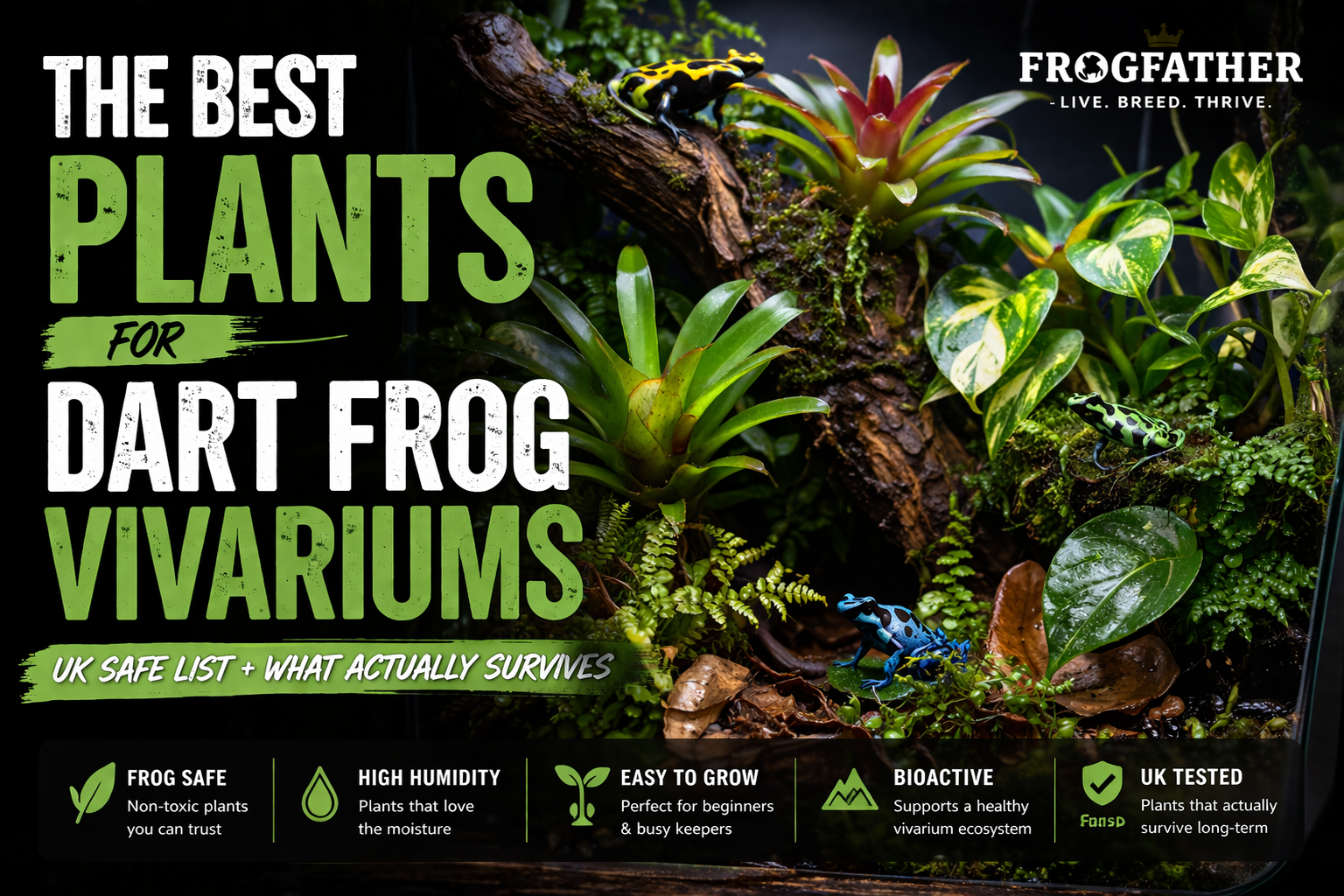
This guide explains how to choose plants by growth habit and vivarium zone, which plants we find most dependable, how to prepare them safely and why planting density matters just as much as the individual species you select.
If you are ready to choose plants, you can browse the complete Frogfather collection of tropical vivarium plants.
Contents
- The quick answer
- Why live plants matter
- What makes a good dart frog vivarium plant?
- Choosing plants by vivarium zone
- The best plants for dart frog vivariums
- Matching plants to different dart frog types
- How densely should you plant?
- Lighting, misting and airflow
- Planting and mounting methods
- Preparing and quarantining plants
- Plants to avoid
- Why vivarium plants fail
- Long-term plant maintenance
- Frequently asked questions
The Quick Answer
Best all-round beginner plant: Pothos or another compact climbing aroid. These establish quickly, tolerate trimming and provide broad cover.
Best functional breeding plant: A suitably sized bromeliad, particularly for Ranitomeya, Oophaga and other frogs that use water-holding leaf axils.
Best creeping plant: Small-leaved Ficus, creeping Begonia, Pilea or suitable Selaginella.
Best shingling plant: Marcgravia grown against cork, wood or a textured vivarium background.
Best background plants: Compact Syngonium, climbing aroids, Cissus and upright tropical plants selected to suit the available height.
Best number of plants: Enough to create cover at ground, middle and upper levels while retaining open feeding areas and access for maintenance.
Most important preparation: Remove commercial soil, rinse and inspect the complete plant, then quarantine it before placing it with frogs.
Most common mistake: Choosing plants for their appearance without considering their mature size, growth direction, light requirement or tolerance of airflow.
Why Live Plants Matter in a Dart Frog Vivarium
Dart frogs can survive in simple quarantine and temporary enclosures without elaborate planting. A permanent display vivarium is different. Live plants allow the enclosure to function as a structured habitat rather than an attractive glass box.
Well-planned planting provides:
- Visual cover that helps frogs feel secure.
- Barriers between territorial animals.
- Broad leaves for resting, calling and courtship.
- Climbing routes through the middle and upper enclosure.
- Water-holding surfaces after misting.
- Shaded and exposed microclimates.
- Root networks that help stabilise substrate.
- Surfaces for springtails and other microfauna.
- Potential egg-deposition and tadpole-deposition sites.
- A more resilient and natural-looking bioactive ecosystem.
Planting can also affect how visible your frogs become. Dart frogs often behave more confidently when they know cover is close. An enclosure with plenty of leaves, low hides and broken sightlines may produce more natural activity than a visually open vivarium where the frogs feel exposed.
This does not mean filling every centimetre with foliage. Frogs still need usable ground, feeding areas and routes through the enclosure. The objective is a mixture of cover and access rather than a solid wall of leaves.
What Makes a Good Dart Frog Vivarium Plant?
A useful vivarium plant needs to do more than tolerate humidity for a few weeks. It should establish and continue growing under the actual conditions inside the enclosure.
Before choosing a plant, consider the following.
Mature Size
Many young houseplants look perfect in a vivarium when purchased but rapidly outgrow the available space. Large-leaved aroids may block lighting, cover ventilation and overwhelm more delicate plants.
Fast growth is not automatically undesirable. A vigorous plant can create rapid cover in a new build. It must, however, tolerate pruning and remain manageable.
Growth Direction
Think about where the plant will go rather than simply whether you like it.
- Low creeping plants suit the foreground and lower walls.
- Shingling plants need cork, wood or a textured background.
- Climbers can fill rear corners and branches.
- Upright plants create background structure.
- Epiphytes and bromeliads can be mounted above the substrate.
Moisture Tolerance
Humidity and wet roots are not the same thing. Many tropical plants enjoy humid air but still rot when their crown or root system remains waterlogged.
The best plant for a damp foreground may be completely unsuitable for a constantly wet bromeliad mount. Matching the roots to the moisture level is just as important as matching the leaves to the humidity.
Light Requirements
Different levels of a planted vivarium receive very different amounts of light. A bromeliad near the top may receive strong direct illumination, while a small fern behind cork at substrate level receives very little.
Plant around the actual light gradient. Do not expect one light-loving species to perform equally well at every height.
Our guide to vivarium lighting for dart frogs explains how plant lighting and frog cover should be balanced.
Physical Structure
Dart frogs are small, but they still climb, push through leaves and repeatedly use favourite perches. Delicate plants placed in busy routes may be flattened.
Use more robust plants around feeding areas and major climbing routes. Reserve very delicate species for protected pockets where they will not be trampled continually.
Residues and Contamination
The plant itself may be appropriate while the material surrounding it is not. Commercial plants can arrive in fertilised compost and may have been exposed to systemic pesticides, leaf treatments or pest-control products.
For amphibian enclosures, preparation and quarantine are part of plant selection. A suitable species cannot be considered ready for a dart frog vivarium until it has been properly cleaned and observed.
Choosing Plants by Vivarium Zone
A successful vivarium usually combines several growth habits. Buying six attractive plants with the same shape often creates competition in one area while leaving the rest of the enclosure empty.
| Vivarium zone | Useful growth habit | Example plants | Primary function |
|---|---|---|---|
| Foreground and forest floor | Creeping, spreading or low-growing | Selaginella, small Pilea, creeping Begonia, Dragon’s Tongue | Low cover, moisture buffering and natural transitions into leaf litter |
| Lower walls and cork | Small-leaved climbers | Ficus pumila, Ficus pumila ‘Quercifolia’, Microgramma | Background coverage and usable climbing structure |
| Middle level | Bushy or broad-leaved plants | Fittonia, Peperomia, compact Begonia, smaller aroids | Visual barriers, resting leaves and shaded retreats |
| Upper background | Climbing, upright or shingling | Marcgravia, Syngonium, Cebu Blue, Cissus discolor | Vertical cover and routes between ground and canopy |
| Branches and elevated mounts | Epiphytic plants | Bromeliads, selected ferns, suitable orchids | Canopy structure, resting places and potential breeding sites |
If you are building a new enclosure, the following plant bundles make it easier to create this layered structure:
- Six Creeping Terrarium Plants Bundle for ground cover, lower walls and spreading growth.
- Six Tall Terrarium Plants Bundle for upright background planting and vertical structure.
Using both growth types creates a much more functional layout than filling the entire enclosure with plants of one height.
The Best Plants for Dart Frog Vivariums
1. Bromeliads
Bromeliads are strongly associated with dart frog vivariums because they combine colour, structure and genuine biological function.
Water-holding varieties form small pools between their leaves. Some dart frog species use these axils for retreating, courtship or tadpole deposition. Even where they are not used for breeding, their leaves create strong horizontal and diagonal perches.
Compact Neoregelia varieties are particularly useful because they can be mounted onto cork, branches or backgrounds without occupying the whole enclosure.
Bromeliads need:
- Enough light to maintain compact, healthy growth.
- Airflow around the crown and root area.
- A secure mount that does not bury the central crown.
- Space to produce offsets as they mature.
- Protection from constantly saturated substrate.
A bromeliad may enjoy water in its leaf axils while simultaneously rotting if its base is buried in wet soil. Mounting and airflow are therefore as important as humidity.
Read our dedicated bromeliad guide for dart frog vivariums before adding them to a breeding enclosure.
2. Creeping and Ground-Cover Plants
Creeping plants soften the boundary between the background, hardscape and forest floor. They provide low cover while leaving taller areas available for bromeliads and structural plants.
Useful options include:
- Small-leaved Ficus.
- Creeping Begonia.
- Pilea varieties.
- Compact Peperomia.
- Suitable Selaginella.
- Dragon’s Tongue.
- Small trailing ferns.
Ground cover should not replace leaf litter completely. Dart frogs still benefit from deep areas of natural leaf litter for shelter, foraging and access to microfauna.
Use creeping plants around the edges, roots and lower wall while retaining sections of loose leaf litter beneath and between them.
For a mixed selection, see the Frogfather Creeping Terrarium Plants Bundle.
3. Marcgravia and Other Shingling Plants
Marcgravia is one of the most characteristic plants used in high-quality tropical vivariums. Juvenile growth presses closely against cork, wood or a textured background, producing overlapping leaves that gradually climb towards the light.
This makes Marcgravia especially useful where you want living background coverage without the loose, outward growth of a traditional vine.
It performs best when:
- Its roots are kept humid but not drowned.
- New growth is placed directly against a climbable surface.
- Humidity remains stable during establishment.
- There is enough light higher in the enclosure.
- The plant is protected from repeated disturbance while rooting.
Once established, the overlapping leaves create small sheltered spaces that frogs and microfauna can explore.
Our Marcgravia sp. ‘Umbellata Type’ rooted cutting is suited to cork, branches and naturalistic vivarium backgrounds.
4. Pothos and Climbing Aroids
Pothos is not rare, but it remains one of the most dependable vivarium plants available. It establishes quickly, tolerates pruning and creates broad leaves that dart frogs can use.
Green pothos is particularly forgiving. Cebu Blue offers narrower, blue-green foliage and a more refined appearance while retaining the useful climbing habit associated with Epipremnum.
Climbing aroids are useful for:
- Rapidly covering bare backgrounds.
- Creating large resting leaves.
- Filling rear corners.
- Providing visual barriers.
- Stabilising a new enclosure while slower plants establish.
The main disadvantage is growth rate. Left untrimmed, pothos can shade bromeliads, cover ventilation and dominate smaller plants.
Use it deliberately and trim it regularly rather than allowing it to become the entire vivarium.
5. Syngonium
Syngonium provides upright and climbing foliage that works well in the middle and rear of a vivarium. Smaller forms can create broad usable leaves without immediately overwhelming the enclosure.
Syngonium rayi is particularly attractive, with dark foliage and a pale central vein. It is generally better suited to humid display enclosures than large, vigorous houseplant varieties.
Allow enough space for new leaves and give the plant something to climb. Regular pruning can encourage a denser shape and prevent it reaching the lighting too quickly.
6. Cissus discolor
Cissus discolor produces striking green, silver and purple foliage. Its climbing habit makes it useful for vertical backgrounds and branches, although it requires more deliberate care than pothos.
It appreciates:
- Good humidity.
- Bright but not excessively harsh light.
- A support or textured surface.
- Air movement around its leaves.
- Regular trimming once established.
Cissus can lose leaves if conditions change abruptly. It is better used in a stable, mature enclosure than as the only structural plant in a new build.
7. Begonias
Begonias provide some of the most varied colours, patterns and leaf textures available for tropical vivariums. Compact and creeping forms can work exceptionally well.
They are useful for creating:
- Colour contrast beneath green planting.
- Low and middle-level cover.
- Broad leaves for small frogs.
- Dense growth around wood and rock.
Begonias vary enormously. Some enjoy humid vivarium conditions while others deteriorate if their leaves remain wet or airflow is poor.
Keep water away from delicate crowns, provide gentle ventilation and avoid assuming every decorative houseplant Begonia will behave the same way.
8. Pilea and Peperomia
Small Pilea and Peperomia varieties are excellent for filling gaps between major structural plants.
They tend to work well in the foreground and middle level, where their smaller leaves provide detail without blocking the entire view.
These plants are particularly useful in Ranitomeya and Oophaga vivariums because they help create a dense network of small leaves and sheltered routes.
Do not plant every specimen directly beneath a nozzle. Fine-leaved plants can remain continuously wet if positioned in the centre of the spray pattern.
9. Selaginella
Selaginella is often sold as spike moss, although it is not a true moss. It produces dense, low growth and can create excellent foreground detail.
Useful vivarium forms include:
- Selaginella uncinata, known for blue or peacock iridescence.
- Selaginella erythropus, which can display darker foliage and red-toned undersides.
- Other compact tropical forms suited to stable humidity.
Selaginella appreciates dependable moisture around its roots but can still fail in stagnant, waterlogged substrate. It also struggles if placed directly under intense lighting or allowed to dry completely.
Use it in shaded or partially shaded damp areas rather than trying to cover the entire floor.
10. Ferns
Small tropical ferns add fine texture and soften hardscape. Their fronds contrast well with bromeliads and broad-leaved aroids.
Choose ferns by mature size. A fern that looks compact in a garden-centre pot may eventually occupy a substantial area.
Ferns generally prefer:
- Humid air.
- Indirect or filtered light.
- Moist but oxygenated root zones.
- Protection from strong direct spray.
Use compact species in side pockets, beneath branches or around shaded backgrounds. Large Boston-type ferns are normally too vigorous for smaller dart frog vivariums.
11. Moss
Moss can be beautiful, but it should not be treated as compulsory carpeting for every dart frog setup.
Many mosses need a particular balance of light, clean water, moisture and airflow. Some remain healthy only where constantly wet, while others fail because they are repeatedly saturated and deprived of air.
Moss works best when used selectively:
- On humid cork and wood.
- Around water-retentive planting pockets.
- On textured backgrounds.
- In shaded areas that remain moist.
- Where it does not replace essential leaf litter.
Do not judge the complete vivarium by whether every surface remains bright green. Healthy leaf litter, plants and microfauna are more important than forcing a continuous moss carpet.
Matching Plants to Different Dart Frog Types
Dendrobates and Other Larger Terrestrial Frogs
Larger terrestrial dart frogs benefit from robust ground-level planting, broad leaves and substantial areas of leaf litter.
Useful choices include:
- Compact pothos and aroids.
- Strong bromeliads mounted at accessible heights.
- Syngonium.
- Robust Begonia and Peperomia.
- Low creeping plants around the edge of open feeding areas.
Do not fill the forest floor with fragile stems. Larger frogs will repeatedly use the same routes and may flatten delicate planting.
Ranitomeya
Ranitomeya make extensive use of height and benefit from small-leaved planting that connects the forest floor to elevated bromeliads and deposition sites.
Useful choices include:
- Marcgravia.
- Ficus pumila ‘Quercifolia’.
- Microgramma.
- Small Begonia, Pilea and Peperomia.
- Compact water-holding bromeliads.
A tall enclosure is only useful if the planting and hardscape allow the frogs to travel through it.
Oophaga
Oophaga vivariums benefit from dense structure, good visual separation and multiple usable bromeliads. Females of obligate egg-feeding species may use water-holding plants as tadpole nurseries.
Provide multiple suitable sites rather than relying on one large bromeliad. Shingling plants and fine-leaved climbers can create privacy between those areas.
Ameerega and Active Ground-Oriented Frogs
Ameerega generally benefit from robust planting, usable ground area, cork, roots and strong cover around the edges.
Avoid creating such dense ground cover that food disappears immediately or the frogs have no clear routes. Taller plants and rear-wall coverage can provide security while leaving open sections of leaf litter for activity and feeding.
How Densely Should a Dart Frog Vivarium Be Planted?
A new vivarium does not need to look fully mature on the day it is planted. Plants require space to root, spread and respond to the lighting.
Planting too sparsely can leave frogs feeling exposed. Planting too densely can create different problems:
- Poor airflow between leaves.
- Plants competing for the same light.
- Hidden rot and dying foliage.
- Restricted access for feeding and maintenance.
- Difficulty monitoring frogs.
- Blocked ventilation.
A useful approach is to begin with:
- One or two structural background plants.
- One or more elevated bromeliads where appropriate.
- Several smaller middle-level plants.
- Creeping or shingling plants with room to spread.
- Open leaf-litter zones at the front and beneath cover.
Think about what the enclosure should look like after six months, not just on planting day.
Lighting, Misting and Airflow
Plants, misting and ventilation must be planned together.
A plant may be described as humidity loving but still fail when:
- Its leaves remain wet all day.
- Its roots sit in anaerobic substrate.
- There is no air movement around the crown.
- The lighting is too weak for active growth.
- Intense light raises leaf temperature.
Healthy plants normally show active new growth, stable colour and firm roots. Plants that repeatedly stretch towards the light, lose colour or produce increasingly weak leaves may need more appropriate lighting or a better position.
Read the following supporting guides when balancing a planted vivarium:
Do not solve every struggling plant by adding more mist. Check its light, roots, airflow and mature requirements first.
Planting and Mounting Methods
Planting in Substrate
Substrate planting suits many ground plants, Begonias, Pilea, Peperomia, ferns, Syngonium and rooted aroids.
Create a planting pocket that holds moisture while still allowing oxygen around the roots. Do not compact wet substrate tightly around the stem.
Mounting on Cork or Wood
Marcgravia, creeping Ficus, Microgramma and some epiphytic plants can be encouraged to root against cork or natural wood.
Secure the plant gently until new roots attach. Avoid tight wire, exposed sharp fixings or large amounts of adhesive around the roots.
Mounting Bromeliads
Bromeliads should normally be mounted with their crown above the substrate. Their small root systems primarily hold them in place and should not be buried deeply in wet soil.
Position the plant where:
- Its rosette remains accessible.
- Water can enter and leave the axils naturally.
- The base receives airflow.
- Lighting reaches the leaves.
- Future offsets have some room.
Background Planting Pockets
Integrated pockets can support ferns, trailing plants and compact aroids. Make sure excess water can drain rather than collecting behind the background.
A hidden pocket of stagnant substrate can remain wet long after the visible enclosure appears balanced.
Preparing and Quarantining Vivarium Plants
Every new plant should be inspected and prepared before it enters an occupied dart frog vivarium.
Potential problems include:
- Snails and slugs.
- Fungus gnats.
- Aphids.
- Spider mites.
- Eggs hidden beneath leaves.
- Commercial fertiliser.
- Pesticide or leaf-treatment residues.
- Unsuitable potting compost.
A practical preparation process is:
- Remove the plant from its original pot.
- Discard the commercial potting medium.
- Rinse the roots gently with clean, lukewarm water.
- Inspect both sides of every leaf.
- Check stems, crowns and root junctions for eggs or pests.
- Repot in clean, vivarium-appropriate substrate.
- Keep the plant separately under suitable light and humidity.
- Observe it for approximately 10–14 days.
- Reinspect it before planting.
Avoid assuming that a harsh chemical dip makes a plant immediately safe. Products capable of killing invertebrate pests may also be dangerous to the springtails, isopods and amphibians that will eventually share the enclosure.
For the complete process, read why you should quarantine plants before adding them to a vivarium.
Plants to Avoid in Dart Frog Vivariums
There is no perfect universal blacklist, but certain plants and plant conditions create unnecessary risk.
Sharp or Heavily Spined Plants
Avoid plants with hard spines, hooked stems or sharp leaf margins positioned where frogs travel regularly.
Euphorbia and Plants With Irritating Sap
Plants that release strongly irritating latex or sap when damaged are poor choices for an enclosure where leaves may be broken during trimming or maintenance.
Plants Treated With Systemic Pesticides
A plant may look clean while retaining treatments within its tissues or growing medium. If its treatment history is unknown, quarantine and observation are essential.
Plants That Rapidly Outgrow the Enclosure
Large Monstera, vigorous Philodendron and full-sized houseplant varieties can overwhelm smaller vivariums, obstruct ventilation and create continual maintenance.
Plants Requiring Dry Roots or Strong Airflow
Some plants enjoy humid air but require dry, airy roots. They may fail rapidly when planted directly into wet vivarium substrate.
Temperate Outdoor Moss and Plants
Plants collected outdoors may need seasonal temperature changes and can introduce pests, pollutants or unsuitable organisms. Wild collection may also be restricted or environmentally damaging.
Artificially Dyed, Glittered or Chemically Polished Plants
Decorative treatments have no place in an amphibian enclosure. Use plants with clean, natural foliage.
Why Vivarium Plants Fail
| Symptom | Likely causes | What to check |
|---|---|---|
| Yellowing leaves | Root stress, excessive water, poor light or transplant shock | Root condition, drainage and new growth |
| Long, weak growth | Insufficient light | Light intensity, plant position and shading |
| Brown, crispy edges | Drying, excessive light or recent root disturbance | Misting coverage and proximity to lighting or vents |
| Soft or collapsing crown | Rot and stagnant moisture | Airflow, direct spray and whether the crown is buried |
| Leaves continually dropping | Environmental shock, root loss or unsuitable conditions | Recent changes, temperature and root health |
| White deposits on leaves | Mineral-rich misting water | Water source and nozzle condition |
| Repeated pest outbreaks | Insufficient quarantine or dying plant material | Leaf undersides, roots and nearby plants |
| No new growth | Weak light, damaged roots or lack of establishment time | Rooting, temperature and realistic growth rate |
Some leaf loss after planting is normal. Plants need time to adapt to different humidity, roots, light and airflow.
Judge the plant by its new growth rather than expecting every original leaf to remain perfect.
Long-Term Plant Maintenance
A planted vivarium is never completely maintenance free. Plants grow, compete and respond to seasonal changes inside the room.
Regular maintenance should include:
- Removing dead or decomposing leaves.
- Trimming plants before they block lighting or ventilation.
- Redirecting vines towards useful areas.
- Checking bromeliad bases for rot.
- Inspecting leaves for pests.
- Keeping open feeding areas accessible.
- Monitoring background planting pockets.
- Removing cuttings after pruning.
- Watching for one species dominating the enclosure.
Trim gradually rather than stripping large areas of cover in one session. Sudden removal can expose frogs, alter humidity and change the way animals use the enclosure.
Healthy cuttings can often be rooted separately and used in future vivariums. This also provides a backup if a plant is later lost from the main enclosure.
Our Practical Planting Formula
For a typical medium-sized dart frog vivarium, a useful starting structure is:
- One or two strong background plants.
- One climbing or shingling species.
- Two or three compact middle-level plants.
- One or more bromeliads where appropriate.
- Several creeping plants or small foreground pockets.
- Substantial areas of natural leaf litter.
- At least one clear feeding and observation area.
The exact number will depend on plant size, vivarium dimensions and growth rate. Six tiny cuttings are very different from six mature plants.
If you want a coordinated selection rather than choosing every plant separately, combine the Creeping Terrarium Plants Bundle with the Tall Terrarium Plants Bundle. This supplies both low spreading growth and taller background structure.
Frogfather’s Verdict
The best dart frog plants are not chosen from a single universal safe list. They are chosen by matching the plant’s mature size, growth direction, roots, light requirement and moisture tolerance to a particular part of the enclosure.
Start with several dependable structural plants. Add creeping and shingling growth to connect the different levels. Use bromeliads where they provide a genuine function, and retain open areas of leaf litter rather than carpeting every surface.
Most importantly, quarantine every new plant and allow the vivarium to mature. A successful planted enclosure develops over time as roots establish, leaves orientate towards the light and frogs begin choosing their preferred routes and resting places.
A perfectly planted vivarium is not the one containing the rarest collection. It is the one where the plants remain healthy, the frogs behave confidently and the complete enclosure continues functioning months and years after it was built.
Frequently Asked Questions
What are the best plants for dart frog vivariums?
Reliable choices include compact bromeliads, pothos, Syngonium, Marcgravia, creeping Ficus, small Begonias, Pilea, Peperomia, Selaginella and compact tropical ferns. The best selection combines several growth habits rather than relying on one plant.
Do dart frogs need real plants?
Dart frogs can be maintained temporarily without live plants, but real planting provides valuable cover, visual barriers, climbing structure, humidity buffering and potential breeding sites in a permanent vivarium.
Are houseplants safe for dart frog vivariums?
Some common houseplants work very well, but they must be suitable for the available light, humidity and space. Commercial soil and possible pesticide or fertiliser residues must also be removed or addressed before planting.
Should vivarium plants be quarantined?
Yes. Quarantine helps identify snails, slugs, mites, aphids, fungus gnats and other hitchhikers before they enter an occupied enclosure. A period of approximately 10–14 days is a practical starting point.
Can I plant pothos with dart frogs?
Yes. Pothos is a robust and useful vivarium plant that provides broad leaves and fast cover. It must be trimmed regularly so that it does not overwhelm smaller plants or block lighting and ventilation.
Are bromeliads necessary for dart frogs?
No, not every dart frog requires bromeliads. They are particularly useful for species that use water-filled leaf axils for shelter or tadpole deposition, but other plants can provide suitable cover for many terrestrial species.
Can I cover the entire vivarium floor with moss?
It is generally better to use moss selectively while retaining substantial areas of leaf litter. Leaf litter provides shelter, foraging opportunities and habitat for microfauna that a continuous moss carpet cannot fully replace.
Why do my vivarium plants keep rotting?
Common causes include waterlogged roots, crowns being buried, direct nozzle spray, insufficient airflow, weak light and unsuitable plant selection. High humidity does not mean every root and leaf should remain constantly wet.
How many plants should I put in a dart frog vivarium?
The correct number depends on the vivarium and the mature size of each plant. Aim to create ground, middle and upper-level cover while retaining open feeding areas, leaf litter and room for the plants to grow.
Can I use plants collected from outdoors?
Outdoor plants can introduce pests, pollutants and organisms that are unsuitable for a tropical amphibian enclosure. Many temperate plants also require seasonal conditions that cannot be provided inside a warm vivarium.
Continue Reading
- Choosing the Right Dart Frog Vivarium Size
- Dart Frog Humidity Guide
- Dart Frog Ventilation Guide
- Best Vivarium Lighting for Dart Frogs
- Bromeliads for Dart Frog Vivariums
- Why You Should Quarantine Vivarium Plants
Choose Plants for Your Vivarium
Explore creeping plants, upright background plants, bromeliads, shingling plants, rare tropical species and dependable vivarium favourites in the Frogfather plant collection.
Browse Frogfather Vivarium Plants
Experience the Frogfather difference today.