Husbandry & Evidence Review – 5 September 2026
This substrate/drainage guide remains current where it describes substrate as one part of a managed enclosure. No substrate mix is universally perfect, and drainage/microfauna do not make a vivarium maintenance-free.
Part of the Frogfather Dart Frog Knowledge Base
The floor of a dart frog vivarium has several jobs. It must support plants, provide habitat for microfauna, hold useful moisture, drain excess water and remain structurally stable for years. Getting it wrong can produce waterlogged soil, dying roots, foul smells and a clean-up crew that never establishes.
This guide explains how to build the complete system—from drainage reservoir to leaf litter—and when a traditional drainage layer is useful rather than simply repeating that every vivarium must contain one.
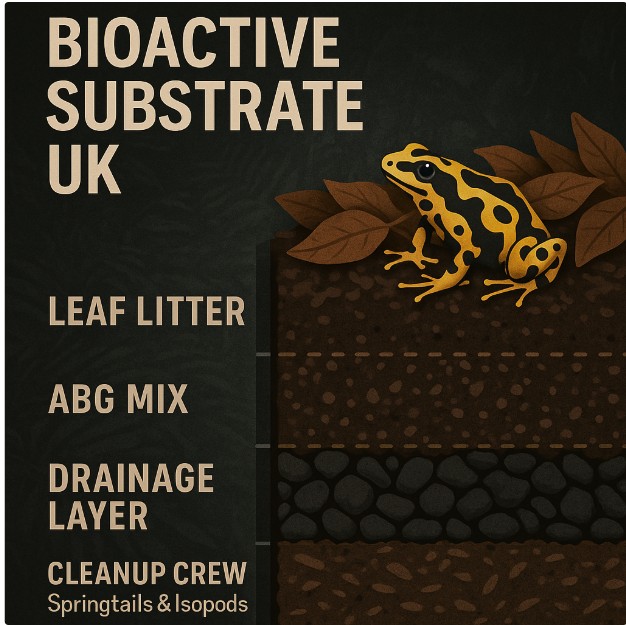
The complete dart frog vivarium floor system
A reliable bioactive floor is better understood as a connected system rather than a pile of unrelated products.
| Layer | Purpose | Typical materials |
|---|---|---|
| Drainage or water buffer | Keeps accumulating water below the root and microfauna zone | LECA, suitable filter foam or raised false bottom |
| Separator | Stops fine substrate falling into an open drainage layer | Inert plastic mesh or suitable fabric |
| Biological substrate | Supports roots, microbes and clean-up crew while balancing air and moisture | Coarse tropical substrate or established bioactive blend |
| Leaf-litter surface | Provides cover, feeding surfaces, humidity buffering and microfauna habitat | Durable, vivarium-safe leaves in overlapping layers |
Plants, hardscape and drainage access must be considered before these layers go in. A siphon tube or drain added during construction is far easier than trying to reach trapped water through a planted vivarium later.
Do dart frog vivariums need a drainage layer?
Not every successful vivarium uses a traditional drainage layer. A carefully watered enclosure with free-draining substrate, modest misting and an outlet through the base can work without a separate reservoir.
However, a drainage buffer is a useful safeguard for most keepers, especially when:
- An automatic misting system runs every day
- The enclosure is densely planted
- The vivarium has no drainage hole through the base
- Seasonal UK conditions change drying rates
- The keeper is still learning how quickly water accumulates
- The enclosure has a large footprint or substantial background planting
A drainage layer does not create humidity and it does not correct over-misting. It temporarily stores water below the substrate. If the reservoir fills until water reaches the soil, the substrate will still become saturated.
Best drainage layers for dart frog vivariums
| System | Advantages | Limitations | Best use |
|---|---|---|---|
| LECA or hydroballs | Simple, lightweight, widely available and easy to contour | Needs a separator; fine material and roots can enter gaps over time | Straightforward small and medium builds |
| Open-cell filter foam | Lightweight, supportive, easy to shape and provides a large biologically active surface | Wicks moisture; must be suitable, clean aquarium-grade foam and not compressed too thin | Lightweight planted builds and Frogfather-style systems |
| Raised false bottom | Creates a large open reservoir and can be connected easily to a drain | More complex; edges and supports must be secure; stagnant reservoirs still need management | Large vivariums and builds with planned drainage access |
| Gravel | Inert and functional when correctly installed | Very heavy and offers little advantage over lighter materials | Usually unnecessary in modern glass vivariums |
LECA or hydroballs
Rinse LECA thoroughly before use because new clay balls can carry a considerable amount of dust. A layer around 3–5cm deep is common in modest builds, although the correct depth depends on expected water volume and available internal height.
Open-cell filter foam
Coarse aquarium-grade foam can act as a lightweight drainage and support layer. Frogfather commonly uses suitable 25 PPI-style foam systems. The foam holds some moisture by capillary action, so it should not be treated as an unlimited reservoir. Water still needs to remain controlled and removable.
Raised false bottoms
Egg-crate or platform systems are useful where a large empty reservoir is wanted. Supports must carry the wet weight of substrate, plants, wood and stone without shifting. Cover sharp or accessible edges and prevent frogs or feeder insects entering the reservoir.
Drainage access and safe water levels
Every drainage system should allow inspection. Common options include:
- A removable vertical siphon tube hidden behind cork or planting
- A drilled bulkhead and external valve
- A standpipe reaching the reservoir
- A deliberately accessible corner behind removable hardscape
A little water appearing after misting is normal. Drain it before the level reaches the separator or keeps the substrate permanently wet. There is no universal weekly or monthly draining schedule because water accumulation depends on nozzle output, ventilation, planting, room temperature and season.
Do not rely on evaporation from a full reservoir to maintain humidity. That approach leaves the substrate close to saturation and hides the real cause of excess water. Adjust the misting routine as well as emptying the reservoir.
What should separate the drainage layer from the substrate?
LECA and open false bottoms need an inert barrier that prevents soil moving down while allowing water through. Use vivarium-safe plastic mesh or a suitable non-metallic landscape fabric with openings small enough to retain the substrate.
The separator should:
- Cover the complete drainage layer, including corners
- Overlap slightly where pieces meet
- Remain stable when planting and adding hardscape
- Allow water to pass without holding a permanently saturated mat
- Contain no exposed metal, treatments or loose fibres
Some filter-foam systems support coarse substrate directly and may not require a separate mesh. That depends on foam grade and the particle size above it. Fine soil can still migrate into foam, so assess the specific materials rather than applying one rule to every build.
What makes a good dart frog vivarium substrate?
The aim is not wet soil. It is a structured root and microfauna zone containing both moisture and air. A useful tropical substrate should absorb water without collapsing into a dense block.
Suitable mixes commonly combine several of the following:
- Fine or medium orchid bark for long-term structure
- Coco husk or coir used as one component rather than the entire mix
- Chopped or milled sphagnum for controlled moisture retention
- Horticultural charcoal for durable pore space
- Decomposed leaf material or other vivarium-safe organics
- Mineral or clay components appropriate to the formulation
Traditional ABG-style mixes can work very well, but there is no single compulsory recipe. Component quality, structure and responsible sourcing matter more than copying a formula exactly. Tree-fern fibre is increasingly difficult to justify where origin and sustainability are uncertain, and modern alternatives can provide the required structure.
Fresh substrate versus established substrate
A fresh mix supplies structure but must still develop its microbial and microfauna community. Established substrate can introduce biological activity and shorten that early stage, although it does not remove the need to stabilise the completed enclosure.
Frogfather 7L Aged Bioactive Vivarium Substrate is developed in established planted systems and includes living microfauna. Because it is a live product, it should not be baked, frozen or mixed with chemically treated materials.
Substrates and materials to avoid
Avoid choosing substrate purely because it grows houseplants. Dart frogs have permeable skin and spend time in direct contact with the enclosure floor.
- Fertilised potting compost: may contain added fertilisers, wetting agents, pesticides or manure-based ingredients.
- Garden soil: composition and contamination are unknown and it may introduce pests or chemicals.
- Pure coco fibre: holds moisture but compacts and provides limited durable structure when used alone.
- Pure sphagnum moss: can remain saturated and collapse; use it as a component or targeted planting medium.
- Fine sand as the main layer: compacts and provides poor habitat for roots and clean-up crew.
- Sharp stone or exposed aggregate: adds weight and can create unsafe surfaces.
- Aromatic or treated wood products: avoid dyed mulch, pesticide-treated bark and unknown timber waste.
If the product label does not make its additives clear, do not assume it is amphibian-safe.
How deep should dart frog substrate be?
A general biological layer of approximately 5–8cm works for many planted dart frog vivariums. Deeper root zones of 8–12cm can help large plants and allow useful contours, provided they remain airy and do not become permanently saturated.
Depth should vary naturally. Slope the substrate, build protected pockets around wood and leave enough internal height for leaf litter without burying the front ventilation strip.
Calculating substrate volume
Use this simple estimate:
Width (cm) × depth (cm) × average substrate thickness (cm) ÷ 1,000 = litres required
| Vivarium footprint | Average depth | Approximate volume |
|---|---|---|
| 45 × 45cm | 7cm | 14.2 litres |
| 50 × 50cm | 7cm | 17.5 litres |
| 60 × 45cm | 7cm | 18.9 litres |
Hardscape, backgrounds and planting pockets reduce the actual amount required, while slopes and deep planting areas increase it. Order with a little allowance rather than compressing the mix to make it stretch.
How to build dart frog substrate and drainage layers
- Plan the drain. Decide how water will be inspected and removed before covering the base.
- Secure heavy hardscape. Large stone or wood must not balance precariously on loose substrate. Protect the glass and make the structure stable.
- Install the drainage system. Add rinsed LECA, suitable foam or a secure false bottom at the planned depth.
- Add access. Install the siphon tube, standpipe or bulkhead and test it with clean water.
- Fit the separator. Cover open drainage material completely so substrate cannot escape around the edges.
- Add substrate loosely. Create the planned contours without compacting the mix into a solid layer.
- Plant the vivarium. Spread roots naturally and keep plant crowns at an appropriate level.
- Settle gently. Water planting pockets lightly rather than flooding the entire floor.
- Add microfauna. Distribute springtails and isopods into protected areas.
- Apply leaf litter. Use overlapping layers with deeper pockets beneath cork and planting.
- Test the complete system. Run lighting, ventilation and misting while monitoring moisture and reservoir accumulation before adding frogs.
Do not add the plants after the frogs simply because the substrate is technically finished. The planted enclosure needs time to settle and reveal problems. The next Knowledge Base guide will cover cycling and deciding when a vivarium is ready.
Microfauna and leaf litter complete the substrate
Bioactive substrate is not complete when the soil goes in. Springtails, isopods, microbes and leaf litter create the active surface system.
Add a proper depth of leaves rather than leaving large areas of bare soil. Leaf litter reduces direct substrate contact, creates feeding and refuge zones and slows rapid surface drying. Read the leaf litter guide and microfauna guide for the next stages.
How to maintain substrate and drainage layers
Weekly observations
- Check whether the lower substrate is damp rather than saturated.
- Look for standing water approaching the separator.
- Notice any sour, sulphurous or stagnant smell.
- Remove concentrated uneaten food and dead plant material.
Monthly checks
- Inspect and drain the reservoir when necessary.
- Check plant bases for softness or rot.
- Replenish thinning leaf litter.
- Confirm springtail and isopod activity beneath refuges.
- Review misting if water is accumulating faster than plants and ventilation can use it.
Do not routinely stir or replace the full substrate. That destroys roots and stable biological zones. Spot repair compacted or contaminated areas and investigate the cause before carrying out a major rebuild.
Common substrate and drainage problems
| Problem | Likely cause | Response |
|---|---|---|
| Reservoir continually full | Excess misting, blocked drain or insufficient removal | Drain safely, check the outlet and correct water input. |
| Black or sour substrate | Persistent saturation, compaction or trapped decaying material | Remove the concentrated source, improve drainage and review misting and airflow. |
| Plants rotting at the base | Crowns buried, unsuitable plant choice or constantly wet root zone | Replant correctly and provide a more appropriate moisture zone. |
| Surface dries immediately | Thin substrate, little leaf litter or excessive airflow | Increase leaf cover and review substrate depth, mist distribution and ventilation balance. |
| Substrate enters drainage layer | Separator gaps or unsuitable mesh | Repair accessible edges; rebuild if migration is compromising drainage. |
| Clean-up crew disappears | Drying, flooding, food loss, chemical exposure or predation | Correct habitat conditions before adding another culture. |
Common build mistakes
- Installing a reservoir with no siphon, outlet or inspection point
- Assuming a drainage layer permits unlimited misting
- Using fertilised houseplant compost because plants grow well in it
- Using pure coco fibre or sphagnum as the complete long-term substrate
- Compacting the biological layer until it loses air spaces
- Making the substrate too shallow for roots and microfauna
- Burying plant crowns in permanently wet material
- Leaving exposed soil with little leaf litter
- Adding frogs before testing water accumulation and plant stability
- Replacing all substrate instead of diagnosing a localised problem
Frequently asked questions
What is the best substrate for dart frog vivariums?
The best substrate is a coarse, airy tropical blend that holds useful moisture without compacting or remaining saturated. It should support plant roots, microbes and clean-up crew while draining excess water.
Do dart frog vivariums need a drainage layer?
Not always, but most automated or heavily planted UK setups benefit from a drainage buffer. It provides temporary space for excess water, provided the reservoir can be inspected and emptied.
What is the best drainage layer for dart frogs?
LECA, suitable open-cell filter foam and secure raised false bottoms can all work. Choose according to vivarium size, weight, misting volume and how water will be removed.
How deep should a dart frog drainage layer be?
Around 3–5cm is common for LECA or foam in modest builds, while large false-bottom reservoirs may be deeper. Capacity and drainage access matter more than copying one measurement.
How deep should dart frog substrate be?
Approximately 5–8cm suits many vivariums, with deeper 8–12cm planting zones where required. Maintain air spaces and keep the layer above standing water.
Can I use ordinary potting compost?
It is not recommended. Potting compost may contain fertiliser, pesticides, wetting agents, manure or other additives unsuitable for amphibian contact.
Should water remain in the drainage layer?
A small amount after misting is normal, but it should not rise into the substrate or remain unmanaged. Drain accumulating water and correct excessive input.
Do I need mesh above LECA?
Yes. An inert separator prevents the biological substrate falling between the clay balls while still allowing water to drain through.
Can I use filter foam as a drainage layer?
Yes. Suitable coarse aquarium-grade open-cell foam can provide lightweight support and drainage. It also wicks moisture, so water levels and misting still require management.
How often should bioactive substrate be replaced?
Healthy substrate is not replaced on a routine timetable. Maintain drainage and leaf litter, spot-repair problems and rebuild only when structure, contamination or persistent saturation cannot be corrected safely.
Final verdict
The best dart frog substrate system is not the one with the most layers. It is the one that keeps the root and microfauna zone moist, airy and separated from accumulating water.
Choose a drainage method you can inspect, use a structured amphibian-appropriate substrate, add enough depth for the planting plan and protect the surface with leaf litter. Then test the whole enclosure before the frogs arrive. That foundation makes every later part of vivarium management easier.