
“Black dart frog” is one of those search phrases that can mean five different things depending on who typed it. Some people mean a frog that’s genuinely dark, almost ink-black in normal daylight. Some mean a frog with a black base and coloured pattern. Some mean a “melanistic” variant. And some mean “a rare morph I saw online that someone says is pure black”.
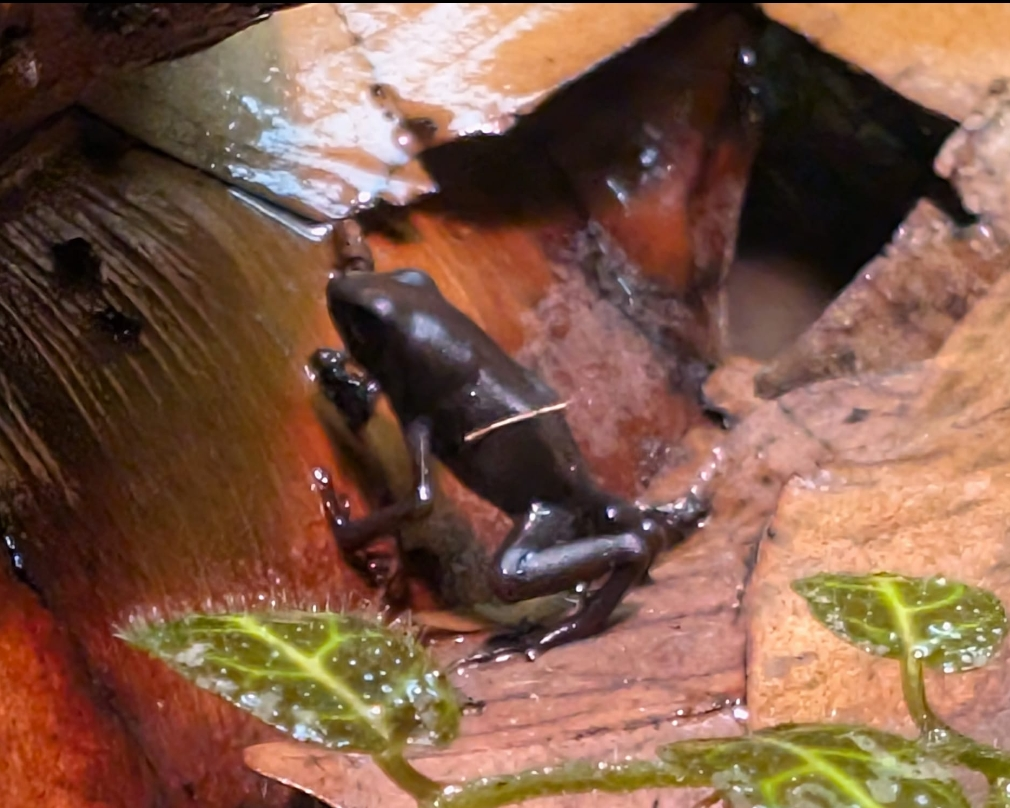
This article is here to cut through the noise in a way that actually helps keepers. We’ll cover what “black” usually means in dart frog colouration, whether pure black dart frogs really exist, what causes unusually dark pigmentation, what husbandry factors can make a frog look darker than it is, and how to approach the ethics when the hobby starts marketing “black” as premium.
If you want the deeper genetics-and-ethics cornerstone that sits behind this page, read this next (and come back): Melanistic dart frogs, morphs & selective breeding: ethics, genetics, and the reality of nature .
Table of contents
- Quick read: the answer in 60 seconds
- What people mean by “black dart frog”
- Do pure black dart frogs exist?
- Genetics vs husbandry: why your frog looks darker
- Melanism explained (without the nonsense)
- Common “black-looking” dart frogs in the hobby
- Care notes for dark-coloured dart frogs
- Ethics: where “black morph” marketing goes wrong
- Best internal reads to pair with this article
- FAQ
- FAQ Schema (JSON-LD)
- CSV tags
Quick read: the answer in 60 seconds
Most “black dart frogs” aren’t pure black. They’re usually frogs with a dark base colour and coloured patterning (black + green, black + blue, black + bronze, etc), or frogs that appear much darker due to lighting, stress, hydration, or diet.
A truly pure black dart frog (uniform black in normal viewing) is uncommon. Dark variants can happen, and melanism can exist, but “pure black” is also one of the easiest labels to hype and misrepresent online.
The keeper move is simple: rule out husbandry first, then talk genetics. If you want the full ethics/genetics deep dive that backs this up, read: our melanistic dart frogs & selective breeding cornerstone .
What people mean by “black dart frog”
In real life, “black dart frog” usually falls into one of these buckets:
1) A frog with a black base and coloured pattern
This is the most common meaning. The frog’s base colour is dark (black or near-black), but it has coloured markings or patterning. In photos, the black base dominates, so people shorten it to “black dart frog”.
2) A frog that is naturally very dark in person
Some individuals and some lines present much darker than others. That doesn’t automatically mean a “morph” was manufactured. Variation exists — and sometimes it’s dramatic.
3) A frog that looks black because of environment and lighting
This happens constantly. A frog under the wrong lighting, in a stressed state, dehydrated, or nutritionally flat can look darker and duller. Fix the system first, then judge the colour.
4) A “pure black” claim (usually marketing language)
“Pure black” is often a sales phrase more than a scientific description. Sometimes it’s accurate. Often it’s “near-black under certain lighting”. The difference matters — because “pure black” is used to justify price, hype, and intentional line-breeding.
Do pure black dart frogs exist?
A genuinely pure black dart frog (uniformly dark with minimal visible patterning in normal daylight) is not impossible. In biology broadly, very dark pigment expression can occur through:
- Natural variation within a population
- Melanism (increased melanin expression)
- Selection (in the wild or in captivity) for darker expression
- Environmental presentation (where colour “reads” darker due to light and health state)
The bigger issue is that “pure black” is a phrase that gets used without standards. If you’re trying to work out whether a frog is actually “pure black”, ask yourself:
- Is it still black in neutral daylight? (Not just under LEDs.)
- Does it show hidden patterning when it moves? Many “black” frogs have patterning that only pops at certain angles.
- Does it stay black when healthy and settled? Some frogs darken under stress and “clean up” when husbandry improves.
- Is the claim backed by clear lineage info? Or is it just a label?
If the conversation starts drifting into “this is a rare morph” territory, you’ll get far more clarity by reading our deeper ethics/genetics piece: melanistic dart frogs, morphs & selective breeding and the companion framework: genetics & selective breeding (responsible UK keeper’s guide) .
Genetics vs husbandry: why your frog looks darker
Before anyone starts diagnosing a “black morph”, we always recommend a boring-but-powerful step: assume husbandry first. Not because genetics don’t exist — but because husbandry is the most common explanation, and it’s fixable.
Lighting makes or breaks perceived colour
Lighting doesn’t just change how you see the frog; it changes how the frog behaves and how the enclosure functions. Many setups are bright to the human eye but weak in usable spectrum for plant growth and natural presentation. If your frog looks darker than expected, compare your lighting plan against: best lighting setup for a dart frog bioactive vivarium and, if you’re debating UVB claims: UVB lighting myth vs science (plus the practical version: do poison dart frogs need UVB? ).
Stress and hiding behaviour can dull a frog
Stress can reduce activity, flatten feeding response, and change how colour presents. If you’re seeing a frog that’s always tucked away and looks “dark and off”, read: why do my dart frogs hide all the time?
Humidity and hydration affect skin presentation
Dart frogs are skin-breathers. Humidity swings, airflow issues, and inconsistent misting can change how the animal looks and how it uses the enclosure. Use this as your baseline: maintaining optimal humidity levels .
Nutrition and supplementation can impact “colour pop”
This is the big one. If feeder insects aren’t gut-loaded properly, or supplementation is inconsistent, frogs can look flatter and darker over time. Start here: dart frog nutrition beyond eggs (UK guide) and the simpler overview: how to feed dart frogs .
If you want to simplify the routine, these are the genuinely relevant tools that align to the nutrition discussion (optional, not “required to keep frogs”): All-in-1 Vitamin & Mineral Dust, Fruit Fly Feast, and for bioactive stability: Springtail Supermix.
Melanism explained (without the nonsense)
Melanism is increased expression of melanin (dark pigment). It can show up as:
- Darker base colour
- Reduced contrast
- Muted pattern edges
- Overall “inkier” look
Two important truths can exist at once:
- Melanism can happen naturally.
- People can also selectively breed to amplify darkness.
Our view at Frogfather is consistent: we don’t line-breed for novelty traits. But we also don’t pretend natural variation doesn’t exist. The ethics isn’t “does a dark frog exist?” — it’s “what incentives are created if darkness becomes premium?”
For the full argument (with context, nuance, and the reality of how this plays out in husbandry), this is the core read: Melanistic dart frogs, morphs & selective breeding: ethics, genetics, and the reality of nature .
Common “black-looking” dart frogs in the hobby
A lot of keepers search “black dart frog” when what they really want is: a frog with a dark base that still looks striking. In the hobby, “black-looking” often means black-backed frogs with coloured markings.
On Frogfather, you’ll see this clearly with some of the dark-base auratus types (dark base with green/blue/bronze patterning), for example: Green & Black Auratus, Blue & Black Auratus, and Highland Bronze Auratus.
Notice what’s happening there: the frogs look “black” at a glance because the base is dark — but they’re not uniform black. That’s usually what people actually want: contrast, depth, and a frog you’ll still see in the vivarium.
If what you really want is “a dart frog you’ll actually see” rather than “a dark frog that hides forever”, this is worth reading: dart frogs you’ll actually see (not shy).
Care notes for dark-coloured dart frogs
Here’s the good news: a darker-looking dart frog doesn’t require special “black frog care”. They require good dart frog care — the kind that makes the animal thrive and makes colour present naturally.
1) Build a stable, planted system (not a wet box)
If you want colour to look right, the enclosure needs to function. Start here if you’re still building your foundations: ultimate guide to building a bioactive vivarium and the dart-frog-specific cornerstone: UK vivarium setup guide (2025 edition) .
2) Keep humidity consistent (and understand airflow)
Consistency beats extremes. If you’re chasing fog and your frog looks darker and “off”, you may be overdoing it. Use: humidity levels guide and, if you’re automating: automated climate control for vivariums .
3) Nail nutrition (this is where “colour” is made)
Great colour is built through feeder quality, gut-loading, and a consistent supplement plan. If you haven’t read these yet: nutrition beyond eggs (UK) and dart frog supplement schedule .
4) Don’t ignore health signs because you’re focused on colour
A frog that looks darker, stays hidden, and feeds poorly might not be “rare” — it might be struggling. Keep this bookmarked: dart frog diseases & parasites (complete UK guide) .
If you’re building a system you can keep stable long-term, the bioactive foundation matters too: springtails for dart frogs, clean-up crew overview, and if you want an all-in-one option: bioactive vivarium kits.
Ethics: where “black morph” marketing goes wrong
Here’s the uncomfortable bit: “black” is a trait that can easily become a commodity. The darker the frog looks, the easier it is to sell a story: rare, premium, exclusive, “pure”.
The ethical issue isn’t the frog. It’s the incentive structure that forms when:
- unusual traits become “premium”
- people selectively pair animals to chase a look
- genetic diversity narrows over generations
- transparency disappears and marketing takes over
At Frogfather, we don’t selectively line-breed for novelty colour or pattern. Natural variation happens, and sometimes it expresses dramatically — but the responsibility is what you do next.
If you want the proper UK framing (ethics + welfare + responsibility), these are the two pages that sit behind everything we say:
- Melanistic dart frogs, morphs & selective breeding (ethics + reality)
- UK legal, ethical & welfare framework for keeping and breeding dart frogs
That’s the backbone. Everything else is detail.
Best internal reads to pair with this article
If you’re using this page as part of a “black dart frogs” content cluster (good idea), these are the internal links that strengthen the topic properly:
- Melanistic dart frogs, morphs & selective breeding
- Genetics & selective breeding (responsible keeper’s guide)
- Legal/ethical/welfare framework (UK)
- Nutrition beyond eggs
- Best lighting setup
- Humidity levels guide
- Diseases & parasites (UK)
- Build a bioactive vivarium
- Dart frog care sheet
FAQ: Black dart frogs and “pure black” claims
Do pure black dart frogs exist?
Truly uniform “pure black” dart frogs are uncommon. Many frogs described as black are actually dark-base frogs with coloured patterning, or frogs that appear darker due to lighting and husbandry factors.
Is a black dart frog the same as a melanistic dart frog?
Not always. “Black” is a casual description; “melanistic” refers to increased melanin expression. Some very dark frogs may be melanistic; others are simply dark-base patterned frogs or are presenting darker due to environment.
Can lighting make a dart frog look black?
Yes. Spectrum, brightness, and enclosure shadows can dramatically change how colour reads. Compare your setup to: best lighting setup.
Can stress or poor husbandry make a dart frog darker?
It can make colour look flatter and duller. Always rule out humidity swings, poor diet, weak supplementation, and stress before assuming genetics.
Are black dart frogs rarer (and more expensive)?
Sometimes dark-looking lines are less common, but “black” is also a label used for hype. Price should be grounded in health, transparency, and responsible practice — not just colour. For the ethics side, start here: melanism, morphs & selective breeding.
Is it ethical to selectively breed dart frogs for darker colour?
Ethics depends on incentives and outcomes: genetic diversity, welfare, transparency, and long-term resilience. Our UK framework is here: legal/ethical/welfare framework.
Next step in this series: we can go ultra-specific and build a dedicated page targeting “pure black dart frogs” as its own long-tail, then link it back into this hub and the melanistic ethics cornerstone. If you want that, we’ll structure it as a tight Q&A + myth-busting page with strong internal links.
For now, if you want the deeper “why this matters” framework, start here: melanistic dart frogs & selective breeding (ethics + genetics) .