
Melanistic Dart Frogs & Morphs: Ethics, Genetics & Natural Variation (UK Guide)
Every so often, a dart frog turns up that doesn’t quite fit what people expect: darker than siblings, muted where it “should” be bright, sometimes approaching a near-black look in certain lighting. That’s usually followed by the same questions:
- Is this a morph?
- Was it line-bred?
- Is it ethical?
- Is it rare… and does that mean it’s worth more?
At Frogfather, our position is consistent: we do not selectively line-breed dart frogs for novelty colour, pattern, or “designer” traits. But natural variation exists, and biology doesn’t ask permission before it expresses itself.
This cornerstone guide explains what melanism is, why darker variants can appear naturally, how to separate spontaneous variation from intentional morph production, and where the ethics sit when something unusual appears in captivity.
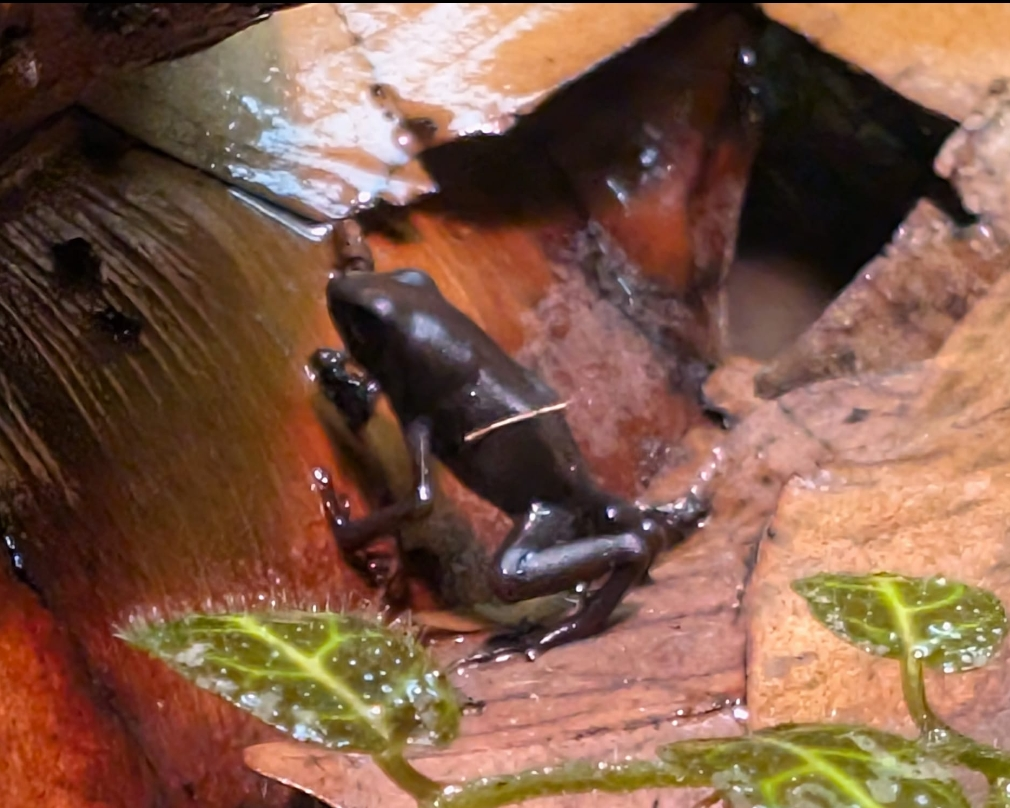
Table of contents
- Quick read: the Frogfather stance in 90 seconds
- Melanism, morphs, and what people actually mean
- Why darker frogs can appear naturally
- Why it’s rare in the wild (and why captivity reveals it)
- The ethical line: natural variant vs manufactured morph
- Frogfather’s position (and why)
- What to do if you get a “different” frog
- The real danger: incentives and monetising oddities
- Supporting guides (internal links that matter)
- FAQ
- FAQ Schema (JSON-LD)
- CSV tags
Quick read: the Frogfather stance in 90 seconds
Some dart frogs will occasionally show unusual pigmentation — darker tones, reduced contrast, muted patterning. The correct term is usually melanistic (increased melanin expression). That alone does not mean someone has created a “morph”.
In the wild, unusual colouration is often selected against because dart frog colour is part of the warning signal. In captivity, that survival filter disappears, so traits that might never persist in nature can occasionally show up and survive.
Here’s the ethical line as we see it: natural variation happens. The responsibility is what you do next. If someone deliberately pairs animals to lock in novelty traits and markets it as premium, that’s selective breeding for appearance — and it can reduce genetic diversity and shift priorities away from welfare.
If you want our wider framework on this (and the stuff that keeps the conversation honest), start here: Genetics & selective breeding: a responsible keeper’s guide and The UK legal, ethical & welfare framework.
Melanism, morphs, and what people actually mean
Melanism (melanistic)
People often say “melaganistic” — the correct term is melanistic. Melanism is an increased expression of melanin, the pigment responsible for black and dark brown colouration.
In dart frogs, melanism (or unusually heavy dark pigment expression) may show as:
- Darker base tones than expected
- Muted contrast (patterns look “soft” or subdued)
- Less “warning pop” in the overall look
- A frog that looks almost black in certain lighting conditions
What a “morph” actually implies
In hobby language, “morph” often gets used to mean “anything that looks different”. But in practice, a morph usually implies the trait is intentionally reproduced and stabilised by pairing animals to reinforce that look.
A one-off dark frog is usually better described as a natural variant unless there is clear evidence of deliberate selection.
If you want a broader grounding in dart frog colour, toxicity myths, and how reality differs in UK captivity, you’ll probably enjoy: Are blue frogs poisonous? Myths vs UK captive reality and Poison arrow frogs: history, toxicity, and modern care.
Why darker frogs can appear naturally
Even within locality-responsible lines, not every animal expresses genes the same way. Genetics are not a photocopier. They’re a set of instructions that can be read slightly differently depending on combinations, expression, and chance.
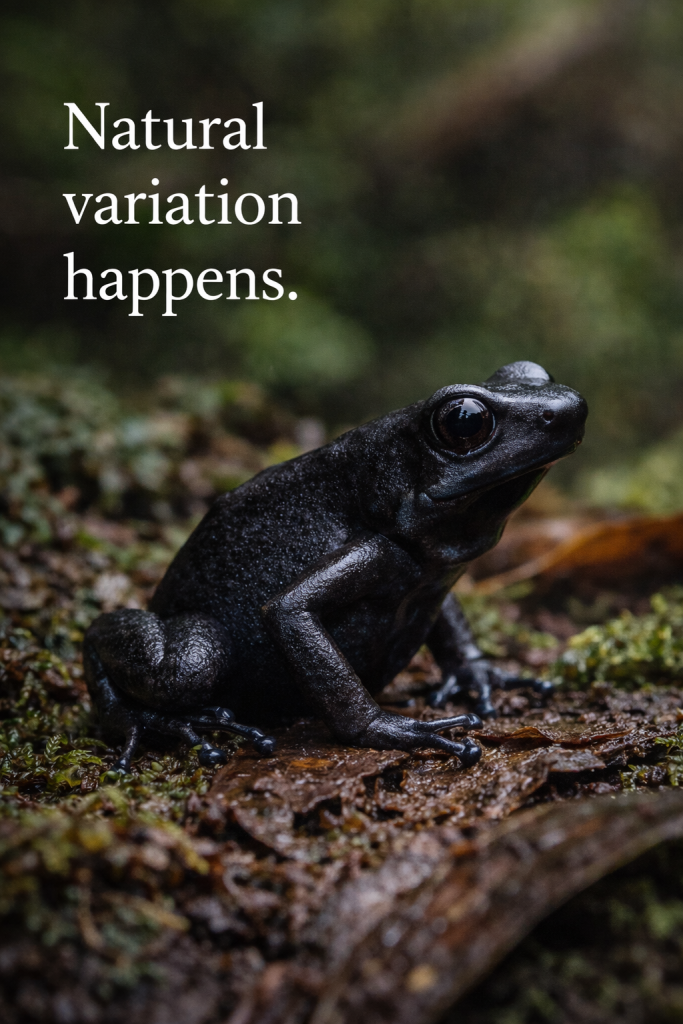
In practical terms, you may see variation in:
- Saturation (how “bright” the colours appear)
- Contrast (how sharply patterns stand out)
- Pattern edges (crisp vs blurred)
- Overall darkness (more melanin expressed)
And crucially: husbandry can mimic genetics. A frog that is stressed, dehydrated, under-lit, poorly supplemented, or constantly disturbed may look duller and darker than it “should”. That’s why this topic always has to be paired with husbandry basics — otherwise people mistake conditions for genetics.
If you suspect your frog looks unusually dark, sanity-check these first: humidity levels, lighting setup, and feeding & nutrition.
Why it’s rare in the wild (and why captivity reveals it)
Dart frog colouration isn’t “just pretty” — it’s a survival tool. Bright colour is part of the warning system (aposematism): it tells predators the animal is toxic or unpleasant.
A darker or muted individual may:
- Advertise that warning signal less clearly
- Blend in like ordinary prey
- Lose some of the “leave me alone” effect the bright animals benefit from
That means a very dark individual is more likely to be eaten before it reproduces, so the trait is often selected against in nature. Captivity removes that filter. The genetics don’t appear because of captivity — they’re just no longer instantly punished by survival.
This is also why we bang on about building stable systems (not just pretty boxes). If you want the deeper science-y side of bioactive stability, you’ll like: substrate microbiome, microfauna deep dive, and water quality & chemistry.
The ethical line: natural variant vs manufactured morph
This is the centre of the whole conversation. The existence of a dark frog isn’t the ethical problem. The ethical problem is what happens after.
A natural variant
- Appears spontaneously
- Is not intentionally paired to reproduce the trait
- Is treated as “interesting biology”, not a product strategy
- Is not marketed as premium novelty
A selectively bred morph
- Is intentionally paired to amplify a trait
- Is reinforced generation after generation
- Often narrows genetics to “lock in” a look
- Usually becomes a marketing angle
Our stance is straightforward: observing natural variation is unavoidable. Manufacturing it deliberately is a choice.
If you want the full responsible-breeding breakdown (in plain English, UK context), this is the companion cornerstone: Genetics & selective breeding of dart frogs: responsible keeper’s guide.
Frogfather’s position (and why)
Selective breeding isn’t automatically evil. But it always creates incentives — and incentives shape behaviour. In dart frogs, appearance-first breeding can lead to:
- Reduced genetic diversity over time
- Higher risk of deformities persisting
- Behavioural changes
- Lower resilience to stress and disease
Dart frogs are behaviour-rich amphibians with specialist needs. We prioritise:
- Robust health over novelty
- Natural behaviour over “designer looks”
- Stable systems over hype
- Long-term sustainability over quick wins
That philosophy shows up in how we build and feed too. If you want to see what we mean by “system first”, these are relevant: ultimate guide to building a bioactive vivarium, UK vivarium setup guide (2025 edition), and dart frog diseases & parasites (UK guide).
What to do if you get a “different” frog
Sometimes a frog appears with unusual pigment expression. That animal still exists — and pretending it doesn’t doesn’t help anyone. The responsibility is what you do next.
- Rule out husbandry first.
Stress, dehydration, weak lighting, poor gut-loading, and inconsistent supplementation can all make frogs look darker or duller. Use these baselines: lighting, humidity, nutrition & supplementation. - Don’t label it a morph just because it’s different.
“Morph” implies intentional reproduction and stabilisation. A one-off variant is not a morph. - Don’t chase novelty.
If the community starts treating genetic oddities like trading cards, the animals lose. - Build stability into the system.
Microfauna, plants, leaf litter, and a consistent routine do more for your frogs than any trend. If you’re missing the foundations, start here: springtails for dart frogs and plants for a thriving dart frog habitat.
And if you’re looking at your routine thinking “I want this idiot-proof”, we’ve built tools for that — without pretending products replace husbandry. Relevant examples (optional, but genuinely useful): All-in-1 Vitamin & Mineral Dust, Fruit Fly Feast, and Springtail Supermix.
The real danger: incentives and monetising oddities
The biggest ethical risk isn’t the existence of a dark frog. It’s the incentive structure that forms when unusual traits become premium, marketable, or status-driven.
When novelty becomes the goal, you often see:
- Narrowing genetics to chase a look
- Secrecy replacing transparency
- Welfare becoming “secondary”
- Animals treated as collectibles first, living beings second
This is why our ethics content exists alongside practical welfare guidance: legal, ethical & welfare framework (UK).
If you want the calm, grown-up version of “what matters”, this is a good companion read: environmental enrichment & natural behaviours.
Supporting guides (the internal links that actually help)
This topic gets messy because people skip the foundations. If you want the wider “ecosystem” around this article, these are the best internal routes:
- Genetics & selective breeding (responsible UK guide)
- UK legal / ethical / welfare framework
- How to successfully breed dart frogs (comprehensive guide)
- Dart frog care sheet (core care)
- Dart frog nutrition & supplementation (UK guide)
- UVB lighting: myth vs science (and do dart frogs need UVB?)
- Best lighting setup for a dart frog bioactive vivarium
- Everything you need to know about springtails
- Microfauna deep dive
Optional “support tools” that map cleanly to this discussion (not mandatory, just genuinely aligned): Bioactive Cleanupcrew, Bioactive Vivarium Kits, Dart Frog Clay Bath.
FAQ: Melanistic dart frogs, morphs, and selective breeding
Are melanistic dart frogs real?
Yes. Melanism is a naturally occurring genetic trait that can appear in dart frogs, though it’s uncommon and often selected against in the wild.
Does a very dark frog automatically mean selective breeding happened?
No. Natural variation exists — and husbandry can also change how colour presents. Rule out lighting, stress, hydration and nutrition before assuming genetics.
Is a one-off dark frog a “morph”?
Not automatically. In practice, “morph” implies intentional reproduction and stabilisation of the trait through selective pairing. A spontaneous one-off is better described as a natural variant unless there’s clear evidence otherwise.
Is melanism harmful to the frog?
The pigment itself isn’t inherently harmful. The risk is what humans do with it — narrowing genetics, chasing novelty, and prioritising market value over welfare.
Do melanistic dart frogs exist in the wild?
They may appear sporadically, but often don’t persist because warning colouration is part of dart frog survival strategy.
Is selective breeding always unethical?
Not universally, but appearance-driven line-breeding in dart frogs raises real concerns around genetic diversity, resilience, and welfare incentives. For the full UK framing, see: legal / ethical / welfare framework.
If this article made you rethink the “morph” conversation, you’ll probably get a lot out of: the responsible genetics & selective breeding guide and the UK legal/ethical/welfare framework.