Can You Add a New Dart Frog to an Established Pair or Group?
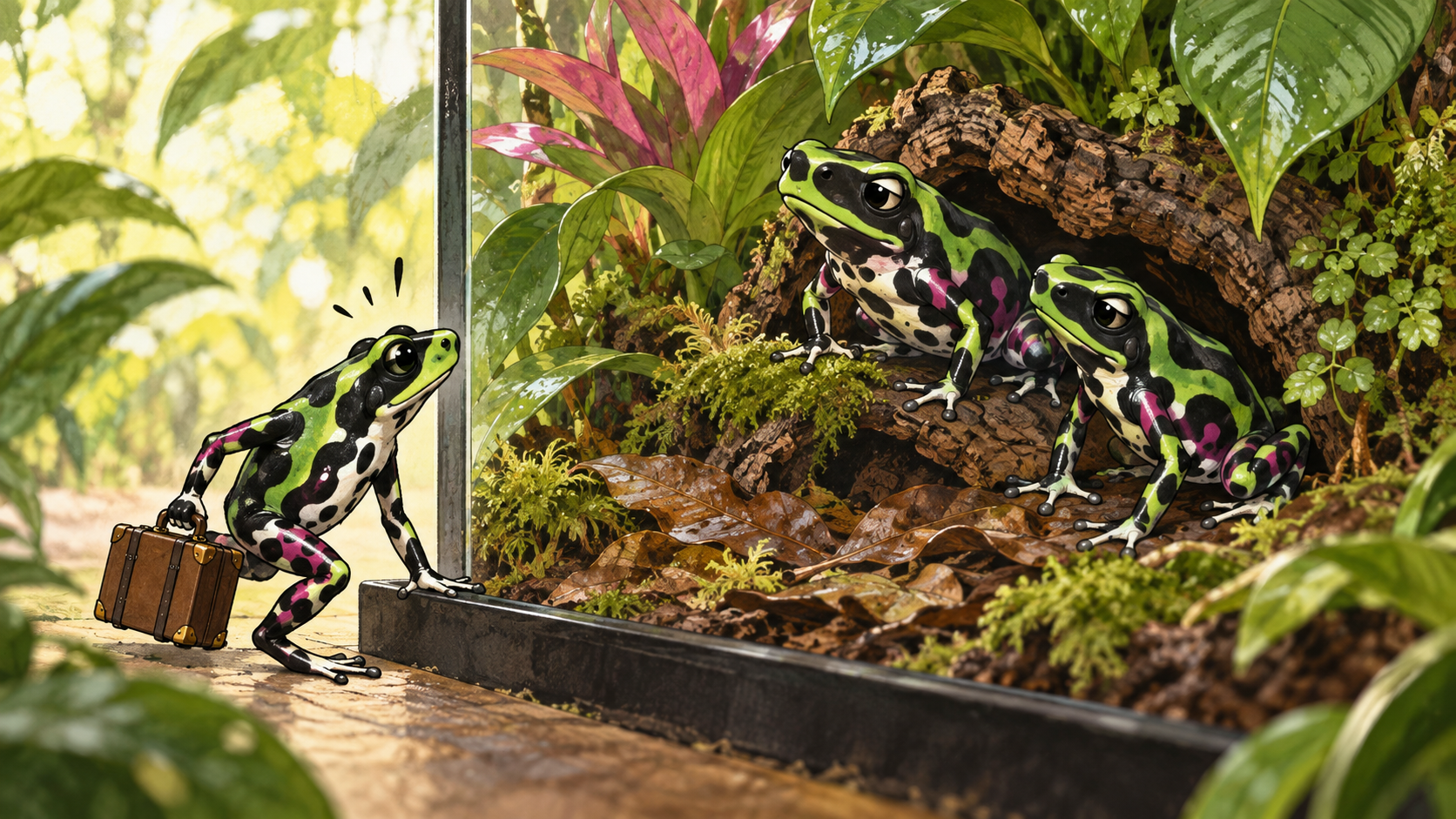
Your established frogs appear settled. They feed confidently, use the whole vivarium and perhaps breed regularly. Then another frog of the same species becomes available. Can you complete the group by placing it into the existing enclosure?
Sometimes an introduction can succeed. It can also introduce disease, disrupt established territories, create an unsafe sex ratio or turn a previously stable arrangement into months of subtle competition. The fact that there is physical space for another frog does not mean there is socially usable space.
The safest starting question is not “How do I introduce it?” It is “Is there a defensible welfare reason to attempt this—and can I house every frog properly if it fails?”
Should another dart frog be added at all?
An established social arrangement has value precisely because it is predictable. The frogs have feeding routes, retreat sites and boundaries. Adding another animal exchanges that known stability for an uncertain outcome.
A proposed introduction needs more than a decorative reason. Potentially defensible reasons include establishing an appropriate breeding pair, rebuilding a species-appropriate group after careful planning or giving a compatible animal a suitable long-term home. “The tank can fit one more” is not enough.
A lone frog is not automatically lonely
Dart-frog social systems vary. Some species form important pair relationships; others interact primarily through courtship, parental behaviour, territoriality or periodic contact. A single frog can live well without an arbitrary companion. Read whether dart frogs get lonely before treating another animal as enrichment.
A stable pair is not an incomplete trio
A compatible male–female pair may already represent the safest arrangement for a territorial species. A third frog can become a reproductive rival or the target of both residents. This is particularly important with many Dendrobates tinctorius localities, where same-sex aggression and prolonged wrestling can be severe.
Do not buy first and work out compatibility later
The new frog needs suitable housing from the day it arrives. Quarantine is not optional waiting time, and the existing vivarium is not guaranteed to become its home. If there is no room or budget for a permanent second setup, the introduction plan is incomplete.
Check species, locality, sex, age and size
“Another dart frog” is not a compatibility description. Before purchase or transfer, document exactly what the animal is and what is known about it.
Species must match the planned social system
Do not add a different species to provide company or colour contrast. Mixed-species displays create mismatched behaviour, disease pathways, feeding competition and possible hybridisation. The guide to why mixing dart frog species usually fails explains the wider risks.
Preserve locality and lineage integrity
Two frogs sharing a species name may represent different localities or established captive lines. Mixing them can erase provenance and produce offspring that cannot responsibly be represented as either locality. Ask for the exact name, source and history; do not infer identity from colour alone.
Sex changes the risk
A third female may create intense female–female competition in some Dendrobates; another male may contest calling sites; a single female may receive excessive reproductive attention in another species. There is no universal ideal ratio for every dart frog.
Use the guide to sexing dart frogs, but label each conclusion honestly as confirmed, probable or unknown. Juveniles that coexist peacefully can change after maturity.
Age and size affect access and vulnerability
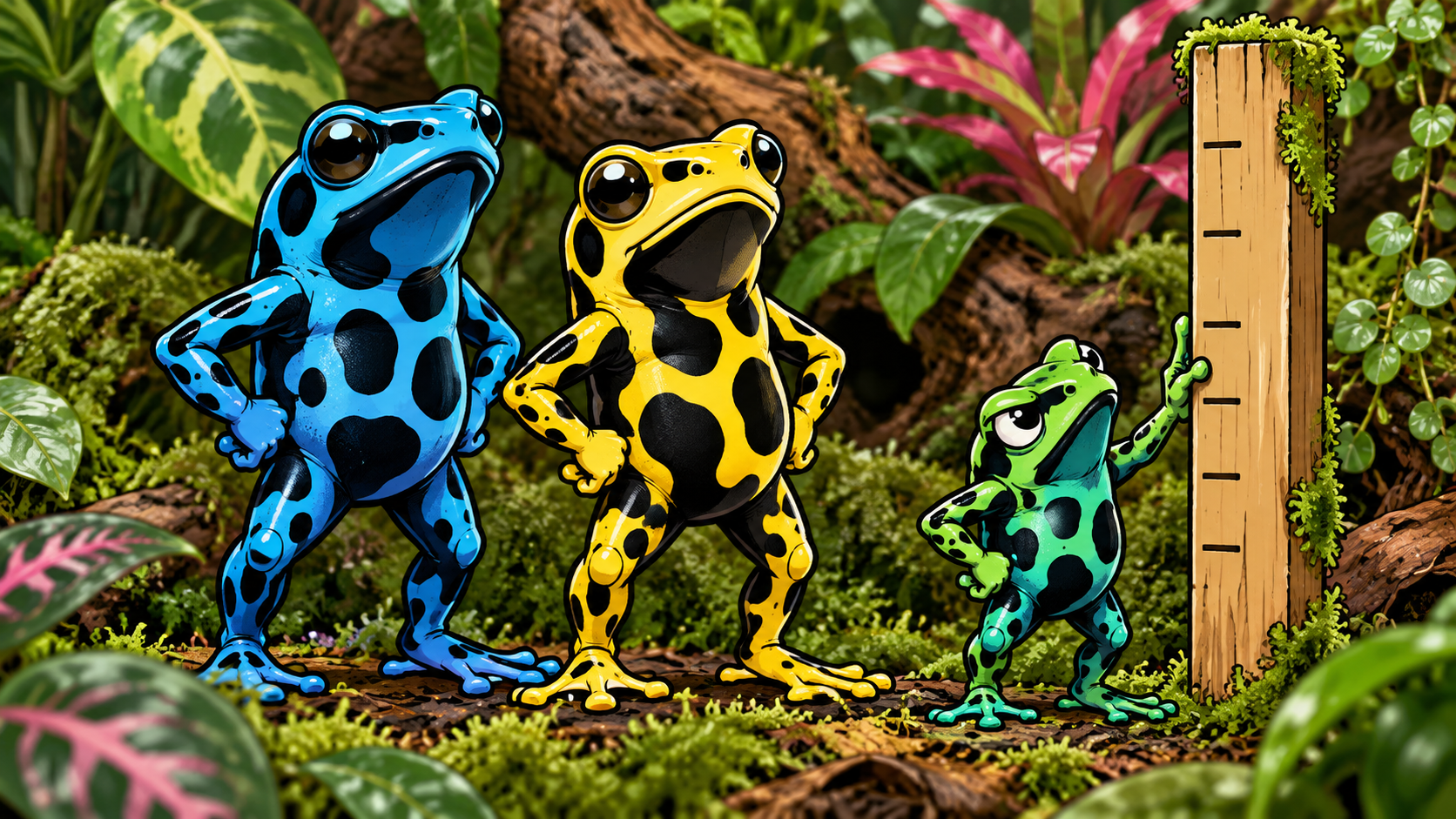
Do not place a tiny froglet with substantially larger adults simply because they share a name. The smaller animal may struggle with prey size, movement around the enclosure and competition. A larger newcomer is not automatically dominant, but a serious size mismatch makes monitoring and equal provision harder.
The article on why one dart frog may be smaller than its companions explains how feeding access and development can diverge without obvious fighting.
Quarantine must happen before social introduction
A bright, active frog can carry parasites or pathogens without displaying an obvious external sign. Direct introduction shares substrate, water films, feeding surfaces and every future tool used in the enclosure.
Quarantine gives you a controlled period to assess:
- appetite and successful prey capture;
- body condition and any measurable trend;
- droppings and whether diagnostic sampling is justified;
- skin, eyes, mouth, posture and movement;
- recovery after transport;
- possible sex or maturity clues; and
- whether the animal is suitable for introduction at all.
Follow the complete UK dart frog quarantine guide, including dedicated tools and appropriate separation. A few good meals do not replace a meaningful observation period.
Should you quarantine two new frogs together?
Housing new frogs together may make it impossible to attribute droppings, feeding or symptoms to one individual and can expose one arrival to the other. Individual quarantine provides the clearest health record. Any alternative should be a considered risk decision, not a space-saving default.
Does a negative faecal test guarantee safety?
No. Parasite shedding can be intermittent, methods differ and a faecal test does not screen for every pathogen. Interpret results with the source history, clinical picture and veterinary advice.
The established-territory problem
The residents know where to feed, hide, call and breed. A newcomer enters a landscape already mapped and potentially defended. In the wild, a losing frog may retreat beyond the resident’s territory. Glass prevents that final escape.
Research on poison frogs demonstrates strong resident responses to simulated and actual intruders. In a classic resident–intruder study involving a dart-poison frog, resident animals escalated to physical aggression in many contests. Modern work also shows that territorial aggressiveness can be a repeatable individual trait: two frogs of the same species need not respond identically.
Does rearranging the vivarium create neutral territory?
Rearranging major features can disrupt familiar routes and may reduce the resident’s immediate location advantage. It does not make incompatible frogs compatible, sterilise the enclosure or erase reproductive competition. The term “neutral territory” can overpromise what moving cork and leaves actually achieves.
Is a larger vivarium always safer?
More usable space can help, but dimensions alone are not enough. One frog may control the only dense shelter, feeding area, calling perch or route between levels. Structure must provide genuine alternatives and visual separation.
The guide to keeping dart frogs in groups covers how species, sex and enclosure design interact.
Prepare both the main enclosure and permanent backup housing
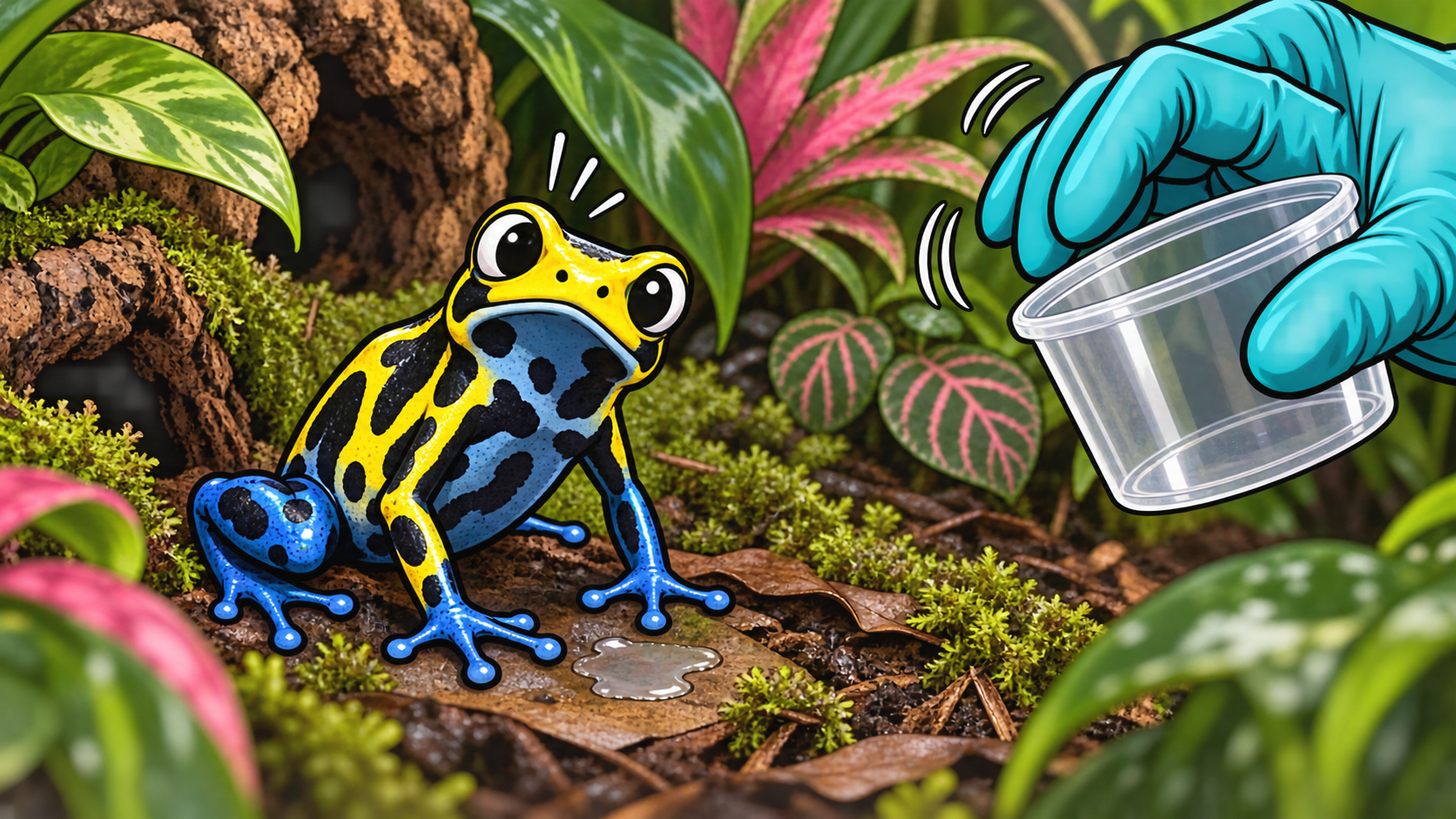
Never begin an introduction with nowhere suitable to put the newcomer that evening. A deli cup is transport equipment, not long-term separation housing.
Backup enclosure checklist
- secure, escape-proof enclosure of appropriate dimensions;
- stable temperature, moisture and ventilation;
- safe substrate or observation surface;
- cover, refuge and usable routes;
- independent feeding provision;
- dedicated or properly disinfected tools; and
- capacity to remain in use permanently.
Main enclosure checklist
- several separated feeding areas;
- multiple hides and visual barriers;
- more than one useful route between levels;
- several resting and calling positions where relevant;
- no narrow trap where one frog can pin another;
- healthy plants and leaf litter without eliminating visibility completely;
- stable environmental readings; and
- a way to identify and observe every frog.
Do not make major environmental corrections and introduce a frog on the same day unless an urgent welfare issue forces the change. Stability provides a clearer baseline.
How to attempt a dart frog introduction
No controlled study establishes one universally safest captive introduction technique for all dendrobatids. The following is a cautious husbandry process, not a guarantee.
- Complete quarantine. Resolve health concerns before social exposure.
- Confirm the proposed combination. Recheck species, locality, sex, maturity and size.
- Record a baseline. Photograph and note each frog’s condition, appetite and normal enclosure use.
- Prepare backup housing. It must be ready, warm enough and secure before the frogs meet.
- Improve resource distribution. Create several feeding points, refuges and routes that cannot all be controlled from one position.
- Consider a substantial rearrangement. If appropriate, alter familiar boundaries without destroying the bioactive system or creating instability.
- Introduce while you can observe. Do not add the frog immediately before leaving home, going to bed or starting a busy workday.
- Release at a sheltered accessible point. Avoid dropping the newcomer directly beside a resident, laying site or defended perch.
- Watch the complete sequence. Record approaches, calls, following, retreat, feeding and resting—not merely the first minute.
- Continue structured monitoring. First-day quietness does not prove long-term compatibility.
Should the frogs meet in a separate neutral tub first?
A brief meeting in a bare tub may expose frogs to stress while revealing little about competition inside the real enclosure. It also provides limited retreat and can encourage direct contact. For most keepers, careful introduction into a prepared long-term environment with immediate separation capacity is more informative than staging a forced encounter.
Should you use a clear divider?
A secure divider can sometimes allow visual or acoustic exposure, but it must prevent squeezing, climbing around the edge and shared-contamination problems. Seeing frogs through a barrier does not test resource access or prove that direct housing will succeed.
What should you monitor after introduction?
Compatibility is a pattern, not a photograph of frogs sitting together. Monitor every named or visually identifiable animal.
| Area | More reassuring | More concerning |
|---|---|---|
| Movement | Normal exploration with voluntary retreat | Relentless pursuit, cornering or frantic boundary climbing |
| Feeding | Every frog reaches and captures suitable prey | One animal waits, flees or repeatedly loses access |
| Resting | Several secure positions remain in use | One frog confined to an exposed or poor area |
| Contact | Brief investigation without escalation | Pinning, wrestling, mounting pressure or biting |
| Condition | Stable individual body shape over time | Weight loss or increasingly prominent pelvis |
| Behaviour | Normal species-typical routines resume | Persistent hiding, suppressed activity or escape behaviour |
| Skin and limbs | No damage | Abrasions, toe injury, redness or swelling |
How long until you know it worked?
There is no reliable universal number of hours or days. Some incompatibility appears immediately; other problems emerge around feeding, breeding, maturity or repeated access to a preferred site. Continue monitoring over weeks and revisit the arrangement when juveniles mature or seasons change.
Do eggs prove compatibility?
No. Reproduction proves that courtship and mating occurred. It does not prove that every frog in a trio or group has equal welfare, and competition may intensify around a breeding pair.
When should the frogs be separated?
Do not wait for blood. Separate when a repeated pattern shows that one frog cannot avoid another, use resources normally or maintain condition.
Act for:
- persistent chasing, pinning or wrestling;
- repeated displacement from food, shelter or breeding sites;
- frantic glass climbing or attempts to escape;
- one frog becoming unusually hidden or inactive;
- reduced feeding or a widening size and condition difference;
- skin, limb or eye injury;
- abnormal posture or weakness; or
- any health concern that requires individual observation.
The guide to fighting versus mating behaviour can help interpret wrestling and pinning, but uncertainty is not a reason to leave a vulnerable animal exposed.
Can they be tried together again?
Sometimes keepers retry after changing structure, sex ratio or maturity, but a serious or repeated conflict is strong evidence that the combination is unsuitable. Permanent individual or pair housing is preferable to repeated cycles of stress.
Common introduction scenarios
| Proposed change | Risk assessment | Cautious position |
|---|---|---|
| Add a second frog to a confirmed solitary adult | Depends strongly on species, sex and history | Research the exact combination; quarantine and keep permanent backup housing |
| Add a third D. tinctorius to a stable pair | High potential for same-sex or reproductive competition | Usually preserve the stable pair rather than forcing a trio |
| Add a juvenile to adults | Sex uncertain and size/access mismatch possible | Grow and assess separately until compatibility can be judged better |
| Combine two groups of a group-tolerant species | More individuals and established social histories increase complexity | Do not rely on species reputation; plan individual monitoring and separation |
| Add a different species | Disease, behavioural mismatch and hybridisation risk | Use a separate species-appropriate enclosure |
| Replace a deceased partner immediately | Cause of death may be unresolved; new frog is exposed | Investigate, stabilise and quarantine before considering another animal |
| Add a frog because the tank looks empty | Display preference provides no welfare benefit | Do not disturb a stable arrangement for appearance |
Evidence and limitations
Poison-frog research clearly documents territoriality, individual variation in aggression, resident responses to intruders and sex-specific competition. It does not provide a single tested captive-introduction recipe covering every species and enclosure.
- A resident–intruder study found that residents frequently escalated aggressive encounters to physical contact.
- Work on Allobates femoralis found moderate repeatability in territorial aggression, supporting the importance of individual temperament.
- Natural-history research on Dendrobates tinctorius documents chasing, wrestling and prolonged pressure during both male and female intrasexual aggression.
- Veterinary quarantine principles support separation, monitoring and biosecurity before animals share an enclosure.
The practical protocol in this article combines those findings with cautious captive husbandry. It should be adapted to the exact species, sex and animals—not treated as a guarantee that an introduction will work.
Research and veterinary references:
- Chaloupka and colleagues: repeatable territorial aggression in a Neotropical poison frog.
- Rojas and colleagues: natural history and intrasexual aggression in Dendrobates tinctorius.
- Baugh and Forester: prior residence effect in a dart-poison frog.
- Merck Veterinary Manual: clinical techniques and examination in amphibians.
Frequently asked questions
Can I add a new dart frog directly to my existing vivarium?
No. A new frog should first be correctly identified, assessed for compatibility and kept in proper quarantine. Direct introduction risks spreading disease and gives you no controlled baseline for its appetite, droppings, condition or behaviour.
Can I add a third dart frog to an established pair?
Sometimes species-specific group housing is possible, but a stable pair is not automatically improved by becoming a trio. In territorial species, the third frog may create same-sex or reproductive competition. Preserve a successful pair unless there is a sound, researched reason to change it.
How long should a new dart frog be quarantined?
Frogfather uses 30 days as a practical minimum and often targets six to eight weeks where collection risk is higher. Duration should reflect source history, symptoms, testing, veterinary advice and the value of the collection rather than convenience.
Should I rearrange the vivarium before adding a frog?
A substantial rearrangement may disrupt familiar boundaries and improve resource distribution, but it cannot make incompatible frogs compatible. Maintain environmental stability, create several feeding and refuge areas and keep backup housing ready.
How do I know whether the residents accept the new frog?
Look for a stable pattern in which every identifiable frog feeds, retreats, rests and moves normally. Brief proximity does not prove acceptance. Persistent pursuit, pinning, exclusion, escape behaviour or declining condition indicates that the arrangement is failing.
How long should I monitor a dart frog introduction?
Monitor closely during the initial introduction and continue structured individual observation over subsequent weeks. Some conflict appears immediately, while other competition emerges around feeding, breeding, maturity or preferred sites.
Can I introduce dart frogs of different sizes?
A substantial size difference makes prey choice, competition and individual monitoring harder. Grow small juveniles separately where necessary and do not assume that sharing a species name makes a tiny froglet safe with mature adults.
What should I do if the introduction fails?
Separate the frogs into suitable prepared housing before condition or injury worsens. Review sex, maturity, enclosure structure and the behaviour observed. Permanent separation is a successful welfare decision, not a failed attempt that must be repeated.