Why Did My Dart Frog Wee When I Picked It Up? Defensive Urination and Safe Handling
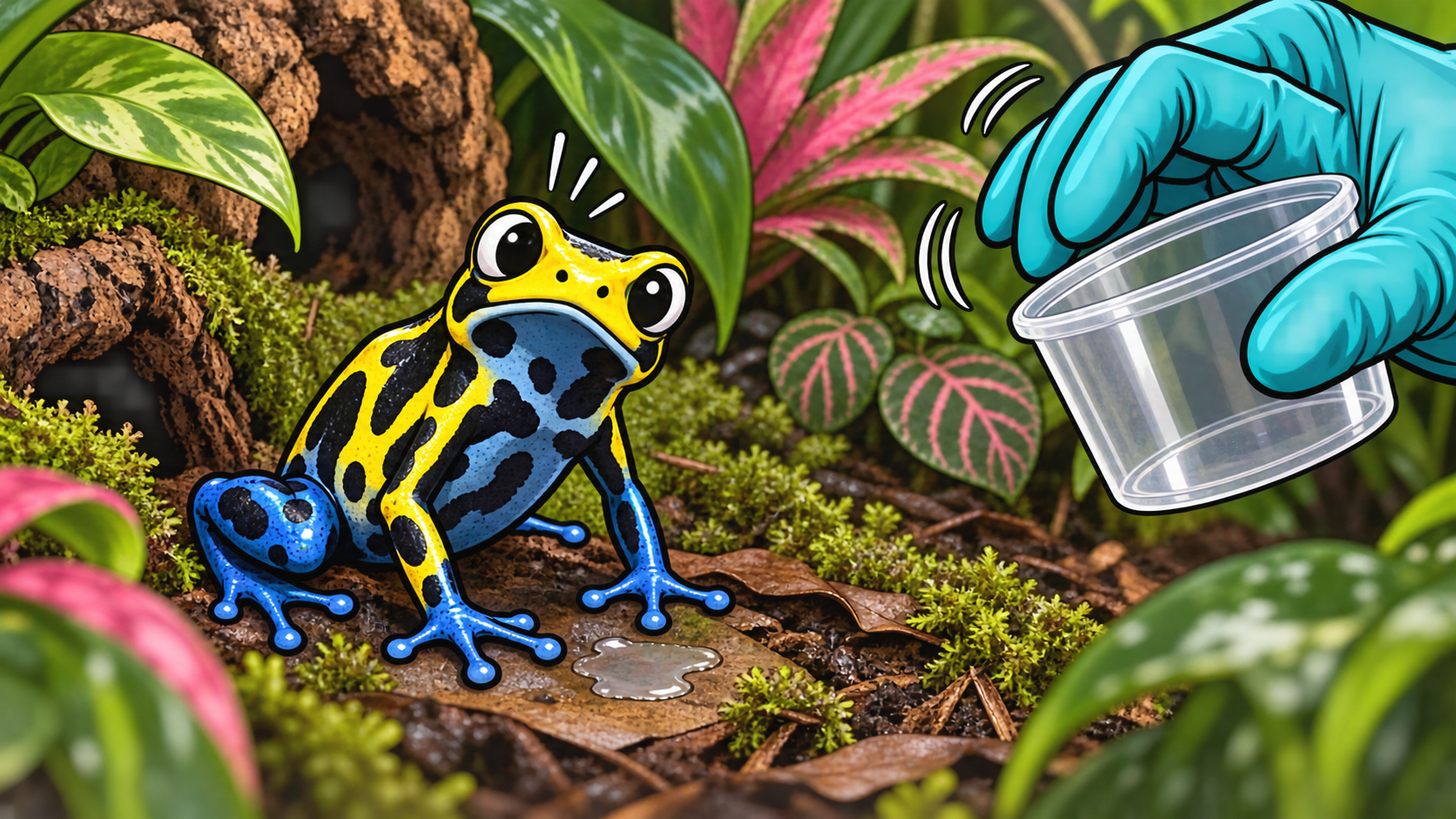
You catch a dart frog during a necessary transfer and suddenly your glove—or the bottom of the catch cup—is wet. It can look as though the frog has emptied an astonishing amount of urine for such a tiny animal. Did fear cause it? Is the frog dehydrated now? Does it indicate a kidney problem?
Frogs of many species release urine or stored bladder fluid when captured or restrained. This can make the animal slippery, unpleasant to hold and more likely to be dropped by a predator. In a captive dart frog, a one-off release at the moment of capture is usually best interpreted as a response to unwanted handling.
That does not make every unexplained pool of liquid normal. Fluid repeatedly appearing beneath an unhandled frog, abnormal material from the cloaca, swelling, straining, weakness or a change in behaviour requires a different assessment.
What probably happened when the frog became wet?
Urine travels from a frog’s kidneys through the ureters, reaches the cloaca and can be stored in a highly distensible urinary bladder. When the animal is captured, compression, movement and a defensive response may cause this fluid to be expelled through the cloacal opening.
Veterinary guidance explicitly notes that some anurans urinate when first restrained and that this can provide a urine sample. That makes the timing particularly useful: fluid released at the precise moment a frog is caught has a straightforward explanation.
Keepers often call the liquid “wee”, which is reasonable everyday language. However, from a photograph alone it may be impossible to determine whether every drop was bladder urine, water already present on the frog or fluid from the wet transfer surface. The practical interpretation comes from the sequence rather than attempting kitchen-table fluid analysis.
Is the frog doing it deliberately?
“Deliberately” can imply human planning. The safer description is that urination or bladder emptying is part of an established defensive repertoire in many frogs. Natural selection can favour a response that makes a restrained animal slippery or distasteful and creates an opportunity to escape.
The frog does not need to understand your intention. A gentle keeper moving it to a clean enclosure and a predator gripping it are both episodes of capture from the frog’s perspective.
Does it mean the frog hates you?
No human emotional conclusion is needed. It does mean the restraint was aversive enough to produce a defensive response. Treat that as useful feedback: improve the transfer method and minimise future contact.
Why urination can work as a defence
A small frog has limited options after a much larger animal closes around it. It can struggle, vocalise, inflate, secrete defensive substances, feign death or release urine and faeces, depending on species and circumstances.
Sudden fluid release may help in several ways:
- making the frog and the captor’s grip wetter and less secure;
- creating an unpleasant sensory surprise;
- encouraging a predator to loosen its mouth or grasp;
- combining with struggling to create a brief escape opportunity; and
- reducing carried mass before a rapid jump, although this should not be assumed to be the sole function.
A wild predator that drops a frog for one second may lose its meal. Unfortunately, a keeper standing over a hard floor can also drop the frog. This is one reason direct hand capture is a poor default even when the keeper is not worried about being bitten.
Are captive-bred dart frogs still defensive?
Yes. Captive breeding removes the dietary alkaloid exposure responsible for the potent chemical defences associated with some wild poison frogs; it does not remove basic escape and restraint responses. A captive-bred frog can be habituated to routine activity around its vivarium while still reacting strongly when physically caught.
The guide to dart frog bites, toxicity and safe handling explains why the animal is usually at greater risk during contact than the keeper.
A frog’s bladder is also part of its water-balance system
The amphibian urinary bladder is not merely a waste bag waiting to be emptied. In many terrestrial frogs it can act as a reservoir from which water is reabsorbed when conditions become dry. Research on amphibian water economy describes bladder water as an important reserve.
This helps explain how a small frog can release a volume that appears surprisingly large. The bladder can be highly distensible relative to the animal’s size, and amphibian urine is often dilute.
Does releasing urine mean the vivarium was too wet?
No. A frog being able to empty its bladder does not diagnose excessive misting or a waterlogged enclosure. Assess drainage, surface moisture, airflow and behaviour directly rather than using one handling response as a humidity meter.
Does it prove the frog was well hydrated?
It shows that fluid was available to release, but it does not establish ideal hydration or husbandry. Frogs regulate water through permeable skin, kidneys and bladder function. The Frogfather guide to how dart frogs absorb water through their skin explains why access to appropriate damp surfaces matters.
Will a dart frog become dehydrated after defensive urination?
One release during a brief transfer does not automatically create a dehydration emergency. A healthy frog returned promptly to a stable, appropriately moist vivarium can regulate its water balance without being chased into a bath.
The sensible response is to reduce further stress and confirm that normal hydration opportunities remain available:
- clean, damp leaf litter and suitable contact surfaces;
- species-appropriate misting without flooding;
- working drainage and ventilation;
- safe water without harmful residues; and
- a stable temperature that does not accelerate water loss.
Do not pour water over a stressed frog, confine it in deep water or add unmeasured salt and electrolyte mixtures. The correct intervention for genuine dehydration depends on severity and cause.
When does fluid loss deserve more concern?
Concern rises when handling has been prolonged, the frog has been loose in a dry room, the enclosure is overheated, the animal already appears weak or abnormal fluid loss continues. Use the article on dart frogs sitting in water to assess hydration-seeking behaviour in context.
One-off defensive urination or a warning sign?
| More consistent with restraint response | Needs closer investigation |
|---|---|
| Fluid released as the frog is caught or first restrained | Wetness or discharge appears repeatedly without handling |
| Clear or pale dilute-looking fluid | Blood, pus-like material, unusual colour or strong abnormal odour |
| Single event that stops after release | Continued dripping, repeated straining or frequent cloacal attention |
| Frog resumes normal posture and movement after settling | Weakness, collapse, abnormal posture or poor coordination |
| Normal appetite and body condition | Reduced feeding, weight loss or declining condition |
| No swelling or tissue protruding from the vent | Abdominal swelling, cloacal inflammation or prolapse |
| Clear trigger: necessary capture or transfer | No clear trigger or a worsening pattern |
A wet patch on paper towel may also be misting water, water carried on the animal or liquid from a recently cleaned container. Do not diagnose urinary disease simply because a small pool is present.
What if the frog defaecates too?
Defaecation can also occur during stress or handling. Record what happened, clean the equipment and avoid unnecessary repeat capture. If droppings remain persistently abnormal outside the event, the guide to dart frog droppings and faecal testing explains sensible sample collection and interpretation.
What if there is blood?
Blood is not a normal “fright wee”. It may originate from the urinary, reproductive or gastrointestinal tract, the cloaca or an injury. Photograph the fluid and the frog without prolonging handling, isolate appropriately for observation and contact an amphibian-experienced veterinary practice promptly.
If isolation is required, follow the dart frog quarantine guide so that monitoring does not create additional cross-contamination risk.
What should you do immediately afterwards?
- Prevent a fall. Lower the frog and your hand or cup towards the prepared container rather than reacting suddenly.
- Complete the transfer. Do not prolong restraint to inspect the frog from every angle.
- Check the toes before closing. Ensure no limb is trapped beneath a lid or cup edge.
- Return it to stable conditions. Provide cover and allow the frog to leave the cup voluntarily where possible.
- Observe from outside. Check posture, movement and recovery without catching it again.
- Record anything unusual. Note why it was handled, how long restraint lasted and whether the fluid looked abnormal.
- Clean and change equipment. Prevent transfer of biological material between enclosures.
Should you mist the frog immediately?
Not merely because it urinated. If the destination enclosure is already correctly prepared, return the frog and maintain the normal environment. Directly spraying a just-released animal can trigger more escape behaviour and does not provide a measured assessment of hydration.
Should you offer food?
You can resume the normal feeding routine once the animal has settled. Do not expect immediate hunting after a stressful transfer, and do not flood the enclosure with flies as reassurance. Persistent appetite loss is more meaningful than refusing food during the first quiet period.
How to move a dart frog without picking it up
A transparent catch cup is usually safer than a hand. It limits skin contact, reduces squeezing and contains the frog if it jumps or releases fluid.
- Prepare the destination completely. Open lids, clear the route and remove distractions before disturbing the frog.
- Work low and within a secure area. Close doors, block gaps and avoid transfers above hard floors.
- Place the clear cup gently over or in front of the frog. Never bring the rim down across toes.
- Guide rather than chase. Use the cup, lid or a clean soft barrier to encourage one controlled movement.
- Slide the lid carefully into place. Visually confirm that every limb is clear.
- Keep the cup upright and shaded. Avoid standing water and temperature extremes.
- Release at substrate level. Let the frog leave rather than shaking or pulling it out.
For longer journeys, follow the UK guide to moving and transporting dart frogs.
When is direct handling justified?
Direct restraint may be necessary during a veterinary examination, emergency rescue, health assessment or when cup transfer cannot be completed safely. “I wanted to hold it” is not a welfare justification.
Where direct contact is genuinely necessary, veterinary guidance favours moistened, powder-free gloves and minimal restraint. Prepare everything first so contact lasts seconds rather than minutes.
Can wet bare hands be used?
Wet hands reduce dryness but do not eliminate salts, oils, soap, sanitiser, nicotine, cosmetics, cleaning chemicals, pathogens or heat transfer. A cup is the first choice and suitable clean gloves are the safer backup.
Hygiene after a dart frog urinates during handling
Captive-bred dart frogs maintained on cultured feeders are not expected to possess the potent wild dietary alkaloid load associated with their common name. That does not make urine, faeces or enclosure water something to ignore.
After the transfer:
- remove and discard single-use gloves appropriately;
- wash hands thoroughly with soap and water;
- clean and disinfect reusable equipment with an amphibian-appropriate process;
- rinse where the chosen disinfectant requires it and allow equipment to dry;
- avoid touching your eyes, mouth or food during the task; and
- never reuse the same unclean cup or gloves between vivariums.
The Frogfather handling, hygiene and biosecurity lesson covers the collection-level risks.
After the animal has settled, assess its normal appetite, posture and activity rather than judging the handling event alone. The guide to whether a dart frog is thriving rather than merely surviving provides a broader welfare checklist.
Is frog urine dangerous to people?
A one-off splash of urine from a captive dart frog is not generally treated as a poisoning emergency. Ordinary hygiene is appropriate. Rinse exposed skin, wash your hands and flush eyes with clean water if splashed. Seek medical advice for eye symptoms, broken-skin exposure, signs of infection or any individual health concern.
What does the evidence show?
Several evidence streams support the practical interpretation, but they should not be stretched beyond what was studied:
- Reviews of anuran defensive behaviour include urine or cloacal discharge among responses used during capture or restraint.
- Veterinary guidance notes that some anurans urinate when initially restrained and that the sample may be collected for analysis.
- Experimental endocrine studies show that capture and handling can activate measurable stress responses in amphibians.
- Physiological research describes the urinary bladder as a water reservoir from which terrestrial amphibians may reabsorb water.
Much of this evidence involves anurans other than captive dendrobatids. It supports a biologically reasonable explanation for a dart frog releasing fluid during capture, but it does not establish how often every dart-frog species performs the behaviour or allow disease to be excluded when other signs are present.
Research and veterinary references:
Frequently asked questions
Why did my dart frog wee when I picked it up?
Capture and restraint can trigger urination or release of stored bladder fluid. This may make a frog slippery and encourage a predator—or surprised keeper—to loosen its grip. A single release at the moment of handling does not by itself prove illness.
Does defensive urination mean my dart frog is terrified?
It shows that the frog responded defensively to capture, but it does not provide a precise measurement of fear. Treat it as evidence that handling was unwelcome and use a catch cup with less restraint next time.
Will my dart frog become dehydrated after weeing?
One release during a brief transfer does not automatically cause dangerous dehydration. Return the frog promptly to a stable enclosure with appropriate damp surfaces and monitor it. Do not force soaking or add electrolytes without veterinary direction.
Should I wash my hands if a dart frog wees on me?
Yes. Rinse exposed skin and wash your hands thoroughly with soap and water. Avoid touching your eyes or mouth during animal care, and seek medical advice if fluid contacts an eye, broken skin or causes persistent symptoms.
Is dart frog urine poisonous?
Urine is not the source of the potent dietary skin alkaloids associated with wild poison frogs. Nevertheless, treat all animal waste as biological material, use ordinary hygiene and avoid deliberate contact.
Should dart frogs ever be picked up by hand?
Routine handling should be avoided. Use a transparent catch cup for transfers whenever possible. Direct restraint should be brief and reserved for veterinary examination, emergency rescue or another genuine welfare need.
What if my dart frog is wet without being handled?
First exclude misting water, condensation and wet surfaces. Repeated unexplained fluid, abnormal cloacal discharge, blood, swelling, straining, weakness or declining appetite warrants isolation for observation and advice from an amphibian-experienced vet.
Can a dart frog also poo when frightened?
Yes, defaecation may occur during capture or restraint. Record the event and clean the equipment. Persistently abnormal droppings outside the handling episode should be assessed separately and may justify a properly collected faecal sample.