Written by The Frogfather | UK dart frog keeper, breeder and bioactive vivarium specialist | Published: 14 September 2026
Why Is One Dart Frog Smaller Than the Others? Normal Variation or a Warning Sign?
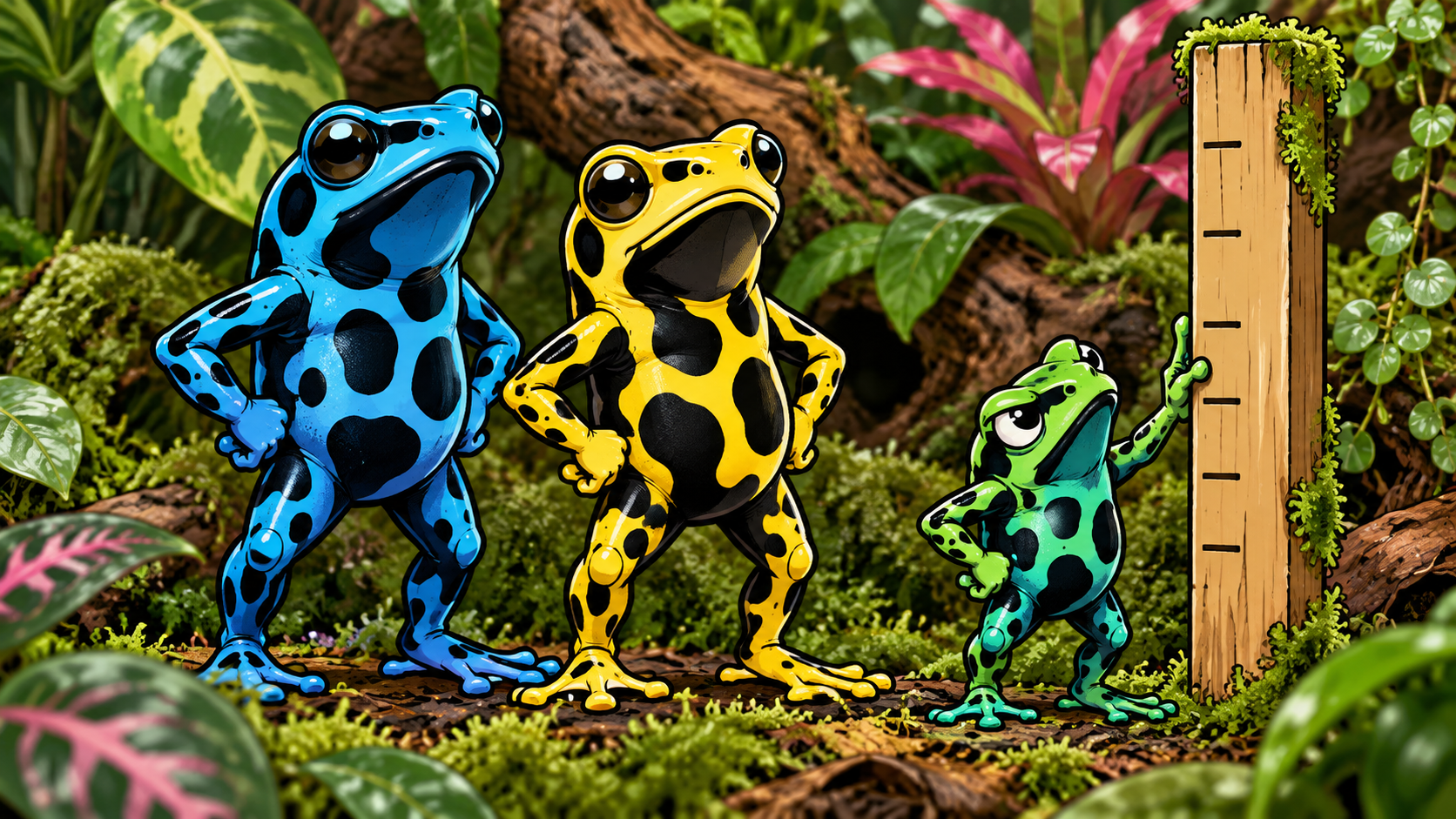
Two young dart frogs arrive at roughly the same size. A few months later, one looks broad and substantial while the other still appears noticeably smaller. Is the smaller frog simply male, younger or genetically petite—or is it losing access to food and quietly falling behind?
Size differences are common, but size alone is a poor diagnosis. Frogs of the same species can differ because of age, sex, developmental history and individual build. Captive companions sold together may not be siblings, may not have morphed together and may not have received equal nutrition before you acquired them.
The important distinction is between a small but stable, well-conditioned frog and a frog that is becoming thinner, growing more slowly or being progressively outcompeted. That requires repeated observation rather than one photograph.
First, separate body size from body condition
A small frog is not necessarily a thin frog. Body size describes the animal’s structural dimensions: its length, head width, limb proportions and overall frame. Body condition describes the soft tissue and muscle carried on that frame.
A naturally small adult can have excellent condition. Its body may look compact and well supported, its pelvis may not be sharply prominent, and its limbs may remain muscular. A larger frog can have poor condition if it has lost tissue from a bigger frame. Comparing length alone can therefore hide the more important change.
It is also easy to confuse posture with size. One frog may sit upright and appear short; another may stretch flat across a leaf and look considerably longer. Camera distance, lens distortion and the curve of the glass can exaggerate the difference.
Use the same viewing angle and the same familiar perch whenever possible. The Frogfather guide to weighing and monitoring dart frogs safely explains how repeatable photographs and occasional justified weights are more informative than frequent handling.
Ask whether the frog is small, thin or changing
| Observation | What it may mean | Best next check |
|---|---|---|
| Shorter or narrower, but well covered and stable | Age, sex or individual build may explain it | Compare dated photographs and feeding behaviour |
| Pelvic area becoming sharper | Loss of condition rather than merely small size | Review appetite, competition, droppings and weight trend |
| Same frame but abdomen temporarily less full | Recent feeding and defaecation can alter appearance | Compare at the same time of day across several days |
| Size gap steadily widening in juveniles | Different growth rate, intake or health requires investigation | Observe individual prey access and development over time |
| Sudden apparent shrinkage | A frog cannot structurally shrink overnight | Check posture, hydration, camera angle and genuine tissue loss |
Normal reasons one dart frog may be smaller
The frogs are not actually the same age
“Juvenile”, “young adult” and “holdback” are broad descriptions, not dates of birth. A few weeks or months can produce an obvious difference during early growth. Frogs bought together may have come from different clutches or morphed at different times.
Ask the breeder for morph dates where known. If exact dates are unavailable, treat age as uncertain rather than assuming the smaller frog has failed to grow.
Sexual size differences are emerging
In several poison-frog species, mature females tend to be larger or broader than males, although the degree and reliability of the difference vary. A pair of similar juveniles may diverge as they mature. Size can support a sex assessment, but it cannot confirm sex by itself.
Toe pads, body shape, calling, reproductive behaviour and species-specific patterns all contribute. Use the guide to sexing male and female dart frogs rather than labelling the smallest frog male automatically.
Individual and locality variation
Not every healthy animal reaches the same dimensions. Genetics, parental size and developmental history create individual variation. Different localities or morphs should not be compared against one generic “dart frog size” copied from a care sheet.
This is also why mixing localities to make up a size-matched group is inappropriate. Preserving identity and compatibility matters more than making the frogs look visually uniform.
One frog morphed smaller
Size at metamorphosis reflects larval growth and the resources available during development. A froglet that emerged smaller can remain behind a larger clutch-mate for some time without being ill. The relevant question is whether it continues to develop and maintains suitable condition after morphing.
Feeding competition and hidden social pressure
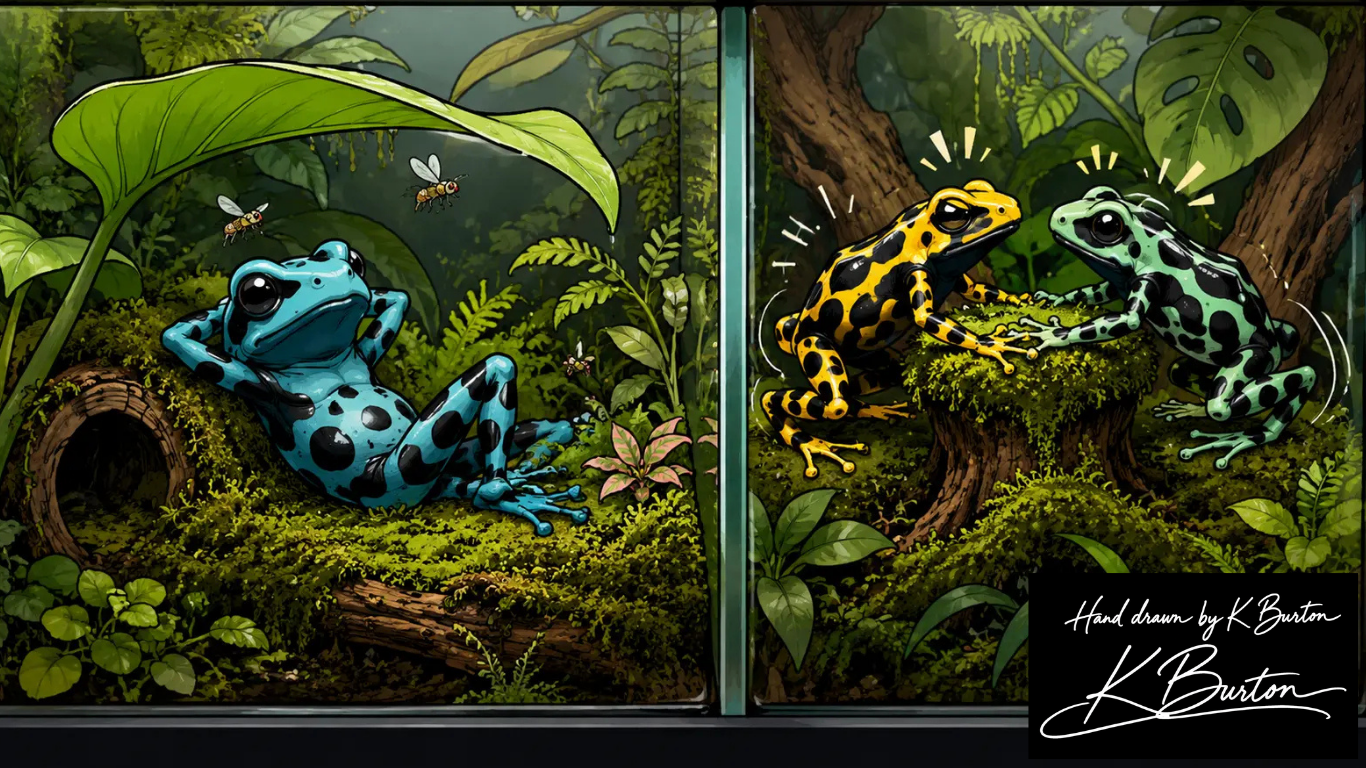
The commonest husbandry concern is not necessarily an obvious fight. It is unequal access.
One confident frog may reach the feeding point first, take the most visible flies and remain in the best hunting area. The smaller animal may eat a little—enough to avoid appearing completely anorexic—but consistently receive less. Over weeks, the difference becomes more pronounced.
Competition does not require wrestling
Dart-frog social pressure can be subtle. Watch for:
- one frog emerging only after the others have fed;
- turning away when another frog approaches;
- being displaced from one particular feeding ledge;
- remaining in a less useful upper, lower or exposed section;
- rushed strikes and abandoned prey;
- persistent hiding that changes when the dominant frog is removed; and
- a growing difference in body condition despite food being present.
Physical pinning, chasing and wrestling make the problem clearer, but absence of combat does not prove equal access. The article on distinguishing dart-frog fighting from courtship helps interpret more overt interactions.
More food in one pile may make competition worse
Dumping extra flies into the same favoured location can reward the dominant frog. Distribute appropriately dusted feeders across several separated, usable areas so that one frog cannot control all of them.
Observe at least part of the feed. “The flies disappeared” only proves that something ate them. It does not show that every frog received an appropriate share. The dart frog feeding guide explains how life stage, prey size and individual condition should shape the routine.
Early nutrition and uneven juvenile growth
Young frogs have to divide available energy between maintenance, activity and growth. A consistent difference in prey intake can therefore show up as a difference in development before an adult merely looks hungry.
Published work in Dendrobates auratus tadpoles has demonstrated that food availability can affect size at metamorphosis and other developing traits. That study concerns the larval stage, so it should not be treated as an adult feeding formula. It does establish the broader point that developmental resources can leave visible differences.
Prey size can create accidental underfeeding
A small froglet may recognise fruit flies yet fail to capture or swallow enough of them. Larger companions can appear to prove that the feeder is suitable while the smallest animal struggles. Offer abundant springtails and appropriately sized Drosophila melanogaster rather than expecting a tiny froglet to manage prey selected for the largest animal.
The dart frog feeder-size guide explains how to compare prey against the frog’s actual capability.
Supplement errors affect more than size
Poor or inconsistent supplementation can impair health and development, but a small frog does not prove a particular deficiency. Review the whole routine: product, dose, storage, expiry, feeder quality and frequency. Do not layer high-dose calcium or vitamin products onto a complete system simply to make one frog grow faster.
Health problems that may affect growth or body condition
Illness becomes more likely when small size is accompanied by a negative trend or other clinical signs. Possible categories include gastrointestinal parasites, chronic infection, oral or eye problems that reduce prey capture, skeletal or nutritional disease, dehydration and wider systemic illness.
Parasites cannot be diagnosed from size
A parasite burden may contribute to poor growth, weight loss or abnormal droppings, but many infected animals initially look normal and many small frogs do not have parasites. Faecal examination is a useful part of veterinary investigation; it is not a perfect standalone verdict.
Use the guide to dart frog droppings and faecal testing for clean sample collection. Do not treat the entire vivarium blindly because one frog is smaller.
Poor prey capture can reduce intake
A frog may approach food but repeatedly miss, drop or struggle to swallow it. That can make the problem look like competition when the animal is actually unable to feed efficiently. Compare performance with smaller, slower prey and read the guide to dart frogs repeatedly missing food.
Warning signs that increase urgency
- documented loss of weight or muscle coverage;
- prominent pelvic bones or a progressively angular outline;
- reduced or absent feeding response;
- persistent abnormal droppings, straining or prolapse;
- weakness, wobbling or difficulty climbing;
- abnormal posture or poor righting response;
- eye, mouth or skin changes;
- altered breathing; or
- similar decline in more than one frog.
A visibly deteriorating frog needs an amphibian-experienced vet, not an internet growth target.
How to assess the smaller frog properly
- Identify the individual. Use stable pattern markings and photographs so observations are not accidentally assigned to the wrong frog.
- Establish the timeline. Record acquisition date, approximate age, morph date if known and when the difference became noticeable.
- Compare condition, not just length. Look at muscle coverage, pelvis, limbs and overall shape from consistent angles.
- Watch a complete feeding sequence. Note emergence, orientation, successful captures, displacement and retreat.
- Offer food in several locations. Check whether access improves when feeders are spread across visual barriers.
- Review prey size and movement. Confirm that the smallest frog can actually capture the feeders being offered.
- Check the environment. Verify temperature, moisture, airflow, cover and usable routes rather than relying on one central sensor.
- Inspect droppings where possible. Quarantine or temporary observation may be needed to attribute a sample to the correct frog.
- Create a dated record. Comparable photographs every one or two weeks are usually more useful than anxious daily impressions.
- Escalate a decline. Contact an amphibian-experienced vet when condition worsens or additional signs appear.
Should you weigh the frog?
A precise scale can help establish a trend, particularly during quarantine or veterinary investigation. However, a single gram value has little meaning without species, age, body length, equipment accuracy and previous measurements. Chasing a tiny frog every few days can create stress and escape risk.
Weigh only when the information will change a decision, use a secure pre-weighed container and keep the process brief. Never compare measurements from kitchen scales that cannot resolve the frog’s small changes reliably.
What should you do when one frog is smaller?
| Situation | Proportionate response | Avoid |
|---|---|---|
| Smaller but stable, active and well conditioned | Record and continue normal monitoring | Trying to force rapid growth |
| Young frog managing only tiny prey | Provide springtails and suitably small fruit flies | Starving it into taking larger prey |
| Unequal access at one feeding point | Use several separated feeding areas and observe | Adding one larger pile of flies |
| Repeated displacement or hiding | Prepare separate suitable housing and reassess the group | Waiting for wounds before acting |
| Thin or declining with abnormal droppings | Isolate appropriately for monitoring and contact an amphibian vet | Blind parasite treatment |
| Feeding attempts repeatedly fail | Record video, offer appropriate prey and seek assessment if persistent | Assuming stubbornness |
| Size difference consistent with emerging sex traits | Continue species-specific sex assessment | Sexing from size alone |
Do not compensate with uncontrolled feeding
Flooding the enclosure with flies makes individual intake harder to measure, can stress frogs and may allow feeders to gather around food or escape routes. Target access, prey suitability and observation rather than simply increasing the total.
Do not change every variable at once
If you simultaneously change supplements, feeder species, temperature, lighting and group structure, you will not know what helped—and a weak frog may be exposed to additional instability. Correct urgent welfare problems immediately, then make other changes deliberately and record them.
When should the smaller dart frog be separated?
Separate when the current social arrangement is preventing reliable feeding, causing repeated displacement or allowing condition to decline. Separation is also useful when you need attributable droppings, controlled food intake or close clinical observation.
A proper observation enclosure should be secure, stable, easy to clean and provide appropriate cover. It must not become a cold, exposed punishment box. For a new arrival or a possible infectious problem, follow the full dart frog quarantine and biosecurity process.
Will separation allow it to catch up?
Sometimes. A healthy juvenile that was simply receiving less food may improve when it can feed without competition. A naturally smaller frog may remain smaller. An animal affected by disease will not be cured merely by living alone, although separation may make investigation and treatment easier.
“Catching up” should not mean making the frog obese. The objective is stable appropriate condition, normal function and a positive or steady developmental trend.
Can it go back into the group?
Only after the reason for the difference has been understood as far as possible and the frog is stable. If social pressure caused the problem, returning it to the unchanged group may repeat the same outcome. Backup housing may need to become permanent.
What does the evidence show—and where are the limits?
Research supports several pieces of the reasoning, but there is no universal captive dart-frog growth chart covering every species, locality, sex and husbandry system.
- Experimental work in Dendrobates auratus shows that larval food availability can affect development and size at metamorphosis.
- Field studies document sex- and population-associated size differences in poison frogs, demonstrating why one generic adult target is unreliable.
- Research on Dendrobates tinctorius and other dendrobatids documents territorial aggression, chasing and wrestling in both sexes.
- Veterinary guidance supports combining history, physical examination, body condition and diagnostic testing rather than diagnosing from appearance alone.
These findings make age, sex, developmental nutrition, competition and disease reasonable possibilities. They do not allow a keeper to identify the cause from one size comparison.
Research and veterinary references:
- Flores and colleagues: diet, development and warning signals in Dendrobates auratus.
- Rojas and colleagues: natural history and aggression in Dendrobates tinctorius.
- Chaloupka and colleagues: repeatable territorial aggression in a poison frog.
- Merck Veterinary Manual: clinical techniques in amphibians.
Frequently asked questions
Is it normal for one dart frog to be smaller than the others?
Yes. Differences in age, sex, genetics, morph date and developmental history can produce healthy frogs of different sizes. It becomes more concerning when the gap is widening, the smaller frog is losing condition or additional behavioural or physical changes are present.
Does the smallest dart frog automatically need separating?
No. A small but stable frog that feeds confidently and is not displaced may not benefit from separation. Separate when social pressure prevents feeding, condition declines, injuries occur or individual monitoring and veterinary investigation require it.
Is the smaller dart frog always male?
No. Females are often larger in some species, but size overlaps and varies with age, locality and individual development. Calling, toe pads, body shape and reproductive behaviour provide additional evidence; size alone cannot confirm sex.
How can I tell whether the smaller frog is eating enough?
Watch several complete feeding sessions and record successful captures, displacement and retreat. Offer appropriately sized prey at several separated locations, identify each frog by its markings and track body condition with comparable dated photographs.
Should I feed extra fruit flies to help a small dart frog grow?
Do not simply flood the enclosure with more flies. Confirm that prey is small enough, distribute it across several feeding areas and make sure the target frog can feed without competition. Growth should be supported steadily rather than forced.
Can parasites make a dart frog smaller?
Parasites can contribute to poor growth or weight loss, but small size does not diagnose a parasite burden. Persistent decline, abnormal droppings or reduced appetite justify veterinary discussion and properly collected faecal testing rather than blind treatment.
Will a small juvenile dart frog catch up with the others?
It may catch up if the difference resulted from age, prey access or a temporary developmental disadvantage. A naturally smaller individual may remain smaller. The useful goal is stable body condition and normal function, not identical size.
When should I take a small dart frog to a vet?
Contact an amphibian-experienced vet when the frog is losing weight or muscle, stops feeding, becomes weak, passes persistently abnormal droppings, develops eye, mouth, skin or breathing changes, or continues declining after simple access and husbandry issues are corrected.